
In early March, I introduced the Information Management/Technology (IM/IT) Lifecycle Model. Since then I have had a few comments including the question, but isn’t this simply COBIT (or ITIL or other frameworks)? In short, mostly but not entirely.
Before getting to the comparison, for those not familiar with COBIT, the following is the summary definition from the COBIT 5 Executive Summary:
Simply stated, COBIT 5 helps enterprises create optimal value from IT by maintaining a balance between realising benefits and optimising risk levels and resource use.
COBIT 5 enables information and related technology to be governed and managed in a holistic manner for the entire enterprise, taking in the full end-to-end business and functional areas of responsibility, considering the IT-related interests of internal and external stakeholders.
The COBIT 5 principles and enablers are generic and useful for enterprises of all sizes, whether commercial, not-for-profit or in the public sector.
Huh? Actually the definition is not too bad but it is also probably clearer if one goes back to COBIT 4.1. That version had a process model subdividing IT into four domains: 1. Plan and Organize, 2. Acquire and Implement, 3. Deliver and Support, and 4. Monitor and Evaluate. These four domains roughly map to:
| IM/IT Lifecycle Steps | COBIT 4.1 – Domain |
| 00.Governance | IT Governance Focus Areas |
| 01. Business Need 02. Budget Review & Approval |
1. Plan and Organize |
| 03. Project Management | 2. Acquire and Implement |
| 10. System Business Operation 13. IM/IT Fleet and Resource Management |
3. Deliver and Support |
| 15. Business Need and Salvage 16. End of Life, Version Update, Change in Standards |
4. Monitor and Evaluate |
| 06. Invoice 09. Project Costs 07. Supplier Inventory, Construction, etc. 11. Recognized & Cost adjustments 12. Depreciation 14. De-Recognition |
Not directly included |
The IM/IT Lifecycle Model includes COBIT but is more comprehensive. I believe that the model presents a more logical progression for the business manager to see the flow of events and their roles within. Finally, COBIT infers the accounting functions but does not draw them out specifically. By contrast, the IM/IT Lifecycle Model encourages the business manager, CFO or IT Manager can see the inter-relationships between the operations of IT and the corporate ERP systems that support its operations.
Finally, this is not an either or discussion either. I hope to be drawing on COBIT (and other frameworks) as the basis for my deep dives into some of the Steps of the model. In the meantime, hopefully it is a means by which organizations can see at a glance how their IM/IT investments are fairing.
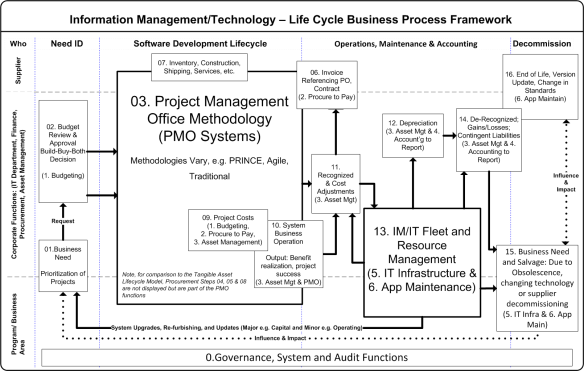
Information Management/ Techology Lifecycle Model (revised March 1 2014)
 Organizational Biology