
In the ‘The RBM Plan!‘, I detailed a number of blogs in a series, this is the third. It is a brief visit to see how the United Nations are doing with their RBM implementation after nearly 20 years of effort and what other organizations can learn from this experience.

An UN-Interlude on RBM: An UN-Interlude on RBM: A brief interlude to examine a United Nations effort to implement RBM. Central to this assessment is a RBM Framework based on five pillars corresponding to the management areas: Strategic, Operational, Accountability/Learning, Change Management & Collective Accountability. These five areas are used to determine the maturity of RBM adoption in the UN.
UN’s Five Central Pillars of RBM
A Brief History of RBM provided an overview including the drivers for its adoption and a noted lack of standardization. RBM should not be one size fits but instead tailored to the specific needs of the organization. Conversely, standards can help an organization benchmark or improve on its RBM efforts.
The Joint Inspection Unit (JIU) of the United Nations [1] periodically published ‘the state of RBM’ reports for the UN’s General Assembly and secretariat [2]. As a result, they have developed a standard of sorts for RBM per the following graphic.
These pillars provide a sketch of what it takes to become an United Nation RBM compliant organization.
RBM Pillar Talk
On the one hand, the five pillars and 17 components are not particularly earth shattering. They represent a standard presentation of the command and control functions of most organizations:
- Strategic Creates >> Operations …
- Operations relies on >> Reporting and Systems …
- These Changed over time …
- As a result, Coordination in and outside of the organization is necessary.
While a bit banal, the JIU-Framework can be applied to a variety of UN-organizations and evaluate RBM Maturity.
RBM’s Maturity
RBM is a thematic area for the JIU. The above framework was developed to evaluate an UN organization maturity and the added value of RBM. The report highlights the challenges and the structural and systemic constraints that affect the development of results-based management in the United Nations system [3].
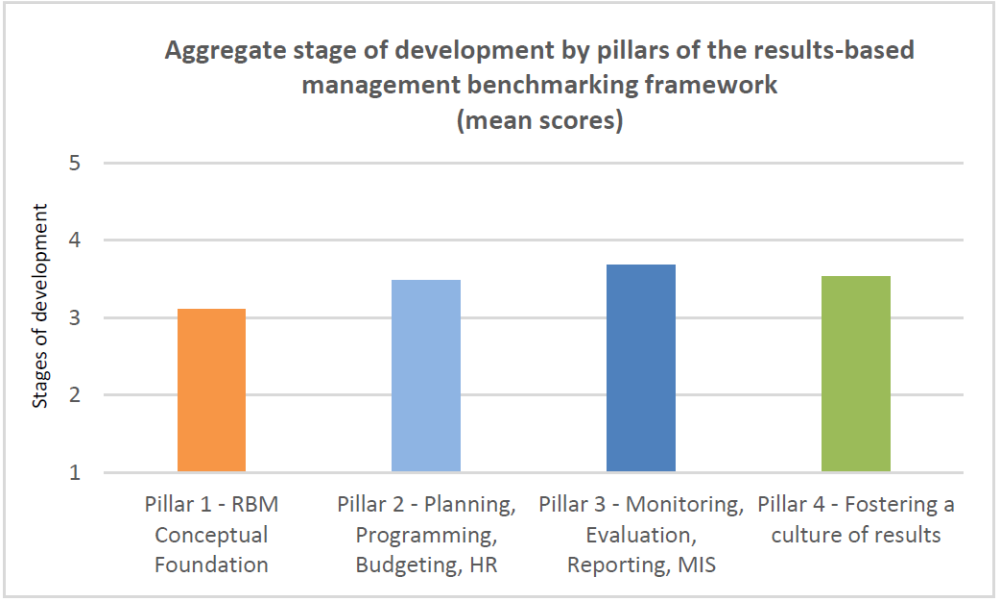
To perform a maturity assessment, JIU uses a standard 5 Stage maturity model to evaluate each of the 17 components and then the aggregated maturity of each of the pillars [4]. The following graphic shows the mean-score for the first four pillars.
A Mature Caution & Lesson
A score of ‘3’ indicates the organization is in progress of implementing RBM rather than having achieved it. “The organization has committed itself to managing for results and is attempting to make the transition from previous systems“. Three is nothing to sneeze at, but many of the UN organizations have been working at RBM for a decade or more.
Nevertheless, the maturity scores are instructive. Pillar 3, essentially the technical portion of RBM, has had the greatest progress. Pillars 2 and 4 are not too far behind. Pillar 2 is more mechanistic than Pillar 4 which focuses on organizational culture. Last of the four pillars is management support and its conceptual foundation. Given the two decades of UN support for RBM, this is both surprising and unsurprising – but more on this in a future blog discussing the challenges of RBM.
Un-UN-Interluding
The periodic JIU reports attempt to understand the value, benefits and costs of RBM in a UN context. Implicit in this understanding is an answer to the question, when will RBM be done? Like most organizational change models, the answer to this last question is never because the organizational needs, environment and expectation of stakeholders continue to evolve. These challenges lead us into the next blog, the Challenges and Costs of RBM.
Notes and Further Reading
- UNJIU. “Joint Inspection Unit: Independent System-Wide Oversight for Efficiency, Effectiveness and Coordination.” Accessed March 4, 2020. https://www.unjiu.org/. See Annex I below as well
- The most recent of these reports is: Prom-Jackson, Sukai. “RESULTS-BASED MANAGEMENT IN THE UNITED NATIONS DEVELOPMENT SYSTEM ANALYSIS OF PROGRESS AND POLICY EFFECTIVENESS; FULL REPORT Joint Inspection Unit; Geneva,” 2017.
- Ibid, p. 2, Paragraph 2.
- Ibid, p. 21, Box 3. Reproduced below as Annex II.
Annex I – JIU Overview
Independent system-wide oversight for efficiency, effectiveness and coordination The Joint Inspection Unit (JIU) is the only independent external oversight body of the United Nations system mandated to conduct evaluations, inspections and investigations system-wide.
Its mandate is to look at cross-cutting issues and to act as an agent for change across the United Nations system. JIU works to secure management and administrative efficiency and to promote greater coordination both between UN agencies and with other internal and external oversight bodies. For the past 50 years, the Unit has been dedicated to assisting the legislative bodies of numerous United Nations organizations in meeting their governance responsibilities. JIU provides support in the context of these agencies’ oversight function regarding human, financial and other resources. In its reports and notes, the Unit identifies best practices, proposes benchmarks and facilitates information-sharing throughout the organizations of the UN system that have adopted its Statute.
The Unit operates with respect to the legislative organs and the secretariats of those specialized agencies and other international organizations, within the United Nations system, that have accepted its Statute. These entities are often referred to as the JIU participating organizations. JIU has a total of 28 participating organizations as of 2018 that play a crucial role in how the Unit functions.
Annex II – 5 Stages of RBM
Stages of development of results-based management systems
- Stage 1 – Not started.
- The organization is aware of, but not committed to, the concept of managing for results.
- There is little or no internal driver for adopting results-based management principles. In some organizations, the decision is to retain the existing management strategy or to adopt an alternative to results-based management.
- In other organizations, many people may recognize that what they have been doing is inadequate and that there must be a better way of proceeding, but adapting systems within the organization to support the mainstreaming of results-based management is not yet seen as the solution, except in the case of a few champions.
- Stage 2 – Exploration for mainstreaming.
- The organization begins to commit to managing for results and
explores different approaches. - During this stage, people begin to pick up on new ideas from a variety of sources. Exploration may take the form of learning groups, benchmarking studies and pilot projects.
- One problem at this stage is that people may prefer one technique or system over others, without having given them a full trial. Another problem may be that too many different ideas are tried at once, resulting in practices that are never fully explored or that are ad hoc.
- During the exploration stage, enough people across the organization develop a sense of the benefits of managing for results and want to explore it in a broader context. That willingness leads to the next stage.
- The organization begins to commit to managing for results and
- Stage 3 – Transition to mainstreaming.
- The organization has committed itself to managing for results and is attempting to make the transition from previous systems.
- At this stage, people begin to make a commitment to the new practices required but adoption is mechanical and not fully integrated. They drop old practices in favour of new ones, since the former can no longer solve day-to-day problems or support plans for organizational effectiveness, as required by results-based management.
- This stage can be characterized by hard decisions on what to keep and what to discard in terms of results-based management strategies. For example, the conversion to a set of results-oriented measures is likely to mean that some old measures need to be dropped.
- As more people see the benefits of managing for results, the system becomes more widespread throughout the organization. The organization begins to seek broader internal integration and alignments. The adoption process is, however, internally focused and there is still a predominant focus on outputs rather than outcomes.
- Stage 4 – Fully mainstreamed.
- The organization fully implements managing for results in almost all areas of the organization. At this stage, groups across the organization begin to see and look forward to the real benefits of the new management approach.
- Resources are allocated and plans designed to support new practices, not to maintain old and outdated ones. There is continuous learning and there is some level of refinement based on ad hoc assessments or the adoption of innovations identified as good practices in results-based management.
- The organization is increasingly focused on outcomes, although that is not fully integrated in all aspects. The adoption process is predominantly internally focused but the organization is exploring outreach and seeking partnerships for common outcome areas and joint work. It is also involved in pilots for joint work or joint evaluations or even system-wide evaluations for collective impact.
- Stage 5 – Continuous learning and renewal.
- The organization now uses the managing for results plan.
- It operates beyond routinized operation and on internal refinements, it conducts evaluations of its system and starts a process of renewal.
- It periodically adjusts and updates existing tools, methods and processes that support the use of information on managing for results in the organization, including training tools, new approaches to planning, experimentation with advanced measurement tools and the development of reporting mechanisms that further align internal and external reporting.
- It has begun a process of overall assessment with the intention
 Organizational Biology