
This is a blog continues the series, ‘The RBM Plan!‘ looking at the challenges and criticisms for RBM. This topic allows an organization to design a RBM program tailored to their circumstances while hopefully escaping the mistakes and errors of other organizations.
Whether RBM does as it promises and at what cost is question worth exploring particularly for organizations looking to implement it or improve their current RBM methodology.
- Is RBM a Four-Letter Word?
- What Do Organizations Do?
- Pity the Public Service
- RBM to the Rescue (results may vary)
- Does Strategic Planning (& RBM) Work?
- What Type of Planning is RBM (Un)Suited For?
Is RBM a Four-Letter Word?
While RBM may be intuitive to a distant decision maker, it is often described in four letter words by those in the field. Criticism itself can be organized according to the following 4 questions of which the first will be addressed in this blog:
- Does Strategic Planning Work and How Does RBM Impact Planning?
- What Type of Planning is RBM (Un)Suited For?
- What Are the Costs of RBM and Is it More or Less Than Other Means?
- What is RBM’s Sweet Spot and What are the Alternatives?
What Do Organizations Do?
Organizations do lots of different things. In one part they are producing widgets (operations). In another part, they are planning on next year’s widgets (tactical or operational planning). Perhaps the executives are asking, ‘Should we be in the widget business?‘ (strategic planning or business vision). In the meantime, the organization is building new factories or implementing new information systems to build better widgets (project planning and project execution).
Pity the Public Service
Making widgets is tough enough but public sector organizations have greater challenges:
- They can’t (generally) go bankrupt or change their product line except with great difficulty
- The services offered are more complex, greater in number and are provided to wider set of clients
- There is typically no direct linkage between what a person pays (e.g. via taxes) and the what the person receives for that payment
- Individuals who pay the most likely receive the least in direct services while those who may pay nothing or very little receive a much greater proportion of direct services
- Public service organizations do not benefit from the discipline of competition in the market
- They answer to nebulas ‘stakeholders’ instead of bottom line focused investors
- The board has a habit of changing radically every few years and the new board may know nothing of the services provided by the organization
- … and it goes on…
RBM to the Rescue (results may vary)
Governments and organizations have turned to Results Based Management (RBM), to better rationalize and validate the use of taxpayer/donor resources in delivering services. Conceptually, RBM is intuitive. What do you want to do, what will it cost and then measure to see if you got what you wanted? Unfortunately, life is seldom this simple, particularly in the complex and challenging world, described above, of public sector organizations.
Does Strategic Planning (& RBM) Work?
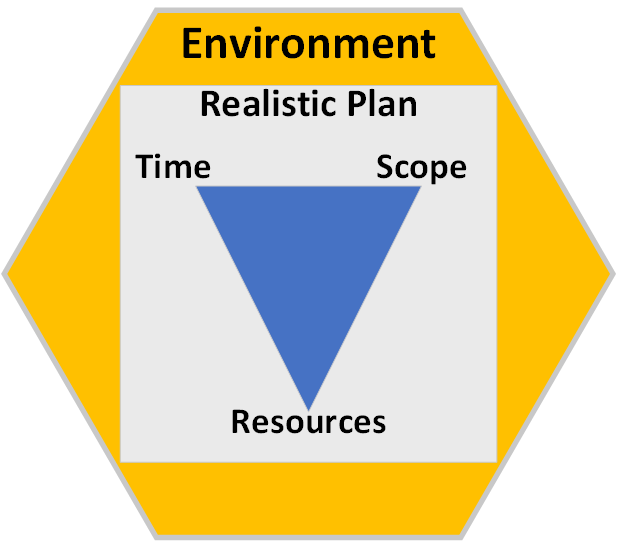
An implicit assumption of RBM is that the strategic planning process works. That an organization can establish large, macro goals and then ‘work the problem’ down to a specific activity in support of these goals. The fact that we have cities filled with buildings that don’t fall down or governments that deliver critical services would suggest that planning works – but there are limitations: time, scope, resources, environmental-change, technology, and realistic-impact.
TIME: the ability to plan typically diminishes as a function of time. The further in the future and event is, the harder it is to plan for. Sometimes time is on the side of an organization. The problem has gone away or the other factors (such as technology) has solved it.
SCOPE: the greater the scope of a plan, the less likelihood of its success. Building a pipeline to export a product may take 10 years from conception to commission has a narrowly defined scope and is realistic. Creating a national energy program to diversify the energy sources for a modern economy has broad scope, is possible but also has a much lower chance of real success.
RESOURCES: Eagle eyed readers will notice that this entry completes the ‘Iron Triangle of Project Management’. Resources are often summarized into the ‘3Ts’: Time, Talent, and Treasure. Time is discussed above. Talent are the capable people, systems, or processes to achieve the plan. Treasure are the (non)financial resources to pay for the above.
The cost of an ambitious plan may be beyond the capacity of an organization to pay, even assuming the environment is conducive to the project.
ENVIRONMENT CHANGE: Changes in the economic, political, legal, technical or other environments may radically change a strategic plan. In some cases, the change may accelerate the plans, in other cases modify or even negate the plan.
TECHNOLOGY: A powerful environmental factor is technology. Problems/ Opportunities identified in one year may be mitigated, eliminated or exacerbated in the following year(s). Increasingly, Technology is borderless with ever-lower cost of adoption.
- RBM Challenge: As a project management tool, RBM excels at taking one objective and planning it through to its logical completion (e.g. building a pipeline or drilling a well). RBM’s challenge is when the Scope is ill-defined, broad or subject to change; the Environment/ Technology causes sudden shifts in priorities or what can be done; or there is a long-elapsed time between establishing the goal and implementing the project or activity.
REALISTIC-IMPACT: On the one hand, Noble goals can inspire a society to achieve the seemingly impossible (think of goal to safely land and man on the moon and return him, John F. Kennedy). Other ambitious callings (think of Nixon’s war on cancer) fall short because of the challenges of time, scope, resources, environmental-change and available technology. While ambitious goals are noble, the ability to differentiate the realistic (or affordable) ones from the King-Canute challenges is equally important.
- RBM-Realistic Impact: Just because an organization has established a noble goal does not mean it can be accomplished. Because RBM directly ties its activities to a meta-goal of an organization, without such a goal or if such a goal is not-realistic, then the RBM process itself is subject to failure.
- Does this mean that organizations should only restrict themselves to pedestrian or easy-to-achieve goals? No, but organizations also need to avoid the trap of ‘Management through Magical Process‘.
What Type of Planning is RBM (Un)Suited For?
In the next blog, we will move from the meta level to a more detailed question of what type of planning activities is RBM best suited for.
 Organizational Biology
Pingback: The RBM Plan! | Organizational Biology