Clubs, societies and non-profit’s come in many shapes and sizes (see Volunteering Definitions for an overview of the differences). This discussion focuses on the question what are the core functions that occupy or consume volunteer or staff time?
Organizational Functions of a Club
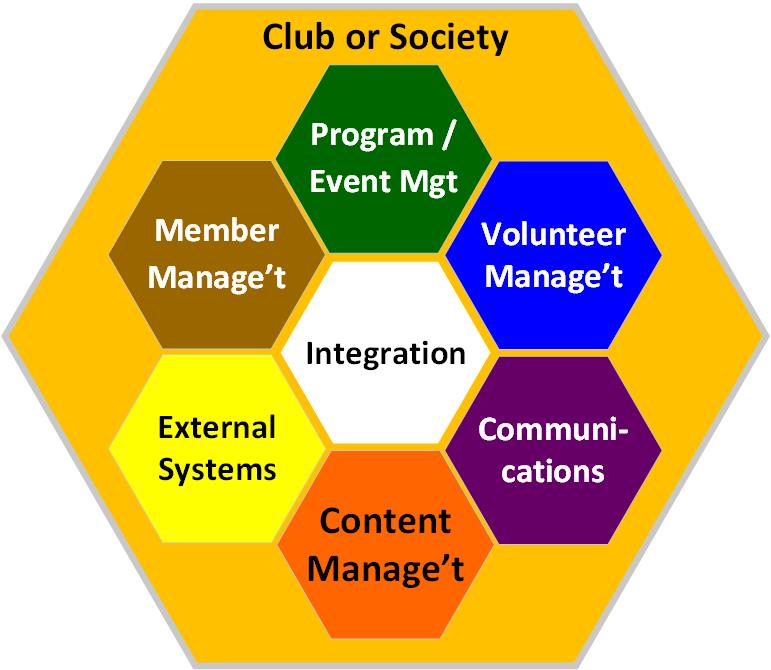
While each organization is unique, there are some common functions they all perform or require as demonstrated in the following graphic.
Absence Makes the Hexagons Grow Fonder
Absent from the above graphic are functions larger organizations would require. For example, financial, human resource, procurement, fund raising or legal activities. As a non-profit grows in size, other organizational models become more relevant such as Porter’s Value Chain [1].
Unfortunately, these business models do not scale down. The above model is designed for a small club, society, informal organization or non-profit which I will collectively refer to as a ‘club’. These clubs are integral to civil society as they provide recreation, teach our children skills, manage facilities, monitor aspects of society, etc. Typically, they are run by volunteers with varying degrees of business or technical acumen.
Each of the Hexagons represents a discrete set of functions of importance to a typical club. An individual club may choose to modify the model by adding or de-emphasizing some of the above ‘starting-point’ functions. Systems and processes for each of the functions are often manual or a hodgepodge of systems. Automating and integrating these systems will likely be the subject of future blogs.
A Functional Whirl Wind Tour
The above hexagons suggest that the functions are distinct and stand alone. The reality is a lot messier. They are inter-connected, over lapping, inter-dependent, complementary and sometimes contradictory. Definitions for each of the functions are as follows:
- Member Register: Collection of information about individual members. This includes tombstone data such as name, address, next of kin, emergency contacts, etc. Club specific information may include ranking (as in a sport), abilities (e.g. first aid certificates, coaching skills) or club related interests.
- Volunteer Management: the use of volunteers is highly club-dependent. This function identifies potential volunteers and matches their skills to the club’s needs. A volunteer’s involvement may be recorded for recognition and managing the Volunteer Lifecycle (for more on this see, see my previous blog: Volunteers in LAST-VEGA).
- Communications: Communications may meet a legislative requirement (filing an annual return), support fund raising, or communications to members (events, updates). Communications may be official (from the Club out); informal, between members; top down or bottom up. Specific examples include:
- Internal leadership to/from members and members to/from members.
- External communication to potential members, peer-organizations and the public.
- Messages take a variety of forms. For example, some may relate to an event, its status (creation, changes, cancellation, results); while others of interest to members (e.g. updates to members on external activities).
- Communications may be real time (e.g. cancelling an event) or be less time-sensitive.
- Types of mediums include: email, newsletter, websites, social media (e.g. Facebook), Listserv Email Groups, physical communication (e.g. brochures and posters).
- Program and Event Management: Central to most non-profits is the program. This could be a soccer game, a hike, updates on a coal mine or a organizing a trip to a new restaurant. System functions may include event sign ups, game notices, etc.
- Content Management: Storing corporate records and information about the club. This ranges from public (e.g. annual general meeting minutes, bylaws); protected but not private (e.g. board documents) and protected and private (e.g. bank details, volunteer contact details). The information is often a combination of physical documents (e.g. incorporation certificate, historical records) and digital.
- External Systems: Systems not under its direct control or the control of its officers. Any Cloud based offering used by the Club is external but would be better categorized in one of the above functions as the ability to cancel a subscription is an example of control.
- A hiking club may own a mapping software that helps them plan hikes whereas a cycling club may lease this functionality from an online provider.
- Personal systems for which the club benefits but does not have ownership includes the executive typing out the annual report on a personal copy of Microsoft Office.
- Integration: Bringing the disparate function (and systems) together is the role of integration. With manual systems, this integration may consume a great deal of valuable and scarce volunteer time, talent and passion.
Civil Society and a Good Club System
Clubs will perform the above functions whether they are aware of them or not. My interest in highlighting them is so a club can identify accountability for the function and consider in investing in systems and processes as required. Technology is never a panacea but if it reduces the burden of volunteering and makes your club more viable, it should be considered.
Notes and References
- For those unfamiliar with Porter’s work, an internet search will quickly illuminate you. In a nutshell, the value chain describes the key functions of business. Primary activities deal with the transformation of raw materials into a marketable product. Support activities assist primary activities. The model is manufacturing centric and of limited value for the world of non-profits or small clubs.
 Organizational Biology
Pingback: GWS and SAPAA in 2025 | SAPAA