
Families find themselves in a Financial Literacy program to deal with a money emergency or (preferably) to prevent such an emergency. Ideally, the family learns about better money management – but do they learn what role money should play in their lives?
Four Asset Model Revisited
The Four-Asset Model was introduced in early 2021 as a way to describe different elements in a person’s life. The blog Balancing the Four Assets provided historical examples of wealthy or talented individuals who did not live a full and/or long life because they were lacking one or more aspects of the Four-Assets.
This blog provides a short essay intended to be read by a family as part of a financial literacy program. It is written at a Grade 6-9 reading level with a key theme that money can help us in our pursuit of happiness but will not make us happy.
Four-Assets and Your Family
Many people believe that if only they had more money, they could be happy. The science of happiness (yes, there is such a thing) says that a family income of about $70,000 brings happiness. After this amount, it takes a LOT more money to gain just a little more happiness.
Can you be happy on an income of $70,000?
Most families can live well on $70,000 per year. Not lifestyles of the rich and famous, but well enough. So how come other families who make this amount, or more, are not happy or are in debt and live pay-cheque to pay-cheque?
Four-Assets
Part of the problem is the question itself. The question doesn’t ask where you live, whether your children are healthy, or if your parents nearby and you ae you on good terms with them. Nor does the question ask whether you are healthy and happy.
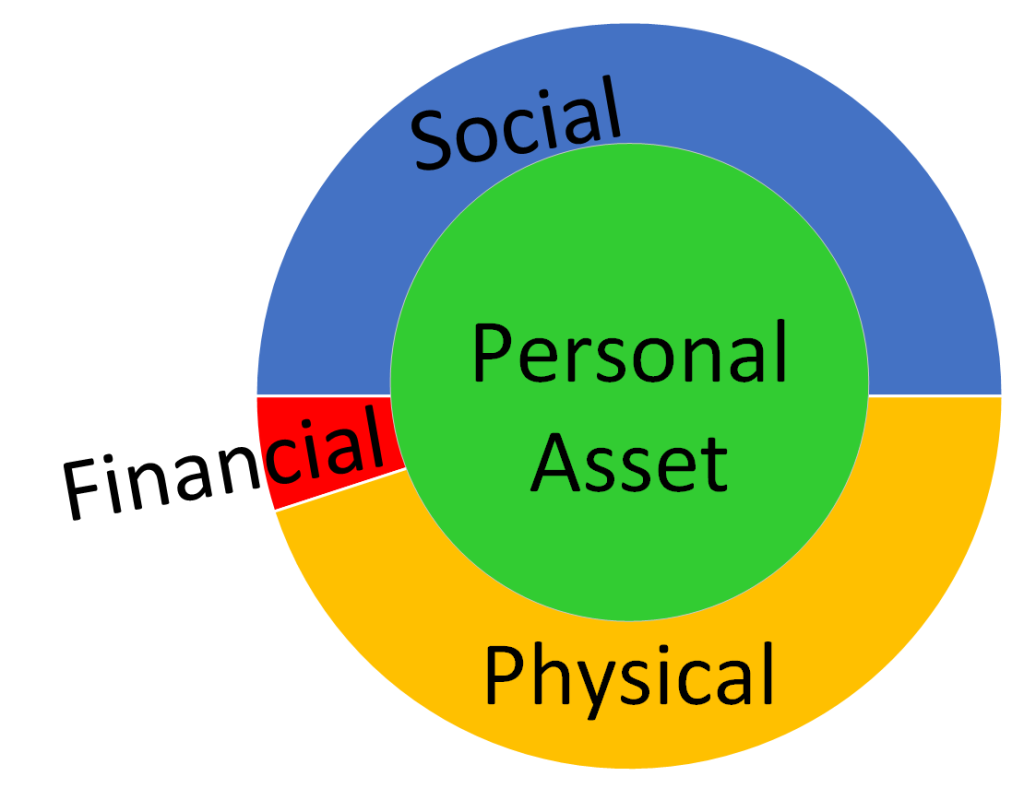
The question focuses on one thing, money. That is a pretty important thing, but, as the drawing above demonstrates, there is more to life.
The Four Assets (and What is an Asset?)
An asset is something that we own or have access to that helps us today or in the future. A car is an asset as it helps us get to work. However, a bus stop near our home with a good route to and from work is also an asset. The four assets represent the things that we own, have access to or have a relationship with.
1. Personal-Assets are our abilities to contribute to the other three assets. For example, being a good listener is a Personal-Asset that helps us with our Social-Assets. Having time, skills and a good attitude helps us earn money which allows for the purchase of Physical-Assets (a home, car, clothing, etc.) or the time to build Social-Assets. Age, wisdom, good health, healthy-spirituality are examples of positive Personal-Assets.
2. Social-Assets are the people around us. As humans, we like to hang out with other folks. Sometimes we need help (moving a couch, money, or to be cheered up) and sometimes those around us need our help. Social-Assets has two parts: how many and how good. If you have lots of people around you (such as family, friends, associates, neighbours, and organizations) that is good – BUT… those relationships also need to be healthy and contribute positively to you as a Person.
3. Physical-Assets are things that you own or have access to – such as the car and a good bus route. Physical-Assets can be things you can touch (a home, car, furniture, phone, etc.) but are sometimes harder to define. For example, if you have a bus pass, is it the card that is the asset or the right to ride the bus? Fortunately, we can leave these types of questions to the philosophers and just enjoy the bus ride.
4. Financial-Assets are a type of Physical-Asset. They are separated out because this is a financial literacy program. Money in your pocket or in the bank is a Financial-Asset but so is a pension, government assistance payments, owning stocks, bonds or investments. Debt or the inability to earn income reduces your financial assets. Sometimes the line between a Financial and Physical-Asset is a matter of opinion. If you own a gold coin, is it a Financial or Physical-Asset? The answer, pick one category and leave the pondering to the philosophers.
Money and Tubas
There are two ways of seeing the little red ‘Finance’ pie-slice in the model: positively or negatively. Those who are good with money see it as a metaphor for how money holds their life together. These people don’t worry too much about their finances and have enough to help their children (Social-Asset). It would be nice to live in a bigger house, but really this one is fine now that the kids are grown-up (Physical-Asset). Besides, they have just started to learn to play the tuba (Personal-Asset).
People who struggle with money see the red pie-slice as a thorn in their side. If they had more money, they would not have to rely on their family for bailouts (Social-Asset). They want to move to a better neighbourhood, but this is the best place they could rent after skipping out on a few landlords (Physical-Asset). Finally, they wish they could stop worrying about money and not be so tired all the time (Personal-Asset). They also want that person across the street to stop practicing the damn TUBA!
To Each His Own Asset
If there are four people in a family, then each person has their own green circle (Personal-Asset) surrounded by their Physical and Social-Assets. The other three people will share some of these social and physical things but everyone gets their own green center.
Each person has different priorities for their Four Assets. One person is into sports while another prefers music or dancing. These are Personal-Assets. But even the other three assets can vary. Some people prefer a comfy home where they can be alone (Physical is more important than Social and their Personal is more of an introvert). Another person would rather have very few possessions because they want to travel and meet new people (Personal and Social is more important than Physical).
There is no right or wrong mix of these assets. There is only what is important to you and that they are healthy. A hoarder has lots of Physical-Assets, but is not healthy. A person hanging out in a criminal gang has strong Social-Assets that may land them in prison.
Your Asset Ledger
How are your Four-Assets? Can you make up a list of areas where you have lots of positive things in each of the first three Assets (Personal, Social, Physical)? The following table provides some examples to get you started.
But, before we go, Assets take a long time to build and can be gone in an instant. A car crash means taking the bus. A change to the bus route means walking longer to get to work. An unresolved argument can destroy a relationship (Social-Asset). Often, we can control the assets in our lives (e.g. drive safely or apologize) and sometimes they are beyond our control (e.g. Transit making changes). Having good financial assets can help us weather these changes (e.g. buying a new car, moving closer to our work or taking someone out to smooth over an argument).
Four-Asset Positive/Negative Examples
| Asset | Positive | Negative |
| Personal | Good Health, hobbies, curiosity, positive attitudes | Poor physical or mental Health, addictions |
| Social | Strong family, good friends, safe neighbourhood | Fighting family, social network who only ‘wants something’ from you, unsafe environment |
| Physical | Safe, and comfortable home. Transportation. Access to public services. | Homeless, too many possessions, physical things are defining you as a person. |
| Financial | Money supports the other three assets even if sometimes they have to wait for savings. | Money thwarts the other three assets because of debt, no surplus funds, worrying about money, etc. |
 Organizational Biology
But what is the remedy when “money thwarts the other three assets because of… etc. etc.” , Frank?
LikeLike
Hello Patsy, please remember this concept is delivered in the context of a financial literacy program. If a family is in the program, money is definitely thwarting these ambitions. The context for this is that taking a financial literacy program is to not become a money guru, it is to have the skills and awareness to better manage your money so the other three assets can be enjoyed.
LikeLike