
I saw Marshall Goldsmith speak more than ten years ago. Unfortunately, I gave away the copy of the book I received and did not replace it until recently. Too bad, I could have used his advice over the past decade!
An Old New Message
When I heard him speak, his book was about five years old, published in 2007. His messages are mostly timeless and applicable to nearly everyone. His coaching practice is focused on making successful people better. This is both lucrative but also very small market. Whether you consider yourself successful or not, Marshall has solid advice for you.
- An Old New Message
- Case Studies to Take You Past This Point in Your Life
- My Memory Jog and Further Thoughts
- The Set Up or Why Successful People Become Unsuccessful
- The 20 Bad Habits: Challenges in Interpersonal Behavior
- Changing Rules
- Thoughts for the Senior Person
- Reference and Notes
Case Studies to Take You Past This Point in Your Life
The theme of this book is:
… the skills and habits that have taken a person to a point in their life might not be the rights skills and habits to take them further.
Adapted from What Got You Here Won’t Get You There
This premise has a few contexts. In its most narrow, it is applied to the people that Goldsmith coaches. A ‘win-at-all-cost lone-wolf salesperson‘ who needs to learn how to build a team; a ‘brilliant executive‘ who must learn to suffer fools-gladly (or at least his direct reports); or a ‘quick witted and sarcastic‘ individual who realizes his sons are growing up to be the same and does not want them sharing his loneliness.
Peter Principle Positively Revisited
In 1969, Peter J. Laurence and Raymond Hull wrote what was intended to be a satire called the “The Peter Principle“. The premise of their book was that people in a hierarchy tend to rise to “a level of respective incompetence”: employees are promoted based on their success in previous jobs until they reach a level at which they are no longer competent, as skills in one job do not necessarily translate to another. (Peter principle – Wikipedia).
This book stoked an active discussion on how best to prepare individuals for more senior roles (or different circumstances). The Peter Principle suggested that this mix-match of skills was inevitable and change was difficult. Goldsmith’s book takes a very different take and suggests that change is possible through self awareness.
My Memory Jog and Further Thoughts
This blog is my 60-second scan of the key themes of Goldsmith’s book. There are some other thoughts and extensions of his book that I want to consider as well but these will be future blogs such as:
- How to celebrate not doing something (and why stopping is so hard).
- What didn’t get you there still won’t get you there.
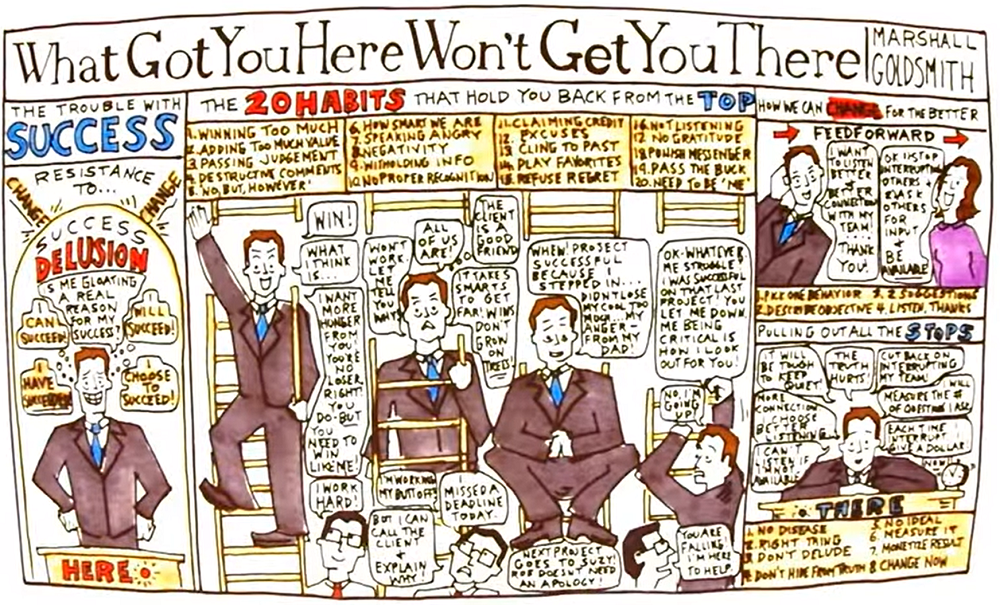
I have listed other such sources below including an excellent 5-minute video worth watching (from which the above graphic comes). The book is divided into three parts:
- The Set Up or Why Successful People Become Unsuccessful
- 20-Bad Habits
- Seven Step Process to Improvement
The Set Up or Why Successful People Become Unsuccessful
This has been largely covered in the above discussion with the following additional notes:
- Successful Delusions: Successful people are by definition delusional to some extent. They see a possibility that does not exist, either in themselves or in the market, and they pursue it. Conversely, the most realistic people are the chronically depressed, everything will likely result in failure so why try.
- Passion versus Compliance: When we do what we choose to do, we are passionate about it. When we do what we need to do we are compliant.
- The fear of over-correction. Successful people almost by definition take things to the extreme and thus over correct a fault to an extreme. Self improvement is about breaking bad habits not a religious conversion to a new faith.
- Why Change: People will change when it is in their self-interest to do so and typically in response to a crisis.
- Self-interest is often centered on one of the following (the first 3 are my additions):
- Self preservation: e.g. the fear of dying
- Loss of family and intimate social connections: e.g. fear of divorce
- Loss of comfort and circumstances: e.g. bankruptcy, social harmony
- Money
- Power
- Status
- Popularity
The 20 Bad Habits: Challenges in Interpersonal Behavior
The following twenty items Goldsmith describes as being non-life threatening. An individual can have one or more of these and live a fuller life. However, recognizing and remediating a deficiency in a bad habit may also help a person live a more full life. In some contexts, these habits may have made a person successful. For example, winning too much is a good habit to have as an Olympic-aspiring athlete – but not as a parent.
There is a much longer list of things that make unsuccessful people unsuccessful. Goldsmith explains that his practice is to make successful people better not treating maladies or mental illness. Nevertheless, many of the twenty can be found on a list of successful people as well as a clinician. As for myself, in retrospect, the bad habits I wish I had worked on (and still need to work on) are those starting with an asterisk.
- Winning too much: The need to win at all costs and in all situations.
- *Adding too much value: The overwhelming desire to add our 2 cents to every discussion.
- Passing judgment: The need to rate others and impose our standards on them.
- *Making destructive comments: The needless sarcasm and cutting remarks that we think
make us witty. - Starting with NO, BUT, HOWEVER: The overuse of these negative qualifiers which
secretly say to everyone that I’m right and you’re wrong. - Telling the world how smart we are: The need to show people we’re smarter than they
think we are. - Speaking when angry: Using emotional volatility as a management tool.
- Negativity, or “Let me explain why that won’t work”: The need to share our negative
thoughts even when we weren’t asked. - Withholding information: The refusal to share information in order to maintain an
advantage over others. - Failing to give proper recognition: The inability to give praise and reward.
- Claiming credit that that we don’t deserve: The most annoying way to overestimate our
contribution to any success. - Making excuses: The need to reposition our annoying behavior as a permanent fixture so
people excuse us for it. - Clinging to the past: The need to deflect blame away from ourselves and onto events and
people from our past; a subset of blaming everyone else. - Playing favorites: Failing to see that we are treating someone unfairly.
- Refusing to express regret: The inability to take responsibility for our actions, admit we’re
wrong, or recognize how our actions affect others. - *Not listening: The most passive-aggressive form of disrespect for colleagues.
- Failing to express gratitude: The most basic form of bad manners.
- Punishing the messenger: The misguided need to attack the innocent who are usually only
trying to help us. - Passing the buck: The need to blame everyone but ourselves.
- An excessive need to be “me”: Exalting our faults as virtues simply because they’re who
we are.
Source: © 2007 Marshall Goldsmith, What Got You Here Won’t Get You There, Page 40-41 Hyperion Books. Reprinted with permission.
Seven Step Process to Improvement
Identifying bad habits is only the first step towards their resolution. Goldsmith offers a process that involves 7 steps:
- Feedback
- Apologizing
- Telling the World
- Listening
- Thanking
- Following Up
- Feed Forward
1. Feed Back
Traditional feedback has two big problems: (a) people don’t want to hear it and (b) individuals who need to provide it do not want to give it. We accept feedback that is consistent with our self-image and reject feedback that is inconsistent. Feedback also focuses on a negative past rather than a positive future.
When soliciting information as part of a 360 process, Goldsmith uses four commitments from those providing feedback. This is in addition to assurances of confidentiality. This list is a good one for any relationship and communications whether professional or not.
- Let go of the past
- Tell the truth
- Be supportive no cynical or negative
- Pick something to improve yourself: change is a 2-way street
Apologizing
When it comes to apologizing, the only sound advice is get in and get out as quickly as possible. You’ve got plenty of other things to do before you change for the better. The sooner you can get the apology over with, the sooner you can move on to telling the world.
Telling the World
Due to cognitive dissonance, Goldsmith suggests that there is about a 1:10 ratio of acknowledgement of progress to actual progress. That is, people will believe you have only improved 10% even if your actual change was 100%. The start of this is to advertise your intention to change and then relentlessly follow up with your ongoing intention to change.
Listening
There are three things that all good listeners do: They think before they speak; they listen with respect; and they’re always gauging their response by asking themselves, “Is it worth it?” The more you subsume your desire to shine, the more you will shine in the other person’s eyes. Specific techniques include:
- Listen and Don’t Interrupt
- Don’t finish the other person’s sentences.
- Don’t say “I knew that.”
- Don’t even agree with the other person (even if he praises you, just say, “Thank you”).
- Don’t use the words “no,” “but,” and “however.”
- Don’t be distracted. Don’t let your eyes or attention wander elsewhere while the other person is talking.
- Maintain your end of the dialogue by asking intelligent questions that (a) show you’re paying attention, (b) move the conversation forward, and (c) require the other person to talk (while you listen).
- Eliminate any striving to impress the other person with how smart or funny you are. Your only aim is to let the other person feel that he or she is accomplishing that.
Thanking
Thanking works because it expresses one of our most basic emotions: gratitude. Gratitude is not an abstraction. It’s a genuine emotion, which cannot be expected or exacted. The best thing about saying “Thank you” is that it creates closure in any potentially explosive discussion. What can you say after someone thanks you? You can’t argue with them.
Following Up
Follow-up is the most protracted part of the process of changing for the better. It goes on for 12 to 18 months. Fittingly, it’s the difference-maker in the process. It is the difference between the flavour of the month and real change on the part of a person by overcoming some key hinderances:
- Too Busy.
- Internalizing understanding by doing
- Becoming a better is a process, not an event.
Feedforward
. Feedforward asks you to do four simple steps:
- Pick one behavior you would like to change that would make a significant, positive
difference in your life. - Describe this goal in a one-on-one dialog with anyone you know.
- Ask that person for two suggestions for the future that might help you achieve a
positive change in the behavior you’ve chosen. - Listen attentively to the suggestions. Don’t judge or critique them; the only response
you’re permitted is “Thank you.”
Changing Rules
- Rule 1. You Might Not Have a Disease That Behavioral Change Can Cure
- Mental illness or skills are not something that Goldsmith can fix.
- As well, these are less likely to be things that got you here and they will definitely not get you there.
- Rule 2. Pick the Right Thing to Change
- There is often a mismatch between what a person wants and what they choose.
- Wanting is a matter of values and judgement, choosing is a matter of action and trade-offs.
- Over-commitment is one of the first impediments to real change.
- Rule 3. Don’t Delude Yourself About What You Really Must Change
- Change is hard, five reasons people fail to follow through on it are:
- Time: It takes a lot longer than they expected. They don’t have time to do it.
- Effort: It’s harder than they expected. It’s not worth all the effort.
- Distractions: They do not expect a “crisis” to emerge that will prevent them from staying with the program.
- Rewards: After they see some improvement, they don’t get the response from others that they expected. People don’t immediately love the new improved person they’ve become.
- Maintenance: Once they hit their goal, people forget how hard it is to stay in shape. Not expecting that they’ll have to stick with the program for life, they slowly backslide or give up completely.
- Rule 4. Don’t Hide from the Truth You Need to Hear
- Rule 5. There Is No Ideal Behavior
- Successful people are successful because they are often unique with quirks and abilities beyond or different from their peers.
- As such, there is no ideal behaviour.
- Returning to the “20 Bad Habits: Challenges in Interpersonal Behavior”, if others are accepting of the habit, then it is more of a tic rather than an impediment.
- Interpersonal behaviour is one of the few things that we can change about selves as adults.
- Rule 6. If You Can Measure It, You Can Achieve It
- But focus on the quantitative measure to the exclusion of the qualitative aspects is just as dangerous.
- To do this, measurement is critical. Recency Bias makes us believe we have improved more/less then what we really have. Sometimes it is also important to monetize or incentivize the result. No matter how it is reinforced, the best time to change is now.
- Rule 7. Monetize the Result, Create a Solution
- Whether for self-motivation or another’s change in behaviour, look for ways to encourage change.
- Rule 8. The Best Time to Change Is Now
Thoughts for the Senior Person
- How to Handle Me – Memo. For those in charge without the ability to change an inter-personal behaviour, let your staff know what your challenges are.
- Stop Letting Your Staff Overwhelm You. Establish boundaries for subordinates and beware of delegating up.
- Stop Acting as if You Are Managing You. Recognize the diverse nature of people and the lack of similarities to you and your values and behaviours. Beware of instigating a conflict in which only you, the boss, can win because of personal ability or position.
- Understanding versus doing. Most of us understand, we just don’t do.
- Stop trying to change people who don’t think they have a problem.
Advice Now From Your Future
We can’t become smarter, taller, re-born into wealth, etc. We can through change something so we can get there. What are the things we would want our 95-year-old selves telling our current selves to be doing; then do whatever that advice is.
 Organizational Biology
Pingback: Creating Citizen Stewardship | Organizational Biology