
A poor man’s O-KT provides ‘Just Enough’ O-KT to exit gracefully and perhaps even get hired back! For organizations, how to create a value proposition for a soon to be ex-employee to leave behind some of their knowledge.
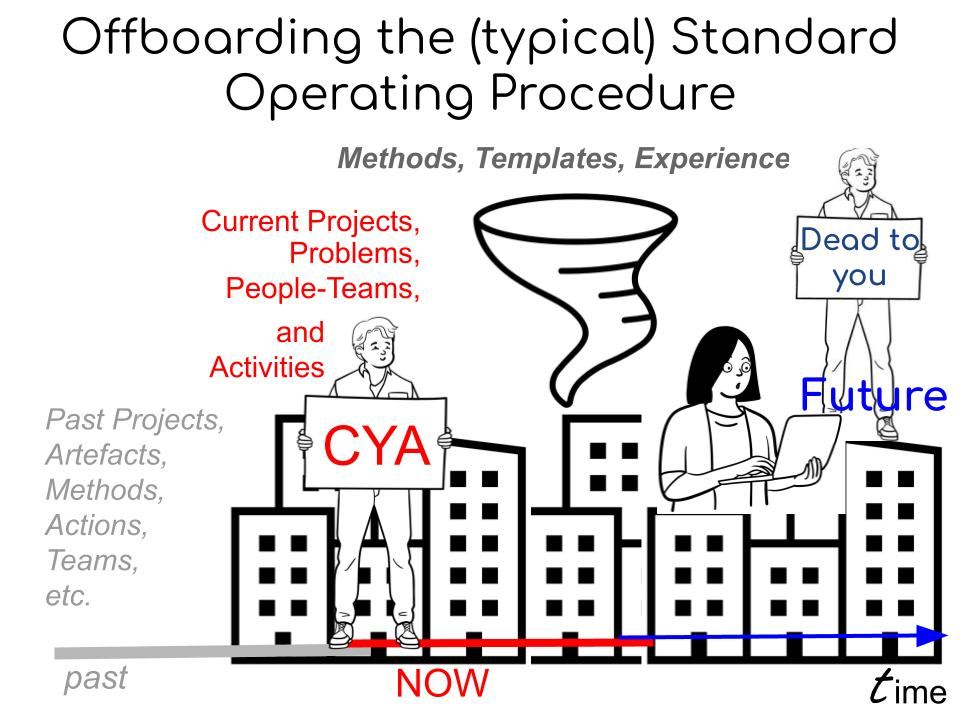
All good things must come to an end, this includes jobs (or volunteer roles). When someone is leaving an organization, there is often a request for an Offboarding-Knowledge Transfer (O-KT).
- Is KT a Waste of Time?
- How NOT to Waste Your Time Doing O-KT
- A Poor Man’s O-KT
- The Poor Audience
- The Benefits of Being Poor
- How to Depart Elegantly
- An O-KT Container
- Why Wait Until the End?
- Offboarding at the O-KT Corral
- References and Further Reading
Is KT a Waste of Time?
A bit like How Documentation is a Waste of Time, I have thought the KT was similar. To start, everyone approaches situations differently. How one person HAD solved a problem is unlikely how their successor WILL solve a future problem. Even worse, the notes describing the past problem/solution are context and time specific so that reading about after the fact and in isolation is at best painful. Finally, having your predecessor’s memoires sounds good except that on Day One you are pushed into the deep end with an expectation of sink or swim. While KT should be a life preserver, it is typically flotsam.
Lots of Resources. A basic internet search yields thousands of excellent articles on the subject [1]. See the References and Further Reading section for just a few, but….
Strategy or Survival? The common thread running through most of these articles is that KT should be seen as a critical and strategic investment for the organization. What they don’t talk about is how to survive the loss of a key employee or what you should be working on in the final days before leaving. Strategy is nice, survival is essential.
How NOT to Waste Your Time Doing O-KT
Let’s start with five principles:
- O-KT is a waste of time,
- Until the moment the KT is used by a future person (including the person leaving).
- Therefore, figure out how that person will use the KT and
- Work backwards from that point … and,
- O-KT should primarily benefit the person leaving the organization, not the organization.
Why the focus on the person leaving? This creates motivation to generate KT. It does not deprive the organization, but the more the soon-to-be-departed benefits, the more the organization benefits.
A Poor Man’s O-KT [2]
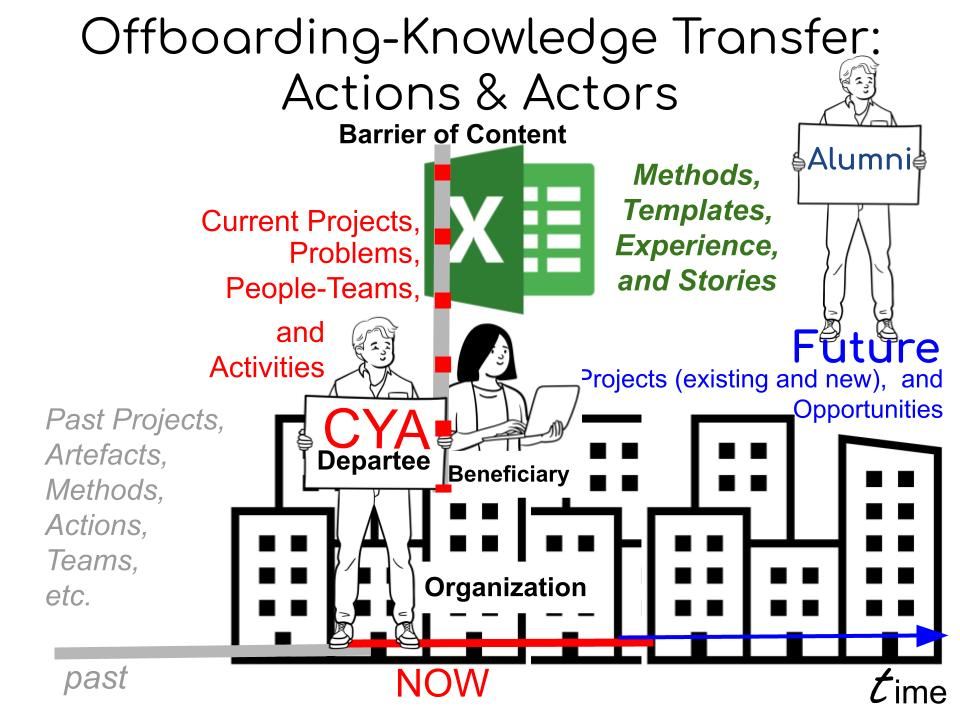
Great, so everyone is benefiting – but from what exactly? A Poor Man’s Off-Boarding – Knowledge-Transfer (O-KT) provides minimal knowledge preservation through three time frames: The Past, Now, and the Future.
The Poor Audience
The O-KT audience has three actors: the person leaving (departee), the person(s) using the O-KT in the future (beneficiary), and the organization.
| Actor | The Past | KT – Now | The Future |
| Person Leaving | What was I working on? Why was it important? What were the problems? How did I solve them? Could I use the solution in the future? | What are the loose ends for which I am accountable to pass on before leaving? Who is the recipient? | What do I want to be remembered for? What methods, tools, or processes could I use again? Can I reproduce the method in a different context? Would I return to the Organization? |
| Remaining/ Future colleagues | What was done and what was the broad context under which it was done? | Where are the methods, procedures, summaries, etc.? How is the past applicable to my current problem? | How can we institutionalize things that worked well in the past? Can I contact the Departee? |
| Organization | If auditable, where can we find the work? How can beneficiaries access and assimilate the knowledge quickly and effectively? | What was the status of various activities, what is outstanding? What needs to be transferred to whom? | How will current or past activities impact future planning or activities? Would we hire the Departee again? |
The Benefits of Being Poor
If you are about to depart, why bother with O-KT? Because the business (or volunteer) world is very small, and you never know who will hire you in the future. If your documents are referred to in the organization, it may lead to future work or at least some good karma. Regarding future karma, it also helps you to update your resume.
How to Depart Elegantly
Use Case – PM Leaving.
Rather than trying to consider every possible combination of employees leaving every type of organization, the following is one use-case. It is written for a project manager rolling off an engagement. It is in many ways a best case scenario because most of the past projects have been completed save for some loose ends and a few smaller projects. While the organization does not have a mature knowledge management strategy, it does have a Project Management Office (PMO) and associated methods and processes.
Use the following as a starting point and change as applicable. For example, an operational versus a project focused position; a blue collar versus a white collar worker, etc.
For this, and most circumstances, the O-KT has three parts:
- Current Work (project, operations, etc.)
- Results (stories)
- Methodology & the Barrier of Content (procedures, documentation, tips, tricks, and skills)
1. Current Work (project, operations, etc.)
Current work is what is in progress or left undone. Also included in this area are potential future activities that came out of departee’s efforts that may impact the organization. For example, if a portion of a project was paused pending the results of a study.
Who Benefits: The organization is most interested in this section to ensure there is no loss of continuity between the Departee and their successor. The Departee has a very transitory interest in this section. The Beneficiary is somewhere in between the two depending on the gap in time between the departure and when the work is assigned.
Perishable and Potentially Pungent. Current work is very perishable in nature. Projects will close and tasks will be completed. Nevertheless, from a craftsmanship and personal accountability stand point, this section is critical for a graceful exit for the Departee. Current work might be perishable, but it can also leave a long lasting stink if not attended to properly.
High Variable. As for a recommended structure, this section is variable. The current work of a CEO and a fork lift operator in the same company will be very different in content although perhaps surprisingly similar in structure. Keeping with the use case, some examples from our departing project manager:
- Links to project sites, project charters, plans, logs, etc.
- List of outstanding items, when they need to be resolved and who could possibly do the resolution
- Personnel or non-project related activities (e.g. performance reviews, billings, etc.).
- Legal holds.
2. Results and Stories of Daring Do
Results are the mummified remains of ‘Current Work’. They are accomplishments the Departee contributed to. In many cases, the line between this section and the next, Methodology, is blurred. In this sense, Results is an over-arching term which focuses on the story rather than the ‘thing’.
Who Benefits: This section is of greatest value to the Departee, limited value to the Beneficiary, and of historical significance to the organization. The Departee will use this section in a future job interview or while writing his biography. The organization may want to know what the Departee is asserting and temper the claims as applicable. By writing this and the next section in tandem, create linkages between the two.
Finally, hopefully, what is in this section is a restatement of an effective performance review process. For the Project Manager, he will write as short summary of each project he was involved with including a synopsis of the lessons learned section.
3. Methodology & the Barrier of Content
Methods and Artefacts are or links to ‘things’ the Departee created (or contributed to). They are valuable and/or useful as future samples to the organization or the departee. While the focus is on a document, they could also be patents, prototypes, or anything else tangible left behind by the Departee (collectively, these are considered ‘Mass’ in Organizational Biology parlance).
Who Benefits: All three actors can benefit from this section. The Departee as an aide memoire of how they did things. The Organization for building its capacity; and the Beneficiary so they need to re-invent the wheel.
The Great Barrier (of) Grief. The Departee needs to be careful about what he takes with him and consider the ‘Barrier of Content‘. There may be legal or contractual restrictions about what can be taken particularly when it comes to intellectual property. If not, there are at least moral, ethical, and privacy considerations. Taking with you how to reconcile Payroll is one thing, taking the data file containing the birthdays and home addresses of employees is definitely wrong.
Results Meets Methods. An accountant may take with her the public financial statements of the company she worked for and which she contributed to; this is an artefact. She may also have a working paper and heuristics on how to calculate a tricky accounting estimate; this is a methodology. The story about how the working paper was designed falls into the above results section. Once again, although separate sections, create links between the two to contextualize them.
Scannable and Agreed to. There is an unease on the part of organizations about former employees taking anything with them… Of course, to replace the Departee, the same organization may ask what type of templates and methods a prospective employee has from their current employer. Rather than creating a black market in good ideas, why not list these things, attribute them to the individual, and apply organizational branding to the product?
PMO to the Rescue! For our Project Manager, he has available to him a Project Management Office to register his good ideas and methods. Examples include:
- Testing, interfaces, templates, etc.
- Decisions and their approvals (how a problem was solved but redacted for confidentiality)
- Documents likely to be requested by an auditor or the like
An O-KT Container
A variety of containers can be used ranging from an ‘End of Engagement’ report to a more formal knowledge repository. Keeping with the “poor man’s” theme, a spreadsheet will suffice with the following tabs (samples are provided in the annex below):
- Project Plan. Who does what to aid in the departure.
- Current Work. A list linking to current project sites and outstanding activities.
- Results. An overview of key projects worked on by the project manager, results, status, lessons learned, and future considerations.
- Methods. Activities or methods the departee is particularly proud, how they could be used and where examples or explanations are located.
Why Wait Until the End?
Some final thoughts. Firstly, why wait until the employee has one foot out the door (or that is your foot)? Why not complete the O-KT template while both feet are firmly planted inside the organization?
One reason is that talking about succession planning or, God-forbid, leaving is a difficult if not a verboten subject. Another is that people and organizations are too busy DOING things to stop and reflect on what and how it was DONE. There is perhaps a bit of superstition as well. For an organization, if you never talk about people leaving, perhaps they never will. As an employee, you perhaps don’t want to tip your hand that you are looking. Silly and immature reasons making them more prevalent.
Offboarding at the O-KT Corral
I have indirectly written about this topic previously. For example, the Avoiding the Lost-Assignment and Task Epidemic or LATE provides a method to document current work and a great way of remembering what you have done in the past. A QIR Project Tool includes a list of open questions, issues, risks, etc. that can quickly bring a Beneficiary up to speed. Finally, Where is the Public Servant Alumni? and 2004-Healthcare Corporate Alumni both ask the questions why the public sector does such a poor job of maintaining an alumni program.
What are your thoughts? Have you had a stellar O-KT experience and if so, how was it done? Any horror stories to share of a not so great process? Leave a comment – particularly if the above was useful and you were able to use it!
References and Further Reading
- “… thousands of hits…” I got about 84,000 hits in May 2023.
- “… poor man’s …” feel free to replace this gender specific term with woman, non-binary or anything else that tickles your fancy.
 Organizational Biology