
To improve its volunteer management processes, the first step for the Canadian Birkebeiner Society (Birkie) took was to create a dedicated website. While this site will be folded back into the pre-existing web presence, this new site side-stepped several technical problems.
For nearly 40 years, the Birkie has used a decentralized approach to finding and managing volunteers. Aging core volunteers and stiff competitions for the hours and hearts of new people has demonstrated the need to centralize some volunteer functions. The previous post, A Spell (and Birch) Binding Use Case, described seven potential steps of which the website is the first.
Why a New Site?
Canadian Birkie main website is due for a refresh and is not set up for multiple editors. In addition, the website is a production environment and primary tool used to communicate with participants, sponsors, and volunteers.
A new site (birkievolunteers) gives the Birkie a ‘sandbox’ to develop and test new ideas. Once proven, they will be moved into the main site but via a controlled release management process. Ideally, the temporary site is just that and will be decommissioned prior to the 2025 Birkie.
Site Design and Development Principles
- Temporary. This is a temporary site with the intention to fold it into the main Birkie site.
- Access will be provided to all who meet minimum right of access and technical skills
- Fail Fast, Learn Faster are two mantras for the site.
Audience
‘Who is the Audience?‘ is a deservedly oft repeated question. The first principle in developing the site is to understand who benefits from it via the following xx audiences:
- The Existing Volunteer: The Role Description helps the existing volunteer and their supervisor refine and validate what they have committed to.
- The Possible Volunteer: The Role Description helps to ‘close’ a prospect answering questions like how much time a role may consume or whether it is a good fit.
- The Future Volunteer: may take a long time to commit, in the meantime, the Role Description presents the Birkie in a positive light – a competent and capable organization.
- Volunteer Lead: A person in a leadership or supervisory role can help to write and then implement the Dole Descriptions. At a minimum, it will help them assess whether they have enough and the right volunteers for their station.
- Board and Senior Volunteers: Building on the supervisory level, the Board, Senior Volunteers, and staff have a better picture of the volunteer landscape and potential risks.
- Legal Reasons: An important but last reason is for legal or statutory reasons. A role description is needed for Occupational Health and Safety (OHS) compliance, or to meet legal requirements (such as Alberta’s Freedom to Care Act).
Accessing the Site
Both the main website and this temporary site use the WordPress platform. Although powerful and intuitive, WordPress is limited in assigning roles. Individuals who have basic computer skills and the interest, will be granted Editor level privileges. This will allow them to edit their assigned pages (and unfortunately all other pages!).
(An Initial) Site Map
A site map helps organizes the volunteer roles into an intuitive structure that starts at the February 10, 2024, Birkie events and radiates out from it:
- Loppet (Feb 10 Event)
- Pre-cursor Events Before or Immediately After the Loppet (Feb 1-11)
- Leadership and Supporting Activities (Loppet and Marketing Committees)
- Governance (Birkie Board)
- General Information for Volunteers (safety, orientation, training, etc.)
- Other Events and Volunteer Roles (Biking events)
The specific Pages are as follows.
| Level | Order | Page | Responsible |
| 1 | 1 | Home | Webmaster |
| 1 | 100 | Loppet (Opportunities) | Loppet Chief |
| 2 | 105 | Awards | Awards Lead |
| 2 | 110 | Clothing Tent | Loppet Chief |
| 2 | 115 | Course | Loppet Chief |
| 2 | 120 | Equipment & Logistics | Loppet Chief |
| 2 | 125 | Festival Tent | Loppet Chief |
| 2 | 130 | Finish Line | Loppet Chief |
| 2 | 135 | Food Stations | Loppet Chief |
| 2 | 140 | Long Start Support | Loppet Chief |
| 2 | 145 | Medical | Loppet Chief |
| 2 | 150 | Patrollers and controllers | Loppet Chief |
| 2 | 155 | Short events Start | Loppet Chief |
| 2 | 160 | Stadium Crew | Loppet Chief |
| 2 | 165 | Timing & Results | Loppet Chief |
| 2 | 170 | Trail Blazers | Trail Chief |
| 1 | 200 | Festival (Opportunities) | Festival Dir. |
| 2 | 205 | Registration | Festival Dir. |
| 2 | 210 | Volunteer Support | Festival Dir. |
| 2 | 215 | Nordic Fair | Festival Dir. |
| 1 | 300 | Barnebirkie (Opportunities) | Barnebirkie |
| 1 | 400 | Leadership (Opportunities) | Chair |
| 2 | 405 | Loppet | Loppet Chief |
| 2 | 410 | Marketing | Market. Dir |
| 1 | 500 | Governance (Opportunities) | Chair |
| 1 | 600 | Safety | Loppet Chief |
| 1 | 700 | General Information | Webmaster |
| 1 | 705 | Youth & New Canadians | Webmaster |
Who Are You and What Do You Need?
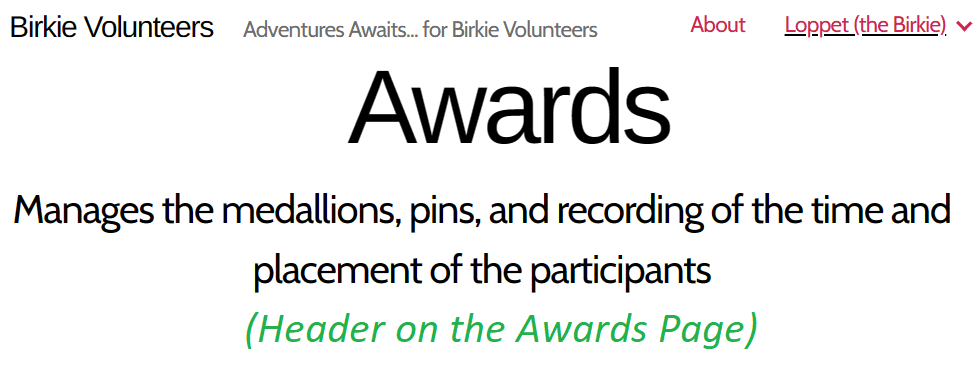
Many of the above pages will follow a standard template with the following elements. The Awards page is the ‘poster-child’ for this template.:
- Hook. A ~250-character summary of the volunteer area without getting into specific details.
- The hook allows the volunteer to quickly assess whether this is an area of interest to them or not by providing the following summarized details:
- Why is it Needed?
- Who Will I be Working With?
- Time Commitment.
- Table of Contents. Quick links to specific sections.
- Who is In Charge? A photo and short biography of the senior volunteer.
- Context For All Roles common, repetitive, information. Exceptions to this are included in the next section, description details.
- Safety Considerations: Hazards and risks.
- Location: Where the work occurs
- Training
- Roles Needed. Detailed descriptions for the one or more roles required.
- These descriptions come from a preliminary Role Log, the subject of the next post.
 Organizational Biology
Pingback: The Birkie Catalog of Opportunities | Organizational Biology
Pingback: Updating Pages – Birkie Volunteers
Pingback: A Poor Man’s (non-profit’s) Volunteer System | Organizational Biology