
How has the 2018 amendment to Alberta’s Occupational Health and Safety (OHS) legislation affected non-profits? The November 2023 conference examined this question.
- A Trip down Occupational Lane
- Context to the Change
- A Tale of Two Compliances
- Sheila S. Introductions
- Ted L What Changed
- Charles World
- Brad Johnston
- Deborah Nilsen
- Panel Discussion
- So What and a Business Case
A Trip down Occupational Lane
In 2018, a significant changed occurred in the non-profit landscape – the requirement to be compliant with recently amended Occupational Health and Safety (OHS) legislation (emphasis added). Prior definitions from 2000 and 1980 are provided for reference.
- Occupational Health and Safety Act, SA 2017, c O-2.1
- (aaa) “worker” means a person engaged in an occupation, including a person who performs or supplies services for no monetary compensation for an organization or employer and, for greater certainty, includes a self-employed person, but does not include [ed. students and select farm workers].
- Occupational Health and Safety Act, RSA 2000, c O-2
- “worker” means a person engaged in an occupation, but does not include, except for the purpose of section 2(2), the following persons engaged in a farming and ranching operation specified in the regulations.
- Occupational Health and Safety Act, RSA 1980, c O-2
- (m) “worker” means a person engaged in an occupation;
Context to the Change
The expansion of OHS legislation to include the non-profit sector could be seen as political expediency. The change trumpeted protecting volunteers while leaving the cost and logistics to non-profits. Looking at other jurisdictions across Canada, some sort of safety standard for volunteers seems to be the norm. While including volunteers in the legislation establishes a common baseline, the resources to support this public policy change did not keep pace.
A Tale of Two Compliances
Fast forward five years and non-profit organizations tend to fall into one of two camps: adoption and blissful ignorance.

Ignore and Hope. This vacuum is evident in a poll conducted for this conference. Less than a quarter of the attendees could point to a safety plan with any confidence. While not a scientific survey, the results are representative of the experience of the non-profit sector. For many organizations, OHS is too big, too mysterious, too foreign, and too costly to do much about other than ignore and hope for the best.
The four speakers at the conference guidance that OHS Compliance and the Non-Profit is possible.
Sheila S. Introductions
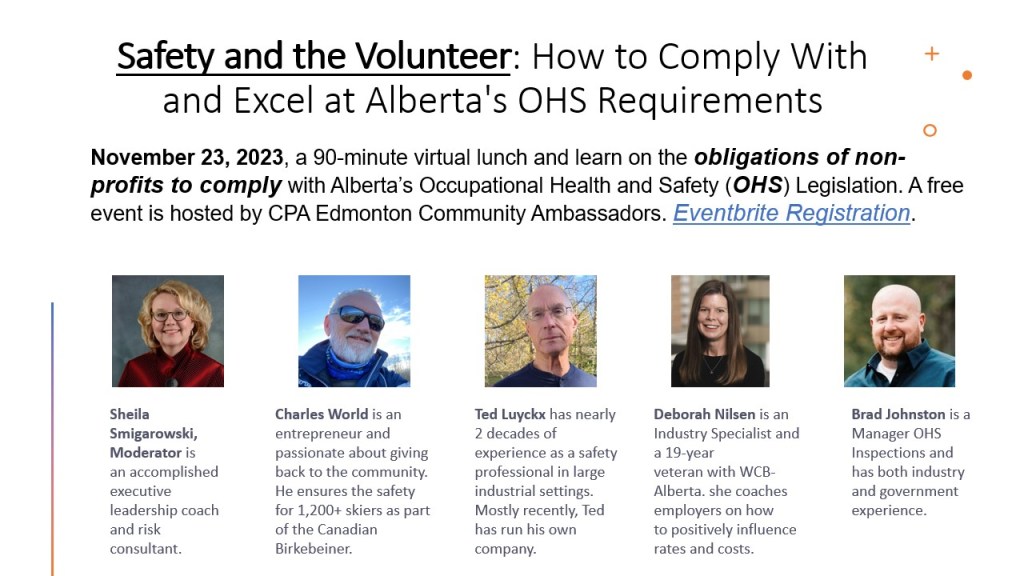
Sheila introduced the four speakers and set context for morning.
Ted L What Changed
Ted provided a practical view on OHS from many years in the field including running his own company. Ted’s message to non-profits is that Occupational Health and Safety (OHS) should be practical, ease to manage, and add value to the non-profit. Start with ‘Just-Enough’ OHS rather than trying to create the ‘mother of all safety binders’ that will go unread.
Charles World
Charles has an interesting vantage point on this issue. Managing building envelope businesses, he knows about the practicalities of OHS in the workplace. He was also on the Board of the Canadian Birkebeiner Society (Birkie) when it was adopted prior to the 2019 event. His community involvement has allowed him to see the best and worst of OHS adoption (or lack thereof).
Charles provides a good overview of the Birkie, its history, and how to safely supporting 1200+ skiers and 500+ volunteers in remote areas. These volunteers handle pots of hot liquids, knives, build stadiums, and use trail grooming equipment. The benefit of the Birkie’s preparedness is brought home in the story of a skier who suffered a cardiac event. Revived, he was transported to hospital by ambulance.
Brad Johnston
Brad provided representation from the Government of Alberta and presented the Internal Responsibility System or IRS. Most of the IRS can be directly applied to a non-profit organization although there are a few rough edges. For example, the defined roles you find in a business (the employer, management-supervisor, worker) blur in non-profits. A volunteer can easily be all three, at the same time.
To help the non-profit, the editor (me!), provided some (un)helpful comments within the presentation. In addition, there are discussion points for a board to consider when implementing/maintaining its own IRS system.
Deborah Nilsen
Deborah, a welcome addition to the conference as the Workers Compensation Board (WCB) can be a mystery. She provided an excellent overview of the services provided and their costs. Boards will need to carefully consider the cost/benefits of some of these services. For example, coverage for board members may be redundant if the individuals are retired, have disability insurance, and the organization buys Director and Officer Insurance. Nevertheless, Deborah laid out the details in a systematic manner.
Panel Discussion
There was limited time for a panel discussion with a few questions being fielded.
So What and a Business Case
Carrying on the theme of practical OHS, the next blog will present a fictional organization and how it baked safety into its volunteer experience to satisfy OHS legislation and to provide a best in class volunteer experience.
 Organizational Biology
Pingback: Easy Bake Safety | Organizational Biology
Pingback: VMS, CPAs, and Volunteers – May 28, 2024 | Organizational Biology
Pingback: 2024 Birkie Business Model | Organizational Biology