
The Birkie Business Model supports event planning, content control, risk and volunteer management for the Canadian Birkebeiner Society. The IPOOG model outlines the organization’s input, process, output, outcome, and governance; tying together various planning tools for annual revisions and current relevance.
Complexity in an organization is a funny thing. It accumulates like snowflakes in the winter until you suddenly can’t open your front door. Complexity also tends to entangle itself and unraveling it can be a challenge!
- Complex Sacred Cows
- Birkie as a Use Case
- Birkie Business Model
- IPOOG (with a Side of SIPOC)
- IPOOG Defined
- Does a Birkie IPOOG in the Forest
- Off to Planning, Visiting the QDIRF, Finding Files, and Tracking Time
- References
- Further Reading
Complex Sacred Cows
Nonprofits are less complex than their for-profit sisters because they run on a shoestring. Conversely, they also are built with more sacred cows. Early founders have an emotional attachment to a program even if it is past its best before date.
So how can a non-profit manage the nostalgic minefield of complexity? Most draconian is to cease to exist and nonprofits do that all the time (see Two Out of Three SNPs are Gone!). Carrying on through volunteer and funder martyrdom is another option, but not a very happy one. Finally, document the complexity so it can be examined, evaluated, and (possibly) fixed.
Groan…. documentation is a waste of time, you bemoan; and for the most part you are right. However, just enough documentation via a business model process can help balance the death-march of procedure writing against the benefits of describing an organization.
Birkie as a Use Case
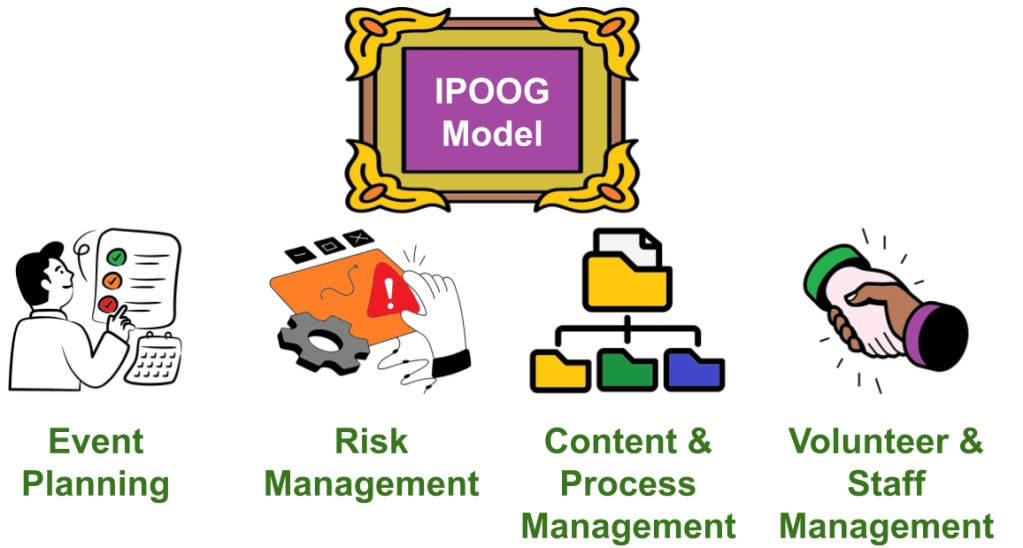
The Canadian Birkebeiner Society (Birkie) is a good use case to test out such a process. It is an Event based non-profit that primarily delivers a single activity (although it is branching out). At a high level, it can be encapsulated in a single graphic. Beyond a pretty picture, the graphic supports subordinate tools such as event-planning, issue/risk management, content/file control, and succession planning for volunteers.
Although not a cross-country skier, I have a soft spot for the Birkie as I believe it represents the best of civil society. It is both affected by forces beyond its control (such as the weather and changing volunteer patterns) and by the decisions of the past and current volunteers.
Birkie Business Model
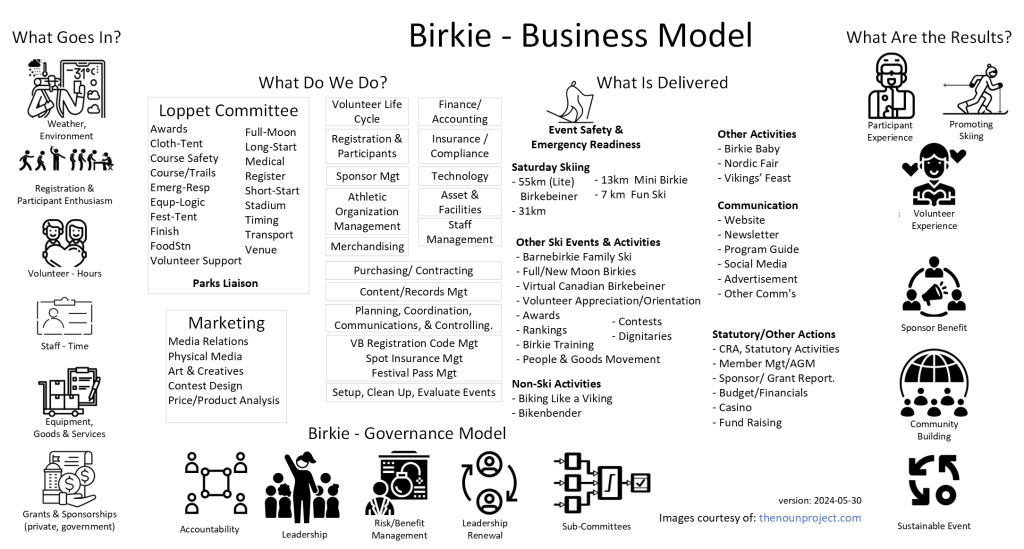
The Birkie Business Model has five parts. The first is the IPOOG graphic which provides an overview of the organization. In a single snapshot, the Birkie is organized into Input, Process, Output, Outcome, and Governance.
Based on this graphic, the organization then uses different tools: an Event Plan, Risk-Issue-Decision Process, Content-Procedure, and Volunteer-Staff Management. Each year, the model is revisited, revised, and refreshed. In this way, it remains reasonably current.
IPOOG (with a Side of SIPOC)
No, not the babble of a two-year old (and phrase that strikes fear in every parent who forgot the diaper bag!). The model is based on the classic Input-Process-Output with the addition of Outcome and Governance.
For those with a Lean Management or Six-Sigma background, it borrows from the Supplier, Input, Process, Output, Customer (or SIPOC) model (for a primer on SIPOC and business process mapping, see Business Process Documentation or Borrowing from Sheffield).
So why not just use SIPOC? A for-profit has a simple outcome statement – make a profit to generate a return on investment; Environmental, Social, and Governance reporting notwithstanding.
Often there is not a customer but there may be a club-member, client, or society at large. Outcomes represent ‘why’ an organization is doing what it is doing [1]. For the Birkie, the Outcome relates to promoting skiing, healthy living, and building the local community (see Further Reading section for more on the Birkie).
IPOOG Defined
The first three elements are shared with the business planning and computer worlds and are familiar to most people. Outcomes is a less well known concept and Governance is an enduring challenge for all organizations.
- Input: Flow of data and materials into the process from external sources. Inputs are the raw materials or information that need to be transformed (What Goes In?).
- Process: Tasks required to transform the inputs including activities, procedures, and operations that occur during the process (What Do We Do?).
- Output: Outputs are the data and materials flowing out of the transformation process. They represent the results or outcomes produced by the process (What is Delivered).
- Outcomes: Short and medium-term effects resulting from the outputs. They represent actual changes or benefits resulting from the activities (Results).
- Governance: Oversight to the above activities to ensure they are still required, operated in an efficient manner, and resources are available.
Does a Birkie IPOOG in the Forest
The Birkie primarily runs a ski event in the boreal parkland east of Edmonton, Alberta. With hundreds or thousands of participants, it is a complex event. Additionally, the Birkie runs the event with high safety standards and volunteer engagement. The above summarizes this complexity in a dense graphic. Daunting at first, with a little guidance and study, it is a useful road map of the event.
Of all the elements in the graphic, the most important is the version date. As the event evolves, so should the model.
Off to Planning, Visiting the QDIRF, Finding Files, and Tracking Time
There are the specific tools (which are covered next). Before delving into the detail – what are your thoughts on a pretty picture as a guide for non-profits? Would it help, be too hard to develop, or is something built and then quickly forgotten? Leave a comment and, yes… the Birkie has been IPOOG’ing in the forest for the past forty years!
- Tracking IPOOG Time
- Welcome to IPOOG
- Covering Risk, Content, and Volunteer Management: Sam IAM – an access management tool.
- (This blog describes the QDIRF although needs to be updated, a good placeholder): A Jack (of all tools) In the Box.
- Both Sharepoint libraries and Google folders use the standard UNIX-born folder structure. How to organize and document these: An Excel Tool to Document File Directories and GDrive Sanity, and 2005-Windows-DocMgt.
- Risk management is always a tricky business for any organization. Consider adapting the Seven ARM Model.
References
- There are lots of resources available on what exactly is an outcome, e.g.: https://www.askdifference.com/output-vs-outcome/
Further Reading
- To learn more about the Canadian Birkebeiner, visit these resources:
- Input, Process, Output (and Outcome) Models
- There are a Gazillion resources online explaining the model. The following represents the first dozen or so that are worth reading – rather than being specifically recommended:
- https://www.isixsigma.com/dictionary/input-process-output-i-p-o/
- https://www.open.edu/openlearn/money-business/business-strategy-studies/introduction-operations-management/content-section-2
- https://cio-wiki.org/wiki/Input-Process-Output_(IPO)_Model
 Organizational Biology
Pingback: Tracking IPOOG Time | Organizational Biology
Pingback: Welcome to IPOOG | Organizational Biology
Pingback: Accessing IPOOG – Sam IAM | Organizational Biology
Pingback: Three Months of IPOOG’ing | Organizational Biology
Pingback: It’s IPOOG TIme! | Organizational Biology
Pingback: Nov 21, 2024 – First IPOOG Session | Organizational Biology
Pingback: Thank You for IPOOGing | Organizational Biology