
The post explores the multifaceted roles of democratic governments, emphasizing their evolution from “stationary bandits” to providers of public goods and services. It discusses various responsibilities such as national defense, economic management, law enforcement, and public welfare, highlighting the complexities and challenges faced in governing diverse populations effectively.
- The Function of the Caveats
- It’s Obvious, Governments Do …. ummm, Stuff
- The Evolving Role of a Government
- Nice Discussion, What is the Result?
- Context for the Blog Series
- Annex – Definitions of Government Functions
Why do we need governments, what do they do exactly and why is no one happy with what they are doing? This post has been in the queue for a few years asking the questions, what exactly are the functions of a western-style democratic government?
The Function of the Caveats
Noticed the qualifiers? The reality is that governments come in a lot of shapes and sizes and this blog could be pretty long if I tried to describe them all. As well, if I just pick one, say Canada or the US, it would involve a lot of details having only a cursory relevance to other countries.
Finally, this is meant to be a high level memory jog for myself while working on other projects, such as how Results Based Management applies to governments. As a result, it does a flying overview of the literature and would not pass the smell test of a most political science courses… but it is good enough for government work!
It’s Obvious, Governments Do …. ummm, Stuff
According to Ian Morris’s book, “War! What Is It Good For?”, governments started out as stationary bandits. Rather than the roving variety, robbing and then disappearing into the forest, they stuck around and kept on robbing. In exchange, stationary bandits protected the peasant or citizen from being robbed (by other would-be thieves). To make the citizens wealthier, they spent some of their loot on roads, defenses, water wells and the like.
The Evolving Role of a Government
Governments are not one-size fits all. A local city government need not worry about things such as defense against foreign invaders or setting monetary policy. Okay, city-states excluded (think Singapore).
Federal systems, such as Canada or the United States, have well agreed to divisions of responsibilities between the different government levels. A national government may influence a lower level’s policy through funding or other levers of power but generally respects this separation of power.
The welfare state has greatly expanded the role of governments. Not every country can afford (or has the political will) to implement such widespread resource distribution. Because everything changes, finances, aging populations, war, environmental changes, cultural influences, technology, and other factors influence the extent and what services are provided.
Nice Discussion, What is the Result?
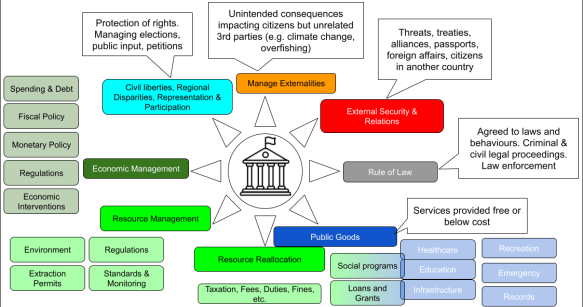
Why do we bother discussing what governments do? From a Results Based Management (RBM) perspective, these are the top tier Results. This is what a government can report on to demonstrate how it is expending public resources against what the public deems to be most critical. An example of this can be found on performance reports from governments around the world. The following image is from Global Affairs Canada’s 2024-25 report.

If citizens are afraid to leave their homes for fear of being mugged, then the government (and society) has failed to deliver the Rule of Law. These services also change over time. At one time, a government providing fire department services as a public good was seen as a frivolous luxury. Now this service is expected as part of the landscape of most western countries.
Context for the Blog Series
Because of a recent volunteer experience, I had a chance to revisit RBM but from governmental perspective. Normally found in development or international organizations, how well can it be applied to a national or sub-national government?
My assessment is that the core concepts and principles are directly transferable. Some of the detail bits are sometimes useful. Overall, an awareness of RBM can help a politician, senior government executive, public servant, or a member of the public, create better governments and therefore civil society.
Next stop, the role of public policy in governments.
Annex – Definitions of Government Functions
The following are common or typical definitions for the functions of government. If some seem to overlap or repeat, that is not too surprising. Governments are complex entities and clear delineations is not easy.
- External Security. Maintaining national security, defending against external threats by establishing military forces and intelligence agencies.
- External Relations: Establishing foreign policy, representing the country in international relations, negotiating treaties, diplomacy, safe passage for citizens, cooperating with allies and international community.
- Rule of Law: ensuring internal order through law enforcement, supporting a judiciary, punishment regimes such as jails or fines, and supporting social contracts to guide behaviour.
- Public Goods: the largest of the functions with the greatest variability. While health, education, roads, utilities (gas, water, sewer, power), and parks top the list; so does maintaining emergency services such as fire or ambulances.
- Resource Reallocation: Collection of taxes, duties, fines, fees, etc. to fund government operations and more fairly distribute wealth within the society.
- Taxation may be personal, value added, corporate, capital gains, etc.
- Social programs are a form of resource reallocation but are also a public good.
- Governments may use loans and grants to influence public policy. For example, the Canadian Pacific Railway was built through the use of generous loans and land grants.
- Resource Management: managing the natural and nearby resources within the territory(ies) controlled by the government.
- This allows for controlled exploitation of the resources in a manner that benefits society as a whole.
- To do this, laws, regulations, standards, etc. control legitimate extractors.
- Poachers and pirates are caught through enforcement and prosecuted.
- Economic Management: guiding and directing the commercial and financial interests of its citizens and organizations.
- Spending & Debt: buying goods and services, borrowing to pay for these or in support of fiscal policy.
- Fiscal Policy: fiscal policies (e.g. inflation targets), debt levels, foreign ownership of corporations, role of a central bank or government departments.
- Monetary Policy: issuance of currency, money supply, interest rates.
- Regulations: Rules and conditions a person or entity may conduct its affairs. Incorporation, operating rules, reporting requirements.
- Economic Interventions: may include inducements to invest in the territory or using the coercive power of the state to otherwise encourage/ discourage certain economic activities.
- Civil Liberties: using the legal and regulatory frameworks to protect the rights of both citizens and those in the government’s territory. This includes protection of the weak against the strong.
- Regional Disparities: not all parts of a territory are as well blessed with resources, people, environments, etc.
- To maintain good order, the government may encourage or forcibly transfer between regions.
- In Canada, this concept is known as equalization payments such that government services are reasonably comparable no matter what province you live in.
- Representation and Participation: refers to elections, managing petitions, soliciting input on public policy, providing access to government information, etc.
 Organizational Biology
Pingback: Setting the Context for government Results Based Management | Organizational Biology
Pingback: Very Mature, gRBM! | Organizational Biology