
The post evaluates Results Based Management (RBM) and its effectiveness in strategic planning. It discusses the methodologies strengths and weaknesses. While RBM is criticized for fostering bureaucracy in organizations like the United Nations, it remains valuable if implemented in conjunction with encouraging a high-trust environment.

- It Must Work Because What Are Our Other Options?
- RBM Specific Challenges
- The Governance Gap
- The Centrality of ‘Ceteris Paribus’
- The High Cost of Change
- The Tyranny of Light Comes to Light
- Prioritizing Structure or Trust
- Recapping the Challenges
- RBM the Right Solution for a Different Time
- Five Ways to Get RBM Back on Track
- Conclusion – Is RBM Worth the Effort?
- Notes and References
Before introducing government RBM (gRBM), it is important to pause and ask, does Results Based Management (RBM) classic work in the first place? Does the methodology that focuses on results deliver the results promised?
It Must Work Because What Are Our Other Options?
RBM must work because it is so logical. Begin with the End in Mind; just as Steven Covey Recommended [1]. Then work backwards from where you want to be to identify all the steps and measurements to get to where to start the project.
This is project management in a nutshell, so what could possibly go wrong?
The Risks of Strategic Planning
The first question is whether strategic planning works in the first place. Can organizations scan the environment, estimate markets or social trends years into the future? Based on this research, organizations then need to formulate large, macro goals and ‘work the problem’ down to a specific activity in support of these goals.
The answer seems to be yes. We have cities filled with buildings that don’t fall down and governments that deliver critical services despite changing with population shifts. Strategic planning works until it does not.
Black Swans and Strategic Planning
For example, on January 1, 2020, how many organizations had factored the COVID pandemic into their plans? The answer is none (or only the most prescient) because COVID is what is known as a Black Swan event.
These events are unpredictable and are an extremely rare occurrence that has a significant and often negative impact on the world. They are difficult to foresee and are often rationalized in hindsight as if they could have been expected. The term was coined by Nassim Nicholas Taleb who has written extensively about randomness and systems [1].
In his follow up book (and my blog) ‘Antifragile: Things that Gain from Disorder’, he calls strategic planning ‘superstitious babble’. He goes on to say “… there is no evidence that strategic planning works… (strategic planning) makes the corporation option-blind as it gets locked into non-opportunistic courses of action.” [2]
Does Strategic Planning Work?
One must admire Taleb’s body of work (and the small fortune he made preparing for the 2008 global financial crisis). While I agree with Taleb that strategic planning is mostly a waste of time, I am also not as wholly dismissive of the effort. What Taleb is missing from this discussion is the basis for rest of his book.
A strategic plan should be the roadmap to make an organization increasingly Antifragile, robust, or resilient. A robust and optionality-attuned-organization can make the best use of circumstances as they present themselves; they can weather small shocks or larger Black Swan events.
RBM Specific Challenges
A strategic plan is an amorphous term that can mean very different things to different people. RBM is much more structured. While there is no global RBM standard, there is widespread agreement on the central tenants. There is less agreement of RBM’s challenges which include the following:
- The Governance Gap
- The Centrality of ‘Ceteris Paribus’
- The High Cost of Change
- Prioritizing Structure over Trust
- The Tyranny of Light Comes to Light
The Governance Gap
The classic RBM Results Chain is missing something, a recognition of the role of governance and supporting systems such as information technology. The following graphic is proposed as the new standard for results chains. Identical save for the addition of these two functions at the bottom.
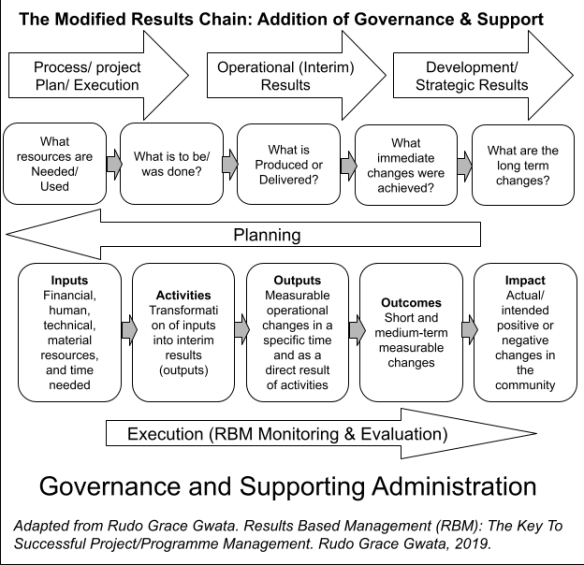
If this addition rings a few bells, it may look vaguely like Porter’s Value Chain. Popular when RBM first came to prominence (mid 1980’s). The value chain recognized that supporting functions are critical to value added functions such as sales or operations.

The Centrality of ‘Ceteris Paribus’
Ceteris Paribus is used in fields such as economics to hold all variables constant save for the one being evaluated. RBM integrates this concept through its use of assumptions (think of the last pillar of the Logframe, a common tool used in RBM). As a result, RBM does not adequately consider the volatility of the planning environment except through a somewhat clunky feedback loop concept.
Logical Framework – Diversion
For those interested in learning more about the LogFrame. A useful methodology for problem analysis. See: A Logical Framework.
These assumptions are ‘baked into’ the Results Chain once the document has been completed. There is an attribution problem of what a project does and its impact: “In complex, multi-actor settings, isolating the contribution to outcomes proved nearly impossible.” [3]
The High Cost of Change
In theory, a feedback loop monitors for changes and triggers the need for revisions. However, if it has taken hundreds of hours of effort to prepare, the Results Chain may not survive the extrication of an assumption.
Mary Akugizibwe works for the United Nations and in an October 2025 LinkedIn opinion piece wrote that “… RBM has become synonymous with bureaucratic reporting, unread documents, and a culture of compliance.”
Bureaucracy is expensive to create and vastly more costly to change. The cost to develop a results chain makes it untenable to revisit it leading to morbid bound organizations and reluctance to change because of internal transaction costs.
This leads to a curious puzzle. The very methodology that promised a focused on results rather than activities has become the one that encourages reporting on activities. This conundrum can be understood in the context of a 1997 article about information paradoxes.
The Tyranny of Light Comes to Light
More information can lead to reduced comprehension of complex issues and undermine social trust in expert systems. At the same time, expert systems must create more complexity to manage the ever increasing amount of information generated because of more complex expert systems [4].
The above observation was introduced in a 1987 article by Haridimos Tsoukas. He explores these paradoxes and their implications for governance and social practices. While not a perfect fit for RBM, it does describe the dislocation that can occur between the central entities demanding RBM information and the disengagement of the those providing the information.
From the abstract, …more information may lead to less understanding; more information may undermine trust; and more information may make society less rationally governable.
Another way to understand this strange paradox is through various human cognitive biases. While many of these biases are contradictory (and therefore represent a self-balancing system), two that are particularly relevant:
- Information bias: The tendency to seek information even when it cannot affect action.
- Illusion of control: The tendency for people to overestimate their ability to control events.
Tsoukas’ article has also been described as the Red Queen Phenomenon. The book Alice in Wonderland, the Red Queen rules a country in which you must run just to stay in one place. The metaphor has been applied elsewhere and is applicable to RBM. Ever increasing information and detail is demanded even though it is not used for better decision making [5].
Prioritizing Structure or Trust
Trust is the most perishable asset an organization possesses and RBM does not naturally engender it. Its focus is on monitoring and evaluation with the implicit assumption of a lack of trust. This results in the loss of organizational goodwill while embodying those who thrive in a low trust environment.
Trust is most important at the grassroots level of a project or process. A minor deviation noticed by someone can be acted upon or ignored. The reason for ignoring the minor deviation is a lack of trust in the process to support the effort to correct the deviation.
This was the fundamental difference between US and Japanese car manufacturing techniques in the 1980’s. For the US auto worker, better to ignore the error rather than slow the production line down. For the Japanese worker had the ability to stop the entire line. The short term cost of a close production line was more than recouped with higher quality and ever increasing market share.
How does this relate to RBM? The documentation and detailing of every Output, measurement of every Outcome, and comparison of projected and actual impact, can remove the people delivering the product or service from the decision making processes. An implied loss of trust which results in human disengagement from the process.
Recapping the Challenges
By way of a recap, RBM involves a fixed set of assumptions that are nearly impossible to change. Paperwork and reports that are barely read and for which decisions makers are hard pressed to do anything about. Most importantly, an erosion of trust through more paperwork, Indicators, and reporting.
Who would design such a system in the first place?
RBM the Right Solution for a Different Time
The answer is in the origin of RBM from the Development Community. Gazillions of dollars were being sent overseas to support a development initiative with little information coming back as to whether the money was well spent or lined the pocket of middlemen.
Remember that this was pre or early internet days when information transmission was more expensive and time consuming. Beyond information, many of these projects occurred in relative isolation. There may have been only a single development project occurring in a single village with few to no secondary or tertiary influences. Attribution is easier in a simpler world.
This relative isolation eliminated or reduced things like Outcome attribution error. The rigor, focus on results, and reporting made perfect sense for this environment.
Five Ways to Get RBM Back on Track
Does this mean that RBM is not worth the effort? No, RBM still has much to offer to a national government or any organization who wants to try to focus on applying scarce resources to best possible Activities.
When considering implementing RBM, the following focuses are recommended:
- Create Trust, Verify Its Placement. Seek first to be a high trust environment. Severely punish those who abuse positions of trust and acknowledge those who sustain this fragile commodity. Internal controls and verification systems are presented in the context of rewarding those who do the right thing, every time.
- Seek to Descale and Simplify. The RBM process must become simpler year over year with less effort, yet with better information generated.
- Focus on the Most Critical Information for Each Audience. In a later blog, the 5-Audiences model will be introduced in the context of government RBM. Each audience has very different information needs. What are the 3-5 pieces of information each audience needs to understand the project or process and trust in its delivery? Prioritize this information over Classic RBM of Results Chains, LogFrames, etc. Use these tools at the appropriate audience level.
- Link Everything Back to What Governments Do. Every government project or program should be about sustaining or building civil society. Civil Society relies on government fulfilling its core functions. Every project and program should be able to link to one or more government functions.
- Invest in Technology, Demystify the Light. Noting the warnings provided by Haridimos Tsoukas about creating overly complex expert systems, investment is still required. However, as much as security concerns allow, the systems need to be open, well documented, and non-threatening to those using or relying on them.
Conclusion – Is RBM Worth the Effort?
Is RBM worth the effort? Yes, but as a tool subordinate to legitimate, ethical, and high trust organizations. Before talking about governments, we need to discuss the core of RBM, what exactly is an indicator?
Notes and References
- Seven Habits of Highly Effective People is still a go to resource for actions to lead your life. First published in 1989, it was a runaway success. Surprisingly, I find the language a bit tedious at times.
- A Black Swan Event is an unpredictable and rare occurrence that has significant and far-reaching consequences. The term describes events that are outside the realm of regular expectations and typically carry severe impacts on financial markets, economies, and societies. For a good summary, see: Wikipedia – Black Swan Event.
- Taleb, Nassim Nicholas. Antifragile: Things That Gain from Disorder. Random House Trade Paperback edition, 2014; p. 234.
- “Why Results-Based Management Failed the UN and How a Hybrid Model Could Work | LinkedIn.” Accessed November 17, 2025. LinkedIn.
- Tsoukas, Haridimos. “The Tyranny of Light.” Futures 29, no. 9 (1997): 827. https://doi.org/10.1016/S0016-3287(97)00035-9.
- Various sources including: https://en.wikipedia.org/wiki/Red_Queen_hypothesis.
 Organizational Biology
Pingback: Setting the Context for government Results Based Management | Organizational Biology