
For-profit organizations focus on generating returns and complying with laws while executing various planning processes. In contrast, public service organizations face complex challenges, such as lack of direct financial accountability and competition. Classic Results-Based Management struggles in this context, revealed through examples like Global Affairs Canada and the need for broader, more inclusive measures.

- For Profit Results Expectations
- … And the Organization is Irrational
- Do you See the Problem with Classic RBM?
- Global Affairs Canada – Case Study
- Compromises and Inferences in RBM
- Conclusion and Next a Definition
- Notes and References
For Profits do lots of different things. In one part they are producing widgets (operations). In another part, they are planning on next year’s widgets (tactical or operational planning). Perhaps the executives are asking, ‘Should we be in the widget business?‘ (strategic planning or business vision).
In the meantime, the organization is building new factories or implementing new information systems to build better widgets (project planning and project execution).
For Profit Results Expectations
A for profit has relatively clear results expectations. Generate a positive return on the capital invested in the organization. Obey local laws and strive to be a good corporate citizen.
Pity the Public Service
Making widgets is tough enough but public sector organizations have greater challenges:
- Governments can’t go bankrupt without causing widespread social chaos
- The services offered are vastly more complex, greater in number and are provided to wider set of clients.
- Many of the services they offer are done as the provider of last resort.
- There is typically no direct linkage between what a person pays (e.g. via taxes) and what the person receives.
- Individuals who pay the most likely receives the least in direct services while those who may pay nothing or very little receive a much greater proportion of direct services
- Because they are the provider of last resort, they can only exit a market or abandon a product line with the greatest of difficulties and the potential for social chaos
- Public service organizations do not benefit from the discipline of competition in the market.
- They answer to nebulas ‘stakeholders’ instead of bottom line focused investors.
- These stakeholders may have very narrowly defined objectives that may even be in contradiction with the vast majority of the government’s ‘clients’
- The board has a habit of changing radically every few years and the new board may know nothing of the services provided by the organization
- Like for profit organizations, they must consider the trade offs between two or more opportunities.
- The final determination of which option to choose may not have a direct relationship with logic or any evidence presented; as such the reasons the choice was made may be obfuscated or at best opaque …
… And the Organization is Irrational
Of course, it doesn’t help that the organization and environment is fundamentally irrational. A citizen can demand that government reduce expenses and thus taxes while also demanding additional services for a cause of interest to them. For the citizen, they don’t see the contradiction in their demands.
The mark of a skilled politician is the individual who promises to do both without making a real promise on either. Not because the politician is duplicitous [1], but because they know they have to balance the real results they can deliver against the finite resources available.
Do you See the Problem with Classic RBM?
Classic RBM is not much help in the government context. Both for reasons discussed in the previous post, Does RBM Work?, and because Classic RBM is so darn rational (if sometimes unrealistic).
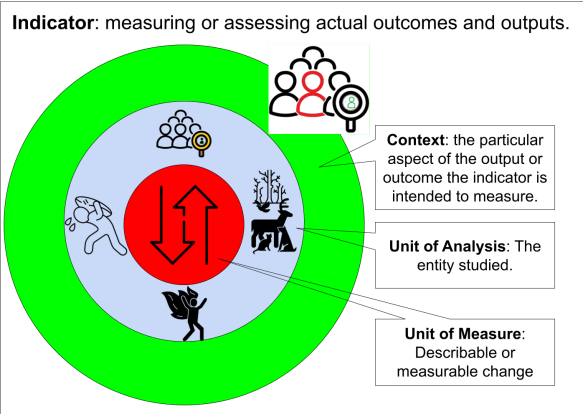
The other problem with Classic RBM is that as the Context expands, the Unit of Analysis increases (instead of one distinct Entity, it must consider dozens or perhaps thousands of Entities constituted as ‘stakeholders’), the Unit of Measure must become less precise and more all encompassing.
Global Affairs Canada – Case Study
A good case study for this comes from the 2024-25 Departmental Results for Global Affairs Canada as presented on the Treasury Board’s Secretariat’s (TBS) GC Infobase operated on behalf of the Government of Canada (GoC, read the following interlude for a backgrounder on who or what exactly does the Canadian Treasury Board do).
A Canadian Federal Treasury Board Interlude
In Canada, the Treasury Board Secretariat (TBS) function for the federal or provincial governments is one of the most powerful institutions of that government. It controls the gathering of budget documents prior to presentation to parliament (or a provincial legislature). It is responsible for the financial reporting of the government.
At the federal level, TBS is also the designated employer-ministry. In other jurisdictions this may be distributed to individual Ministries or a corporate human resource function. Other TBS functions include policy development for the operations of government (procurement, etc.).
TBS and the Ministry of Finance typically work closely although with slightly different areas of responsibility. The Ministry of Finance focuses on the financial management and budgeting of the government, while the Treasury Board is involved in the broader policy-making and oversight of the government as a whole.
Other Commonwealth countries (e.g. Australia or New Zealand) have a Treasury Board function (with different names). Further Reading:
Following the RBM methodology, one can work backwards from the desired results to the creation of an indicator.
- 1. Government Function: External Relations (see What do Governments Do, Anyway?)
- 1.1. Current Government Priorities: Mandate Letter from Prime Minister Carney, 2025-05-21.
- 2. Desired Result: Advancing Canadian interests through deepened global engagement [2].
- 3. Departmental Result, subordinate to the Desired Result: “Canada’s leadership on global issues contributes to a just and inclusive world.”
- 4. Indicators: There are three indicators to measure the above Departmental Results:
- i) Number of influencers and decision-makers reached through Canadian-hosted events, including events on women’s empowerment and rights and gender equality.
- ii) Percentage of Canadian-led decisions introduced through international and regional organizations that are accepted.
- iii) Number of Canadians in leadership positions in international institutions.
- 5. The first two Indicators achieved their results while the third missed the mark by a wide margin.
Compromises and Inferences in RBM
Does hosting a diplomatic party in some far flung corner of the globe in which gender equality is mentioned constitute a significant contribution to a just and inclusive world? Probably not and this is where this case study shows the limitations with Classic RBM.

The three measures noted above for the result are all valid, at least in a narrowly defined manner. They are reliable, simple to understand, and easy to collect. Whether they have broader validity, sensitivity to global changes, or useful is up for debate.
Nevertheless, these indicators should remain because of the compromises that need to be made. More valid or useful measures are not likely to be found, or they cannot be published for political, diplomatic, and practical reasons.
In other words, Classic RBM works but only if one understands the trade offs and compromises needed. To differentiate this variation of RBM from its more constrained progenitor, we will call it government-Results Based Management or gRBM versus ‘Classic RBM’.
Conclusion and Next a Definition
In the next post, a definition of gRBM will be provided as well as how it varies from the classic variety. Spoiler alert, it involves leadership, governance, and compromises.
Notes and References
- Having hung around a few politicians I disagree with the general sentiment that they are ‘all crooks and liars’. Certainly there are tinpot dictators having Swiss bank accounts or New York’s infamous Tammany Hall. Other than these Crooks and Liars, most are (at least in Alberta) decent people who have a strong public service sentiment.
- The Departmental Plan and Results are taken from these two sources:
 Organizational Biology
Pingback: Introducing government Results Based Management | Organizational Biology