
This post, one in a series on Results Based Management as applied to government (gRBM), explores the structure of government. It outlines the branches of government and how these branches, described as audiences, have different roles to play in gRBM.
- British/Canadian Parliamentary System
- Insert Here a Myriad of Variations … Not Relevant to this Blog
- Dropping Judicial, Adding Academic and Two Public Sectors
- 5-Audience Model Visits gRBM
- Comparison to Classic RBM
- Notes and References
Most people have at least a vague understanding of the structure of government. For example, the US constitution recognizes 3 distinct branches: Legislative (Congress and the House of Representatives), Executive (President and federal public service), and Judicial (supreme court, etc.) [1].
British/Canadian Parliamentary System
The Canadian Parliamentary System, based on the British model, has less obvious Executive branch of Government. The Executive is the Cabinet, Prime Minister, and the King (as represented by the (Lt.) Governor General. The cabinet is formed from the party who won the most seats and can form a government [2].
While the US President can pick anyone to be the Secretary of Whatever (subject to legislative approval), in Canada, the Executive Branch is made up sitting members of the house [3].
Insert Here a Myriad of Variations … Not Relevant to this Blog
The Canadian and US examples are by no means the most common political structures. There are more than a dozen variations including One-Party States, Islamic Theocracies, or a Parliamentary Republic [4].
The point of this post is to introduce common building blocks in which most(ish) of all countries have: Executive, Legislative, and Judicial.
Dropping Judicial, Adding Academic and Two Public Sectors
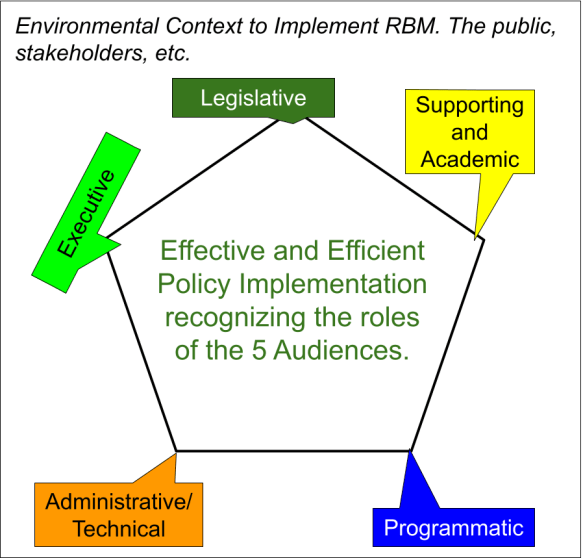
From this list, we are dropping Judicial because entities interested in Results Based Management seldom interact with this branch (although, there was that one night…). Added to this list are the following:
- Programmatic: Public Servants, Agency, and other entities that deliver program or are working on a development project within a jurisdiction.
- Administrative/Technical: Typically Planning and Monitoring Evaluation specialists, those supporting IT functions, financial, statistical, and equivalents.
- Supporting and Academic: Central agencies (statistical, finance, etc.), civil service representatives, senior public servants centrally assigned.
International organizations may fit support one or more of the above as they have unique expertise in the area of interest.
The Public and various Stakeholders surround the above graphic. They are definitely involved in the policy and planning formation but in an advisory versus a controlling manner.
5-Audience Model Visits gRBM
The RBM literature is often silent about who exactly is planning or working on what bit. You would be forgiven in thinking that senior public servant is working with a program officer to figure out the best indicator for a relatively minor project. This is seldom the case and often the above Audiences are working in isolation from each other.
This is unfortunate as there should be cross-level knowledge across the Audiences. The Senior Administrator need not be conversant in the details of program development if they can trust their programmatic staff. Central organizations are not in the business of running government but instead monitoring and advising the machinery of government. And the list goes on… all the way to when we introduce government Results Based Management, in a future post.
Comparison to Classic RBM
Before leaving the audiences, let’s compare the 5-Audience model to a more typical project run as part of development program.

- The Donor(s). One or more organizations providing funds to achieve the project objective. In some cases, the donor and the delivery organization may be the same (e.g. a UN Agency), for the most part, funding and delivery can be considered separately.
- Delivery Organization. A local or international organization who is organizing the work on the ground. If an international organization, they are likely partnering with a local entity. The delivery organization typically has responsibility to plan and report on the results.
- The Program Staff. The individuals on the ground who work with the community to deliver the program. They may be locals, international staff, but most likely, a combination of the two.
The white background represents the community the project or program is running within. This model does not consider all of the various permutations possible, nevertheless, a good demonstration of the increased complexity of government RBM.
Notes and References
- See Branches of the U.S. government or read the US constitution… probably easier to ask AI to summarize it for you.
- Mostly, there have been instances in which opposition members formed part of Cabinet. In particular, the Union Government at the end of the First World War. See Canada History.
- With a few notable exceptions such as John Turner and even the political master himself, William Lyon Mackenzie King. While it is possible to have a non-Member of Parliament, tradition would not tolerate it for long. See Examples from the CBC.
- This Wikipedia post seems to have the best summary of the various systems, despite acknowledged problems with the page. For our purposes, it is a better presentation then even the US’ Central Intelligence Agency’s World Fact Book.
 Organizational Biology