
Governments face the challenge of demonstrating effective use of taxpayer money through performance reporting systems. Government Results Based Management (gRBM) focuses on measurable outcomes from government activities, bridging traditional and modern reporting methods. Governments must sometimes use inferential measures to compensate for the size and complexity of what they are reporting on.
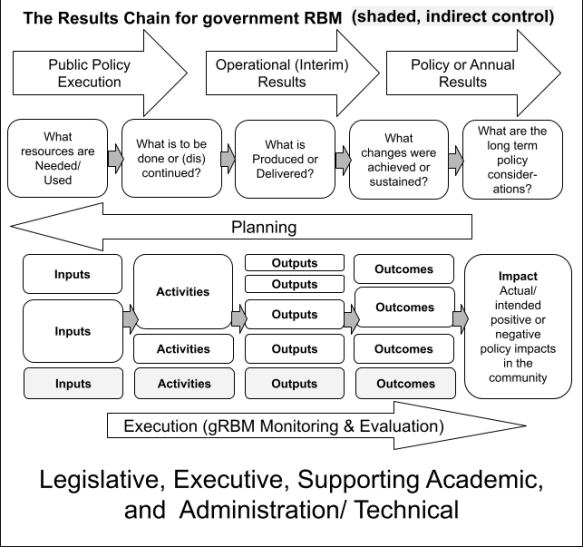
- Slightly Modified Graphic – gRBM
- Definition of gRBM
- Breaking Down the Definition
- Evaluating Government Results is a Function of Level
- A Representative Measure
- Conflation and Comingling Caution
- The Need for Inferential and Indexed gRBM Measures
- Judgement is Needed in gRBM to Design a Level Appropriate Measure
- Documenting the Results
- Conclusions and Next Steps
- Notes and References
Governments want to and must show results for taxpayer money spent. How best to do this is an enduring challenge which has given rise to sophisticated performance reporting systems. Government Results Based Management (gRBM) supports this diversity and bridges the gap between ‘classic RBM’ and other reporting methodologies such as international public sector accounting standards (IPSAS).
Slightly Modified Graphic – gRBM
The first gRBM change is the graphic itself. It is recognized that gRBM operates in a complex environment. The simple Input, Activities, Output, and Outcome model does not quite fit the government context.
- Inputs may come from numerous sources and some provided in-kind or as part of other government operations.
- Activities are similarly mixed with actions undertaken by public servants, contractors, volunteers, and other community members.
- Outcomes may not always be clear except in their absence.
- Those relying on a government program may not be evident until the program is changed, scaled back, or eliminated.
- Public Policy Impacts may not be clear and inferential at best.
- Indirect Control (shaded boxes) governments are not in control of some of the inputs or outputs they rely on. For example, a grant from one level of government to another, social behaviour, or external influences may impact the above.
Drilling down from a ministerial level to underlying projects or programs, results in activities that do fit into Classic RBM. All organizations have their own complexities and RBM struggles to scale up within these complexities. The above diagram is meant as a reminder of the particular challenges governments face and the need for government Results Based Management (gRBM).
Definition of gRBM
The previous post, Setting the Context for government Results Based Management, the challenges of government performance reporting were outlined. Into this challenging environment enters gRBM, defined as follows:
“A focus on the results of activities dis/encouraged by the government to the extent that the government’s role can be economically measured.”
Breaking Down the Definition
- A focus on the results… Governments need to be accountable for the resources they use and the outputs and outcomes they provide.
- A magnifying glass focuses light from a wide area into a narrow point.
- The same is for gRBM; the concentration of many smaller results into a narrow measure which acts as a representative value.
- The larger the magnifying glass, the more that is gathered to and focused on a single spot.
- … Activities dis/encouraged by the government… Governments both encourage things (obeying speed limits, paying taxes, staying healthy) and discourage other activities (committing treason, stealing, smoking).
- Governments are also in the business of maintaining the status quo.
- Classic RBM tends to be about change, gRBM may be about stasis.
- … to the extent that the government’s role can be economically measured. In a modern democracy, governments set up the conditions for a result but then have varying degrees of real influence on the actual results.
- As noted in the discussion on setting up indicators (see What Makes for a Good Indicator), affordability is a pervasive constraint in most monitoring systems, including RBM.
- Indicators are sometimes representative of a larger result for the sake of brevity, affordability, and information usefulness.
Evaluating Government Results is a Function of Level
In a previous post, Setting the Context for government Results Based Management, the Global Affairs Canada case study was introduced. In the end, three indicators were selected for the Departmental Result: “Canada’s leadership on global issues contributes to a just and inclusive world.”:
- i) Number of influencers and decision-makers reached through Canadian-hosted events, including events on women’s empowerment and rights and gender equality.
- ii) Percentage of Canadian-led decisions introduced through international and regional organizations that are accepted.
- iii) Number of Canadians in leadership positions in international institutions
The departmental result was tied to a larger Desired Result which in turn was tied to a mandate letter issued by the Prime Minister. The departmental result is the lowest level publicly available.
A Representative Measure
The three results are hardly comprehensive but that does not mean they were not appropriate. Whether individuals want to come to a Canadian Event is an indirect measure of the influence the country has in the world (and how good of a buffet Canada puts on).
Decisions in international organizations are a highly politicized affair. The more political-capital Canada has in these organizations, the more the country is listened to and a proposal is supported.
Finally, an appointment to a leadership role is often competitive. Many countries want their citizen in a position of leadership to help nudge international-policy in a desired direction. The ability to win over other countries to support a nomination is once again a sign of political capital Canada has in a global context.
Conflation and Comingling Caution
Conflation and Comingling are kissing cousins. Both involve merging of two or more sets of information, texts, ideas, or opinions into one, often in error. As the government amalgamates increasingly dissimilar activities up into higher levels of programs and services, these discrete measurements cannot be combined.
Conversely, there needs to be a summarization of measures otherwise the politician or citizen is forced to wade through zillions of smaller measures. There is no easy answer to this conundrum. With this caution out of the way, time consider how to measure results in a government.
The Need for Inferential and Indexed gRBM Measures
Governments manage complex organizations and deliver numerous services to a wide variety of customers/ clients/ citizens. As a result, classic RBM with its focus on detailed measurement of Outputs, Outcomes, and Results is applicable only at the lowest level of government activity.
Inferential Measure. One measure is used as a proxy for all activities. This was done in the Global Affairs Canada case. Three distinct values were used to measure the nebulous concept of international influence.
Indexed Measure. An index that measures noncombinative values may also be required. For example, there may be ten discrete indicators available to government. Each of these values can be converted to standard measurement (e.g. a value between 0 and 1) through data normalization. If all ten values have equal weight, then each measure contributes 10% towards to final index. If some measures have greater weight, then a weighted average can be used instead.
Judgement is Needed in gRBM to Design a Level Appropriate Measure
The above case study highlights the fact that inferential measures are often needed because of the lack of more direct or comprehensive measures.
Judgement and a transparent process is needed to ensure that an inferential measure is not selected because of expediency or nefarious purposes. This is the role of the Executive function within the 5-Audiences as well as the Support or Academic function.
The rationale for an indicator as well as any changes to the measure must be documented and approved through a formal process. This will reduce the inclination to ‘game’ measures that are not likely to be achieved.
Documenting the Results
The Government of Canada InfoBase does a good job of documenting decisions relating to a result. See the example below for the change log for one of Global Affairs Canada’s Result Indicators.
Example of a Change Log from GC Infobase
The following are the details behind the last indicator, the number of Canadians in leadership positions.
Number of Canadians in leadership positions in international institutions.
- Indicator: Number of Canadians in leadership positions in international institutions.
- Report: 2024-25 Departmental Results Report
- Date to achieve target March 2025
- Target At least 25; Actual result 13
- Status Target not met
- Result explanation: Target was not met due to an error in setting the target that included leadership positions in regional development banks. These positions were not meant to be included in the calculation as they do not involve elections or official endorsements.
- Methodology
- This is a consolidated corporate-level DRF KPI 1.2.3 to which MFM contributes.
- Rationale: The indicator provides a quantitative measurement of Canada’s leadership and influence on global issues. Through leadership positions in international institutions, whether pursued via election or appointment, Canada is able to promote Canadian interests and values, influence the multilateral policy agenda and contribute to the effectiveness, efficiency, accountability and relevance of international organizations.
- Calculation: This indicator will be calculated using the following family indicators:
- 1. Percentage/Number of Government of Canada-endorsed Canadian candidacies successfully elected to the UN; and
- 2. Number of Government of Canada-endorsed Canadian candidates successfully appointed to leadership positions (D1 and higher) in international organizations.
- These will be compared against targets to be determined by the International Staffing Committee as concerns international appointments.
- The number of Canadians filling leadership positions will be counted and disaggregated by institution and gender.
- Definitions: International institutions include UN bodies, international and regional organizations.
- Leadership positions means positions at the D-1 (Director or equivalent) level or higher in the case of merit-based appointments.
- Government of Canada-endorsed Canadian candidate means a Canadian national whose candidacy was formally supported by Canada.
- Note: In the past, MFM tracked only those Canadians in leadership roles obtained by way of an appointment process (not election), and included any Canadian national known to occupy a leadership role, regardless of whether their candidacy was endorsed by the Government of Canada.
- Last year’s target: At least 12
Conclusions and Next Steps
Governments grapple with attempts to make themselves more business like or rational. Governments also operate in a nonbusiness and sometimes irrational environment. It is easy to dismiss RBM out of hand because of these challenges. This does not improve civil society, hold governments accountable, or eliminate waste.
Results Based Management has a place in the government landscape, just not deployed in the same way as it in the international development community. Instead, the focus must be on the end result of creating a better civil society. Sometimes a civil society is a bit messy and that is okay.
Notes and References
- Having hung around a few politicians I disagree with the general sentiment that they are ‘all crooks and liars’. Certainly there are tinpot dictators having Swiss bank accounts or New York’s infamous Tammany Hall. Other than these Crooks and Liars, most are (at least in Alberta) decent people who have a strong public service sentiment.
 Organizational Biology
Pingback: Very Mature, gRBM! | Organizational Biology