
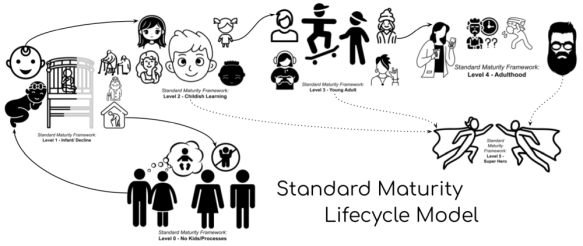
The Maturity Framework categorizes organizational development into stages resembling human life: from ‘Infant/Declining’ (non-existent or immature processes) to ‘Super Heroes’ (fully integrated and high-performing systems). It proposes six levels, encouraging organizations to reflect on their growth and structure. The aim is to enhance understanding and application of maturity concepts.
- Level Headed Questions
- A Thought Experiment in Levelness
- Standard Lifecycle Levels
- Infant/Declining (Step 1)
- Childish Learning (2)
- Young Adult (3)
- Adulthood (4)
- Super Heroes (5)
- DINK’s and No More Kids (0)
- A Level (Re)Progression
- One Level at a Time, No Skipping Levels
- It Takes a Village to Raise a Level
- What Do You Think of My Kids?
- Notes and References
The most distinctive part of a Maturity Framework are the various levels. Discussed in the previous post, Stumbling into Maturity (Frameworks), the number of levels is typically 4-5 with a level 0 representing ‘non-existent’.
Level Headed Questions
Poking around various Maturity Frameworks and their level representation, the following questions came to mind:
- If one is building a brand new framework, how many levels to include?
- How should the levels be constructed? For example, should they be additive. That is a lower level is automatically part of the next higher level.
- Should the levels be stand alone or tied to each other in some fashion?
- Can you be at a higher level in some parts of the Maturity Framework and lower in others?
- How best to present the levels?
A Thought Experiment in Levelness
Rather than incrementally building on the great work of others who have created one of the thousands of Maturity Frameworks, I thought I would start with a blank page. Even better, because this is a Thought Experiment, I don’t have to deal too much with icky things such as reality or practicality [1].
Some guiding concepts and principles for this experiment:
- Question: Is there a universal structure that all Maturity Frameworks can use as their starting point noting the need to subsequently modify them to make them fit for purpose?
- Concept: Given that maturity is fundamentally a biological term (related to growth or the completion of a process such as fermentation); what can the organizational sciences learn from the life sciences in developing maturity levels? [2]
- Problem: Maturity frameworks that are single dimensioned quickly become cluttered and lose their relevance in a sea of detail. How can a representation of a complex Maturity Framework be accomplished, that is both pleasing to the human eye and not being too complex?
Standard Lifecycle Levels
Every living entity has a lifecycle and none are immortal, although things like tardigrades give death a good run for its money. [3] Setting aside these life forms, and noting that it is humans who construct organizations, let’s build a lifecycle based on the human condition.
I am proposing that a standard lifecycle will have 6 steps. The second-last, step 5, is essentially unachievable except in the most exceptional circumstances (more on this later). The proposed definitions are an AI mashup of the text used in the twenty nine models surveyed (see: Annex – A Short Survey of Maturity Frameworks in the previous blog).
A Business Process Jack of All Terms
A note on terminology. The nearly 50 maturity frameworks identified in the survey cover most aspects of an organization with an over-representation of the IT functions. In some cases these ‘things’ are a business area (e.g. Internal Audit), business process, or a cultural dimension (e.g. ethics). Rather than rattling off possible combinations I am simply calling the aspects ‘Business Processes‘ (in italicized and in capital letters).
| Focus Description | Level |
|---|---|
| Business Process | 2 |
| Information Technology | 21 |
| Line Area (Finance, HR, etc.) | 7 |
| Other (Ethics, Risk, Controls, etc.) | 6 |
| Planning (Strategy but not Project) | 4 |
| Quality or Project Management | 5 |
| Total | 47 |
Infant/Declining (Step 1)
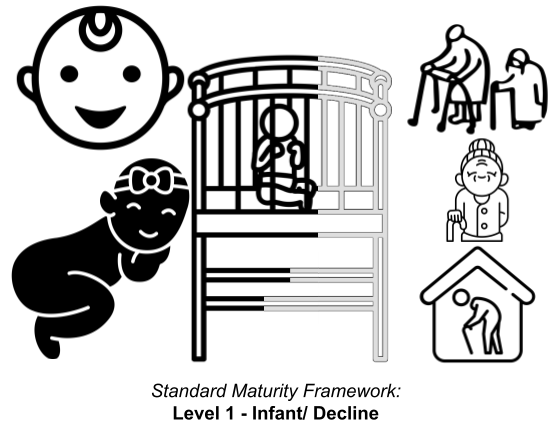
This stage is equivalent to human life from ages -1 to 3 year of age. Sure, a lot of learning happens in these three short years (language, walking, pooping in a potty), but a child on the eve of their fourth birthday is still pretty useless (and cuddly).
The analog to an organization is a Business Process that is very immature. Such non-existence or immaturity is represented by either a value of ‘0’ or ‘-1’ in the survey. Six of the twenty nine models have one or both of these levels. For the other twenty three models, some would rate this level as being a maturity level of ‘1’.
Compliance or Temper-Tantrums. Some Business Processes or activities may be in an infantile state and are equivalent of asking a two-year old to clean up their toys. It might happen or there may be a meltdown (this depends on things like nap time and the availability of free snacks in the lunch room).
No Babies Hurt in the Making of this Step. Because no one likes to have the words ‘dying’ and ‘babies’ in the same sentence I am using Declining instead. Processes may go through their own death throws or at least become languid and still be in their bathrobe at 5pm. Note that Dead and Gone are covered below in Step Six.
Proposed Definition of Infant/Declining (1)
The Business Process is new to the organization or it is operated with minimal structure, awareness of risks, quality issues, or service continuity needs. Any existing practices are ad hoc, inconsistent, and possibly unsupported by leadership. This results in high vulnerability to failures, incidents, and operational disruptions. Overall, there is no recognition of disciplines necessary for reliable, repeatable performance. The above definition applies to both an emerging aspect of the business and one that is in decline.
Childish Learning (2)
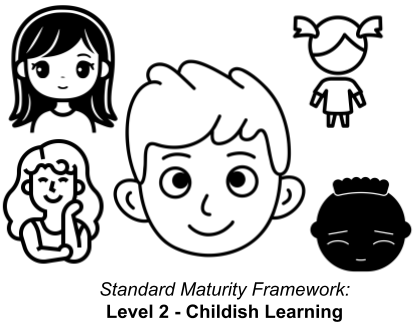
The ages of about four to eleven is a period of remarkable change in these mini-humans. These creatures can do things like clean up their room, go to school, or empty the dishwasher (maybe).
Once upon a time, childhood stopped somewhere around age four. Street urchins were perfect for sending down chimneys, working in factories, or as a coal miner. If it wasn’t for the need of more advance education (and child labour laws) we would still be benefiting from this workforce (obviously my tongue is firmly in my cheek).
The problem with children is that they lack worldly experience, strength, and things like thinking in abstract terms. It is the same with Business Processes. They exist in an organization but can’t compete with their older brothers and sisters in other organizations.
Proposed Definition of Childish Learning (2)
Organizations at this stage operate in a largely ad hoc, reactive, and inconsistent manner, with Business Process that are un/poorly documented and siloed. Success is heavily dependent on individual effort rather than standardized capability. Due to a lack structure, strategy, and coordination; instability, inefficiency, and higher costs or failures are common. While leadership may recognize the need for improvement, the organization as a whole remains fragmented, compliance‑driven, and without a unified long‑term plan.
Young Adult (3)
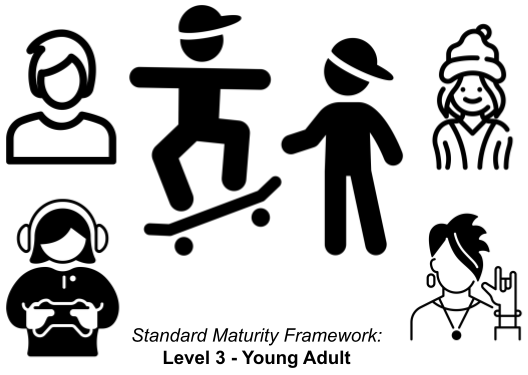
Humans between twelve and sixteen are wonderful/terrible creatures. They are becoming more sentient and capable even if there are issues. Of course slamming doors and screams of ‘I HATE YOU’ are not uncommon.
Young Adult Business Processes generally work except when they sleep in. They still have lots to learn, need some more development but they are mostly reliable.
Proposed Definition of Young Adult (3)
Organizations have basic, repeatable Business Process and emerging governance structures, but practices remain inconsistent, siloed, and heavily dependent on individual knowledge. Business Process are present in foundational forms even if lacking standardization, integration, and strategic alignment. Teams and individuals can follow procedures and identify issues, the organization struggles to translate strategy into reliable, coordinated, cross‑functional, well‑supported processes.
Adulthood (4)
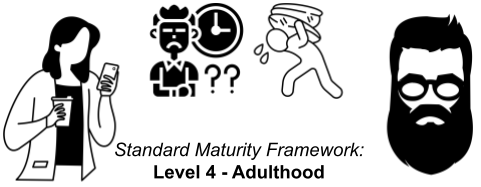
Adults run from about age seventeen until they are shuffling around in their bathrobe at 5pm (see cessation above). They work, pay taxes, volunteer to coach hockey, and are organizational stalwarts. They are not without their problems but generally, they are pretty useful.
These are the Business Processes you want! They arrive on time, do their job, are mostly willing to evolve and do things better, and are reliable. Treat them well and they will never leave…
… and then you need them to leave. They have the wrong skills, are intransigent, and too costly. In this way, they may be replaced with smart young whipper snapper Young-Adults who are hip to new technology, are more nimble, and can be paid less.
Older Adult Business Processes are not entirely a lost cause. They have learned a lot in their years of service and may also be the familiar face that customers want to talk to.
Proposed Definition of Adulthood (4)
Organizations have standardized, documented, and increasingly integrated Business Processes supported by governance structures, technology, and cross‑functional collaboration, enabling greater consistency and efficiency. The ability and capacity for continuous improvement exists but may not be effectively used or taken advantage of by the organization. As a result, some functions struggle to anticipate risks, maintain consistency, or adapt effectively under pressure.
Super Heroes (5)
And then there are the super-heroes with their extraordinary powers. These individuals have abilities one or more order of magnitudes greater than even the best Adult. Think Rain Man counting cards, or Peter Parker spinning webs.
The problem with Peter Parker was his self doubt and having to learn the hard way that “with great power comes great responsibility“. While Dustin Hoffman’s character flourished in a casino, he could not live on his own (and he read a lot of telephone books).
Peter Parker and Rain Man both need good support systems so their talents don’t go to waste or are used for evil purposes (or at least they are not kicked out of the casino).
Proposed Definition of Super Heros (5)
Business Process operate as fully integrated, data‑driven, continuously improving systems where strategy, processes, technology, and culture are seamlessly aligned. Advanced analytics, automation, and AI optimize decisions and workflows in real time, while enterprise‑wide governance and functions are proactive, predictive, and deeply embedded. The organization is agile, innovative, and consistently high‑performing, with empowered teams, mature controls, and a learning culture that adapts quickly to internal and external change.
DINK’s and No More Kids (0)
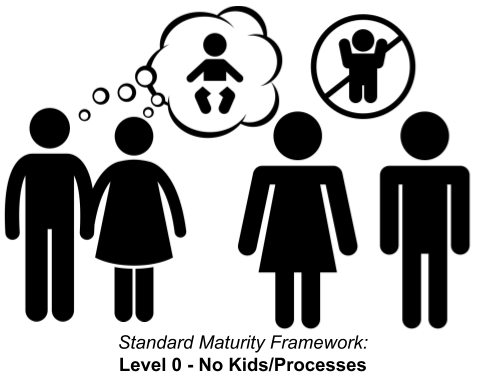
So far we have been looking at big or small humans as an analogs to an organization or Business Process. But what happens if there is nary a human or a process in sight? Some couples have chosen to be ‘double income, no kids’ or DINKS.
Other couples have long since launched their grown children and are living their own lives in a distant city (there is another set of circumstances in which a former parent has lost or abandoned their child. But let’s keep the model up beat and stick with empty nesters).
An organization may not be aware of the need or benefits of doing something. There may be awareness, but the organization has decided a particular activity is not for them. The same is for an organization who has a faint memory of a past process which has long since been abandoned. (e.g. typist pools or switchboards). These processes (and humans) have a maturity level of ‘0’ which means non-existent.
Proposed Definition of Super Hereos (5)
Business Process that have yet to emerge or have long since been abandoned. As such, they no longer actively contribute or impact the organization in any meaningful way.
A Level (Re)Progression
Just like humans, the Standard Maturity Levels are additive and typically sequential. You have to be a baby to get to the toddler stage let alone the shuffling elderly state. Like humans, Business Processes can jump up levels or regress to earlier states.
For example, if the supporting organizational structures such as governance and collaboration disappear, then a perfectly healthy Level 4 Adult Process may be reduced to a less mature state. Mergers, changes in culture/leadership, environmental factors, can cause such a regression. Regression in children exists but tends to be temporary except in pathological circumstances (e.g. as a result of trauma, disease, etc.).
One Level at a Time, No Skipping Levels
Humans don’t skip levels, we need time to mature and the maturation of one age to prepare ourselves for the demands of the next one. Technically it is possible through adoption, step children, and kidnapping (not recommended). For the most part, a human needs to work their way through the maturity steps and this is the reason it takes so long for a baby to become a functioning human.
A similar maturation process is at play for Business Processes. You need to put in the time to develop a corporate culture and infrastructure to support maturation. The Business Processes equivalent to adoption or mixed families are mergers, acquisitions, or a start up.
It Takes a Village to Raise a Level
Children need a community to grow into well-functioning adults. While there are documented cases of Feral Children, have a loving family is highly recommended. Business Processes might also spontaneous generate in a dysfunctional organization, but don’t hold your breath.
Conditions that make one Business Process successful (leadership, governance, etc.) are very seldom isolated to one organizational department or process. A culture of continuous improvement will permeate the organization or not exist, it is seldom siloed.
This village condition creates both virtuous and viscous cycles. An organization working hard on employee empowerment, quality, continuous improvement, etc. can have cross corporate gains. This is the virtuous cycle. A viscous cycle may have the best intentions. A poor financial quarter and massive cost cutting to temporarily ‘make the numbers’ can wipe out years of carefully cultivate corporate culture.
It takes a village to raise child or a Business Process, just make sure you pick the right village!
What Do You Think of My Kids?
What are your thoughts? Do the slightly humorous categories work for you? What about the definitions, are they both clear enough to be useful but also general to apply to any old business process?
Notes and References
- Einstein was a big fan of thought experiments so it must be a good idea, see: Thought Experiment | Wikipedia.
- This speaks to the underlying nature of this website, Organizational Biology. Humans can not help but bring biological constructs into their organizations because they are biological beings at heart. Perhaps Artificial Intelligence will move us more toward a mechanistic organizational structure – but hopefully not. See: https://www.merriam-webster.com/dictionary/mature
- A downside of everyone being immortal and the 2-bedroom apartment gets crowded after the fourth or fifth generation. See: BBC Wildlife | Immortal Animals.
 Organizational Biology
Pingback: Very Mature, gRBM! | Organizational Biology
Pingback: Stumbling into Maturity (Frameworks) | Organizational Biology