
Government services and their results are difficult to communicate. Government Results Based Management (gRBM) and a standard maturity framework might help. Eight maturity factors can be applied to government functions at varying levels through this model. Examples are provided to aid in the discussion of the model.
- How To Build a Maturity Framework
- RBM, Will You GROW UP!
- Maturity Rankings
- Ranking the Factors
- Mongol Hordes and Current Results
- A Spider’s Web of Growing Up
- Thought Exercises and Comments
- Notes and References
Government Results Based Management (gRBM) was introduced in a previous blog as a way to think about performance measurement. gRBM is a variation of RBM-classic which started international development arena.
For organizations like USAID [1] or the United Nations, focusing on results seems like a no brainer. But fast forward a few decades and international organizations as well as governments struggle to report on results for a variety of reasons. This post consider one such factor, the maturity of the government.
How To Build a Maturity Framework
How hard is it to build a Maturity Framework? Five levels, a few bullets per level and presto! Unfortunately, the literature has other ideas. This is what I discovered and resulted in the post: Stumbling into Maturity (Frameworks). Spoiler alert, maturity frameworks come in a variety of shapes, and focuses and have their own limitations.
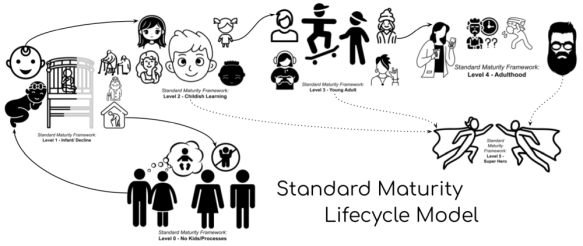
In theory, a standard maturity framework should be possible which was introduced in the post, Growing Up and Maturing (Levels). This is the one that I will use to evaluate gRBM.
RBM, Will You GROW UP!
The basis of a Maturity Framework is to know what makes something (im)mature. Generally a framework examines select aspects of an organization to assess its maturity. The gRBM will consider the following factors:
- Result-Openness (1.Openness). Does the government want others to know what the results are? Corruption, incompetence, indifference, need for secrecy, and other priorities may make the answer no.
- Result-Reception (2.Reception). What happens if no one is around to listen or cares? Reporting results is a bi-directional affair. If the citizens, stakeholders, and taxpayers are unable to or are unwilling to evaluate the result then an important feedback loop is lost.
- Result-Context-So What (3.So What). A result may be well received but it has to be useful, consumable, and contextualized to the audience. Why is it important, what is its impact, and how can the information be used?
- Result-Context-Landscape (4.Landscape). The second part of context is the result relative to local and larger environments. Is the result compliant with international reporting standards? Can it be combined (but not conflated) with other measures for the respective government?
- Results-Standards/Evolution (5.Standards). This is a ying-yang factor. On the one hand, standards ensure consistency and comparability. On the other hand, a standard must be based on a common denominator. What happens if your government structure or process is a round peg and the standard is a square hole? Standards change, so how effective and responsive is the change process in a government?
- Result-Processing (6.Processing). Building on the landscape factor, how well established is the result process? This has both an efficiency and effectiveness dimension.
- Result-Technology (7.Technology). An integral part of processing is the underlying technical infrastructure. Computer and communication systems are prime examples.
- Results-Governance & Operations (8.Gov-Ops). Pulling all of the above together is strong and engaged governance as well as good operations including management.
Maturity Rankings
One of the criticisms of RBM is that it quickly becomes obsolete. While the above factors are reasonably enduring, their measurement can have a very short shelf life. Still, you have to start somewhere. One a scale of 0 to 5, maturity definitions for the above factors. The maturity levels are:
- 0. DINK: Non-existent, actively suppressed or discouraged.
- 1. Infant: Results reporting is new to the organization or it is operated with minimal structure
- 2. Child: Results reporting is largely ad hoc, reactive, and inconsistent manner, with Business Process that are un/poorly documented and siloed.
- 3. Young Adult: Results basic, repeatable Business Process and emerging governance structures, but practices remain inconsistent, siloed, and heavily dependent on individual knowledge.
- 4. Adult: Standardized, documented, and increasingly integrated Business Processes supported by governance structures, technology, and cross‑functional collaboration, enabling greater consistency and efficiency.
- 5. Hero: Business Process operate as fully integrated, data‑driven, continuously improving systems where strategy, processes, technology, and culture are seamlessly aligned.
Ranking the Factors
The above six Maturity levels (0-6) and eight factors creates a matrix of 48 possible definitions. While it is possible to develop 48 definitions they would quickly get out of date, and be of limited relevance to an individual organization. Instead, select examples are given for level 0 and level 5 with some reasons why an organization might climb toward adulthood (level 4) or be stuck in the infantile state.
| Factor | Level 0 | Level 5 | comment/ Example |
|---|---|---|---|
| 1.Openness: Government is… | Indifferent or actively suppresses results | Results are pushed to information consumers as quickly as possible. | 0 = Military secret 5 = Immunization rates during a pandemic |
| 2.Reception: Audience(s) are…. | Unwilling or incapable of understanding results | Engaged and rely on results for private and public reasons | 0 = Cultural hostility toward the information 5 = Economic data |
| 3.So What: Result is… | Audience is aware of the result but incapable of using it | Audience has systems and knowledge to quickly assimilate information | 0 = Written in foreign language, wrong level, not timely 5 = Lottery results |
| 4.Landscape: Results … | Are unique due to the nature of the activity or choices made in their compilation. | Generated results are common, well known, and/ or agreed upon. | 0 = Vatican’s religious role 5 = Financial reporting compliance |
| 5.Standards used are… | Unique to the government and/ or there are no external standards or comparisons. | Internationally recognized. Government is a contributor or leader in the standards. Full compliance. Combined measures remain valid. | 0 = International standards are ignored. 5 = International Accounting Standards |
| 6.Processing capacity is … | Absent and the people/ institutions lack the skills, capital, or infrastructure to implement | Exists, mature, and is constantly being updated and improved. | 0 = An antiquated military 5 = Best in class eGovernment & and engaged public services |
| 7.Technology used is … | Manual with limited automation; hampered by technical literacy | Fully automated and integrated with robust security | 0 = A paper based tax process 5 = Automated tax processing regime |
| 8.Gov-Ops: Leadership & Management is: | Nonexistent, uninformed, and/ or hostile. | Fully invested, well informed, supportive | 0 = A dictator towards an independent judiciary 5 = Genghis Khan’s willingness to learn from conquered peoples. |
Mongol Hordes and Current Results
The above factors and maturity levels are time and context specific. For example, Genghis Khan was a master of seeking out people, processes, and technologies he could add to the Mongol-juggernaut. Initially his armies relied strictly cavalry and archers. A few decades later, they were using fast communication systems, siege weapons, gun powder, and had a navy. [2]
Fast forward a few centuries and these methods would be hopelessly out of date. In other words, a government might be a Level 5-Super Hero this year and quickly slip down levels in the following years. Consistency and continuous improvement are both critical.
A Spider’s Web of Growing Up
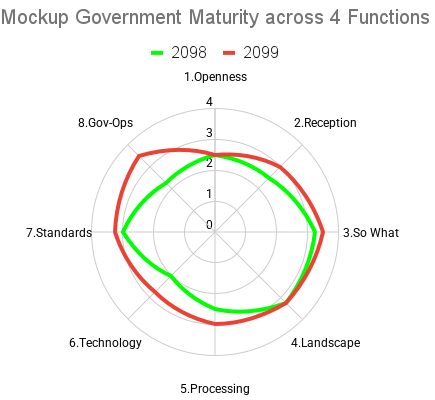
A spider’s web or radar graphic can be used to visually demonstrate the maturity state of a particular gRBM measure. Better still, by doing simple math, perhaps it is even possible to calculate and over all gRBM value for a government.
This graphic shows a fictional government’s all maturity levels across the eight Factors. Generally, the government is generally getting better (Red Line) although none of the factors are at the ‘4.Adult’ stage.
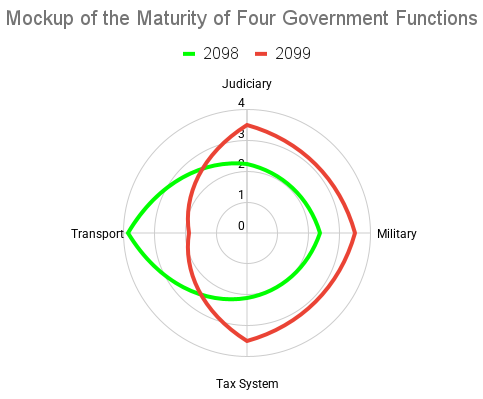
Using the same data, a government is rated on just four of its services or Functions: an efficient tax system, a defense force, an independent judiciary, and transportation infrastructure. These four are plucked from a previous post, What do Governments Do, Anyway?.
In this example, three of the four functions are improving in their overall maturity with Transportation declining on a year-over-year basis. In both of these graphics, the values are purposely dramatic to contrast (dis)improvement on a year over year basis.
Thought Exercises and Comments
This post concludes my private research into RBM and the introduction of the concept of gRBM. It has taken me down a Mature Rabbit hole and left me with additional ways to think about civil society.
For my purposes, I am satisfied (for the moment) with the research. What are your thoughts? Have I added original thought or just shuffled around old-stale concepts? As always, leave a comment!
Notes and References
- For the moment, I am setting aside and not commenting on the fact that USAID is shut down. Their leadership in developing RBM is still relevant to this post.
- For an excellent overview of the Mongols and this period of history, see: The Rise and Fall of the Second Largest Empire in History: How Genghis Khan’s Mongols Almost Conquered the World. 2010, by Thomas J. Craughwell.
 Organizational Biology
Pingback: Stumbling into Maturity (Frameworks) | Organizational Biology