Unknown's avatar

About Frank SAPAA

Webmaster and Board Member of SAPAA and born and raised Albertan. Love exploring Alberta particularly in the winter on snow shoes.

Kettle Valley: Chute Lake – What a Road!

This is the last of 3 blogs concerning my 2017 riding of the Kettle Valley. The good intentions were to hub and spoke out of Penticton and complete three rides: 1) Osoyoos North to Penticton; 2) Skaha Lake 3) Chute Lake to Penticton.

What Road!

The road up to Chute Lake was impressive. At times a 12% grade with numerous switch backs on a sandy gravel surface. It was challenging enough in dry weather I could only imagine the climb after a recent rain or snow fall.  Slick as snot comes to mind (to use a technical term).

The road deposits you at the Chute Lake Resort and the lake itself. The KVR passes the lake from a point further east and our original put-in, Myra Lake. Had we started from Myra, the distance would have been 80KM.  A bit out of reach for a first ride of the area so Chute Lake was a reasonable compromise.

Mileage Signs en route.

Sand Bogs and a Closed Tunnel

The first 5KM or so of the ride was mush. Mush in this context means sandy soil that quickly absorbed one’s tires and made it nearly impossible to ride. In some places a raised shoulder provided enough terra firma to allow for some speed but often this effort was absorbed with a return to the mushy middle of the trail. Lower air pressure likely could have compensated and I suspect a good fat bike tire would have glided over this section of trail with barely a whimper or note of the mush underneath.

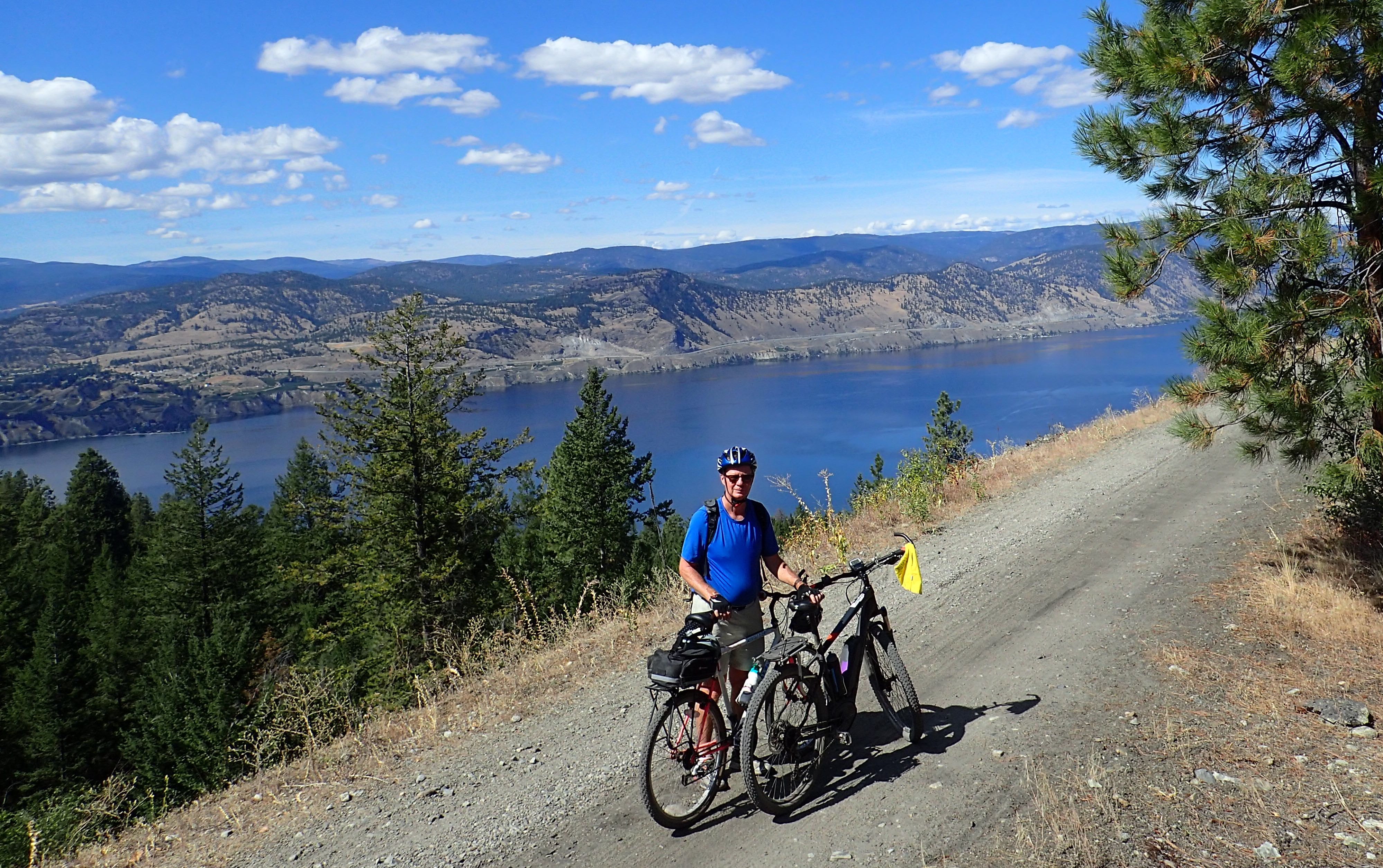
After this initial section, the trail began to harden to a more uniform gravel bed that was generally fine to ride on.  Given the altitude gained on the road up to the put-in, vistas were available aplenty. One portion of the trail that was closed was a U-shaped Adra tunnel.

Currently barricaded, the tunnel is about 500M long and takes a north/south orientated track to an east/west exit/entrance. Appeals for donations are made for the tunnel’s restoration which would be great. In the mean time a steep descent provides a cut off for the tunnel. A fun ride down, it would be a hard ride/push up! Coming from descent side of the tunnel, the temperature appreciably drops at 10C in the gloom of its entrance.

In front of the closed Adra tunnel.

Ride Into Penticton

From the tunnel, the ride is a gentle descent past numerous historical markers including a number of rock ovens used to bake bread during the KVR’s construction. Other markers include the foundation for a long-since dismantled water tower, a larger Ponderosa Pine and things of that ilk.

One of the great vistas with Summer Land across Okanagan Lake.

Conclusion

Our transport picked us up still high above Penticton. The trail however continues down into the city along the KVR route and as well along a city constructed trail. Finding the trail required a small bit of route finding as one section would end and the next would start-up to half a block away. A disappeared trail general meant a scan up and down the road to see where the city put the next piece.

Overall, this is a great section of trail. The ride from Myra Lake to Penticton is very doable on a good mountain/fat bike. Likely this would be an all day affair particularly with a car shuttle. Given the remoteness of the initial section, an available support vehicle would be a strongly desirable additional feature. In other words, Penticton KVR – I will be back!

Kettle Valley: Skaha Lake Loop – Ice Cream Detour

This is the second of a set of 3 blogs concerning my 2017 riding of the Kettle Valley. The good intentions were to hub and spoke out of Penticton and complete three rides: 1) Osoyoos North to Penticton; 2) Skaha Lake 3) Chute Lake to Penticton.

Skaha – Consolation Prize

Unfortunately my partner in riding had an unanticipated work commitment and the planned ride could not occur. Nevertheless, the ride we did was a perfect little putz with a too large ice cream in the middle.

Skaha Lake is just south of Penticton and like most of Okanagan lakes is narrow and long. Smaller than most lakes, it is 11.8km long and book ended by Penticton to the North and Okanagan Falls to the south. This ride took us from our motel at the north end of Skaha south along the west side of the lake to Okanagan Falls.

Although the trail was empty when I rode it the previously day, on this day there were about a dozen cyclists and walkers using the trail. The trail itself deposits you at the beach in Okanagan Falls and from this location the logical thing is to look for ice cream.

Vista Skaha Lake from the west side.

This is a Children’s Cone?

On the south side of the town is an ice cream institution, Tickleberries. A combination of ice cream gift and junk shop, they are known for their generous portions so I thought I would be smart by ordering a childrens cone. Apparently in the Okanagan, children are capable of eating two fist size scopes of ice cream! Either they are very tough or have a morbid obesity problem.

Return Along the East Side

Like most large lakes in British Columbia, there is a distinct East and West side (mostly because the mountain ranges generally in BC run North/South). Our return was along the East road and generally it was uneventful and occasionally pulled the user up into a mid-level vista of the lake. Good asphalt and a reasonable shoulder. We took a short detour back into Penticton to find a cold beer and then rode out to the hotel.

Conclusion

A nice albeit short ride of about 30km with moderate undulations in climbs and descents. Suitable for an older child reasonably comfortable on a bike. This could be a tune up and a first day ride if just arriving in the area. The one factor is the amount of fine grit and sand on the west side which tends to cover the bike and running gear. Like other trails in the KVR, a good chain cleaner is a must post ride!

One of the many historical and natural sites along the route.

Kettle Valley Osoyoos to Penticton – NOT

This is the first of a set of 3 blogs concerning my 2017 riding of the Kettle Valley. The good intentions were to hub and spoke out of Penticton and complete three rides: 1) Osoyoos North to Penticton; 2) Skaha Lake 3) Chute Lake to Penticton.

These rides were based on the trail guide: Cycling the Kettle Valley Railway, by Dan Langford.  Generally a well written and descriptive book, in this section alas it failed miserably.  Not to put too fine of a point on it but there is NOT a contiguous trail North from Osoyoos to Penticton.  The trail guide is not the only source that suggests that there is such a route, the provincial maps also clearly show such a trail.  Certainly poking around north Osoyoos failed to yield much evidence.  However, if you don’t mind a bit of highway riding and some flat and boring trails, you can get North to Penticton.

Note: this is a potential source of future reference, Trails BC.

North of the 49th

We started our ride at the border crossing just south of Osoyoos.  Still in Canadian territory, the ride went north along Highwya 97 to Osoyoos town limits.  From the park in the town, a trail winds it way North until private land and signs indicating no trespassing stop you at this point.  Apparently the land on which this spur of the railway was sold in the 1970’s and there is no longer a legitmate public access route.  As well, there is some hostility amongst landowners against a trail being created due to concerns of vandalism, etc.

Back to Highway 97

From the end of the trail, we re-climbed out of the valley to highway 97.  While the road is ‘okay’ (reasonable shoulder, moderate to heavy traffic), it certainly is not ideal. In the end we cut east again along Road 22.  Mentioned a few times, this road was also ‘okay’.  It had its share of undulations and the hill climbs gave a moderate cardio work out.  The alternative was to ride along the river/irrigation canal that runs from Skaha Lake to the North and Osoyoos Lake to the south.

Road 22 to Oliver

Road 22 eventually descends into the town of Oliver where we had a spot of lunch in the park.  From there, the trail along the river continues on until it intersects Highway 97.  Once again, the maps suggest that it continues west of the highway but we could find no sign of the trail.  Instead the route was along highway 97 to Okanagan Falls.  From here there is an excellent trail on the west side of Skaha lake that will take you into south Penticton.  Along this route I had the following black bear experience:

On a remote section a black bear Cub popped onto the trail. The problem with a bear club 100m ahead of you is where is it’s the mother. Fortunately she popped up beside the cub. She took a look at me and decided I was not worth the bother and ambled off to the other side of the trail with cub on tow. At this point, 15 seconds later I was glad I was uninteresting… Alas no photo but at least I got to tell the tale!

Conclusion

It might be interesting to go back and try to find a route from Osoyoos to Penticton… okay, not fantastically high on the priority list of trips to do in the time remaining here on earth, but if circumstandes allow for it, interesting nevertheless.

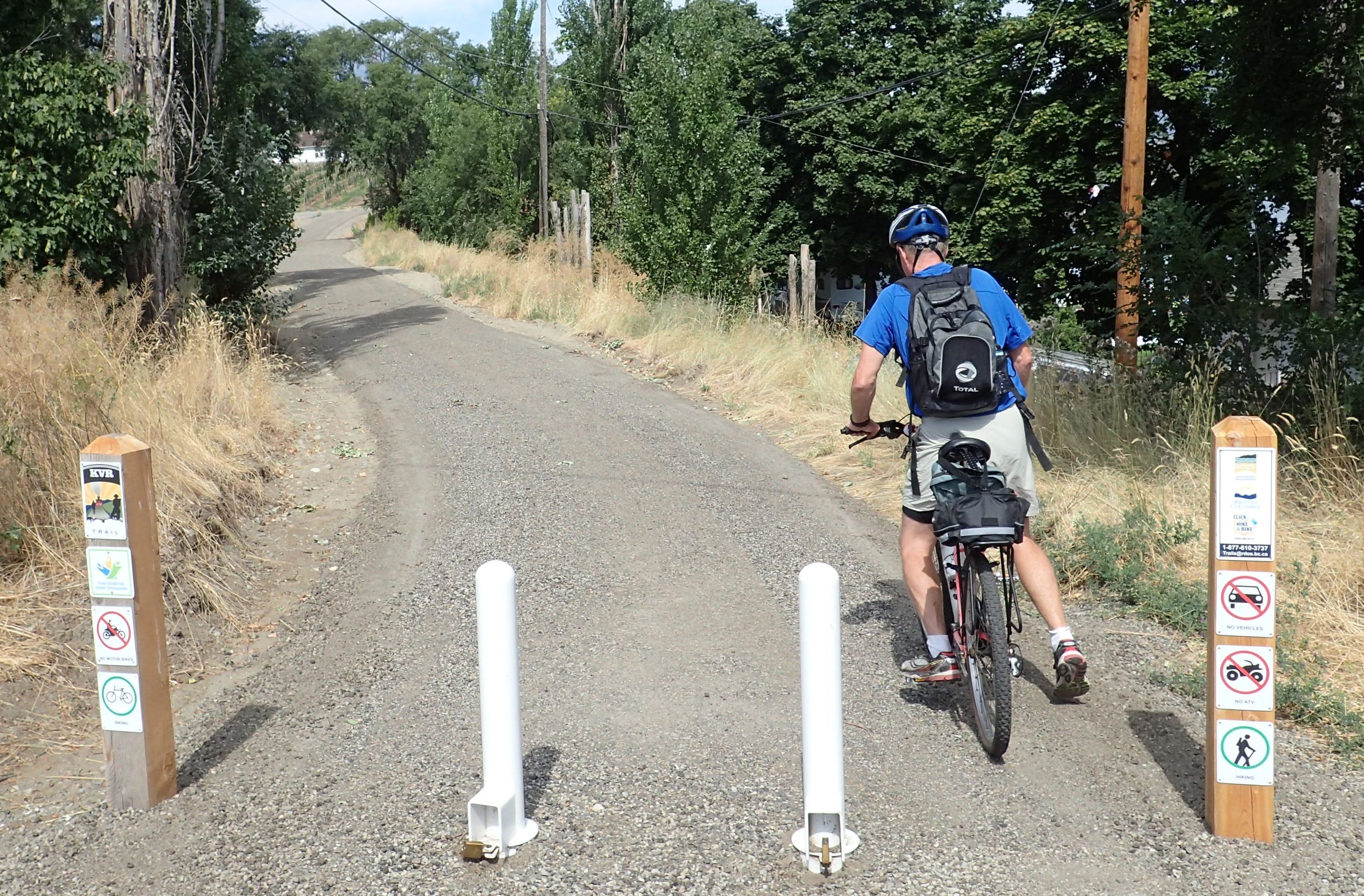
Starting on one of the intermittent sections of the Osoyoos to Penticton KVR.

Driving MS Daisy 2018

A Little Context Please

Canada has the highest rate of multiple sclerosis (MS) in the world, with an estimated 1 in 340 Canadians living with the disease. While it is most often diagnosed in young adults aged 15 to 40, younger children and older adults are also diagnosed with the disease (source, MS Society).  Each June the MS Society of Alberta and the NWT runs the Leduc to Camrose ride over two days and about 150km.

Year round bikes are a key transportation means.
Continue reading

Driving MS Daisy – Rough Notes

Don’t read this blog.  It is here really to provide me with some notes on an idea.  Better yet, read the next Bog – Driving MS Daisy 2018.

Does anyone have a circa 1995 crew cab pick up truck in good working order that I can borrow for the weekend of June 9 and 10, 2018?  Even better, can I keep it, write on it with indelible markers and then auction it off for a good cause?  Read on for what I am thinking.

A Little Context Please

Canada has the highest rate of multiple sclerosis (MS) in the world, with an estimated 1 in 340 Canadians living with the disease. While it is most often diagnosed in young adults aged 15 to 40, younger children and older adults are also diagnosed with the disease (source, MS Society).  Each June the Alberta Chapter runs the Leduc to Camrose ride over two days and about 150km.  This ride fits neatly into two of my interests, public service and cycling.

For a few years I have had the ability to sit on a tail gate and cheer on the riders (see my reflections, MS Ride 2017).  The challenge is that I put 435km on my personal vehicle while transporting folks in a Ford Ranger with a five speed stick.

The WIN-WIN of Driving MS Daisy

I have no problem making this donation to the bike club and the society but it is not something I would want to do on a more permanent basis.  Beyond insurance anxiety, I believe a borrowed or donated truck can contribute much more to the MS Society, the ride and cycling; these benefits break into:

  1. Raising Funds/Awareness for MS.
    1. Improve contributions and donations to the ride.
    2. Use the vehicle as a mechanism to deliver education about MS.
  2. Promotion for the Truck Owner.
    1. Loan/give me a truck and I will make it worthy your while… through promotion, etc.
  3. Mitigating Costs/Risks for the Truck Owner.
    1. There are inherent costs and risks with loaning out a vehicle.  Registration, insurance, cost of the vehicle, and operating costs (e.g. gas).
    2. The vehicle will travel about 400 – 500km over the weekend.  At the Canada Revenue Agency’s mileage allowance this a cost/value foregone of about $216 to $290.
  4. Details, Details, in order, the ideal vehicle is as follows:
    1. Properly Insured for the weekend use and registered.
    2. In good working order (e.g. the rescue vehicle will not need a rescue).
    3. Pick Up Truck
    4. Crew Cab
    5. As old as 1984 to 2003; this represents the range when MS is on average diagnosed (34 years old) or typical first onset (15 years old).
    6. White with a relatively recent paint job (see below for specifics for each scenario).
    7. Willingness to call the truck MS Daisy 2018 which represent a terrible pun on MS, the movie and the year the truck will be used in the ride.

How to Pick MS Daisy

Back to sitting on a tail gate, am looking for a donation of the use of a truck for June 8 -10, 2018 weekend to support the ride.  In my minds eye, this could take a few different forms:

  1. Use a Personal Vehicle
  2. Go and Rent a Truck.
  3. Borrow a Company Truck.
  4. Borrow a Car Dealer Truck.
  5. Have a Truck Donated and Then Auction It.

Use a Personal Vehicle

Assuming one has a truck, this is the easiest option but also the one with highest personal risk and costs.  Also it has limited opportunity to raise funds or cross promote the ride.  Ideally the owner of the vehicle has cleared the weekend with their insurance company.  Any insurance and operational costs could be reimbursed by the Society and the individual providing the vehicle may choose to donate-back these amounts to the society.  As for risks, particularly for an older vehicle, the owner or driver would need to hope for the best and have their car club card (e.g. AMA) handy.

Go and Rent a Truck

The society already rents vehicles for the ride and presumably adding one more would not cost too much more.  The rental agency may even be encouraged to donate the use of the vehicle and operating costs in exchange for promotion and acknowledgement.

The rental agency could even have its staff driving the vehicle to further promote the organization’s support of MS.  Unfortunately, with the number of charity events and the demands for similar donations from rental agencies, such a sponsorship arrangement can be a tough sell.  Whether a donation or a commercial transaction, this option virtually eliminates the risks of break down, availability and insurance coverage.

Borrow a Company Truck (including one from a Dealer!)

An extension of renting a truck but in this case it is one owned by a corporation who is willing to make it available for the weekend.  Borrowing the truck could be part of a larger sponsorship by an organization of the MS ride (e.g. in addition to their team).  A truck with company markings already provides some brand recognition although it may be lost to most people.  The company providing the vehicle would assure that it is in good working order, insured and of course registered.

Have a Truck Donated and Then Auction It

Picture this, you are on the MS ride and true to form it is raining, you are tired and there is BIG-FRIGGIN’ hill between you and the next rest stop.  This hill is about as high as Mount Everest, who builds roads up FRIGGIN’ Mount Everest.

As you stare at this hill that is growing by the minute in height, you cannot even remember why you signed up for this ^#@)!=& ride in the first place. Actually you know why, that cursed wife/husband, girl/boyfriend, co-worker, aunt/uncle, etc. talked you into it.  Who the hell cares about MS anyway, you just want to go home.

Giving Everest a Pass for MS

Just as you contemplate that divorce/break-up/new-job/family-estrangement, a white pick up truck pulls in front of you.  From it walks a friendly volunteer who talks you down from thoughts of murder/family-job-strife.  For example, the volunteer discusses how MS is episodic, there are great days and there are days just like this one that REALLY suck.  Like most diseases, it is easy to be over-whelmed and even lash out to those who care for you and are trying to help.  The volunteer suggests that you hop in the truck, take a pass on the Mount Everest’esque hill and get driven just a few kilometers to the rest stop.

At the rest stop the volunteer then asks you to do something strange, sign the truck.  With a larger marker, you write your name, perhaps including a small note.  You notice that you are not the first to sign the truck.  Hundreds of people who have been helped by the truck or who have helped create the truck inter-mingle on the hood, fenders and doors of this circa 1995 white truck.

It is then you understand why you signed up for the 2018 ^#@)!=& MS ride.  It is because some days, people with MS just need a small rescue and a bit of hope to get to their next rest stop and so they can carry on the next day.  Just then your wife/husband, girl/boyfriend, co-worker, aunt/uncle, etc. pulls into the rest stop.  All is forgiven… well until the next big FRIGGIN’ hill that is… but that is down the road.

Wanted an Old Truck Called Driving MS Daisy

On June 9 and 10, 2018 I would like to be that volunteer that helps both riders and possibly the a marriage or a relationship.  For the weekend it needs to be in a good running condition and reasonable shape.  Likely the MS Society will register and insure it and quite frankly when we are done with it, I would then like to auction it off and possibly start again for the 2019 MS ride with a circa 1996 white pick up truck.

I have really no idea if or how I am going to do this so let’s start with a vision of how it could be done.

1. Sponsors and Friends of MS Daisy

To start, this will be a community and collaborative affair.  I am looking for a variety of sponsors from getting the truck pro bono, repairing and restoring the truck, applying thank you-decals, driving it (possibly all over Western Canada), writing on it and finally auctioning it off to start fresh.

A Pro Bono Circa 1995 Truck

To start, I need a truck. Ideally I would like to find a circa 1995 white crewcab pick up truck.  Perhaps there is a car dealership or broker who has one sitting in their inventory or a great deal comes up on the wholesale auction.  In any case, the organization providing the truck would get primary sponsorship space on the truck itself.  For example, this may be a 1-2 foot square decal on 3-4 sides of the vehicle not mention the sponsor’s name in press releases, promotional material, etc.

Repair and Restoring the Old Girl

Circa 1995 vehicles typically are showing their age.  They have a bit of rust, need mechanical work and generally need to get back into shape.  There is a parallel here to MS in which a healthy lifestyle may prevent MS episodes or at least make the episode easier to weather.

In my ideal world, this work would be done by a technical college or even a high school as a class project.  Even better, a garage or auto body shop would sponsor and supervise the work restoring MS Daisy 2018.  While in the shop she would get a good basic engine overhaul, full mechanical inspection and repair (e.g. brakes, electrical system, suspension, etc.) and possibly new rubber.  Cosmetically she will get a paint job, ideally in flat matte white.  Why, because it easier to write on of course!

In addition to sponsorship decals, everyone who is involved in buying and restoring MS Daisy will get to sign her.  In this way, the MS Society can use MS Daisy as a symbol as how the disease touches the lives of Canadians.

Driving MS Daisy 2018

The intent is drive MS Daisy in the June 9/10 2018 Leduc to Camrose MS Ride.  In of itself this would be success.  However this is just one of a number of events held in Alberta and Western Canada for MS.  As a result, MS Daisy can be used in these other events in the same role – helping riders make it past that one seemingly insurmountable hill.

Beyond MS Events, the MS Society may also wish to loan the vehicle out to other events.  For example, MS Daisy can help with the Tour de l’Alberta, the Tour of Alberta or even other rides that meet the MS Society’s goals or that sponsor the society.

Whether on the Leduc to Camrose MS Ride, another MS Ride or on a partnership event, everyone who comes into contact with MS Daisy needs to sign her guest book. The fact that her guest book is her hood, front fenders and doors is part of what makes MS Daisy eccentric and a bit charming.  It also builds a tangible link between individuals, the vehicle and the MS brand.  In the day in age of instant celebrity and oblivion via social media, this gives those touched by MS Daisy and supporting her (sponsors, volunteers) a tangible touch point to a larger community cause.

Retiring MS Daisy

Every year MS will strike a new group of young people in Canada and every year a new MS Daisy should be found.  But what to do with the old one?  My suggestion is to make this a very public auction and invite everyone who signed MS Daisy to come and see her go to her new home.  To a certain extent, this is the final metaphor for the MS Daisy program.  By riding in the MS Ride, we want those who have the disease to go on with their lives in as normal of fashion as possible.

But what about 2019?  Ideally a new MS Daisy will be found and the above will start over again.  Perhaps as the program gains traction, there may even be a chance to have competition to be the technical college who works on MS Daisy or a bidding war to be the car dealership who found the best MS Daisy.

These are possibilities for the future, in the meantime, does anyone have a circa 1995 white pick up truck?  I would like to use it to help someone conquer an Everest’esque hill one June 9 and 10, 2018.

MS Ride 2017

On the weekend of June 10/11, 2017; I once again volunteered for the Multiple Sclerosis (MS) Society’s Leduc to Camrose ride.  I got involved in the ride primarily through my involvement with the a local bike club, EBTC.  I have done a few different things for the ride including pounding signs for a few years.  However, what I did this year is what I enjoy volunteering for the most – Marshaling the ride.

Continue reading

Teaching Gears to Be a Better Manager

In the Spring I run a weekly program called ‘Wheeleasy Wriders‘ which teaches newbie cyclists how to go from a painful 20KM ride to thinking that a 60KM ride is a breeze. Although this is a hobby, the techniques that I use are directly translatable into a work environment and the reverse as well – Wheeleasy Wriders makes me a better manager – last week is a good example.

How To Explain The Round Gizmos On a Bike

Many new riders are scared of their gears.  Although a marvel of engineering, they do require a small investment of time to learn how to use them properly.  But using gears effectively is not what this blog is about (however the blogs listed below DO talk about such things).  Last week I took a page out of my work environment and did the following:

  1. I broke the riders into groups of three composed of 2-newbies and 1-experienced rider.
  2. I separated married couples into different groups (more on this later).
  3. My request was that each newbie explain to the other newbie how their gears worked on their bike (as if the other explainee-newbie was going borrow the explainer’s bike).
  4. After a couple of minutes they switched roles and the explainer became the explainee.
  5. The experienced rider was there to listen and provide additional information, corrections and encouragement.

Teaching Focuses the Mind

The result was that most of the newbies self-assessed their gear knowledge higher after the explanation than before.  Why, for the following reasons:

  • They had to actively recall past explanations and externalize the content and concepts.
  • Based on the recall, they had to match the explanations to what they were seeing.
  • There was a small amount of anxiety to get the explanation right.  This anxiety actually helps to better form memories.
  • Anxiety notwithstanding, the experienced rider represented a safety net.
  • The experience rider had to compare their own mental-model of how gears work into two different newbie explanations.  This conversion strengthen their own understanding of the gears.
  • I separated the couples because people who know each other very well can have a harder time communicating.  They use codes, shortened forms of speech, etc. that takes away from the effort to externalize and codify a complex topic (such as how bike gears work).

Giving Training the Gears

I use similar teaching methods at work when I need to train people.  Rather than standing around in a parking lot explaining bike gears, at work this is done through webinars and conference calls.  One of my ‘rules’ is that I actively encourage cheating on my exams. Thus, other audience members are encouraged to help the ‘trainer’ out. Because the audience knows they be asked next to provide an explanation, there is better attention and retention for the content.  I have learned a few cautions/guidelines though:

  • Always Build Up: This is not about ridiculing or embarrassing the person. Before asking the question, be reasonably assured the person can answer the question or be guided to the answer. Only use this technique (or select the person) if the person can feel more positive about themselves after they have done the activity.
  • Be Ready to Move On … QUICKLY: You may discover that you asked a person who simply does not know or is getting flustered by the attention.  If so, quickly move on so that person is not social embarrassed.  Moving on could include: providing lots of clues, going to someone else or changing the subject.
  • Gentle Humour Lubricates: use gentle and positive humour to help the situation. Be careful that the humour is not caustic or ridicules the person. A bit of self-depreciation works for me.
  • Mix Up the Couples: mix and match people who don’t know each other well.  This forces different levels of communication effort.
  • Bit Size the Learning: if possible, focus on only one to two key concepts in each session.  More than this will overload the person and create too much anxiety.
  • Summarize, Crystallize and Repeat the Learning: be sure to repeat the 2-5 key messages from the learning so that the memories can quickly form around these kernels. Memory and learning works best when there are mnemonic devices or conceptual construct to hang the details on.

Good luck with your efforts to train and explain in your organization.  Also, if you want to learn more about riding or how to use your gears, be sure to read: