Accountants define an asset as: “…a resource controlled by the entity as a result of past events and from which future economic benefits are expected to flow to the entity.” [1]


Accountants define an asset as: “…a resource controlled by the entity as a result of past events and from which future economic benefits are expected to flow to the entity.” [1]
One of the challenges of teaching financial literacy is developing an assessment of where individual students and the entire class is at in regards to their knowledge and habits. The following self-assessment tool is a non-scientific method to perform this evaluation.

One definition of financial literacy is: “… having the knowledge, skills and confidence to make responsible financial decisions.” [1]

For the third year, I have been a member of Alberta Chartered Professional Accountants (CPA) achievement awards review committee.

For most people, we accumulate (or not) wealth slowly, year over year. We work, save, spend, borrow and then go back to work. For the (un)lucky few, wealth comes suddenly which can give rise to Sudden Wealth Syndrome (SWS).

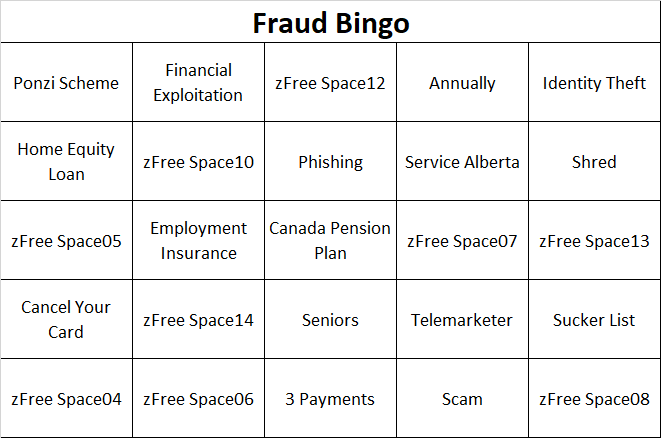
Central to most financial literacy programs is fraud awareness. How to keep the bad guys from getting your money, possessions or good name. Who Wants to be a Fraudster? is a variation of the classic bingo game in which participants match a term or concept to a fraud related question.
A core premise of adult learning is that the individual must have influence over the content of the instruction. In a workshop setting, this can be done by asking participants to rate both their knowledge of a topic and the relative importance a topic is to them relative to the time and attention available in the session.
Continue readingIt is sometimes necessary to divide a group up randomly. While the good ole’ fashion count-down-the-line works, it fails to give the resulting groups a starting point of their own identity.
Continue readingFull Disclaimer: I am not an expert on cycling. I have never raced, mountain biking seems like too much bother and I don’t ride in -40C. Nevertheless, I am passionate about cycling because it has allowed me to see things and meet people in contexts that generally promote conversations, beer drinking and long-term memories (okay, the last two sometimes clash). Before reading on, insert the standard caveats about checking with a physician before starting a physical exercise program. This blog is not intended to replace medical advice. Use at your discretion and always employ common sense.

I like to share this passion and I have run ride programs. One individual from a program asked the question about whether she bought the right bike and why she seems to be so slow. I responded in email but to help to thwart the eventual hardening of the brain cells (too much cycling and eventual beer drinking), I thought I would throw the advice out here to for public consumption. Feel free to weigh in (but please correct me gentle).
Riding with a club gives you a chance to see the super-duper triathlon types and the newbies who simply want to keep up. This advice is more for the newbie in which 40km seems daunting and 80km or more seems impossible. So, to keep up with the group you need to focus on three things: physical conditioning, equipment and technique.
Guess what triathletes, you have this one nailed! In the other corner are folks like me who discovered a winter bulge where one did not exist last fall (or at least I was better at ignoring it). To ride with a group, the better fitness level the better but most people who can walk for a few hours, climb moderate hills, etc. can do well on short to moderate (40-80km’ish) rides. So even if you have mystery winter bulges, carry on to the next two things.
To bicycle you need, well, a bicycle. Myself I tend toward the touring hybrid variety as I like to carry stuff in panniers (saddle bags), water bottles accessible while riding and fenders for my commuting bikes. Like anything in life, the more you spend, the better quality you get and the less you will experience in break downs, etc. A reasonable starting price for a new hybrid is about $500 and a good one can be had for the $750-1,000 mark. If you are now experiencing sticker shock, remember how much a golfer pays for a good set of clubs. As for where to buy, MEC is a good starting point or any local bike shops (a plug for my local shop, Crankys in St. Albert). My experience is avoid department stores, chains or anywhere where the mechanic looks like a high school student working part-time.
Alternatively buy a very good used bike. Pay a bit of premium by buying it through a reputable bike shop or a club sponsored bike swap, such as this one – bike swaps.
A word of caution though, bikes are like mushrooms, before you know it your one bike will soon be 2, 3 or more!
Buying the bike is only the beginning, maintaining it is even more important. Bikes are remarkable bits of machinery, they can be forgiving but when the fail – they generally do so as far from home as possible. As a result having some basic knowledge is critical. In particular you should know how to: change both tires (front and back), wash your bike, clean and lubricate a chain and do basic lubrication of the bike. Adjustments, bearings, etc. I leave to my friendly bike shop. If you are like my wife, you can also leave everything to your husband.
Where do you learn these skills, back to joining a club, taking part in a cycling 101 such as the one offered by the Edmonton Bicycle and Touring Club, Westend Wriders and talking to people who pretend they know things about cycling (like me!).
Okay, you are at least minimally fit and you spent your kids college funds on a new bike – now you can keep up, right? Maybe but probably not. Cyclists are generally a lazy lot who like to get places while spending as little energy of their own energy as possible (and looking dazzling in spandex). As a result, the following six techniques are critical.
Technique number one, cycling is about RPMS, not torque. You may have seen the big guy grinding his way up a hill while a petite young lady zips past him. If you have, you have seen the difference between revolutions per minute and torque. When riding, you want to ideally be spinning the pedals at the same cadence (revolutions per minute) and with the same effort (light, think of gently kicking a soccer ball to a 3-year old) whether you are on the flat, the up or the down hill. To do this, you must know how to use your gears so that your cadence and torque can remain consistent.
Technique number two – be kind to your delicate bits. Get a comfortable saddle, riding shorts and then take the time to let your more delicate parts get used to it. ‘Time in saddle’ is something you have to do each and every cycling season.
Technique number three – Learn to post. Post means getting up on the pedals and riding for a distance with your delicates hovering over the instrument of torture. Posting a few times an hour (or thereabouts) allows the blood to flow back to the pelvic floor and other nether-regions (not to be confused with the Netherlands).
Technique number four – pedal baskets or shoes. There is only one point of energy transfer between you and the bike – the pedal. The conventional pedal is a mediocre connection device as most of the force is only spent in the 1 to 5 o’clock position of the down stroke. With baskets, shoes, etc, the energy transfer is possible through the entire rotation. As a bonus, posting is alot easier with your feet attached to the pedals.
Technique number five – jettison weight. I have to admit, I have a hard time with this one as I like to carry tools, extra water, a snack, a second camera, clothing (well you get the idea). Unfortunately every gram of weight has to be paid for by your effort. If you can leave stuff (and winter-bulges) behind.
Technique number six – Hydration and Nutrition. Thanks to Joe who provided the advise below. My own rule of thumb is to only snack on rides (e.g. no big lunches) and lots of fluids. Joe’s advice is even more targeted:
Proper hydration and nutrition come into play long before you get thirsty or hungry. Start when you leave the parking lot and take a sip every 15 minutes, consider a quality sports drink or easily digestible carbs to conserve your glycogen. Do not eat at least 2 hours before the ride starts, since it takes that long to stabilize your blood sugar, otherwise the insulin will rob you of energy at the start.
Finally, like anything else, get out there and ride. Not only will it reduce your winter surprises, give you time in saddle – you will also get to meet interesting people, go places – and hopefully drink some beer.
Garet H, reminding me about the benefits of posting and Greg P. reminding me about my weight (errr, carrying weight) and Joe M. about hydration and nutrition.
Look for this in my Books Read section as well although I thought this book deserved a bit more of posting.
Title: The Social Animal, by David Brooks
A Recommended Read (out of 5, 5 being highest): 4
My thoughts: This book touches on my interest of the self-reinforcing roles of biological evolution versus social structures and how the two reinforce each other. Brooks accomplishes this through a fable of two individuals (Harold and Erica) who come from different worlds (within the American context). He proceeds to discuss all aspects of life including such things as why we marry (and should we), how we become happy (or not) the role of the rationale and unconscious mind.
A couple of great examples of how this fable story telling works includes the relationship of the newly arrived Harold and his mother and then the role of play and imagination in the development of children. To the first, some great quotes:
“Harold spent his nine months in the womb, growing and developing, and then one fine day, he was born. This wasn’t a particularly important event as far as his cognitive development was concerned, though he had a much better view.”
“Though he still had no awareness of himself as a separate person, little Harold had a repertoire of skills to get Julia (his mother) to fall in love with him.”
“Julia’s old personality battled back. You have to give her credit for that. She didn’t just surrender to this new creature without a struggle. … One night, about seven months into Harold’s life, Julia was in the chair with Harold at her breast…. if you could have read Julia’s mind at that moment, here’s what you would have found her saying: ‘F*ck!, F*ck!, F*ck!, Help me! … At this moment – tired, oppressed, violated – she hated the little bastard. He’d entered her mind with tricks of sweet seduction, and once inside, he’d stomped over everything with the infant equivalent of jack boots. … He was half Cupid, half storm trooper. The greedy *sshole wanted everything.”
About six years later, Harold’s father, Rob, tried to insert himself into a room full of boys as they were playing a fireman’s game:
“He (Rob) got the urge to join in (with the boys). He sat down with the boys, grabbed some figures, and joined Harold’s team. This was a big mistake. It was roughly equivalent of a normal human being grabbing a basketball and inviting himself to play a pickup game with the Los Angeles Lakers. Over the course of his adult life, Rob had trained his mind to excel at … ‘paradimgatic thinking.’ This mode of thought is structured by logic and analysis. … But the game Harold and his buddies were playing relied on … ‘narrative mode.’ … As their stories grew and evolved, it became clear what made sense and what didn’t make sense within the line of the story. … Rob was like a warthog in a frolic of gazelles. Their imagination danced while his plodded. They saw good and evil while he saw plastic and metal. After five minutes, their emotional intensity produced a dull ache in the back of his head. He was exhausted trying to keep up.”
A well recommended read to all who are interested in how the heck you got here, human/social interactions and generally a darn good story about two people (Harold and Erica) who you will end up rooting for. Generally I give away books after a read but this Brooks’ book will be a keeper.
From Chapters: With unequaled insight and brio, New York Times columnist David Brooks has long explored and explained the way we live. Now Brooks turns to the building blocks of human flourishing in a multilayered, profoundly illuminating work grounded in everyday life. This is the story of how success happens, told through the lives of one composite American couple, Harold and Erica. Drawing on a wealth of current research from numerous disciplines, Brooks takes Harold and Erica from infancy to old age, illustrating a fundamental new understanding of human nature along the way: The unconscious mind, it turns out, is not a dark, vestigial place, but a creative one, where most of the brain’s work gets done. This is the realm where character is formed and where our most important life decisions are made-the natural habitat of The Social Animal. Brooks reveals the deeply social aspect of our minds and exposes the bias in modern culture that overemphasizes rationalism, individualism, and IQ. He demolishes conventional definitions of success and looks toward a culture based on trust and humility. The Social Animal is a moving intellectual adventure, a story of achievement and a defense of progress. It is an essential book for our time-one that will have broad social impact and will change the way we see ourselves and the world.
 Organizational Biology