Kettle Valley Osoyoos to Penticton – NOT

This is the first of a set of 3 blogs concerning my 2017 riding of the Kettle Valley. The good intentions were to hub and spoke out of Penticton and complete three rides: 1) Osoyoos North to Penticton; 2) Skaha Lake 3) Chute Lake to Penticton.

These rides were based on the trail guide: Cycling the Kettle Valley Railway, by Dan Langford.  Generally a well written and descriptive book, in this section alas it failed miserably.  Not to put too fine of a point on it but there is NOT a contiguous trail North from Osoyoos to Penticton.  The trail guide is not the only source that suggests that there is such a route, the provincial maps also clearly show such a trail.  Certainly poking around north Osoyoos failed to yield much evidence.  However, if you don’t mind a bit of highway riding and some flat and boring trails, you can get North to Penticton.

Note: this is a potential source of future reference, Trails BC.

North of the 49th

We started our ride at the border crossing just south of Osoyoos.  Still in Canadian territory, the ride went north along Highwya 97 to Osoyoos town limits.  From the park in the town, a trail winds it way North until private land and signs indicating no trespassing stop you at this point.  Apparently the land on which this spur of the railway was sold in the 1970’s and there is no longer a legitmate public access route.  As well, there is some hostility amongst landowners against a trail being created due to concerns of vandalism, etc.

Back to Highway 97

From the end of the trail, we re-climbed out of the valley to highway 97.  While the road is ‘okay’ (reasonable shoulder, moderate to heavy traffic), it certainly is not ideal. In the end we cut east again along Road 22.  Mentioned a few times, this road was also ‘okay’.  It had its share of undulations and the hill climbs gave a moderate cardio work out.  The alternative was to ride along the river/irrigation canal that runs from Skaha Lake to the North and Osoyoos Lake to the south.

Road 22 to Oliver

Road 22 eventually descends into the town of Oliver where we had a spot of lunch in the park.  From there, the trail along the river continues on until it intersects Highway 97.  Once again, the maps suggest that it continues west of the highway but we could find no sign of the trail.  Instead the route was along highway 97 to Okanagan Falls.  From here there is an excellent trail on the west side of Skaha lake that will take you into south Penticton.  Along this route I had the following black bear experience:

On a remote section a black bear Cub popped onto the trail. The problem with a bear club 100m ahead of you is where is it’s the mother. Fortunately she popped up beside the cub. She took a look at me and decided I was not worth the bother and ambled off to the other side of the trail with cub on tow. At this point, 15 seconds later I was glad I was uninteresting… Alas no photo but at least I got to tell the tale!

Conclusion

It might be interesting to go back and try to find a route from Osoyoos to Penticton… okay, not fantastically high on the priority list of trips to do in the time remaining here on earth, but if circumstandes allow for it, interesting nevertheless.

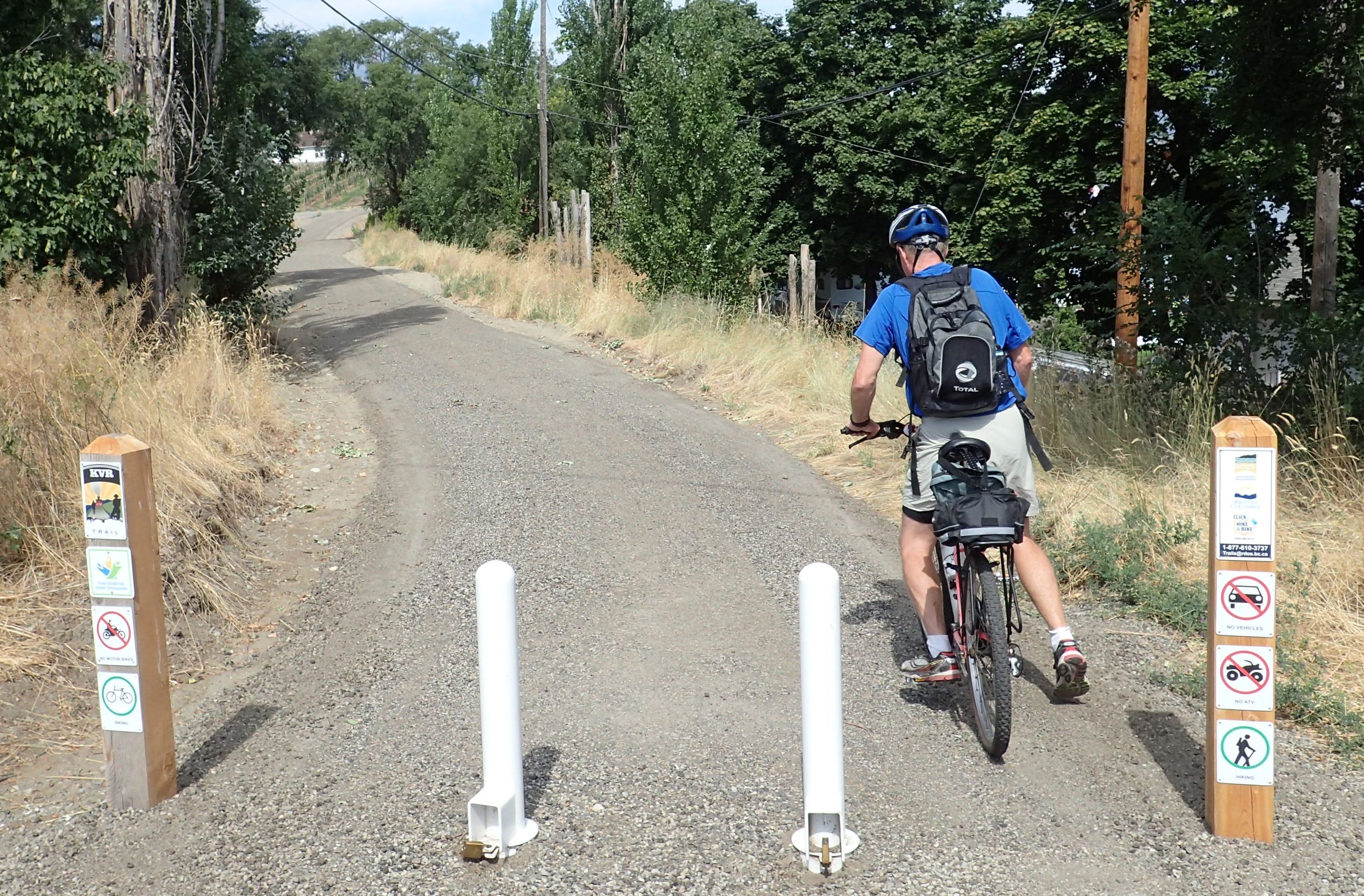
Starting on one of the intermittent sections of the Osoyoos to Penticton KVR.

Driving MS Daisy 2018

A Little Context Please

Canada has the highest rate of multiple sclerosis (MS) in the world, with an estimated 1 in 340 Canadians living with the disease. While it is most often diagnosed in young adults aged 15 to 40, younger children and older adults are also diagnosed with the disease (source, MS Society).  Each June the MS Society of Alberta and the NWT runs the Leduc to Camrose ride over two days and about 150km.

Year round bikes are a key transportation means.
Continue reading

MS Ride 2017

On the weekend of June 10/11, 2017; I once again volunteered for the Multiple Sclerosis (MS) Society’s Leduc to Camrose ride.  I got involved in the ride primarily through my involvement with the a local bike club, EBTC.  I have done a few different things for the ride including pounding signs for a few years.  However, what I did this year is what I enjoy volunteering for the most – Marshaling the ride.

Continue reading

Teaching Gears to Be a Better Manager

In the Spring I run a weekly program called ‘Wheeleasy Wriders‘ which teaches newbie cyclists how to go from a painful 20KM ride to thinking that a 60KM ride is a breeze. Although this is a hobby, the techniques that I use are directly translatable into a work environment and the reverse as well – Wheeleasy Wriders makes me a better manager – last week is a good example.

How To Explain The Round Gizmos On a Bike

Many new riders are scared of their gears.  Although a marvel of engineering, they do require a small investment of time to learn how to use them properly.  But using gears effectively is not what this blog is about (however the blogs listed below DO talk about such things).  Last week I took a page out of my work environment and did the following:

  1. I broke the riders into groups of three composed of 2-newbies and 1-experienced rider.
  2. I separated married couples into different groups (more on this later).
  3. My request was that each newbie explain to the other newbie how their gears worked on their bike (as if the other explainee-newbie was going borrow the explainer’s bike).
  4. After a couple of minutes they switched roles and the explainer became the explainee.
  5. The experienced rider was there to listen and provide additional information, corrections and encouragement.

Teaching Focuses the Mind

The result was that most of the newbies self-assessed their gear knowledge higher after the explanation than before.  Why, for the following reasons:

  • They had to actively recall past explanations and externalize the content and concepts.
  • Based on the recall, they had to match the explanations to what they were seeing.
  • There was a small amount of anxiety to get the explanation right.  This anxiety actually helps to better form memories.
  • Anxiety notwithstanding, the experienced rider represented a safety net.
  • The experience rider had to compare their own mental-model of how gears work into two different newbie explanations.  This conversion strengthen their own understanding of the gears.
  • I separated the couples because people who know each other very well can have a harder time communicating.  They use codes, shortened forms of speech, etc. that takes away from the effort to externalize and codify a complex topic (such as how bike gears work).

Giving Training the Gears

I use similar teaching methods at work when I need to train people.  Rather than standing around in a parking lot explaining bike gears, at work this is done through webinars and conference calls.  One of my ‘rules’ is that I actively encourage cheating on my exams. Thus, other audience members are encouraged to help the ‘trainer’ out. Because the audience knows they be asked next to provide an explanation, there is better attention and retention for the content.  I have learned a few cautions/guidelines though:

  • Always Build Up: This is not about ridiculing or embarrassing the person. Before asking the question, be reasonably assured the person can answer the question or be guided to the answer. Only use this technique (or select the person) if the person can feel more positive about themselves after they have done the activity.
  • Be Ready to Move On … QUICKLY: You may discover that you asked a person who simply does not know or is getting flustered by the attention.  If so, quickly move on so that person is not social embarrassed.  Moving on could include: providing lots of clues, going to someone else or changing the subject.
  • Gentle Humour Lubricates: use gentle and positive humour to help the situation. Be careful that the humour is not caustic or ridicules the person. A bit of self-depreciation works for me.
  • Mix Up the Couples: mix and match people who don’t know each other well.  This forces different levels of communication effort.
  • Bit Size the Learning: if possible, focus on only one to two key concepts in each session.  More than this will overload the person and create too much anxiety.
  • Summarize, Crystallize and Repeat the Learning: be sure to repeat the 2-5 key messages from the learning so that the memories can quickly form around these kernels. Memory and learning works best when there are mnemonic devices or conceptual construct to hang the details on.

Good luck with your efforts to train and explain in your organization.  Also, if you want to learn more about riding or how to use your gears, be sure to read:


EBTC Volunteer of the Year

The author reflects on receiving the Edmonton Bicycle and Touring Club’s Volunteer of the Year award for 2016, appreciating the club’s low-drama environment and effective volunteer engagement through purpose, affiliation, and experience. They emphasize the importance of hope in cycling, while suggesting potential improvements to attract diverse community members.

Continue reading

Cycling on a Grade – Part I of II

Describing cycling ride difficulty poses challenges due to the need to assess individual abilities and bike conditions. Current grading rubrics cater primarily to experienced cyclists. To address this, a Cycling Grading chart inspired by skiing is proposed, categorizing rides by distance, speed, duration, and elevation, enhancing clarity for new cyclists.

Continue reading

We Don’t Need No Stinkin’ Gears

This week I ran a cycling program for my bike club called: “We Don’t Need No Stinkin’ Gears“.  I have talked about gears and cycling for a number of years but this is the first time I pulled together a program that dealt with the topic en masse.

Audience and Do we Need Another Post?

A quick Google search indicates more than 500,000 hits on this topic – so why another post?  Firstly as a reminder for me when I do this instruction in person.  Secondly because the audience for this post is the person who is keen to learn but is trailing behind in a 20KM ride and the thought of riding 50KM seems absolutely daunting.

As always, if you have improvements (e.g. Phrank has no idea what he is talking about, don’t listen to him), comment away!  As well, take a read of the 500,000 or so other resources on the internet; including some of the better ones I stumbled across, see the conclusion section below.

The Big Gear is Connected to the Little Gear

Bikes typically have two sets of gears: front and back.  The front one is called the crank or the chain rings and the rear one is the cassette.  The numbers of gears vary: 2-3 front rings 5-9 cassette rings are common.  Looked at on angle, both sets of gears look like a cone with the top loped off.  The front one has more lopping and a wider base and the rear one less so on both accounts.

The little gear on the crank is the first gear or number 1 with the reverse for the cassette.  From there the numbers ascend until you run out of gears to count (e.g. 3 on the crank and 9 on the cassette).  The chain connects the front and the back and transmits the power.

You Can Count on Your Gears

If you look at a bike, the first gear in the front, the small one, is closer to the bike.  From there the second and third are further away from the bike.  Just like in a car, a first gear is good for climbing hills.  Similarly, the first gear on the rear is also number 1 and it is also good for climbing hills.

Here is the tricky bit, watch carefully….

If you look at the rear cassette the cone is reversed or inverted from the front.  That is the big gear is close to the rim and the small (first) gear is furthest away from the bike.  This gives the bike its mechanical advantage.  For example, if you divide the number of teeth of the front gear by the number in the back you get a ratio of roughly how many fully pedal strokes it takes to turn the rear cassette once.  The following graphic does a better job of showing this ratio.  Assuming this configuration exists, for every turn of the front crank, the rear hub would turn somewhere between 0.8 and 4.0 times.

Mecahnical Advantage of a 3 ring crank X a 9 ring cassette.

mechanical Advantage of a 3 ring crank X a 9 ring cassette.  This gear configuration is for illustrative purposes only, your gear ratios will likely vary from the above.

The Missing Gears

The good news is that you paid extra for that 27 speed bike… the bad news, using all 27 is inadvisable.  Chains like to run in rings that are mostly parallel to each other.  They can handle a bit of an angle but not too much.  A cross geared bike will not only wear faster but is more susceptible for the chain jumping from one ring to another.  This is why it is important to get used to shifting through both the front and rear gears – so you can maximize the 27 gear POTENTIAL of your bike.
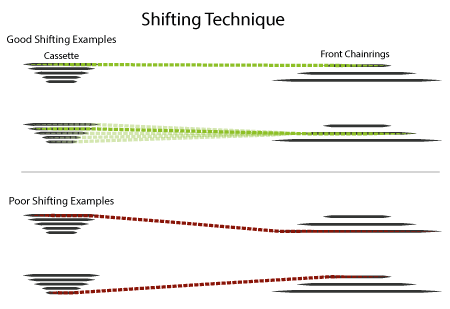
Proper and Cross Chain gearing. Image courtesy of REI.com.

Proper and Cross Chain gearing. Image courtesy of REI.com.

Cadence, Torque and a Little Downstroke will Do Ya

In an early blog, The Art of Riding Bikes, there is a discussion of the importance of cadence over torque.  Torque is the big strong guy grinding up the hill.  Cadence is the 90lbs lady passing him on the hill pedalling in a seemingly effortless manner.

You do need to apply torque to the pedal, some force is needed.  The analogy I use is: ‘apply as much force to the pedal as you would to a soccer ball being kicked to a two-year-old’.  Now, unless you like kicking balls hard at small children, this means a relatively light amount of effort.

Because the effort is less, something needs to compensate to provide power to the bike – this is where cadence and gears come in.  Try to keep your cycle strokes the same with a consistent force allowing the gears to compensate for the terrain or wind.  How many strokes?  Aim for anything between about 70-120 per minute with an ideal of about 90.  Your legs will tell you if you have too many revolutions per minute or if you can add a few more to the mix.

Put the Peddle to the … Little Metal Thing on your Cycling Shoe

The peddles are how we convert the up and down motion of your legs to the circular motion of the gears.  What is the best pedal to use, the answer is one you are comfortable with.  Before you stick to the tried and true flat pedal (available on kids bikes everywhere), to think about and consider adding toe clips, baskets or cycling cleats to your pedal ensemble.  They will help you transmit more energy with very little or no additional effort on your part.

At this point in the discussion I usually get dubious looks about attaching a bike to the bottom of one’s shoe.  To start, you will probably fall over due to unclipping at least once (ish) and it will take practice.  Some very good riders I know have forsaken the clip and they do fine.  A basket or cleat will take you further but you have to comfortable and trusting in the relationship.

A Shift in Cycling Style

Putting all of the above together takes practice.  Shifting needs to become simple muscle memory that you no longer think about.  To do this you need to get on the bike and start riding and shifting through the gears – both the front and the rear.  On a flat stretch, consciously practice working from the first gear front/back to the highest gears (e.g. 3/9) in the rear.

By becoming comfortable with shifting you can then better anticipate and be shifting up or down an instant or two before you need to.  By doing so, you can maintain that constant cadence and torque discussed above which in turns allows you to cycle for longer time periods and thus distances.

Alas you will run out of gears on some future hill that is a bit too steep.  At this point you have one of three choices.  Firstly get off and walk.  Due to a missed gear, a steep hill or other reasons (my dog ate my homework and so I had to walk my bike); sometimes the walk is the best answer.

Your second option is to traverse the hill.  Assuming the path way is wide enough, cut an angle back and forth across the hill rather than straight up it.  This will add some distance but cut down the angle of attack.

Send Your Nether-regions a Post

The final hill climbing technique is the post.  This is where you stand in the pedals and lift your tender bits off of the seat.  As an added bonus, the method also allows for blood to return to the pelvic floor thus reducing the discomfort of a allow a saddle to come in contact with your No-Sunshine Zones.  Posting is a short-term solution as you are switching from low-torque-high-cadence model to a high-torque-low-torque model.

Conclusion, Further Reading and Good Links

Once again, this post is meant to be used as a memory jog for me and a learning aid for the people I am standing in front of.  If you want to learn more, the internet has a plethora of material including posts that are a lot more technically accurate than the above (including strange algebraic symbols).

See you on the road!

REI

I ripped off their graphic so the least I can do is point out an excellent article on their website: https://www.rei.com/learn/expert-advice/bike-gears-and-shifting.html

Coach Levi

Very good article cover many of the same topics as in the blog:
http://coachlevi.com/cycling/complete-beginner-guide-to-bicycle-gears-shifting/

Wikipedia

When in doubt, what have the wiki’ites to say about the topic:
https://en.wikipedia.org/wiki/Bicycle_gearing

Still More Links!

Bike Gears: How Do They Work?

http://www.cyclingweekly.co.uk/news/product-news/using-bikes-gears-efficiently-148101

Gearing 101 Tutorial: A bit technical and much more detail then the above.  http://www.cyclingsite.com/lists_articles/gearing_101.htm