Ian Morris’ “War! What Is It Good For?” tackles the complex relationship between war and societal development. He contrasts Hobbes and Rousseau’s views, asserting that war fosters larger, more organized societies that ultimately reduce violence. While acknowledging the human costs of conflict, Morris argues that understanding war’s historical role is vital for future peace.
Continue readingCategory Archives: History
This Read is Garbage (and that is good)
Some thoughts on a book that was garbage – and why that is a good thing. Garbage Land: On the Secret Trail of Trash by Elizabeth Royte, Jennifer Aquino, et al. [1]. An excellent survey of the world of trash and the disposal of other unmentionables.

This blog is part of my ongoing effort to remember what I have read. I have tried to write it for your enjoyment, but its primary purpose is, better recall of this worthwhile book.
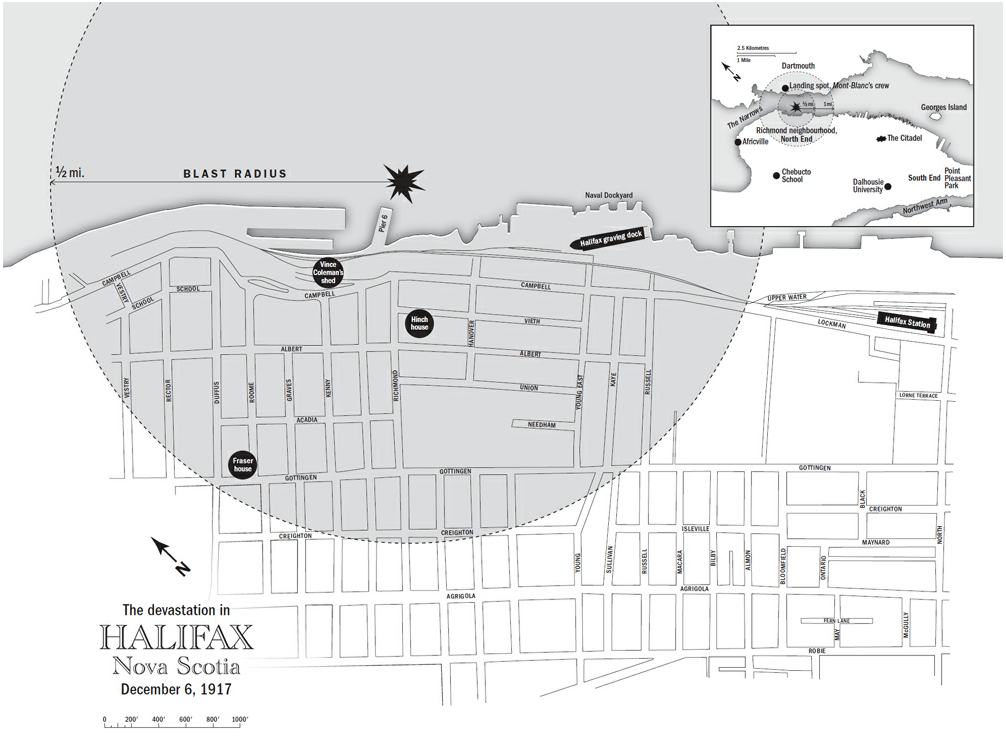
Continue readingThe Halifax Explosion
In my ongoing efforts to remember what I have read, some notes on the book, The Halifax Explosion by Ken Cuthbertson.

Smallwood – Big Read
Most Canadians know who Joey Smallwood is, the first premier of Newfoundland and Labrador. Richard Gwyn, one of Canada’s pre-eminent popular historians, book on Smallwood lists his triumphs and his failures. Gwyn’ makes you wish you had known Smallwood and realize that characters such that can no longer exist in your hyper-connected world.
SMALLWOOD: THE UNLIKELY REVOLUTIONARY by Richard Gwyn, February 17, 2015
A Practical Socialist and Politician
Smallwood called himself a socialist and spent much of his early years on one failed social project or another in Newfoundland and a brief stint in New York city. By his middle age, and after the Second World War, he seemed to have missed his chance to make his mark in the world despite having hosted a widely popular Newfoundland based radio program.
However, timing is everything, and just after the war Newfoundland was given an opportunity to regain its ability to self-govern or join Canada (joining the United States was another possibility but lacked a champion). In this campaign, Joseph Smallwood became Joey a likable buffoon with cat-like political instincts.
Needless to say Joey won the referendum (the second one actually) and Newfoundland joined Canada. He then went onto to become one of Canada’s longest-serving premiers until his election loss in 1972 (23 years in office). More than just a provincial politician, Joey played key roles in the Canadian Federal Liberal scene and was an intimate of St. Laurent, Pearson and Trudeau.
Impractical Schemes, Graft and Churchill Falls
Smallwood was a man of his times and Gwyn paints a sympathetic albeit tragic portrait of the man. Newfoundland had a small war chest on joining Canada and Joey proceeded to use the money in (mostly) misguided attempts to industrialize the province. While there were some successes in iron ore mining and paper mills, most would now be considered busts including his crown jewel – the Churchill Falls Hydroelectric station.
In addition, some of the associates and government ministers re-directed government resources for their own benefit. Despite this temptation and Joey looking the other way, Smallwood did not enrich himself during his time in office – but others did. These others are part of a cast of characters that Smallwood associated with in order to achieve his objective of industrialization.
A Book 3-Decades in the Writing
This book was initially published in 1968 just as Smallwood had announced his (first) retirement and then was updated 1972 after he retired for a second (and last) time after his election loss. Gwyn re-issued it twice in 1999 (8 years after Smallwood’s death) and most recently in 2015. In many ways reading a book written and revised over 3-Decades is almost as interesting as the core subject matter. Gwyn does not fully update the text but does tease out some individuals for special mention who went on to greater things such as John Crosbie or Rex Murphy.
In the end, a good read about an interesting character, a period in Canada of significant change and our newest and most easterly province – Newfoundland.
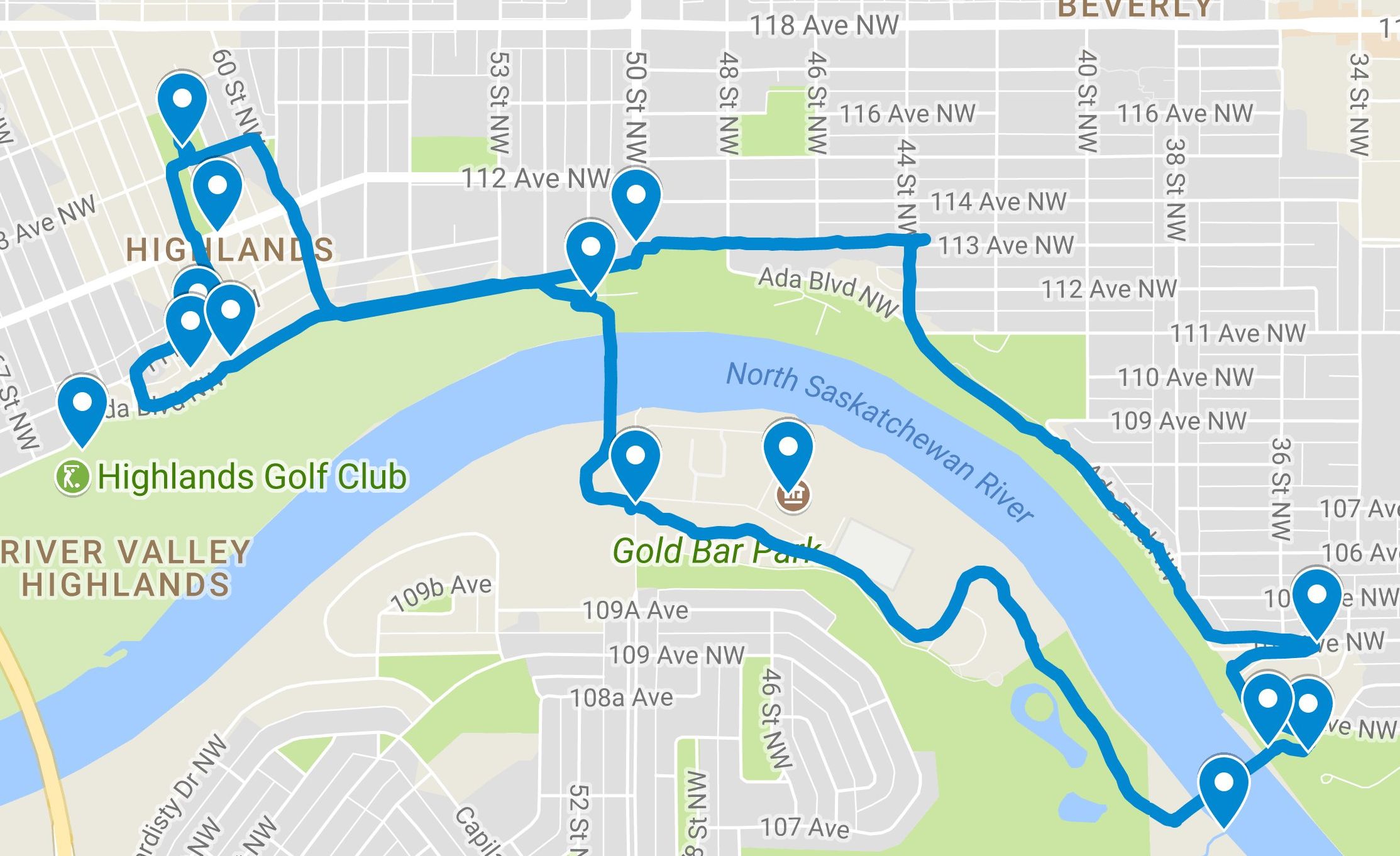
2017-12-03 EBTC Highlands-Beverly Walking Tour
These are some notes from a December 3, 2017 historical walk I did for the Edmonton Bicycle and Touring Club. This was a combination of a stroll, historical and social notes. See my sources below if you want to read more.
Context: The Area pre-1914
- The area was annexed by Edmonton in 1912, and “was named in a contest offering a 50-dollar Gold Bar.” [1]
- The neighbourhood is bounded on the north by 118 (Alberta) Avenue, on the east by 50 Street, on the west by 67 Street, and on the south by the North Saskatchewan River valley. [2]
- The community is represented by the Highlands Community League, established in 1921. [2]
The Walk
- 01) Start: Highlands Community Centre, 6112-113 Avenue, Edmonton.
- What was the area like at different epochs: 10,000 years ago, pre-Hudson Bay Company, HBC era and then in 1900.
- 02) South to 112 Avenue; be careful crossing 112th street, look both ways for street cars… the last one ran in 1951 but they could start-up any time! [3] The end of the line was at 112 Avenue x 61 Street [4].
- The development of the area was predicated on a street trolley being built.
- 03) Walk to 6229 111 Ave NW; the Carriage House; this is where they stored the carriages! [1, pp. 267-269].
- 04) Walk to 6240 Ada Blvd; this is the mansion for Magrath, one of the two developers [1, pp. 257-259].
- Lived with his wife Ada… notice a connection?
- And their son Adrian.
- 05) Walk to 6210 Ada Blvd NW, Holgate Mansion [1, pp. 259-260].
- Walk along Ada Blvd East towards 50th Street.
- 06) 50th Street, start of the Beverly Heights Neighbourhood.
- Originally part of the Town of Beverly, amalgamated with Edmonton 1961. [5]
- Edmonton assumed the town’s debt of $4.16 million debt ($34.0 million today).[6]
- The neighbourhood is bounded on the south by the North Saskatchewan River valley, on the north by 118 Avenue, on the west by 50 Street, and on the east by 34 Street and 36 Street. [5]
- Beverly incorporated as a village on March 22, 1913 and became the Town of Beverly on July 13, 1914. [6]
- Beverly was a coal mining community that overlooked the North Saskatchewan River valley. During the first half of the twentieth century, more than 20 coal mines were active in and around the town. The larger mines provided much of the town’s employment. [6]
- In 1907, construction began on the Clover Bar Bridge. The Grand Trunk Pacific Railway (GTPR) built its own bridge as it could not use the CPR High Level. [6]
- The GTPR became the biggest shipper of coal in Alberta, with much of the coal mined in and around Beverly. [6]
- The Great Depression hit Beverly particularly hard. In 1936, the town defaulted on its debt. [6]
- A provincial administrator to manage the town from 1937 to 1948.
- 07) Take Trail to the River
- 08) Look downstream to the beautiful Rundle Park [7].
- Named for an early Methodist missionary.
- This was the site of the Beverly Dump.
- As the community grew post amalgamation, there were calls to close the dump to reduce the smell, salvage men and the bears that inhabited the site.
- Futuristic plans were drawn up… a more modest park was built-in its place in the mid-1970’s.
- Rundle Park: With an area of 117.68 ha, the park was named for Rev. Robert Rundle. He was the first Protestant missionary to serve at Fort Edmonton and in fact the first permanent missionary of any church to settle west of Manitoba. In 1840 he came to Rupert’s Land at the request of the Hudson Bay. [12]
- 09) The bridge to cross to the South Side of the river is named for Ainsworth Dyer, one of 4 Canadians killed in a friendly fire incident in Afghanistan [8].
- 10) As you cross the bridge look for Gold Bar stream coming into the river. Early miners panned for gold in the gravel bars here. [9. p.13]
- 11) The Gold Bar Waste Water plant [10, p.6]
- Open in 1956.
- Waste water is sent to the refineries where it reduces their water needs.
- 12) Take a moment to look north along 50th Street – yup no bridge yet. [6]
- Promised a new bridge for vehicular traffic across the North Saskatchewan River at 50 Street, residents of Beverly cast ballots in a referendum regarding amalgamation with Edmonton in which 62% voted in favour. The 50th Street bridge has yet to materialize.
- 13) Highlands Golf Course [1, pp.254-255] and [11]
- Built in 1929 surrounding the Premier Coal Mine.
- The original lease started in 1929 for a 21-year term with a 20-year option to renew (1970).
- The current lease is for 50 years starting in 1989 with a 10 year extension.
- occasional sink holes from the coal mine cause some trouble for the course.
- The Capilano Freeway (now Wayne Gretzky Drive) impacted the golf course when it was constructed in 1969.
The Sources
- Historic Walks Of Edmonton, by Kathryn Ivany.
- Wikipedia: https://en.wikipedia.org/wiki/Highlands,_Edmonton.
- City Museum of Edmonton https://citymuseumedmonton.ca/2015/05/19/when-trolleys-came-to-edmonton/
- Street Car lines circa 1944; http://www.tundria.com/trams/CAN/Edmonton-1944.shtml.
- Beverly Heights: https://en.wikipedia.org/wiki/Beverly_Heights,_Edmonton.
- Beverly, Alberta: https://en.wikipedia.org/wiki/Beverly,_Alberta.
- Edmonton: A World Class Dump, Part Three – Salvage Men, Coal Mines, and a Futuristic Weir; https://citymuseumedmonton.ca/2016/12/06/world-class-dump-3.
- https://en.wikipedia.org/wiki/Tarnak_Farm_incident
- Nature Walks and Sunday Drives ‘Round Edmonton Paperback – Nov 14 2003 by Harry Stelfox (Author), Gary Ross (Illustrator)
- Comprehensive valuation report; City of Edmonton – Gold Bar Wastewater Treatment Plant: http://webdocs.edmonton.ca/occtopusdocs/Public/Complete/Reports/CC/CSAM/2009-01-20/2009PW2573%20-%20Attachment%202rev.pdf
- Highlands Golf Course: http://www.highlandsgolfclub.com/About-Us.
- Wakahegan Trail Guide, 7th Edition.
Other Resources
- 1). Edmonton and District Historical Society, http://www.historicedmonton.ca.
- Highlands Historical Society Society, facebook.com/highlandshistoricalsociety