As I pack up and prepare to leave Vienna and my gig at a Vienna Based International Organization, a few images of what Christmas looks like. Enjoy!
Christmas in Vienna
Reply
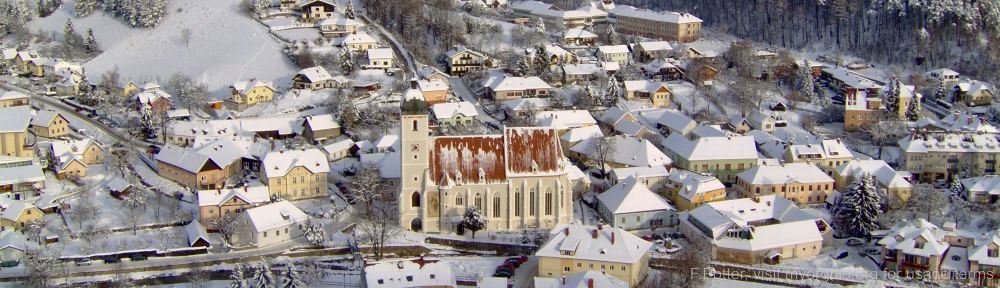
As I pack up and prepare to leave Vienna and my gig at a Vienna Based International Organization, a few images of what Christmas looks like. Enjoy!
The is the third leg of riding about 500km of the Iron Curtain Trail or FeCT.
| Date: | August 12, 2018 |
| Starting Point (via): | Marchegg Bahnhof |
| Weather | Sunny, warm to hot and moderate to moderate north becoming south winds. |
| Route: | South from Marchegg picking up the FeCT. Through Bratislava and exiting the trail at Mönchhof (98km total ride, 78km without re-traces and 72 km FeCT riding). |
This was supposed to be a simple ride. We picked up the trail where I had left it a few weeks ago, through Bratislava and zig zags down to a convenient railway station allowing for a good ride pick up later on… that was the plan. Instead it became a comedy of errors of route finding, construction detours, poor signage, a bit of bushwhacking, missed trains and some generous albeit drunk Austrians. All in all a good day.
I picked up the trail after a short 6km leg from Marchegg to the Friendship bridge.The route was good all the way into Bratislava. Some of the walking trails showing their age being overgrown or somewhat broken. As a warning Iron Curtain Trail signage in Bratislava is at best spotty, is hopefully not missing and at worst confusing and contradictory.
Getting to the first bridge that crossed the Danube presented our first mystery relating to signage. The route involved going far back toward the bridge proper and take a ramp up to the pedestrian walks below the deck and on the sides of the bridge. Clear signage to get you through a dark parking lot, nope. Maybe a few clues spray painted on the pavement, nope. And thus our first route finding fiasco had us trying to get up to the car deck where we discovered not pedestrian access.
Once across the bridge, the routing out of Bratislava consisted of a single sign directing us with vague ‘somewhere in that general direction’ accuracy. Needless to say, bring a VERY good map to Bratislava, take it VERY slow and watch carefully and either a GPS or a Slovak enable smart phone are good additions as well.
The Hungarian/Austrian/Slovak borders south of Bratislava are a series of jagged saw tooth projections into each others territories. Given that this border was heavily fortified, it must have taken enormous manpower given the elongations the border contours would have caused – which of course is exactly why the Hungarians opened the border because they could not afford to fix the then aging infrastructure.
Once again signage is okay to non-existence so be prepared to do a bit of route finding along the way. Say hello to the occasional Austrian soldier who is keeping vigil because of the recent waves of migration from the eastern countries. Of course one of the joys of route finding is being completely off the grid. That happened in one leg when we ended up ‘bush whacking’ over a fairly overgrown trail and then enjoyed a few km of gravel roads until we could pick up a hard top surface riding into our final destination, Mönchhof.
From Mönchhof we thought we would enjoy a beer and meal in Neusiedler See (lake). Alas we got off at the wrong station which may be just as well as there does not seem to be much in the way of services. Nevertheless found cold beer and a passable Chinese supper at another train station. As we were leaving, some nearby Austrians invited us for a drink – a nice hospitable gesture – that caused us to miss our train by about 30 seconds. Little did we know that next train just happened to be not an hour later but a full two hours later.
So, an eventful ride that was about 20km longer than intended marked by lots of route finding, generous invitations, missing signs and a very strange train schedule!
60km of the FeCT. Map courtesy of bikemap.net.

Route map (purged of all the bits where we circled around lost).
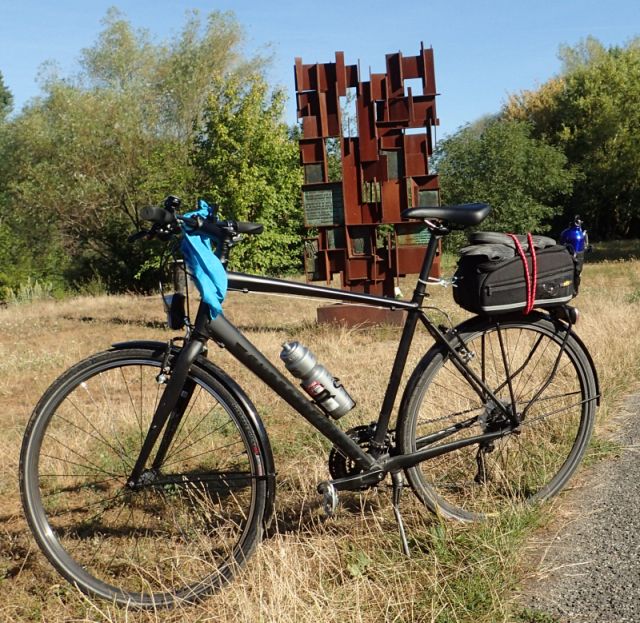
The trusty steed at the Devin memorial

These guys were feeding bread crumbs to the Carp in the water. Those are not rapids but were instead a few hundred large carp fighting for the food.
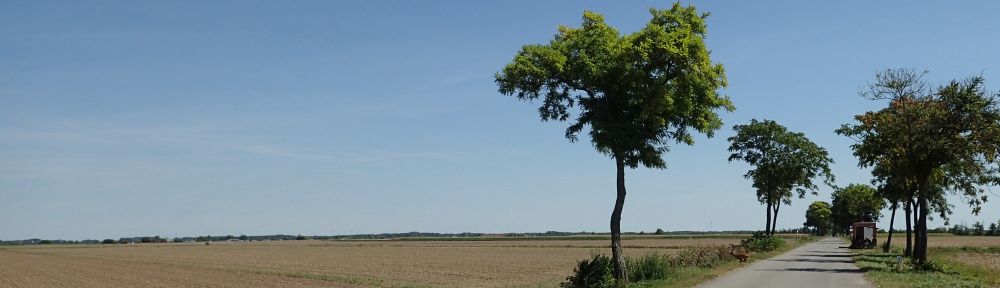
The Sea can in the distance where for the soldiers monitoring this remote out post. Note the deer just to the left of the road.

Tri-corner where Austria, Slovakia and Hungry meet. I was Austrian and Gift (right) was feeling a bit more Hungari(an)
| Date | Distance | Name | Impressions/Comments |
| 2018-07-15 | 66 km | Retz to Laa | A great section with lots of things to see. |
| 2018-08-05 | 60km | Laa to Hohenau (almost) | Rolling hills, lots of rural-ness. |
| 2018-08-14 | 10 km | Bernhardsthal to Hohenau am March | A stub ride to finish the gap. |
| 2018-07-15 | 52.7 km | Hohenau to Friendship Bridge | Green and very flat; accessible from Vienna. |
| 2018-08-12 | 72 | Friendship Bridge to Mönchhof | Bring a good map and plan to route find! |
Based on a promise to ‘Pay Attention‘, this is one of six blogs with the good intention is to publish a photo a day of my six month adventure in Vienna with a caption and thoughts on the image. Be patient and wait for the pictures load. August has no theme but I will be looking for good pictures over the past 5+ months that did not match the prevailing themes or that have artistic merit (well, at least to me).
August 17: My last photo of the day and one of the first I took in Vienna last March. A quiet moment on the Danube Canal with a young woman sitting in safety on the near shore and families out with their prams walking past tidy apartment buildings. In a single a few of the reasons Vienna has been voted the Economists most liveable Global city for 2018.

A quiet March 2018 moment in the worlds most liveable city.
August 16: A collage of corner buildings in Vienna. The question is, if you owned such an apartment, what would you put in such a room? A swivel chair to look out each of the 3+ sides in turn? Filled with plants to catch different sun locations or a series of cat-stands so Fluffly is never bored.

Collage of corner apartments
August 15: Two separate images of a large and now partially abandoned farm building.

The Road to the Farm.
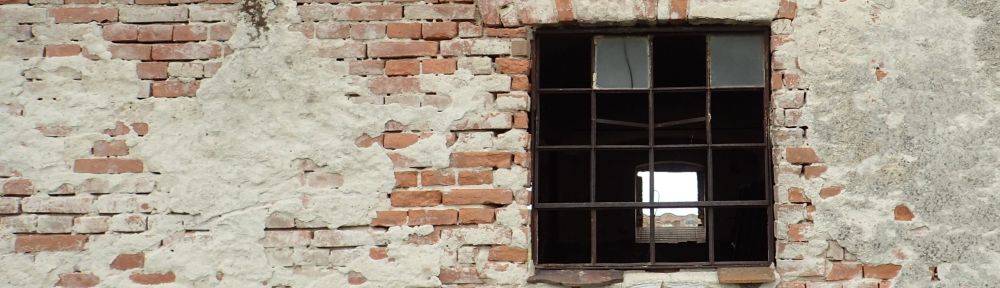
Looking through the abandoned barn into the inner farm yard.
August 14: No, these are not little homes for elves. They are ventilation chimeys for the wine cellars built into the side of the hill. Above freezing in the winter and cool in the summer, they dot the Austrian country side. This particular group near Hohenau.
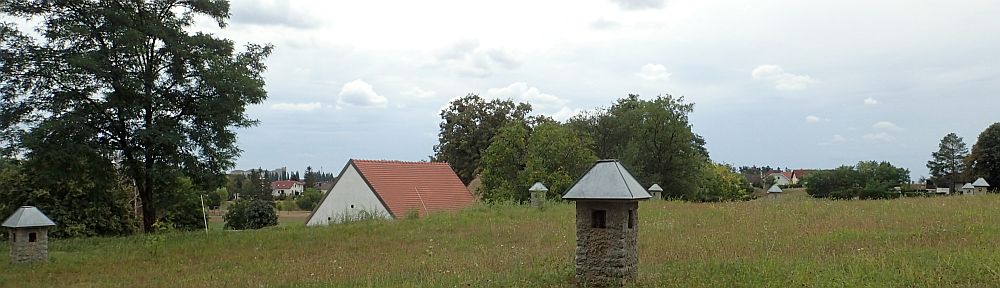
Ventilation shafts for underground wine cellars.
August 13: Having read the book The Day of the Triffids by John Wyndham as a kid, I always find sunflowers to be particularly creepy – especially when they are part of a field as far as the eye can see and standing in military precision rows.

The Day of the Sunflowers…
August 12: Scenes from the FeCT 2018-08-12 Ride.
At the point where three countries borders meet, my trusty steed and some Carp gone wild!
Tri-corner where Austria, Slovakia and Hungry meet. I was Austrian and Gift (right) was feeling a bit more Hungari(an)
These guys were feeding bread crumbs to the Carp in the water. Those are not rapids but were instead a few hundred large carp fighting for the food.
The trusty steed at the Devin memorial
August 11: A winch attached to St. Stephen’s Cathedral. Used (according to the book Secret Vienna) to winch asylum seekers up into the cathedral to avoid prosecution. As to who did the winching and why not remove the winch – details not available.

A winch and looking south east from St. Stephan’s cathedral.
August 10: A nick nacks shop within the courtyard formed by 3-4 buildings. A quiet and cool place on a hot summer day.
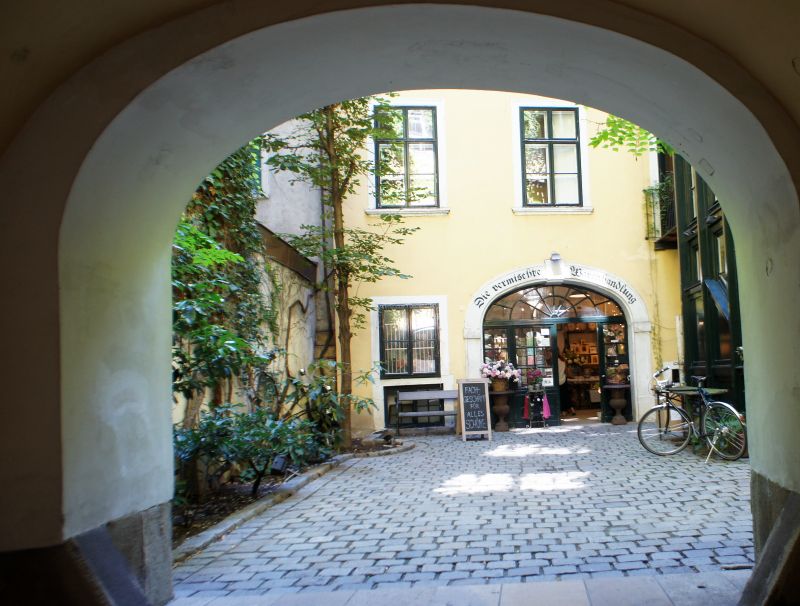
A quiet inner courtyard.
August 9: A free mason’s door complete with hanging stone… errr in case of earthquake perhaps find a different door way to shelter under.

The door to the free masons
August 8: occasionally you will see these signs and this one was outside of the literature museum in the inner city of Vienna. In four languages (English, French, Russian and German – the first three being the languages of the occupying powers) it reads: ‘Protected by the Convention of The Hague, dated 14 May 1954, for the protection of cultural property in the event of armed conflict’. The Austrian Military even produced its own rules of engagement for managing cultural property in case of conflict.

Cultural Property afforded protection under international law.
August 7: Scooters are incredibly popular amongst the Viennese for getting around. Normally associated with a 10 year old, I have seen seniors, business men, professional women (complete with heels) and everyday Joe/Janes zip around on them. It makes sense as it allows you to cover a longer distance with less effort. For those wanting more ummphhh you can also buy electric scooters so you don’t need to exert yourself at all. Cost, in the 80-300EUR depending on quality, powered or not, etc.

Scooters for sale and a few individuals zipping about.
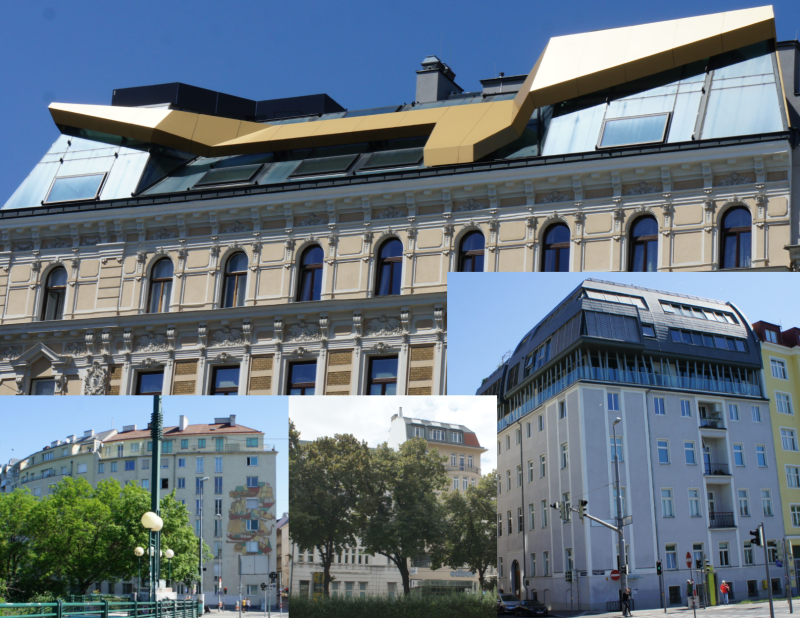
August 6: Add on Buildings: Both Vienna and the city where I grew up, Calgary, made the top 4 list of the 2018 most livable cities. By way of sustainability however, Vienna has Calgary through density. Vienna covers an area of 414.65 km2 (160.10 sq mi) while Calgary is double at 825.56 km2 (318.75 sq mi). Populations and respective densities are even further apart at 1,889,083/1,239,220 and 4,326.1/km2 (11,205/sq mi)/1,501.1/km2 (3,888/sq mi) respectively. One of the ways that Vienna is that much more dense is because of it builds up and then provides excellent public transit to service the population. Sometimes building up goes questionably wrong.
In the following montage are 4 buildings in which an additional floor has been added. In the bottom left, assuming the top floor was an addition, the penthouse flows nicely with the architecture. Bottom-middle has a top floor peaking up above the others but it sort of flows in an erect sort of way, bottom-right is germanic metal super-structure on an otherwise ordinary building. And then there is the flying wing. This gold doggish-thing apparently serves no purpose other than decorative and the Southeast exposure ensures the penthouse is an oven in the summer-heat. No wonder it has apparently gone unsold in over two years.
August 5: Scenes from the FeCT 2018-08-05 Ride.
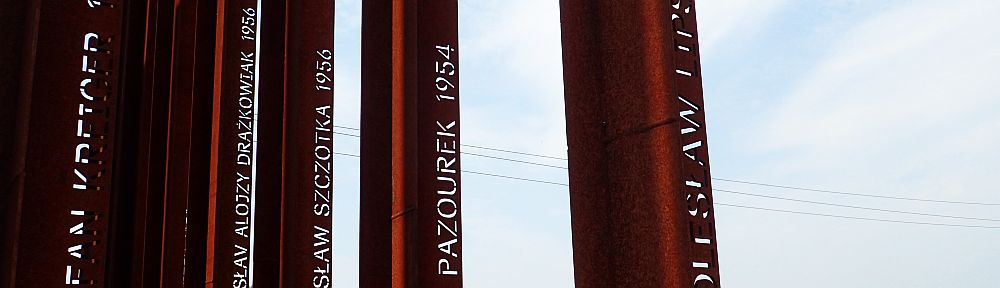
Euro Velo 13: A new memorial sculpture commemorating those that died trying to cross the border during the Cold War was due to be unveiled. The visitors are given an early glimpse of this thought-provoking piece – each iron column represents one of the 53 people that died trying to escape along the Czech-Austrian border.
Heading North, the city of Mikulo in the distance.

Heading North

Wien Kellers
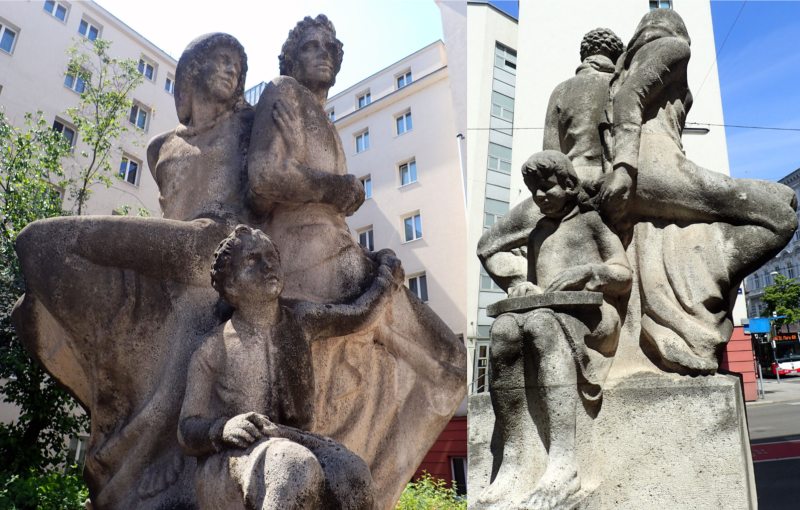
August 4:Two sides to the same statue, public art example.
August 3: Boats on the Danube.
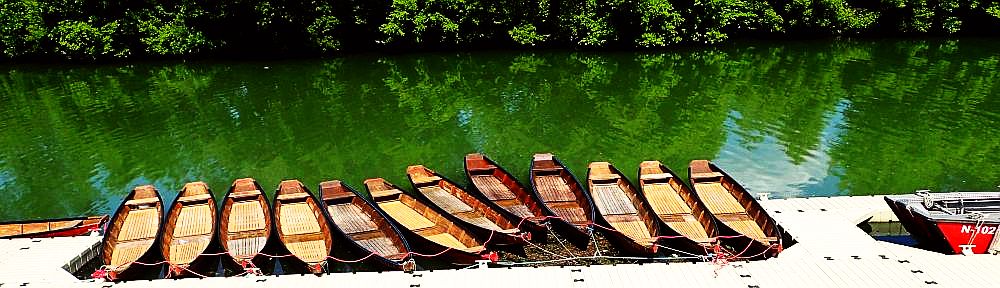
Boat on the Danube near Klostenneuberg.
August 2: Another orphan, the main entrance to Ausgarten.

Ausgarten
August 1: An orphan from July-Photo-A-Day displaced by a district. On the road to Baden.

On the road to Baden
The is the second leg of riding about 500km of the Iron Curtain Trail or FeCT.
| Date: | August 5, 2018 |
| Starting Point (via): | Laa Bahnhof |
| Weather | Sunny, hot and moderate to strong NW winds. |
| Route: | East from Laa with a small North jog into the Czech Republic (52km and all FeCT riding). |
This was a fill in section and unfortunately I have small gap of about 10km. Alas the 35C temperatures and not wanting to miss a train both depleted me and forced the decision. As for the section, not bad. I would take the Austrian section between Retz and Laa over this bit but this is nitpicking.
The tour was was rural Austria/Czech at its best. Through in a few castles, ancient churches and you have yourself a great ride. Mostly on ashpalt but enough rough pavement and gravel to make you want to leave your pricey road bike at home. In fact a soft tail or shocks would have been good for these sections.
The route itself was through rolling hills and there was some good sections about the history of the Iron Curtain… with the catch that you have to be able to read Czech. The Czech side seemed a bit more developed than the section from Retz to Laa and there were lots of locals on their bikes with kids and large groups.
As for the Iron Curtain, it has largely disappeared other than the memorials and the occasional machine gun emplacement. This of course is a good thing and the whole point of this trail…
60km of the FeCT. Map courtesy of bikemap.net.
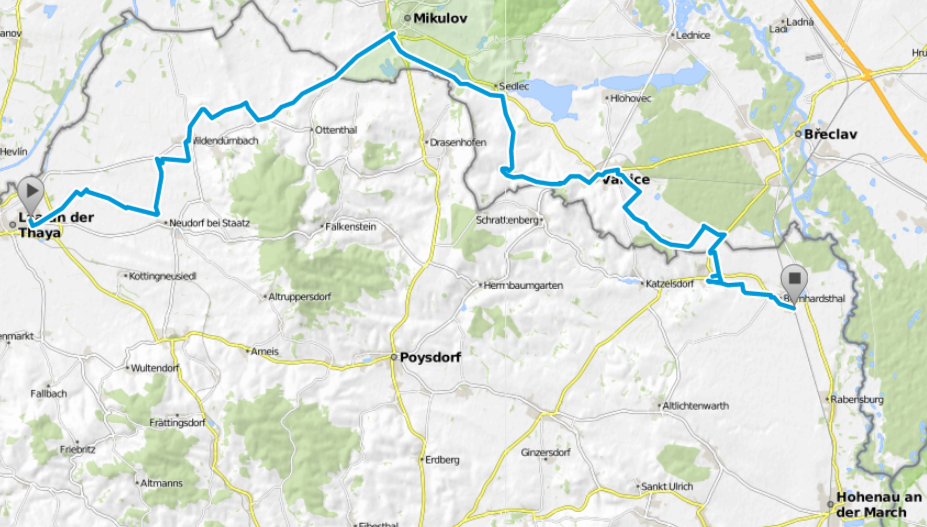
Laa to Hohenau (almost)
Wien Kellers
Heading North into the town of Mikulov
| Date | Distance | Name | Impressions/Comments |
| 2018-07-15 | 66 km | Retz to Laa | A great section with lots of things to see. |
| 2018-08-05 | 60km | Laa to Hohenau (almost) | Rolling hills, lots of rural-ness. |
| 2018-07-15 | 52.7 km | Hohenau to Friendship Bridge | Green and very flat; accessible from Vienna. |
| 2018-08-12 | 10 km | Bernhardsthal to Hohenau am March | A stub ride to finish the gap. |
Goals are like thinking about where you want to go for dinner tonight. A good destination to walk toward until you pass something better. So, here is my goal – I want to ride at ~500km of the Iron Curtain Trail or FeCT.
The FeCT runs from the Arctic to the Black Sea along the former borders of the Iron Curtain. At 4,127km long, it is not my intent to ride the whole thing… this year… but instead the sections that are reasonably accessible by train from Vienna. I might do a few longer trips in Fall if weekends and work permit, but for the moment, 500km is a nice round number.
Ohhh, here are my rules for myself. KM only count if they are on the trail and doing a section twice does not double the distance. I will attempt to do a blog to remember the ride, make some notes in case I go back (or someone stumbles on this via Google). Finally, I also get to changes these rules at my whim.

Full Route of the Iron Curtain Trail (www.ironcurtaintrail.eu – All rights reserved)
| Date: | July 15, 2018 |
| Starting Point (via): | Hohenau an der March via Wien Mittel |
| Weather | Sunny, hot with strong North/North West Winds |
| Route: | East from Hohenau and the south to the Friendship bridge returning to Wien via Marchegg Bahnhof (7km of non FeCT riding). |
The section is definitely bucolic and only moderately busy (closer to Bratislav) and flat. Trip notes:

The first 66km of the FeCT. Map courtesy of bikemap.net.
An old guard-house at the border with a control gate and customs house. Notice the decoy electrical box with a camera pointing toward Slovakia from the Austrian side.
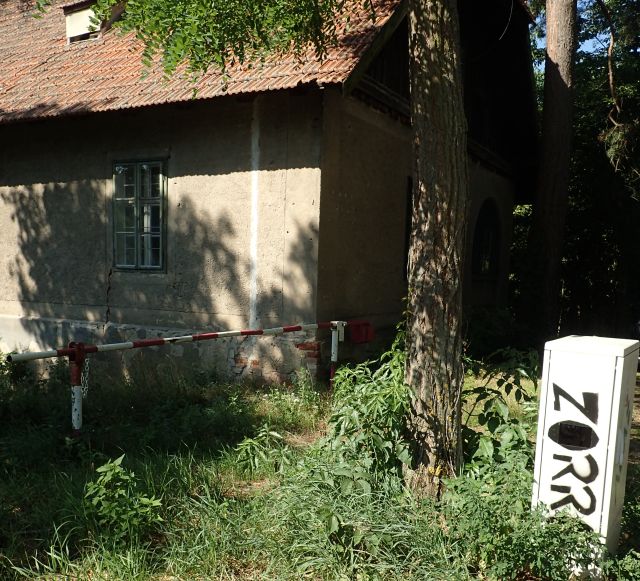
Former Border Control just east of Hohenau.
And so it begins, at the Slovakia border.

Austrian / Slovak border.
Lots of Oil and Gas activity. It could have been Alberta….

A derrick working the Slovak oil fields.
An abandoned bunker along the berm on the former Czechoslovakian side.
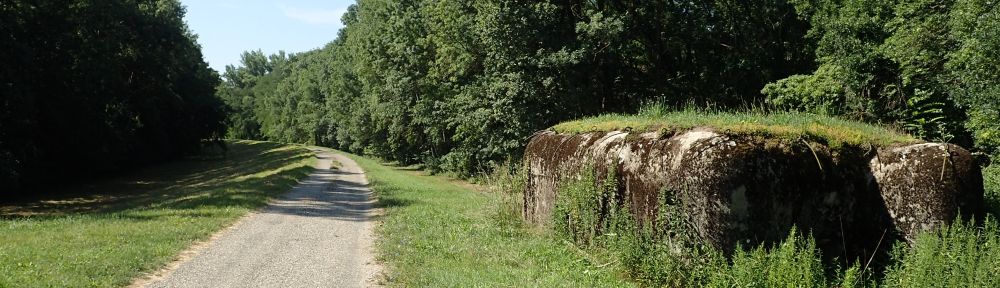
Abandoned bunker. There were at least 6 all spaced ~200M apart.
| Date | Distance | Impressions/Comments |
| 2018-07-15 | 66 km | Green and very flat; accessible from Vienna. |
Based on a promise to ‘Pay Attention‘, this is one of six blogs with the good intention is to publish a photo a day of my six month adventure in Vienna with a caption and thoughts on the image. Be patient and wait for the pictures load. Also because July is a thematic month, it is best to view the images from the bottom to the top.
Theme for July: Vienna is divided into 23 districts each with its own name and corresponding number (see this interactive map from the City of Vienna). For us North Americans used to a grid based city, this system can be confusing as people with assurance talk about the 9th and 10th districts although they are no where near each other. For this photo-blog I may visited each district either in July or previously.
| District | Date | District | Date | District | Date |
| 1st | July 31 | 2nd | June 18 | 3rd | July 27 |
| 4th | July 24 | 5th | July 25 | 6th | May 12 |
| 7th | June 21 | 8th | July 8 | 9th | July 9 |
| 10th | July 10 | 11th | July 11 | 12th | July 12 |
| 13th | July 13 | 14th | July 14 | 15th | July 15 |
| 16th | July 16 | 17th | July 1 | 18th | July 18 |
| 19th | July 19 | 20th | July 20 | 21st | July 21 |
| 22nd | July 22 | 23rd | July 23 |
The first district to visit?. Why the 17th of course! Selected only for its very punny connection to Canada. But first an overview courtesy of a tongue in cheek community character map ‘The Vienna Expat survival guide: 13 ultimate tips for internationals moving to, or living in Vienna‘.
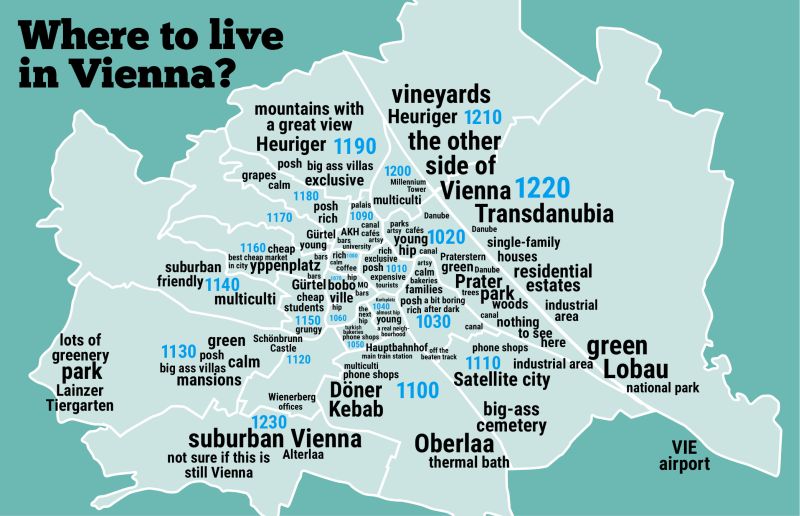
District Characters courtesy of http://www.viennawurstelstand.com
July 31: 1st District, the first and most central area occupying the last place in the month of July. I took one afternoon a tried to find streets I had not yet travelled. The results are (top left, clockwise): A mural commemorating a 750 year anniversary, Figlmuller – a fixture of the tourist trade, a wall mural, a statue on an art nouveau style building, idealized men on the same building, a wall mural nearly 300 years of an abby and finally the tragic figure of Emperor Franz Josef.

Six images of Vienna in the 1st district.
July 30: This picture is taken from where the Danube Canal separates from the main stream (top left) and an irrigation canal (top right), Marchfeld, starts its journey through agricultural land to return to the Danube just before Slovakia. To make the scene a bit more full throw in a few boats, a S-Bahn city train, a bridge supporting a major thorough fare and my bike just by one of the well marked cycling trail heading north out of Vienna (phew!).
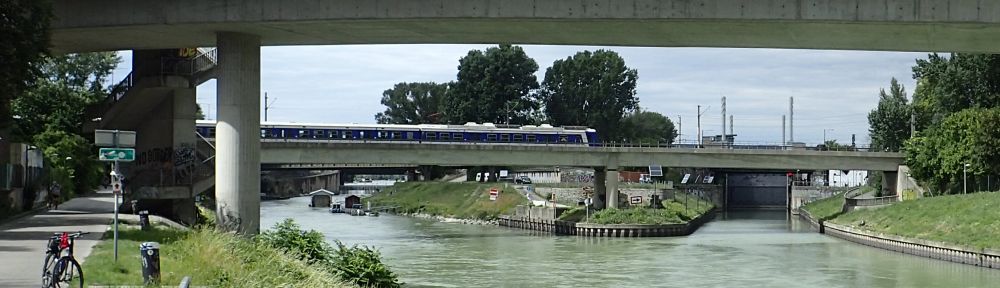
A Picture is worth a 1,000 ways to travel… or something like that.
July 29: These are two separate example of social housing, public art and a feature of Viennese architecture – The building spanning the road. I decided to superimpose these two images as a comparison between a social housing project built in the 1950s and another built in the 1980s (back and fore ground). A consistent architecture feature is the raised building over the road entrance and then an inner courtyard (look carefully for the bike).

Old and newish public housing, street art and a bit of graffiti for good measure.
July 28: I don’t normally go too much into gimmicky photographic tricks but in this case I put my camera on an art mode by mistake and end up liking the results. Below are both images, one gimmicky and one normal.
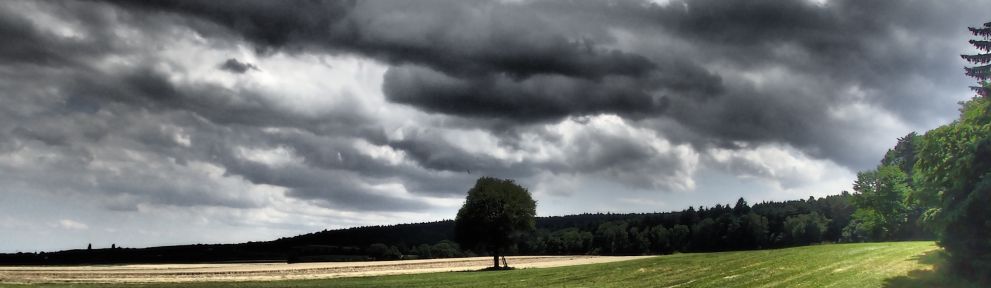
A loan tree but with an artistic sky.

A lone tree sans gimmicks
July 27: Vienna has not one but two big friggin’ towers. The taller of the 2, the Danube Tower can be seen in the pictures from July 22nd below. The more mysterious is the the one lurking in the 3rd District where it dominates the skyline. According to the newspaper, Wiener Zeitung, requests to visit the tower are refused and little information is known about. Nevertheless one can visit by watching the Vienna. City Panorama Web Camera from the A1 Radio Tower/Arsenal Tower.

Vienna’s second tower, a building mural and the St. Nikolaus Cathedral (Russian Orthodox).
July 26: A little bit more from the town of Baden which was having a Weiss or White festival. Never before have I seen so many people in white and never has tomato based pasta sauce yearned to leap from nearby plates so much so as to colour those nice white clothes.
Weiss festival in Baden
July 25: The last time I lived in Vienna, I constantly rode through the 5th District and then later looked at it from my apartment windows. The district sprung up along the Vienna river and individual communities were amalgamated into one. If you look at the insert photo you will see Margaraten Street heading east towards Vienna. This is exactly what many small Austrian towns look like, buildings built right to the main street.

A classic building on Margareten Street and an insert of the same street show how it used to be a main street running towards Vienna.
July 24: the 4th District is in the SW corner and includes lots of residential areas. It also includes Karl’s Church and a monument given to the Austrians by the Soviets on the occasion of the withdrawal of occupying powers from Austria in 1955.
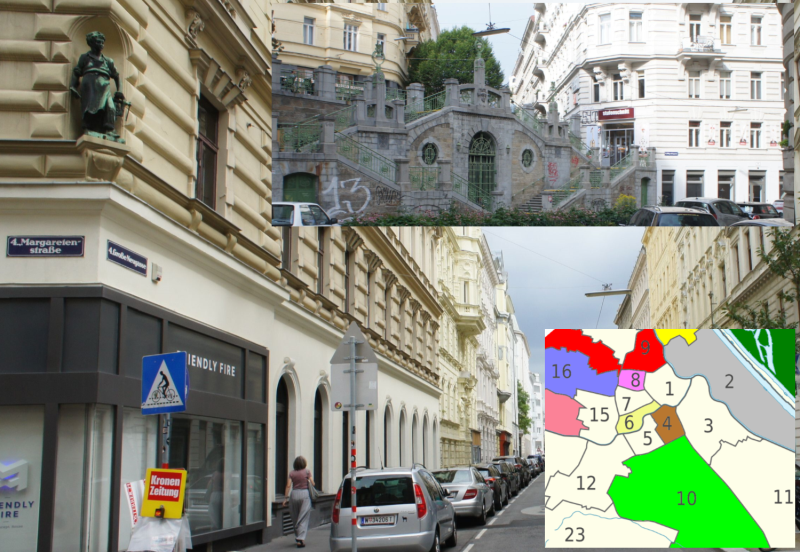
Building upon building of residential areas and a stair case to manage a change in gradient.
July 23: The last district in Vienna is the 23rd which is also the transition into the Vienna woods and beyond the Alps. The apartment building is the Wohnpark-Alterlaa which is a social housing complex that is essentially a small city within a city.

The Liesing or 23rd district complete with a city within a city complex.
July 22: The 22nd District is an interesting blend of shiny office towers, the UN Centre, car dealerships, suburban homes and recreation. It includes a national park along the Danube and is the largest of the districts. Lots of water sports on the Alte Donau.
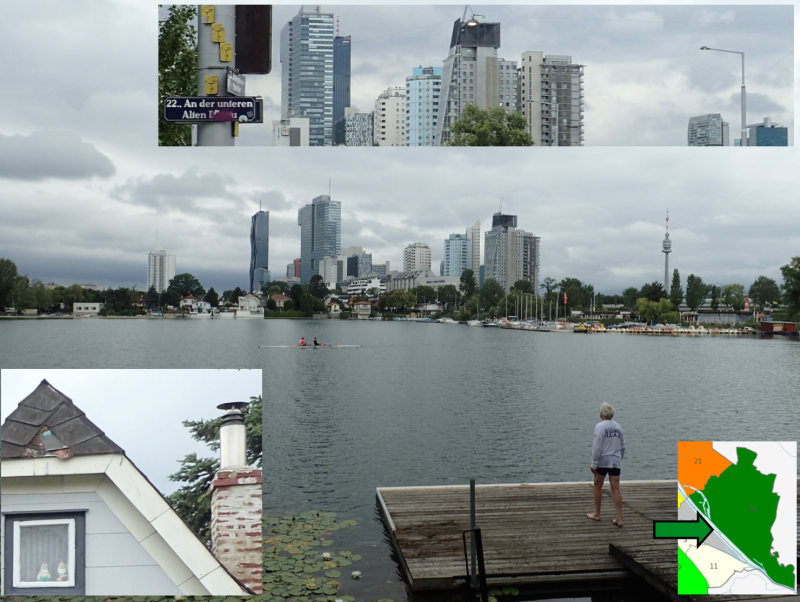
22nd District, Office Towers, Neighbourhood PaTROLL.
July 21: The 21st district is the sister to the 22nd bordering the Alte Donau (old Danube, a former channel of the river). It has a more urban feel though with seemingly more social housing (such as the mosaic shown here) and numerous cement block apartments. For a bit of whimsy a street art in the insert.
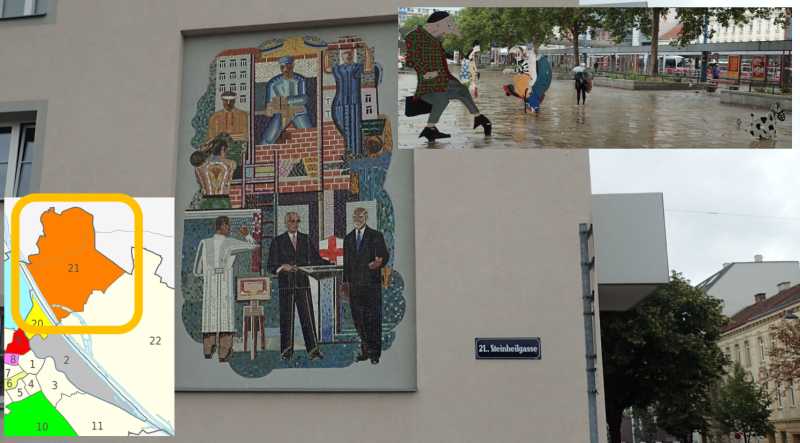
21st Vienna District. Note that street art in the top right corner.
July 20: Two street scenes from the 20th district. What I like about these pictures is that the business names are all in German. Many current Austrian businesses have English names where as these are not only German proper nouns but descriptive nouns as well Wascheri+Putzereri (washing), Möbel (furniture) and angelsport (finding devine creatures).
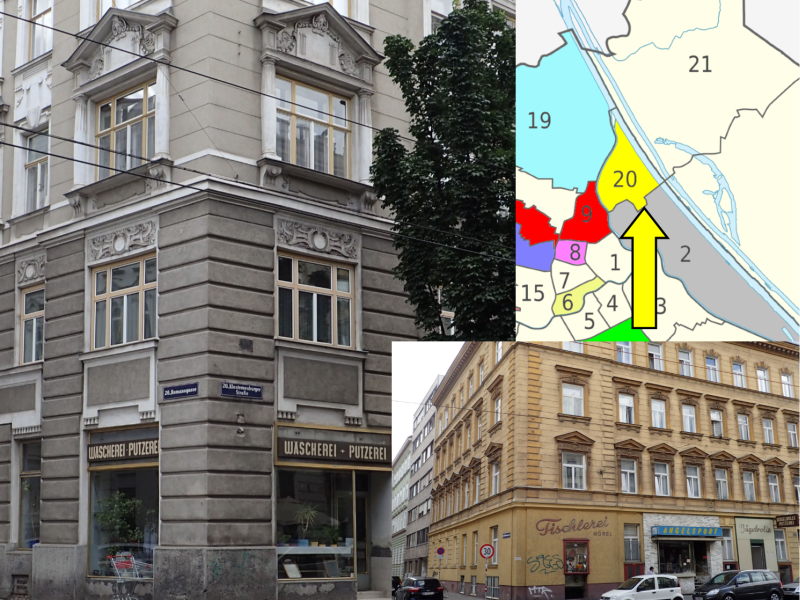
Vignettes from the 20th District.
July 19: A few different scenes from the 19th district. the background is a social housing complex built during the occupation years. In this case the building was built in the US occupation zone. In laid is a corner statue from another building.

Statues from the 19th District.
July 18: 18th District. The original city rail road with an Otto Wagner style bridge. If you notice below the bridge, a shuttered business which is common along the railway as this seems to be an area of lower income and homelessness. In contrast, a neighbourhood bakery does a brisk business on a Sunday morning.
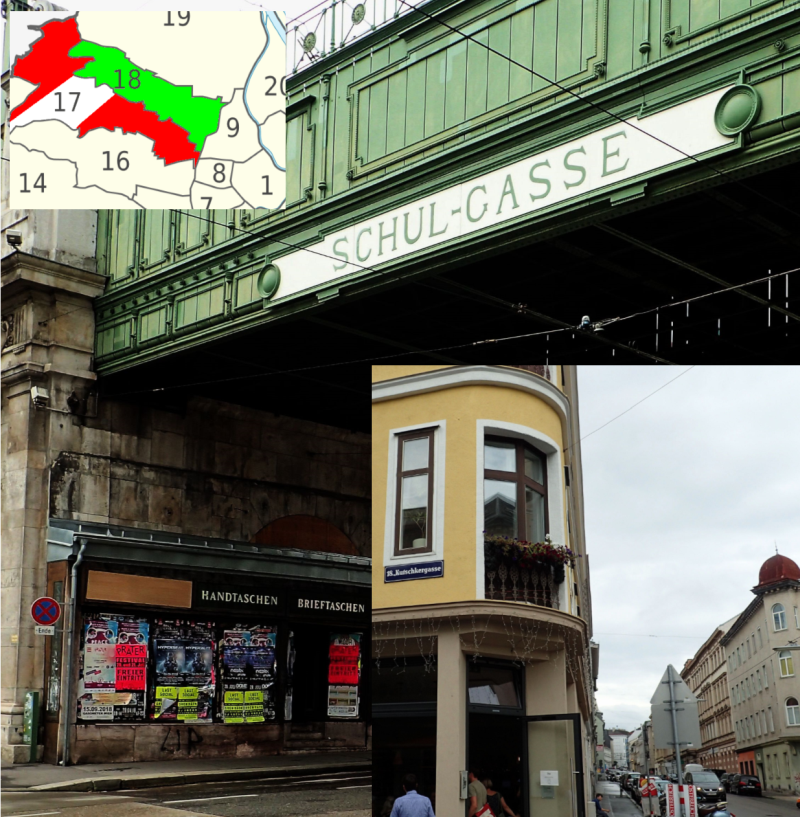
Two contrasting scenes in the 18th district.
July 17: A look into an inner courtyard of a social housing complex. The inner courtyard keeps the complex cool in the summer and provides a place for kids to play and tenants a place to socialize.

Iron work looking into an inner court yard.
July 16: A large social housing complex built at the height of Red Vienna in the 16th district. It has both an imposing and appealing look at the same time with a touch of art deco decor.

Schuhmeier Hof built ca. 1926-27
July 15: The 15th was once considered a dodgy neighbourhood. My experience so far is enjoying an excellent lunch at a combination bicycle shop/bistro called Velobis. Note the tree sculpture in the corner of this building and that one side faces the 15th district and the other the 13th.

A tree sculpture in the 15th.
July 14: Lots going on in this picture from the 14th district. In the background is a long narrow road radiating to/from Vienna and likely an older country road. Bottom left are the trains heading west out of the West Bahnhof towards Munich, Salzburg, etc. The hills in the background are the start of the Vienna woods (Wienerwald). Top right is a more classic building in Vienna with a pub on the main floor. The treed area to the left is a small beer garden – a place to escape the heat of the apartment!

14th District vignettes
July 13: One source describes the 13th district, Hietzing, as the “Austrian Empire Theme Park” with the former hunting grounds (Tier Garten) and the Schonbrunn Palace. Even the Hietzing U-Bahn Station are fashioned in Otto Wagner style.

U-Bahn station a la Wagner, Schonbrunn and lots of greenery describe the 13th.
July 12: The 12th district is also highly residential. This image has a number of classic European and Vienna images. Firstly the mosaic on the side of the overhang of the building. The Zu Kaufen sign is offering the corner apartment for sale. Finally, the business in the image is for a flooring company. A relatively common business because of course when you move out you take the floor with you (as well the cupboards, etc.).

The 12th district mosaics, business and an apartment for sale!
July 11: The 11th district is generally residential but does have the huge Central Cemetery. Within the cemetery is the Friedhofskirche zum heiligen Karl Borromäus, which has strong Art Nouveau features. Near this church is a large section dedicated to the Red Army and their losses taking the city in 1945. (The Central Cemetery is so large the Viennese describe it as ‘having half the population of Zurich where people have twice as much fun as Zurich’.

Interior of the large art nouveau church and a sculpture of a grieving soviet soldier with a Red Army star behind him.
July 10: Two examples of public art, both in the 10th district and all for July the 10th!
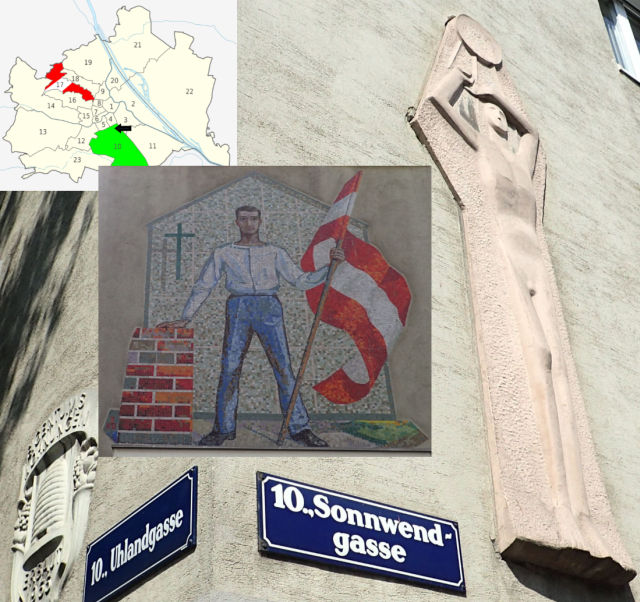
Mosaic and a Sculpture in the 10th district.
July 9: The 9th is my “hood and where I live. Some public art in the local buildings and the corner of my apartment. The bad news is that the door is on the left hand side of this corner although my balcony over looks the right – a very appropriate view.
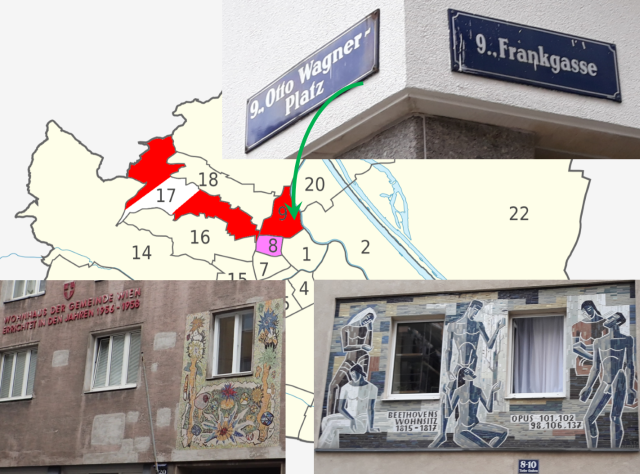
Some views of the 9th district
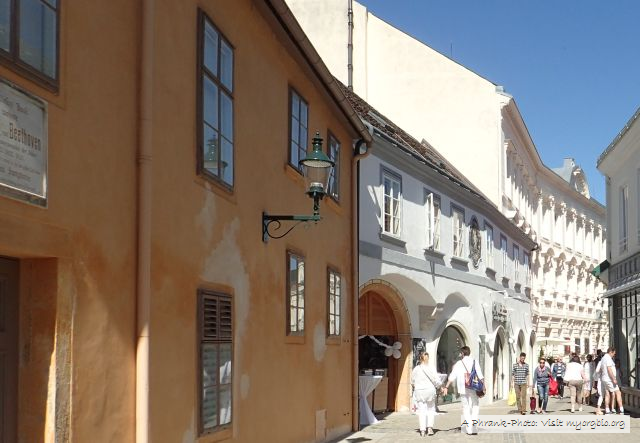
July 8: From the Eight District, three different street scenes starting top left an inlaid sculpture, bottom right more inlaid sculptures and an older style street name sign in Gothic script and on a building where Beethoven lived and worked in 1819-20 and finally, a street sign shop… where all of these street signs come from!

Beethoven, sculptures and a shop selling street signs – all in the 8th district.
July 7: Before we leave the Votiv Kirche, a detail and the view from my apartment balcony (two for one week!).

West Door of the Votiv Kirche. Note the Adam and Eve motif over looked by the saints.

Looking east to the Votiv Kirche from my apartment balcony.
July 6: Near my apartment is the Votiv Kirche and in a back corner in an art piece dedicated to Vivaldi and entitled “AD ANTONIO VIVALDI” and organized by the Lions Clubs of Vienna and Venice. Two detail headers from this piece.

AD ANTONIO VIVALDI: Detail

AD ANTONIO VIVALDI (Detail)
July 5: Unlike many North American cities, Vienna is very much a train dependent city and has 3 separate stations. For those train watchers out there, Wien-Meidling Station looking north towards Vienna.

Wien-Meidling Station, the hardes friggin’ station in Vienna to find!
July 4: Happy 4th of July to all friends from the United States! This monument is about 100M from my apartment and I walked by it for 2 months thinking it was a traffic control box. The inscription is reproduced below and it was presented on June 17, 1948 at Bedford Indiana to the Stone City of the world (Vienna presumably). Based on some basic Google research:
Demokratiezzentrum (translated from German): Monument on the Frankhplatz in Vienna, which was dedicated to the city of Vienna in 1948 by the USA. The memorial bears the following inscription: “This cornerstone of freedom presented June 17, 1948 at Bredford, Indiana, USA, the stone city of the world AUSTRIA.” Austria’s importance for western civilization transcends by the geographical size of the country Indeed, Austria may be regarded as the heart of the European Commonwealth, Presented by Indiana Limestone Company Inc.”
From the Historical Marker Database: On this spot June 17, 1948 as a part of the Indiana Limestone Centennial Cornerstones of Freedom were given to representatives of 17 friendly Nations in one of the most impressive displays of International good will ever manifested anywhere in the World. Countries given markers include: Austria, Belgium, Burma, Canada, Denmark, France, Great Britain, Greece, Honduras, Iran, Italy, Liberia, Lithuania,Norway, Philippines and Saudi Arabi (Sic).
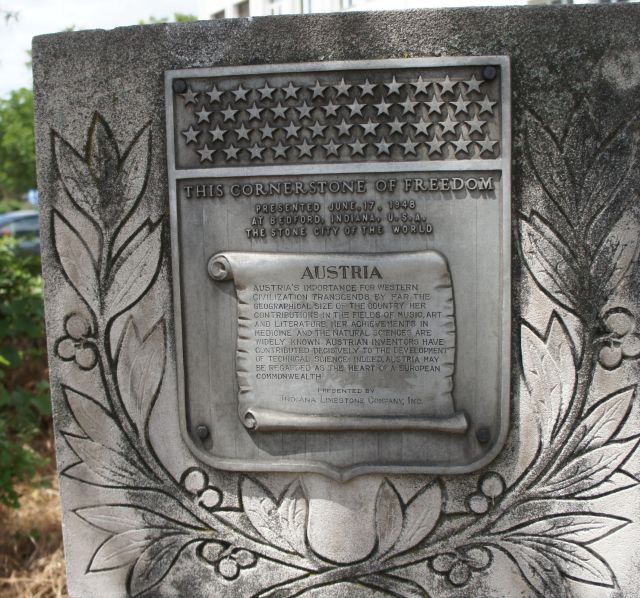
One of a series of limestone markers distributed by the Indiana Limestone Company in 1948 on the occasion of their 100th anniversary.
July 3: A little bit more of the bathing culture…

Cabins in the upper deck of Bad Vöslau.
July 2: The Vienna area has a strong ‘bathing-culture‘… okay beyond good basic personal hygiene this also involves a German propensity to go swimming in lakes and rivers as well as a number of thermal baths. A few pics from the larger Vienna area (include Baden and Bad Vöslau) which share in the tradition of coming clean with a leisure activity.
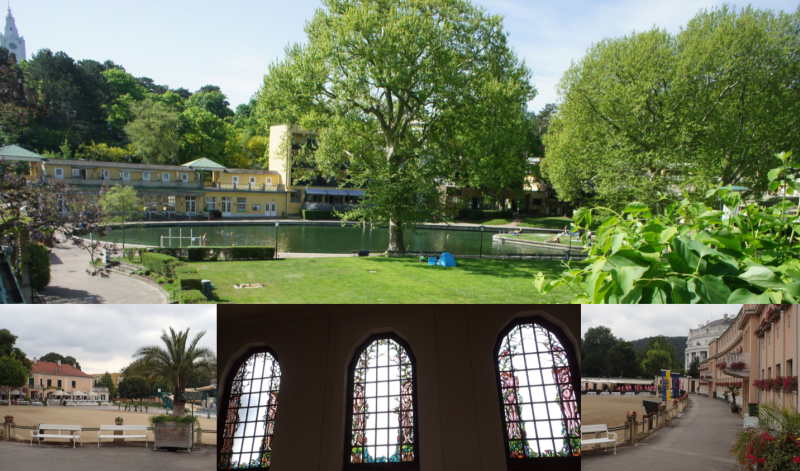
Images from one of the pools in Bad Vöslau and in Baden.
July 1: Happy Domain (errr, Canada) Day. Don’t worry non-Canadians if you don’t get it.
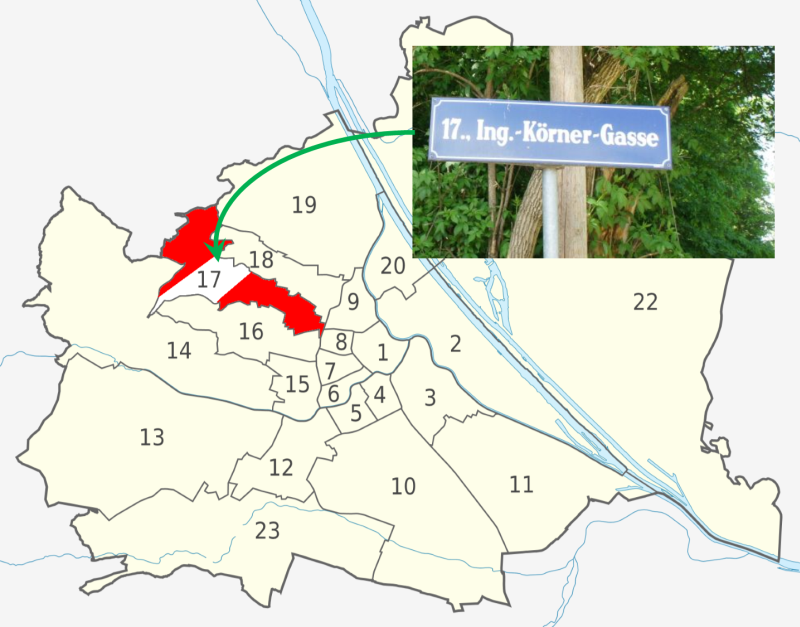
Korner-Gasse in Vienna (sorry Brent was no where to be seen).
 Organizational Biology