
In my ongoing effort to remember what I have read, some notes (aka memory jogs) on the book “Co-Opetition”, by Adam M. Brandenburger, Barry J. Nalebuff [1]. First published in the mid-1990’s, this is not a new book. But, with increasing global competition and the rise of the virtual business place due to COVID, perhaps one that should be revisited.
In a Nut Shell
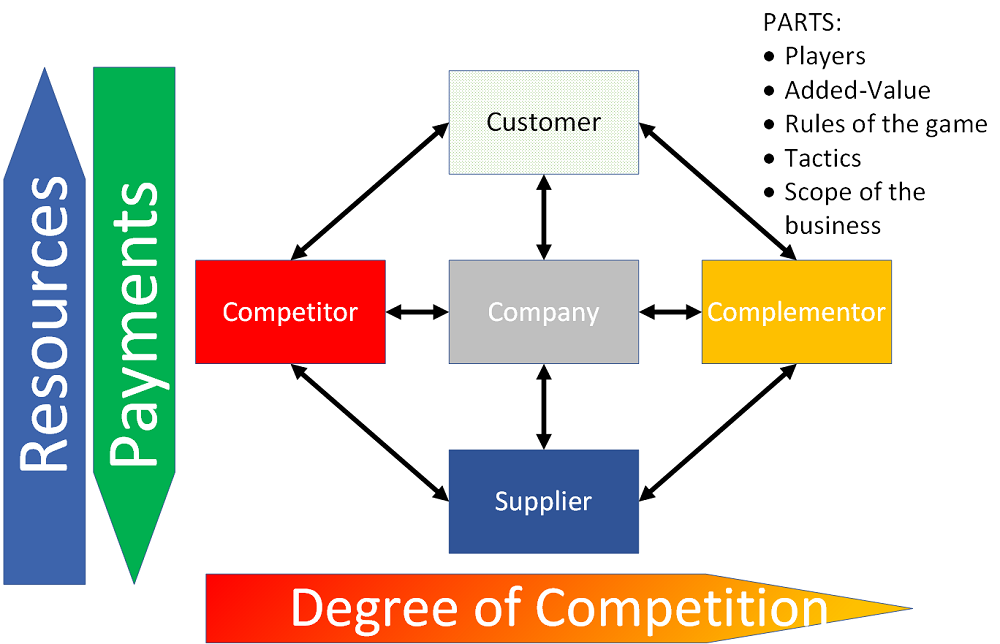
The above graphic highlights the key features of Co-Opetition which are [1]:
- Game Theory can help organizations understand a particular business situation.
- Two Axes form the components of the game.
- Vertical Axis is the flow of goods/services up to a customer and money down.
- Horizontal Axis is the competitive/complementary game the company is playing.
- Players are the entities involved in a single game. Adding a player to the mix changes the game to a greater or lesser extent. At different times, different entities will play different roles in different games.
- Players Interaction (arrows) defines the game and all players interact with each other save for those on the opposite corners of the diamond (more on this later).
- Value Added is the basis for the game; players seek the highest value by cooperating or competing with each other.
- Competitor: a players is your competitor if customers value your product less when they have the other player’s product than when they have your product alone.
- Complementor: a player is your complement if customers value your product more when they have the other play’s product than when they have your product along.
PARTS of the Game
For any game there are the components or PARTS [3]:
- PLAYERS in the game;
- ADDED-VALUE that a company can bring to any of the players;
- RULES OF THE GAME or business in which a company or organization is participating;
- TACTICS the ways of influencing perceptions of how the organization fits into the game;
- SCOPE OF THE BUSINESS or the linkages between you and any of the other players in your Value Net (who in turn may be linked to other games, thus representing opportunities for you to expand or change your own operation).
Reasons to Play the Game
A player will engage in the game if the value they receive as a player is greater than the value they would have received being out of the game. Other reasons to play include [2]:
- In a monopoly the number of legitimate players maybe regulated (although there may also be a thriving black market!).
- The most common motives for firms to engage in coopetition are to develop larger markets, to improve industry standards, to share the costs of research and development, and to increase consumer awareness for the benefit of all the industry players.
- Coopetition emerges from interdependence of firms in complex markets.
- Firms may cooperate to challenge competitors that are not part of the alliance network.
- The insights from complexity theory that are crucial to coopetition is the high level of adaptive capacity in organizations that exhibit the characteristics of complex adaptive systems such as adaptation, self-organization, and cooperation.
Co-opetition Practicalities
The neologism “Co-opetition” has quickly gone into the business lexicon… and then become diluted over the past ~25 years. Reasons for this dilution includes the following:
- The model is innate and is something that organizations are doing anyway; Co-Opetition simply codifies it.
- The Game Theory descriptions is academically interesting but difficult to sustain in the busy work and market places.
- The model breaks down quickly in the real world in which customers are fleeting, the supply chain dynamic and competitors/complementors coming from global sources.
Co-Opetition & COVID & What Happens Next
Post-COVID, companies will need every advantage they can get in a hungrier market place. Co-opetition provides a good conceptual model to think about how to both compete and cooperate. Questions at the end of the book are useful if creating a joint venture with a competitor or contributing to industry standards [see 3]. The business examples are a bit stale twenty+ years on. Nevertheless, a good book to have handy when thinking about whether or not to play nice!
Notes and Further Reading
- Brandenburger, Adam, and Barry Nalebuff. Co-Opetition. 1st ed. New York: Doubleday, 1996.
- Sammut-Bonnici, Tanya. “Coopetition,” 2015.
- “Co-Opetition: Book Review from TCI Management Consultants.” Accessed October 12, 2020. http://www.consulttci.com/Book_reviews/coopetition.html.
 Organizational Biology