In my ongoing efforts to remember what I have read, some notes on the book, The Halifax Explosion by Ken Cuthbertson.
Fading Milestones and Unforgettable Events
My father grew up in Nova Scotia and often talked about the Halifax Explosion, In the 1930’s and 40’s, the explosion would have been in living memory of most people. To me, it was a story of a very distant past. For him, part of the fabric of his upbringing – perhaps how children born today see the September 11, 2001 attacks in New York.
A Quick Re-Cap of the First Big Bang of the 20th Century
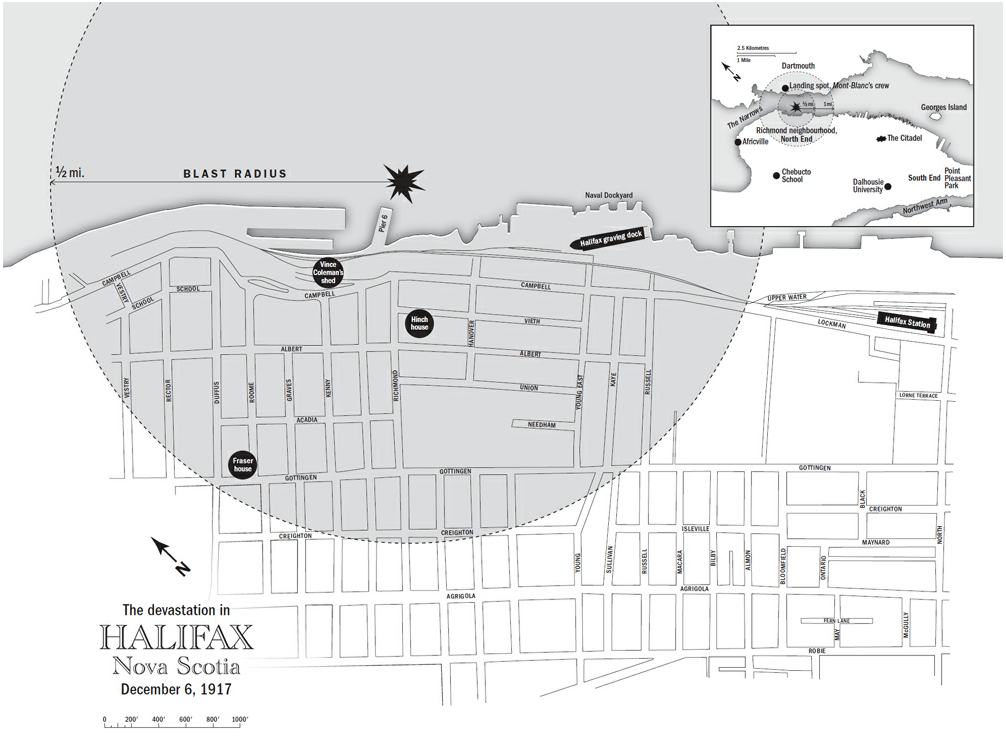
The explosion occurred on December 6, 1917. It was the result of “SS Mont-Blanc, a French cargo ship laden with high explosives, collided with the Norwegian vessel SS Imo. A fire on board the French ship ignited her cargo, causing a massive explosion killing approximately 2,000 people. and an estimated 9,000 others were injured. The blast was the largest human-made explosion at the time, releasing the equivalent energy of roughly 2.9 kilotons of TNT (12 TJ).” [adapted, 1]
Not Malicious but Lots of Blame
Unlike the September 11 attacks, there were no villains – but there was lots of blame to go around. The book describes the effect of lots of individuals doing what was required of them but not being willing or able to change a larger picture.
The captain of the Mont-Blanc had a ship ill equipped and inexperienced handling explosives. War time demand for material over rode this consideration. The captain of the Imo was Norwegian like his ship and was on a Belgium War mission. He pushed his ship too fast to make up a schedule on which they had fallen behind.
The port authorities were a series of independent units working together but with simmering tensions. As a result, there was a break down of communications particularly in allowing the Mont Blanc to enter the harbor in the first place. She failed to fly the necessary warning flags because the regulations were ambiguous on this matter.
Many Heroes
Relief efforts sprung into action almost immediately from the Maritimes and North Eastern United States. Personal sacrifice included Vince Coleman who stayed at his telegraph dispatch station for the railroad. As a result, incoming trains into Halifax were halted saving hundreds of lives. Physicians from around the region arrived to aid with the injured including a good number of ophthalmological treatments. The concussion bruised and, in some cases, pop the eyes from heads.
Timing is Everything
2,000+ died as a result of bad timing. For example, had the ships been a few minutes later or earlier, they would have passed without incident. Underlying the event was the timing for Canada. It was still semi-dependent upon the United Kingdom for things such as foreign policy and the Canadian Navy was barely formed (1910) when the first world war broke out (1914).
One of the most divisive elections in Canadian history occurred a few days later on December 17. This election pitted the pro-British and thus war elements against to pro-isolationist Quebec sentiments. The explosion brought the election issues into sharp relief of the sacrifices and silliness of war.
A Slow, Solid Burn
Cuthbertson’s book starts off slow. I suspect this was intentional so as to build up to the catastrophic event we know is coming. It also gives the author time to provide background and context to the event. A good read for those interested in general, military or Canadian history.
Notes and References
- Wikipedia: Halifax_Explosion.
- Canadian Encyclopedia: Halifax Explosion.
- City of Halifax.
 Organizational Biology