Chance Favors the Prepared Mind – and the Oblique Approach

(With apologies to Louis Pasteur)

Louis Pasteur, courtesy of Wikipedia.

Obliquity: Why Our Goals Are Best Achieved Indirectly by John Kay

I have spent most of my professional career thinking and planning for the future.  Certainly not as a futurist but as a ‘Budget-Guy’ or strategic planner.  Unlike most accountants, I preferred the numbers of tomorrow to those of yesterday.

Given that I have written my fair share of plans, I was interested in John Kay’s book which has a premise that the path to tomorrow is often not straight and definitely may not be quantifiable.  Kay proposes that a focus on passion and excellence leads to better profits than maximizing shareholder value.  For example, Boeing was more successful when aeronautic-philes ran the board room versus when it was filled with suits, MBAs and accountants.

Given that I a) own a suit; b) am an accountant and c) have a MBA; should Kay’s premise worry me?  Are budget guys of the future doomed to be replaced by those with passion?  I think not for two good reasons, both contradictory, like the premise of this book.

The first is that passion is a well-known and recognized attribute of successful companies.  Passion causes people to work long hours for NASA so as to put a man on the moon.  Or passion drives working for a charity or a non-profit organization.  Business gurus have cleared whole forests coming up with other names for passion such as an organization’s Vision or the need to stick to one’s knitting.

The second good reason is in the form of the question: ‘how do we know that Boeing was more profitable when it was run by passionate versus suited-accounting-MBA types?’.  Presumably because in both cases, suited-accounting-MBA types were still there paying the bills, developing budgets and keeping government regulators at bay.

In other words, we should be willing to take the long road home and follow our passions.  Great discoveries have been found through chance when the right person was looking in the right direction (hey, it got Louis Pasteur a nice Nobel Prize).  So, Obliquity is something to cultivate and encourage… but… in the end only execution matters.  The aeronautic-phile executives at Boeing developed the 747 through both vision and a lot of hard work (including the suited-accounting-MBA variety).

And this brings us back to Kay’s book and whether or not you should bother to read it?  My thoughts are:

  • a) Yes, because he is right.  Chance favors the prepared mind and the organization needs to expect a bit of serendipity to accomplish its goals.
  • b) No, Kay has cherry picked his examples.  For every Boeing that has re-located its passion there are dozens of Packard Motor Works who had passionate people but lacked the capital or size to compete.
  • c) Yes, because Kay is an engaging writer.  Even if the book suffers from a lack of research, it is still a great read.

I was going to suggest that you rush out and buy the book but decide to instead recommend obliquity finding it in a book shop near you while not looking for it.

Healthcare Ethos: Its Positives and Negatives

The healthcare ethos extends well beyond the front line worker. Front line managers, administrators and support staff also participate in the healthcare ethos although the strength of the values and belief systems decreases with the distance from the patient or client.

Like many things, the healthcare ethos has a positive and negative side. The positive side is a powerful motivator; people have been known to go to heroic extremes for the safety their patients. Managed properly, the ethos can help healthcare organizations to deliver the very best patient focused services. Without proper management, the ethos can lead to stagnation, animosity and anything but organizational harmony. The larger organization goals can be clouded by the immediate priorities of the care giver.

So how do successful healthcare organizations strike a balance between the good and the bad of the ethos, through 4 strategies.

1. Communication, Trust and Respect
2. Managing the Group through the Individual
3. Intangible Asset: Nurture but don’t Exploit
4. Manage change transparently, but practice tough medicine

Healthcare Ethos – As a Motivator

(This is the second in an intended series on the Healthcare Ethos, be sure to Read the Ethos Definition.)

I have worked directly or indirectly for healthcare organizations for nearly 15 years. During this time I often ran internship or cooperative education programs and thus would have a steady stream of young people joining and leaving my teams. One of the ways I introduced a fresh-faced twenty-something to the world of healthcare was to give them this observation on their first day of work:

“Somewhere in this hospital (or organization), there is a small premature-baby weighing about as much as a pack of ground beef; and all he wants to do is take his next breath. Somewhere else is a little old lady surrounded by children and grandchildren who wants to take her last breath with dignity and respect. This is what we do for a living.”

I would go onto explain that while we may be doing budgeting, accounts payable or some other seemingly far removed work from that baby and beloved grandmother, we were still contributors to their well-being and journey in life.

As a result, I found that by explaining the Healthcare Ethos, my staff better understood our role, were better motivated and interested in the work at hand. This does not come without a warning about not abusing this emotional message however, but more on that in future blogs.

The Healthcare Ethos – A Definition

Overview –Motivating People is Hard Work

Motivating people is hard work.  If you are responsible for more than yourself, you know the difficulties in keeping your staff engaged.  As tough as your circumstances are, consider this question.  How do you keep staff motivated working in a hospice in which every single client will die?  How do you motivate staff on a paediatric oncology department in which too many of the children will lose their battle with cancer?  How about within a mental hospital; how do you motivate the staff whose clients sometimes face limited cure possibilities, a life of poverty, loneliness and an ostracizing stigma?

A black sofa is seen amongst a backdrop of vibrant green.

Couch amongst the bushes.

These are the motivational challenges facing managers who work in healthcare.  Yet despite the seeming difficulty, the vast majority of people who work in healthcare enjoy their job and generally look forward to helping the patients and clients that they serve.

Motivators and Organizational Ethos

Good pay and benefits help, but as Herzberg pointed out, lack of pay and benefits may lead to job dissatisfaction but they are not themselves motivators.  Thus the enigma of what keeps a nurse, a doctor, or an aide going back to work, day after day and dealing with circumstances that are by definition life shattering?

The enigma of course is also the solution.  A number of separate studies of nurses have consistently shown that the prime motivation to enter that profession is to make a difference, engage in the human connection, a need to be needed and altruism.  Individuals working directly with patients are exposed to many of the strongest and most powerful human emotions.  Pain, suffering, despair are balanced against hope, joy and relief.  Thus frontline healthcare workers are active participants in the human condition.  For most healthcare workers, this exposure is life affirming and positive.

Of course healthcare workers are not unique in this regards.  Police officers, firemen, teachers or soldiers can also experience intense emotional environments.  In each case, a fraternity develops amongst the workers and there is a desire to do ‘good’.  In the case of healthcare I call this motivation and fraternity the healthcare ethos which is defined as follows:

“The vicarious emotional impact felt by healthcare workers as they experience the human condition indirectly through their patients.  This impact acts at the individual and group level as a motivator, driver to protect patients and as an affirmation of purpose and importance of the work done by the group or individual.”

Buying In – BzzAgents and Volunteer Marketers

Just finished the book, “Buying In: The Secret Dialogue Between What We Buy and Who We Are” by Rob Walker who writes a column for the New York Times Magazine: “Consumed“.  Being a cheap consumer, I purchased the book second hand from the excellent local used book store (SHAVA) that we have here in St. Albert.  As a result, the book is a bit stale published in 2008; well before the financial melt down and the resulting impact on consumption.

Nevertheless, Walker is an engaging writer who walks the reader through the world of consumption, brands and fashion.  For example, who knew that the Hello Kitty mouth was too hard to express in a cute way – so it was cut from the final design in 1974 (pp. 15-16).
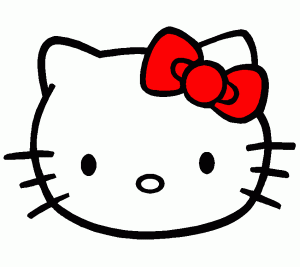
Hello Kitty - sans cute mouth

Hello Kitty – sans cute mouth

Or that the Pabst Blue Ribbon (PBR) beer was purchased in 1985 by a Texas ‘beer-baron’ whose business plan was to slash costs and let the brand “decline profitably”. PBR used to be the blue-collar beer of the working man.  Now it is the markedted blue-collar beer made en masse.

While Hello Kitty and PBR are cute and taste okay (in that order), the interesting section in his book is on volunteer product evangelists or word of mouth marketers (p. 166).  These are volunteers who work for companies like BzzAgent who employ ‘volunteers’ to talk up products.  The volunteers button-hole friends, neighbours and unsuspecting would-be consumers with encouragements to buy sausages, perfume or read particular books.  They are encouraged to post positive reviews and write glowing praise of the particular product that is being promoted.

Some of the volunteers spend as much as 10 hours a week doing the promotion, writing reports and networking with other volunteers.  This is a part-time job working for a marketing company, promoting products – all done pro bono.  Walker provides an example of one word of mouth marketer:

Gabriella and the rest of the [BzzAgent] sausage agents are not paid flunkies trying to maniplate Main Street Americans; they are Main Street Americans…. … and she gets no remuneration.  She and her many fellow agents had essentially volunteered to create “buzz” about …. dozens of … products, from books to shoes to beer to perfume.  By 2006, BzzAgent claimed to have more than 125,000 volunteer agents in its network.” (p. 168)

While these volunteers earn points for prizes – many do not cash in the points.  So what motivates them?  One BzzAgent agent Ginger explained her willingness to volunteer for the following reasons:

  • It was a chance to get products before their release (and be an insider)
  • BzzAgent gives her something to talk and opinion about with other people
  • She believes she is helping people – by promoting a specific product.

To be fair BzzAgent’s code of conduct includes an expectation that:

BzzAgents always tell others they are part of a word-of-mouth program.  Be proud to be a BzzAgent. When Bzzing others, you must let them know that you’re involved with BzzAgent and tell them what you received as part of the campaign. If you genuinely like something (or even if you don’t), it’s your open, honest opinion that counts.

Code of conduct notwithstanding, somehow it feels like BzzAgents are on the wrong side of an invisible line.  Certainly they are not boiler-room fraudsters trying to hustle little old ladies out of their life savings – but still there is a part of me that is a bit queasy about the whole word-of-mouth marketing model.

Perhaps it is because I am a ‘free-lance’ word of mouth marketer.  I promote businesses that have given me good services or products and I do so because I believe that I am being helpful.   However, I do so on products and services of my own choosing and without having to report back to the business (or an intermediary such as BzzAgent) of my efforts to date.  As well, when in the course of a normal conversation, how exactly do you interject that you are now been sponsored by the ACME corporation?  I envision a conversation like:

  • Frank’s Friend: Boy it sure hot today!
  • Frank: Sure is… oh, by the way, this part of conversation is brought to you byBzzAgent and Pabst Blue Ribbon beer or PBR.
    • Boy this PBR is sure refreshing, goes down smooth and is cheap too.  The beer of hipsters and rappers, PBR is the only beer for me. 
  • Frank: We now return to our regular conversation already in progress.
  • Frank’s Friend: Huh?  Are you okay?  I think you need to get out of the sun and stop drinking so much of the PBR swill.

Myself, I am happy to stay on this side of that invisible line and continue to promote/malign in an objective manner good/bad products and services.  Nevertheless, I would love to hear your comments – perhaps over an ice-cold and refreshing PBR, the official beer of word of mouth marketers….

Where Public Health Stops and the Nanny State Begins

Last week I had the pleasure of hearing Dr. Talbot speak.  If you don’t know who he is but you have heard of the current measles outbreak or past-pandemics, then you know of his and his office’s work. In addition, if you get a chance to hear him speak (and hopefully not telling you that there is a quarantine on your house), be sure that you hear what he has to say.

Firstly he is an engaging and down to earth speaker who has a knack of being able to explain the complex via the simple metaphor.  Secondly he has excellent perspectives on how public health can be cheap yet effective.  Finally he has an excellent sense of the history of public health and a sense of humor.  He can tell you about the cholera outbreaks of yester-year to the current measles blip with a wry context.

So while I would encourage you to hear Dr. Talbot speak, listen as a private-citizen looking to protect your own right of choice in a free society.  Hear what he has to say on public health but ask where the public good stops and the Nanny State begins.  Here are some examples, one past and some future.  The past example is the public health battle against public smoking.  I will admit that I have had the very occasional good cigar but otherwise have never caught the smoking bug.  Thus, over the past ten years, I was ambivalent and ultimately thankful when smoking was banned in places like bars and restaurants.  In my view,assuming you have read the warnings on a cigarette package, and you are not polluting my space or kids – it was your choice to start, continue or stop smoking.  In other words, banning smoking in public places is a reasonable public health compromise of personal choice versus public good.

Fast forward now into a time when sugary drinks are perhaps the new smoking campaign.  Not only will we not be able to super-size our mega-drinks while ordering a big Muck, they pop is banned outright as a public health measure.  Because I am not a big pop drinker, perhaps I will continue to watch this change with more ambivalence.

But what about the next step beyond smokes and a glass of pop.  What happens when public health measures become so intrusive that there is a backlash against them – and good is thrown out with the bad.  Perhaps we are seeing this already with the local measles outbreak.  A virtually preventable disease making  a come back because some parents have chosen not to vaccinate their children.

In other words, public health measures which effectively reduce our choice or make decisions for us (smoking, sugary drinks) may lead to public health challenges because people are tired of having choice taken away from them.

This situation can be described in the question of where exactly does public health stop and an intrusive nanny state in the guise of public health kick in?  I don’t have an answer but it is an excellent question that I will ask Dr. Talbot the next time I hear him speak.

PP+E, Its Life, Its Verification, Its Article

Happy Victoria Day (the first long weekend of the traditional Canadian Summer, e.g. no snow – maybe).  In addition to celebrating a long dead monarch of the British Empire, I am also celebrating the publication of my 6th published article (an even half-dozen!).  Entitled, the IAEA Property, Plant and Equipment Lifecycle Framework (whew!), I am pleased at how it turned out.  If you want to read it right now, visit the Spring 2014 FMI-Website.

If you want some more details on the framework, be sure to check out my Director’s Cut of the Framework.  Included in the Director’s cut is a bit more detail on the Verification Framework and Attractive Assets.

Once again, thank you to my ‘friendly peer-reviewers‘ who assisted me in developing this article and to the IAEA for giving me a chance to solidify this set of ideas (and an incredible one year!).

So, enjoy the long weekend (fellow Canadians) and if you have trouble sleeping, take a read at article number 6… and now to start writing article number 7… after the long weekend!

DIY Sleep – Luddite’s Style

I have two shocking confessions.  The first is that my first and only smart phone to date is an employee issued Blackberry Bold.  The second is that I appear to snore – a lot.  To the second confession, I have an apology to make.  To all of those friends and family members I have shaed a room with, I am sorry about the snoring thing.  (Errr, a small explanation, room sharing means the same sleeping areas, for example a dorm in a hostel…).

The two confessions are related in the following way.  To start, I thought I had a health problem (snoring) and being a Do It Yourself (DIY) kinda guy, I went out and bought a digital voice recorder and software for analyzing sound.  Over the past few nights, I have been recording the ambient room noise and then analyzing them with the software.  I have done this to confirm that yep, I sure as heck snore.

Sound Sample from May 9th.

Sound Sample from May 9th.

The above graphic I plan to give to my family doctor physician when I see him next week.  Not sure what happens next but I do I hope to start sharing rooms with friends and family once again (in a platonic hostel-dorm sort of way).

The smart phone confession comes in when I thought, “This is brilliant, why hasn’t someone built an app for this (recording and analyzing snoring)”.  Well lo and behold, about 100 different apps available on the market (google ‘app snore sound record’ for about 700,000 hits).  Had I been more smartphone savvy and less of a Luddite, I would have realized that instead of a DIY solution, my Blackberry could have done this with an app that is either free or at most a few bucks.

Looking a head 10 years, perhaps it might be strange to your family physician if you did not show up with a record of your sleep – whether you suffered from snoring or not.  Of course the smart phone 10 years hence may also tell your doctor your average blood sugar, physical activity, pulse rate, blood pressure and karma/fung shi levels as well.  In other words, the smart phone may become our most powerful tool to maintain a healthy lifestyle.

There is an Orwellian double-edge sword here.  What happens if that information is not freely given but instead is demanded by insurance companies, employers, health authorities or governments.  This is not as much of a stretch as you think.  The US National Highway Traffic Safety Administration (NHTSA) estimates that there are 1,550 fatalities and 40,000 injuries as a result of driving drowsy.  People who do not drink or smoke get insurance breaks – why not people who sleep well?  Employers can test for drugs, why not how well you have slept over the last month?

George Orwell aside, I hope my Luddite-DIY-Snore information can help me get a better night’s sleep in the coming months.  Wish me luck!

The Origin of the Origin – Charles Darwin

Evolutionary theory is a key underpinning of our understanding of our natural world.  It, and its sister theories (e.g. the theory of gravity, germ theory, planetary motion, thermodynamics… well you get the idea) have given us a profound understanding of our planet and the universe.

I suspect that I am like most people in that had a fuzzy notion of who Charles Darwin was.  He took a trip on the Beagle, visit eco-tourist spots (Galapagos) and wrote a book, On the Origin of Species.  Oh, and he had a cool beard (as it turns out primarily because he had trouble shaving himself).

Charles Darwin - in old age

Charles Darwin – in old age

It turns out that Darwin was a well-respected Zoologist in his own right long before his evolutionary explosion.  Detailed in a very accessible book, Charles Darwin, Cyril Aydon, follows his life from his wealthy beginnings to, well, his wealthy end.

A key theme of Aydon’s was that Darwin was very privileged and fortunate.  He was born into a solid upper-middle class family and he had a (for the time) relatively supportive and indulgent father.  On the latter point, Darwin’s success on the Beagle was due in part to his father’s willingness to fund expeditions and the trip itself.

Upon his return, his family wealth and his need to organize the fruits of the expedition allowed him time and resources to become a well-respected zoologist and authority in his own right.  Thus his fear of being a dilettante was allayed by the quality of his earlier works.  This also gave him the necessary credibility for his work on evolution.

Two other things that I had not appreciated about Darwin were his family focus and his very poor health.  He married well into both a good dowry but also an understanding and loving companion in Emma.  They dotted on their children and it sounds like the Darwin’s was the place to go for lunch and sleep-overs if you were friends with their kids.  Darwin was a homebody partly because of very poor health (and was exacerbated by stress).

Aydon does not shy away from Darwin’s warts.  The author paints Darwin for what he was, an eccentric scientist boiling pots of animal remains to examine the creature’s skeletal structure.  His marriage to Emma was fortunate because she was self-effacing, put her husband’s needs ahead of her own and was not an intellectual force in her own right.  Also Darwin was fortunate to have boosters who promoted and defended his ideas (e.g. Thomas Huxley) when his poor health would have prevented him from doing so.

In the end, Darwin lived a good life and was productive well into his later years.  He was survived by his beloved Emma and most of his children.  Darwin contributed scientific understanding that would have made him a well-respected zoologist – and of course he started us down a path that forms much of our modern-biological understanding.

Aydon’s book, Charles Darwin, is a good and very accessible read and biography for those who want to understand the origin of the origin.