
Most people have heard of the marshmallow test. Ask a young child if they want one marshmallow now or two in a short while. The test was designed and originally delivered in the late 1960’s and early 1970’s, it showed a correlation between a young child’s ability to delay gratification and their future success [1].
Gratifying Poverty
Subsequent follow ups and attempts to replicate the original results demonstrated that the success the child had in the future was not so much their disciple at an early age but instead their entire family and social environment. Discipline was an effect of the cause of family social status and cultural norms. Children from poor families failed the marshmallow test and were later less well because they were from poor families [2].
This challenge of cause and effect is relevant to designing financial literacy programs for families and in particular designing programs that help families set and attain goals. Goal setting and attainment is a sign of emotional and cognitive maturity. It is also a sign of whether or not you can afford you goals.
Why SMART is Dumb
This leads us to the gold standard to evaluate a goal, SMART. First coined in 1981, the acronym stood for Specific, Measurable, Assignable, Realistic and Time-Related. The various letters have drifted in different interpretations including Achievable versus Assignable and Together versus Time-Bound.
SMART was developed in context of corporate planning. As such, it is a great memory jog. Deciding to sell 10,000 cubic metres of sand to the Saudi government by next year is Specific, Measurable, and Time bound. But is it realistic and thus assignable or achievable… given the surplus of sand in the Arabian Peninsula [3]?
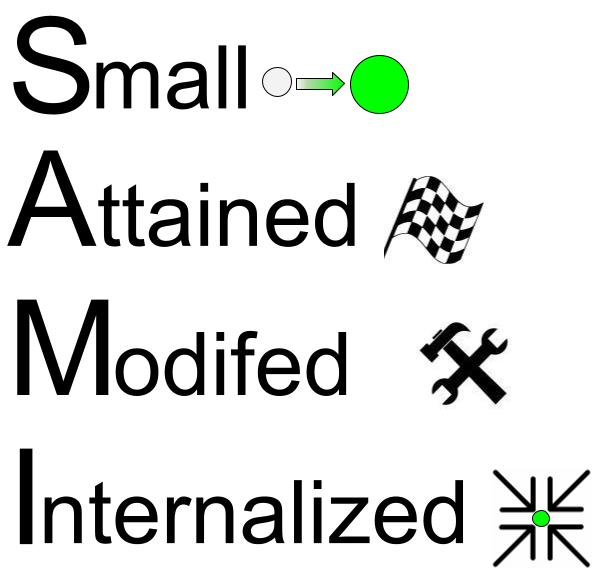
SMART is a good tool if you are testing a goal. It is a terrible thing to inflict on a struggling family trying to deal with too little money, too many dreams and too many distractions. Instead of trying to define a perfect goal that will probably be abandoned, focus instead on:
- Small Goals: set small goals as an example of what the process of goal setting feels like. Larger and more complex goals can be added in time.
- Attained Goals: small and immediately achievable goals allow them to be finished creating a sense of success.
- Modified Goal: Based on the above experience, increase the size, complexity and difficulty of the goals – SLOWLY. Modified also means establishing the processes to change a goal when it is no longer relevant or circumstances have changed.
- Internalized Goal Setting: Goal setting, attainment and their responsible modification becomes internalized in the habits and abilities of the family. When this has occurred, more complex concepts, such as SMART can be introduced.
Goal Setting Takes Practice
Setting goals is easy, completing them is hard, and responsibly modifying them harder still. As a result, a financial literacy program needs to focus on helping a family:
- Identify possible goals and select 1-3 near term goals that are obtainable.
- Write down and define the goal. Don’t go all ‘SMART’ on the family, writing down an objective may be challenging enough.
- Be reminded of the goal on a periodic basis so they don’t get superseded by the next distraction.
- Understand the trade offs between the future state and the Want or Impulse calling to them today [4].
- Modify a goal when reality strikes and the goal needs to be expanded, changed or abandoned.
- Know when a goal is completed and they can start the next one.
- Cultivating an appreciation of goal completion as an end in itself.
Notes and Reference
- Mischel, Walter; Ebbesen, Ebbe B. (1970). “Attention in delay of gratification”. Journal of Personality and Social Psychology. 16 (2): 329–337 and numerous subsequent follow up discussions available.
- Numerous sources, including the Behavioral Scientist. “Try to Resist Misinterpreting the Marshmallow Test,” July 3, 2018. https://behavioralscientist.org/try-to-resist-misinterpreting-the-marshmallow-test/.
- I selected this example because Saudi Arabia does in fact import sand. Its desert sand is not usable for concrete production. This in turn has led a global sand shortage and thefts of whole beaches. Why Saudi Arabia Imports Sand, a tongue in cheek discussion on this.
- For more on what is a want, impulse or need see my prior blog, The Goal is Learning to Set Goals.
 Organizational Biology
Pingback: 2×2 Goal | Organizational Biology & Other Thoughts