
It is sometimes necessary to divide a group up randomly. While the good ole’ fashion count-down-the-line works, it fails to give the resulting groups a starting point of their own identity.

Belgium Births
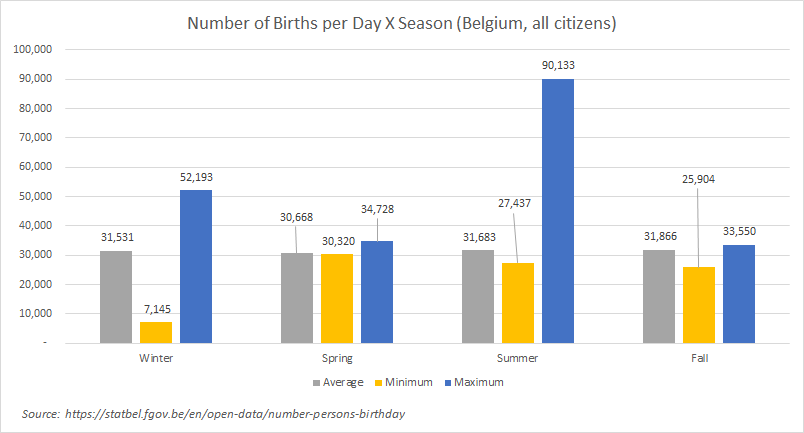
Fortunately, humans tend to have babies throughout the year. The following graph shows the distribution of Belgium birthdays [1] across four seasons. Belgium has about 11.5 million citizens. On average there are about 31,000 births X 365.25 = 11.4 million – the math checks out [2]. There are about the same number of births for each of the four seasons with Spring being slightly lower.
In other words, statistically, the season when a person is born is a reasonable method to randomly distributed a sufficiently large group of people [3].
Season of Birth as a Randomizer
To divide an audience into four groups, set up a graphic for each of the seasons and ask people to self-select where they belong. Self-selection is important. Most people are honest and if a person is uncomfortable publicly selecting a Season, privately tell them to pick one.
Smaller groups may result in small distribution difference (remember the law of large numbers). Move a few folks around to balance out the four groups (e.g. December birthdays join Winter if Winter is a bit smallish).
A Bit of Commonality
The advantage of this method is that it gives the resulting groups something in common which is effectively random. The day of birth [4] is another option but it is getting a bit close to personal information – this is why I prefer this method.
Do you Need Two or Three Groups?
If you need just two groups, break the audience into Summer and Winter.

If you need three groups, try Summer, Fall, and Winter.

Further Reading and Notes
- Why Belgium? Because the data set appeared fairly high in a google search. The national statistical organization makes this file available via open data: https://statbel.fgov.be/en/open-data/number-persons-birthday.
- Because you are going to ask:
- February 29 is the least likely birthday (go figure) followed by November 11 (remember that date… a joke for Canadian Readers).
- July 1st is a busy day in Belgium maternity wards with nearly 4x as many birthdays following on ‘Canada Day’ as any other date (another reference for Canadian readers).
- January 1st is the second most likely birthday (hmm, perhaps a Belgium tax benefit)?
- Setting aside these outliers, the remainder averages out to about 31,000 birthdays per calendar day.
- See the discussion on the law of large numbers.
- To create four groups, all those born on a day divisible by 1 or 2 (but not 4) or 3 or 4 go to four distinct groups. To create 3 groups, drop the divisible by 4. To create 2 groups, self identify the odds and evens.
 Organizational Biology