
A core premise of adult learning is that the individual must have influence over the content of the instruction. In a workshop setting, this can be done by asking participants to rate both their knowledge of a topic and the relative importance a topic is to them relative to the time and attention available in the session.
RELEASE THE DOTS!
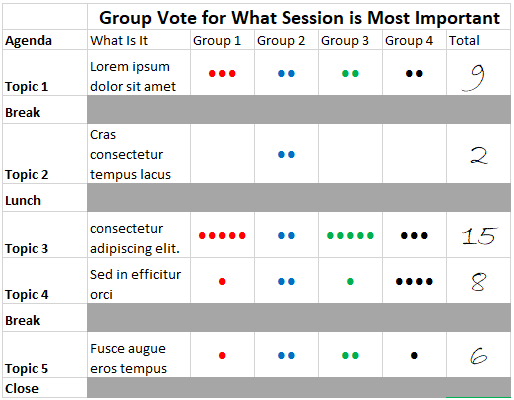
An age old method to collect scoring in a facilitation environment is to use sticky-dots on flip charts. The following graphic assumes the audience has been divided into groups and five topics to be covered in a one day session.
Topic Three is the Winner!
After dividing the audience into four groups (perhaps using the Seated by Season method described in an earlier blog), each group receives 10 ‘dots’. The group has a defined amount of time (e.g. 5-minutes) to agree to the allocation of the dots across the topics. Ideally make the number of topics dividable into the number of dots. In this way, a group may simply allocate their dots across all topics indicating equivalent importance such as what group 2 did.
Topic 3 has garnered the most interest with Topic 2 the least. The facilitator can then discuss the rationale for the scoring. It may be because the audience is well versed in topic 2 and its importance can be de-emphasized and the time re-allocated. Alternatively, the audience may have been unaware of the importance of this topic.
Monochrome Voting
In the above graphic, I have separated out the groups so I could drill down on the motivations of a sub-set of the entire audience. The alternative is to distribute a single colour and not identify the groups. This might be done early in a session before these sub-groups have had a chance to ‘Form/Storm’.
 Organizational Biology