This page is transferred to its new home on its own dedicated website (www.yegville.ca). It is being retained for now until the transfer has been completed.
Welcome to YEG-Ville Snowshoeing. Hundreds of places to use your snowshoes in about a two-hour drive from Edmonton, Alberta.
Page Overview
- What is a YEG exactly?
- The Two Hour Hard and Fast (ish) Rule
- Challenge Category
- Four Quadrants of Adventures
- Trail Guide Details
- Trip Rating
- Safety and Personal Responsibility
- Equipment and What to Wear
- Notes and References
1. What is a YEG exactly?
YEG is the code [1] for the Edmonton International Airport. YEG represents more than just the city. It is a way to describe Central and Northern Alberta. If you drew an East-West line along Highway 11, everything north of the highway would be YEG territory. … which is a pretty big area.

2. The Two Hour Hard and Fast (ish) Rule
If YEG was a country, its area would be 523,334 km² [2] the 50th largest country in the world [3]. While this would make it on par with Yemen or Thailand… AND, YEG has much better snowshoeing.
For this snowshoe guide, YEG-Ville is smaller and defined as anything about a 2-hour drive one-way. The area around Edmonton in the above map roughly corresponds to this. YEG-Ville is only 38,000 square kilometers. If it was a country, it would be on par with Bhutan – where snowshoeing is excellent [4]. Because every 2-hour drive has to start somewhere, all distances are denoted in Wayne Gretzky driving units.
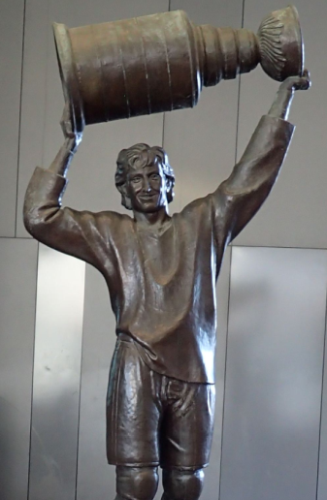
Depending where you live, you will need to factor your own travel time to get to the statute of the great one at Rogers Place. Calculations are based Wayne not moving from 53.54629, -113.49723 and calculated using:
Distance Calculator
3. Challenge Category
Unfortunately, not every location in YEG-Ville is worth the drive. I have been to them all and some live up to their advanced billing, some are little known jewels and others are, well stinkers. As well, the stink-i-ness of a location is in the snowshoe of the beholder. For a beginner, a few KMs of trail and a washroom if shoe-Nirvana. For an experienced individual, that Nirvana is boring.
As a result, all of the locations are grouped into the following three Challenge-categories:
- EASY-PEASY: While short on distance or technical challenges, these locations offer washrooms, trails and a place for Low Beginners+ to try out the sport. They are typically kid-friendly meaning there is a playground or something to keep a 4-16 year old occupied. EASY-PEASIES are good for other activities such as cross-country skiing, walking, taking Fido for a stretch, or fat biking.
- ADVENTURE: A step up form Easy-Peasy, these locations either offer longer distances (e.g. 5+ KM), involve ice safety (e.g. a frozen lake or river) or have some technical challenges. They may have washrooms and other amenities but don’t count on it. If your kids are more adventurous, bring them along. Activities beyond those with done in EASY-PEASY locals may include ice fishing or hunting. These locations are for Beginners and above.
- OFF THE BEATEN TRACK: These are other locations in natural areas and land trusts in and around the city. There are hundreds of these locations many coming with interesting stories of early settlers, First Nations, or a generous land owner who has made a donation. Not all of them have been well cared for, however, All Terrain Vehicles (ATVs) gouge deep ruts or there are few trails to follow. Nevertheless, they are included as part of the legacy of nature available to us YEG-Villers. Some are worth the drive. For others, drop by only if you are in the neighbourhood.
- NOT MUCH HERE: Sometimes things don’t work out. I am listing these locations even if I really never need to go back (at least for snowshoeing). You may still want to drop by but don’t say I didn’t warn you.
4. Four Quadrants of Snowshoeing
YEG-Ville is still a big place so I have further divided it into four quadrants with the following approximate boundaries.
- North West: North of Highway 16 and West of Highway 2.
- North East: North of Highway 14 and East of Highway 2.
- South East: South of Highway 14 and East of Highway 2
- South West: North of Highway 11 and West of Highway 2.
5. Trail Guide Details & Overview
Each location has a set of descriptions of how to get there and what to expect.
5.A Definitions for Each Location
- Name and Owner: Official name and who owns the land (e.g. a trust, government, county, etc.).
- Is it Worth It?: Let’s face it, driving 2-hours to discover you are trumping around in a flat featureless field is disappointing. A 1-5 rating is provided with 1 on the low end and 5 at the fantastic end. You won’t find many 1s or 2s unless they are very close to the city and near other higher-scoring destinations.
- Why Here?: Related to ‘Is it Worth it?’, what exactly is here. This includes nature, distance from civilization, likelihood of being run over by a snowmobile and other factors.
- Location and WGU: Provided in Latitude/Longitude and Alberta’s rural address system [4] and linked to its Google map placement. Wayne Gretzky driving time and distance provides a comparator between locations.
- Backroad Map Books: Either the Central Alberta or Northern Alberta map book, page number of and grid location. A paper map is always recommended when heading out on an Alberta-winter highway.
- Maps: A map of the location. For lower rated trips, this may simply be an overview of the area. For better rated trips, published trail routes.
- Difficulty Rating and Safety Considerations: Most of the locations are low difficulty. A higher rating is given for water crossing, hills, challenging terrain or an isolated area.
- Links and Further Reading: Historical notes and activities besides snowshoeing. All links worked the day I posted them but let me know if they have since changed.
- The Drive Out: Half the fun of heading out to these locations is driving through rural Alberta. Enjoy the journey. I have provided notes of interesting things to look for, what the locals know and possible side trip (e.g. museums).
- The Other Shoe: Non-snowshoe, self-propelled activities that are possible in the area.
- Phrank’s Trip Notes: When I first did the trip and subsequent returns to the location.
4B. Not Just for Snowshoeing
I have visited everyone of the locations in this book at least once. As natural areas, they don’t change much year to year. However, fires, new restrictions or other unforeseen changes may happen. Always check the links and do an internet search particularly for the smaller locations.
Many of the locations can be enjoyed year-round and for more than snowshoeing. They may be destinations for summer hikes, bird watching or mountain biking. Where these activities seem possible, I have listed them. I have also indicated whether a location was a good destination to take children to. For the ankle-biter set, I have kept an eye out for playgrounds, parks, nature programs and the like.
If an area permits noise makers such as snowmobiling or all-terrain vehicles, these are noted. While nothing is worse than a quiet winter day interrupted by an engine, snowmobiles do make excellent compacted snow.
5. Difficulty Rating
I use Andrew J. Nugara’s rating system from his books on how to snowshoe in the Rocky Mountains [REFERENCE]. I have expanded the definitions of beginner or intermediate trips. See the reference section for more on Nugara’s books [PENDING].
- Low Beginner
- Inner city or close by urban areas.
- Less than 5KMs in distance round trip.
- Nominal cumulative elevation gain (less than 50M).
- No technical challenges (e.g. walking through bush, steep grades).
- New, untested or ‘Department Store’ equipment acceptable.
- Beginner
- Inner city or close by urban areas.
- Less than 10KMs round trip.
- Nominal cumulative elevation gain (less than 100M).
- Few technical challenges.
- High Beginner
- Less than an hour’s drive to Wayne Gretzky on good highways (e.g. Elk Island, Chickakoo)
- Less than 15KMs round trip.
- Some cumulative elevation gain (less than 150M).
- Some technical challenges (e.g. ATV ruts, hills, distance from urban areas).
- Lake or river sections in which there is a danger of break through.
- Recreational snowshoes of at least moderate quality required, test equipment on lower rated trips.
- Low Intermediate
- One to two-hour drive from Wayne Gretzky.
- Less than 15KMs round trip.
- Some cumulative elevation gain (less than 200M).
- Number of technical challenges (e.g. walking through bush, steep grades, etc.).
- Lake or river sections in which there is a danger of break through.
- Recreational snowshoes of at least moderate quality required, test equipment on lower rated trips
- Intermediate
- One to two-hour drive from Wayne Gretzky.
- Less than 25KMs in distance round trip.
- Carry emergency equipment (e.g. matches, emergency blankets, whistle, etc.).
- Some cumulative elevation gain (less than 300M).
- Recreational snowshoes of moderate or better quality required, equipment should have been used recently to ensure it is in good working order.
- Numerous technical challenges.
- Hazards (e.g. rock falls, avalanche potential, exposure on steep as/descents.
- Lake or river sections in which there is a danger of break through.
- High Intermediate and Beyond: Beyond the scope of YEG-Ville.
6. Safety and Personal Responsibility
Leaving your house in the winter to drive on an Alberta highway can kill you. Strapping on snowshoes and trumping about in the snow can give you a heart attack. Having a problem in a remote, rural Alberta location or on a back road may result in you freezing to death or at least losing a toe or two to frost bite. Life is dangerous and stay home, watch TV and get fat on the couch… wait that will kill you as well.
Okay, how about leave the house but take some friggin’ common sense with you! If you have never snowshoed in your life, start nearer to the Wayne Gretzky statute by doing it in the city’s river valley. If car is a piece of sh*t don’t drive it 2-hours on winter highways. Let people know where you are going, particularly if the area seems remote. Pack extra water, a blanket, matches, and food in case you have to spend the night.
7. Equipment and What to Wear
What to wear and what to use while snowshoeing is a matter of personal preference, your own physiology and of course what you own. There are OODLES of resources on the internet on the subject so Google away (some good resources are included in the Notes section below). The following are a few key considerations, starting with your feet and working upwards.
7A. Snowshoe Varieties
When I was a kid, snowshoes were simple and not a lot of fun. They were constructed of wood, had animal gut webbing and impossible to tie frozen straps. After taking 3 steps, the frozen webbing would come loose and frustration would set in.
Better bindings (some made from recycle car inner-tubes) helped but this identified another problem: wooden snowshoes are slippery suckers. You could walk more than 3 steps but God-forbid if any of that journey involved the slightest elevation. Fast forward to 2008 when I bought this pair of MSR shoes:

The orange frame is made out of aluminum, the deck (black part) is a strong nylon material and the bindings (straps) are neoprene. This set has been repaired a few times. Wear on the decking was fixed with Duct Tape. I put a bolt in the heal-strap because I was wearing the same size hiking boots and the strap had a tendency to come loose. Grip wise, the entire frame acts as a crampon.
This set of snowshoes is close to the upper end in quality and design and I am glad I paid the money. Of course, if you are just getting into snowshoeing, consider renting them or buy a pair of cheapies. Worst case, you will have a spare pair after you upgrade.
7B. What Boot to Wear
Check the forecast for what type of boots and socks to wear. If it is a warm day (e.g. -5C to 2C), a pair of walking shoes may work if the trail is trampled and your shell pants long enough. Colder than that, I prefer a hiking boot with increasing levels of sock thickness. This will take me from 0C to -20C. Colder than this may call for an actual winter boot – or staying home and binge on Breaking Bad.
While on the subject of the feet and lower legs, a good pair of gaiters will keep your feet dry and snow out of your socks. Shell pants might work but snow flakes are sneaky and like to snuggle with the ankle bone.
7C. Head and Shoulders, Knees and Toes
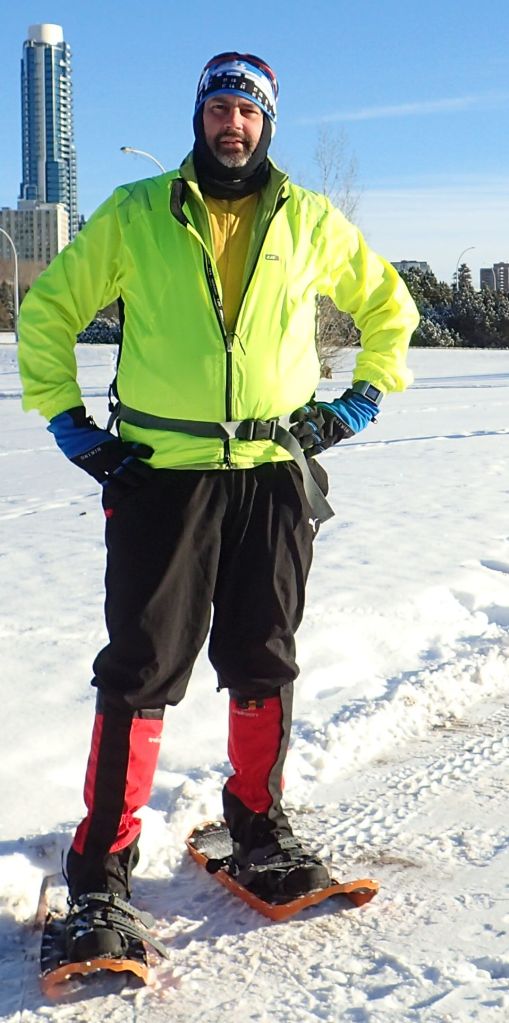
I run hot which means even down to -10C I will often only be wearing a cycling jersey, shell pants and be hatless. For those who run colder or when starting out, layers are your friends. Once you find that perfect combination of layers, take a picture of yourself so you can remember what to (not) wear. In particular, note what worked for these areas:
- Head/Neck:
- Torso:
- Hands:
- Legs:
- Feet:
- Pack:
- Comments
2016-12-27: -8C to -4C light winds, sunny
- Head/Neck: light beanie or bare head to evacuate heat; initially a fleece headtube.
- Torso: long sleeve cycling jersey, fleece vest; cycling shell although this was quickly taken off.
- Hands: initially, neoprene cycling gloves and then full-finger summer cycling gloves.
- Legs: Shell pants with gaiters
- Feet: Hiking boots.
2017-01-02: -25C to -19C, ice fog and the clearing, no wind.
- Head/Neck: Insulated cap, head tube.
- Torso: Winter insulated shell.
- Hands: Lobster mitts.
- Legs: Insulated snow pants
- Feet: Hiking boots.
- Comments: had to exchange neoprene gloves for lobster mitts. After ~20 minutes began to over-heat so exposed head. Shell and fleece vest were adequate when temperature had warmed up (-17C to -20C).

08. Summary, Notes and References
An internet search engine and trial and error will help you buy equipment, select clothing and become confident in your snowshoes. The following links provide interesting rabbit holes and some references. Now, let’s Shoeing!
- WTF is up with the Y in Canadian Airports?
- Estimated with the very cool tool available at: freemaptools.com.
- Yeah Wikipedia! List of countries and dependencies by area.
- Bhutan is in the Himalayas. A quick Google search resulted in a number of outfitters who will take you and your snowshoes there!
- The most current Central Alberta edition is the 5th and Northern Alberta is on its 4th edition.
- Snowshoe Purchase Guidelines, lots of resources, here are few to get you started:
- REI from the US: How to Choose Snowshoes.
- Best Snowshoe Review – who knew there was a website dedicated to buying snowshoes?
- Snowshoe Magazine – with a name like that, they must know a thing or two.
 Organizational Biology