Maximizing a Secondment Experience

This past Friday I met up with a fellow Government of Alberta (GoA) employee by the name of Henry (name changed to protect the innocent from bad blogging) who is soon off to Washington DC for a two-year secondment with an international banking organization (the Bank). Henry wanted to pick my brains about my secondment experience with the International Atomic Energy Agency (IAEA) a few years back. I thought the advice I gave him so good that I figured I would take some notes on the off-chance anybody ever asks me again (hey, it could happen).

Before, During and After

As it is always good to start with a definition, thefreedictionary.com defines it as:

2. secondment – the detachment of a person from their regular organization for temporary assignment elsewhere.

From this definition, a secondment involves three parties. Henry; the GoA or the ongoing employer; and the seconding organization – in this case the Bank. Secondments also have three distinct time periods: the time before you go, the time on secondment and then the return. While good to think of them in three distinct periods they should nevertheless have a constant theme – the Value Proposition to three parties involved in the secondment.

Before the Before – The Secondment Circumstances

A secondment happens because a person has:

  • a) applied for a position possibly unbeknownst to their current employer,
  • b) the ongoing-employer encouraged the person to apply, or
  • c) the person was requested by the seconding organization.

There is a subtle difference between these circumstances. Henry was encouraged to apply to the Bank position by the GoA. Thus his boss (his home Ministry) is behind him 100%.  In contrast, I have found myself in both circumstance a) and c). In 2003 I had sought out an opportunity to work in Munich Germany – type a). Unfortunately the employer at the time did not grant me a leave of absence and as a result I quit that job to go to Germany. In 2010, the IAEA sought me out to assist with an accounting project – type c). In this case, I was able to secure a leave so as to take the secondment. What changed in the intervening seven years? I had a better understanding of how to sell the value proposition of the leave to my ongoing employer.

To support this value proposition, it was critical that the IAEA email/write to my boss and describe the circumstances behind why they specifically wanted me and the value to the GoA of my involvement. This provided credibility to the experience and started the process of making my experience a larger organizational experience.

Before – Start with the End in Mind

Henry, assuming you have the full endorsement from your Assistant Deputy Minister (ADM), it is now time to start planning for your return from your secondment. Steven Covery calls this ‘starting with the end in mind’. Envision the first day/week/year of your return from the secondment and define how you want to be thinking about success for the experience. To help you with this visioning, enlist the aid of your boss (and your boss’ boss); ask questions such as:

  • What are the three critical things you want me to accomplish while on this experience?
  • What is the number one problem for our organization the seconding organization can help us with?
  • If you were me, what would be your personal and professional priorities for this experience?

You don’t have to accept all of their advice but you should accept those that align best with your own ambitions, interests or priorities. The benefits for you to start with the end in mind includes:

  • It reinforces the fact that you will be returning to the ongoing employer.
  • It begins the process of making your secondment a shared experience with the organization.
  • It helps you to define the ongoing value proposition themes.

I have been focusing on your employer Henry but don’t forget to do the same thing for your friends and family. What does your wife want to have accomplished in the same time period? Can you offer to host family members so as to share the experience? Can you take your children and can they take part in the international school experience? For myself, here are the goals I had when I went to Vienna:

Goal 1: Family & Health

  • Setting up circumstances to share this experience with my wife and son
  • Maintain my health so I can continue to be productive
  • Experience the Austrian cultural life as much as a non-German speaker can

Goal 2: Exit Gracefully the IAEA

  • Contribute positively and effectively to the project
  • Over the course of the year, complete about 90 ‘things’ well to support the project

Goal 3: Re-Enter the Government of Alberta Gracefully

  • Re-charged, reset and ready for new challenges.

Goal 4: Prepare for Future Opportunities

During the Secondment

In a very short period of time you will be living the dream – the secondee in Washington DC. Then, in a few months the honeymoon will end. At this point you will start to feel (at least a bit) depressed, in limbo, out of touch and isolated. Fortunately the cultural difference between Washington DC and Edmonton are not as extreme as say Edmonton and Haiti. Nevertheless, more than likely you will be living in a small apartment, working in a small cubicle for seconded staff*. And the permanent staff members and those around you will have their own lives and families to go home to.

* small aside, I had a great office and room-mate while working for the IAEA – nevertheless I have worked in some crappy places as a consultant.

So feeling tired, out of sorts and a bit crummy is normal; expect it, deal with it and get over it. A two-year secondment means that you will have 780 days on the ground. 780 is not a large number and it will go by fast. Nearly 25% of the time will be the weekend or statutory holidays (and you will be working a few of these, trust me). 10-15% of these days will be vacation/leave (guard these jealously!). Now you are down to 500’ish work-days. Be clear with your new boss what you want to/can/must accomplish in those 500 days.

Just as important, for the weekends and leave days, what do you want to accomplish? Do you want to visit every memorial/museum in the city, drive the entire east coast of the United States, explore the Southern United States – set a goal and have a great time accomplishing it!

At the same time though, don’t forget about your ongoing employer. While I was in Vienna I tried to provide a monthly ‘blog’ to my home Ministry. Generally I would alternate between a technical themes (e.g. on accounting, governance structures, etc.) and personal matters (e.g. Christmas markets, cycling or Vienna wall murals). Contact your communications person and establish a writing schedule, possible themes – and then stick to them! Amongst other things, it will force you to better understand your experience, your organization and it will give you some great memories (see the links at the end of this Blog).

After the Secondment

Here is a curious fact Henry – a week or so after finishing the experience, it will be as if you never left. If you don’t plan your return carefully this fact can lead to a sense of loss or make you question why you went in the first place. In contrast a well-planned return can give you a sense of closure, purpose and context for the experience. Here are some suggestions for a ‘gracefully re-entry’ to your Ministry:

  • Keep your goals up to date. The will evolve and change, that is okay, but keep focused on why you took the secondment in the first place before, during and after its completion.
  • Keep in touch with your boss, organization and co-workers. See the blogs discussed above but include a few phone calls to your boss, emails to co-workers, etc. to stay in touch.
  • Share the experience by presenting it. Plan to do a series (e.g. 2-4) brown bag lunches on your experience. Space them out every 2-3 weeks. During the presentation don’t forget to profusely thank your boss and the organization for the experience.  I have included links to the three presentations I did below.
  • Stay in touch with the Bank and its family of employees.  They are part of you and your network now.  And of course, if they need a good accountant who writes blogs, I can send you my resume….

So Henry, that is my advice in a nut shell. Your secondment experience will go by fast! Best wishes to you and your wife and make the best possible use of your 780 days. Also, don’t forget to include me on your blogs about your experience!

 Sample Blog and Presentations

(Links fixed, 2013-11-27)

Drive-By-Management

Drive Bys, Definitions and Dilbert

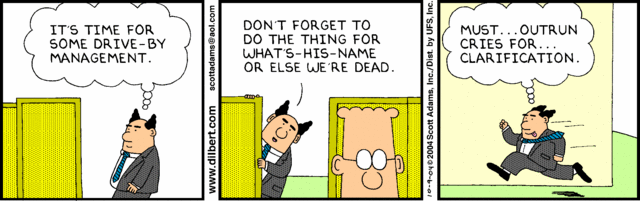
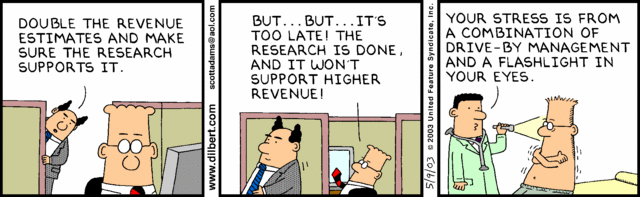
Now that cycling season is over, it is time to get back to thinking about Organizational Biology – and this includes updating Phrankisms.  What really jogged my memory (and motivation) was coming across a couple of old Dilbert cartoons introducing the concept of ‘Drive-By-Management’.

Provide courtesy of www.dilbert.com per the Uclick terms of use policy, all rights reserved by Uclick and its associates.

The urban dictionary defines Drive By Management as:

A management style bearing the characteristics of a drive-by shooting. Typically, this involves firing off pointers at subordinates with a total lack of regard for accuracy or willingness to take personal responsibility. The manager will then make a quick getaway without accomplishing anything.

I am not sure that quite captures my thoughts on the matter so my definition is:

The assignment of work objectives without the opportunity to negotiate the corresponding details to ensure an optimal result. These details may include due dates, quality or quantity measures, the purpose or ultimate use of the output and a discussion on how to improve the quality and productivity of similar, future requests.

John Wayne, the Military and What is the Problem?

So, what is the problem with Drive-by-management? Heck, think of a John Wayne war movie where he orders (or is ordered to) take that hill/building/machine-gun-nest. The doomed squad goes off with determined grit on their face to achieve the objective despite the possible costs. Later, a smaller number return having achieved the objective and saving the day. Hearty pats on the back and more determined gritted-faces follow. What is not to love about Drive-By-Management!

From a leadership position, the ability to send men (and women) off to do the impossible, without the bother of having to provide details or context, sounds pretty good. In reality it does not work that way. Let’s go back to Mr. Wayne and the military example.

Militaries don’t tend to willy-nilly send their soldiers off to certain doom simply because soldiers, in particular modern ones, are hard to come by.  Perhaps the last time we saw such willy-nilly’ness on a large-scale was during the First World War. Thus a military squad capturing a hill is actually not really Drive-By-Management. Before being sent off, the squad has had training on such things. It benefits from resources such as weapons, supporting fire, and communications between it and the rear.  The squad also has a visible objective – the hill/building/machine-gun-nest. After the objective is achieved, it will be carefully documented in the war diary and will likely be debriefed and evaluated by the higher-ups to see what can be learned for the next hill/building/machine-gun-nest. As a result John Wayne and real life equivalents display very little Drive-By’ness.

A better military example of Drive-By-Management in a military context is the Charge of the Light Brigade. If you don’t know the history the summary is there was:

  1. Personal antagonism on the part of the leadership of the English Military leaders,
  2. Poor communication that provided insufficient clarity and details on the objective, and
  3. Unwillingness on part of the subordinate to verify the details and facts before going and charging into what was asked of him.

The result was a great poem by Alfred Tennyson, the death of 156 men, and the loss of a critical fighting force the English could have used later on if it had not been wasted.

Are You a Victim or a Perpetrator of Drive By’s?

This is where the catchy name/metaphor breaks down a bit. Drive-By-Management is easy to thwart by the driver getting out of the car and asking such basic questions as ‘Do you understand or can you do it?’ The person on the receiving end has the ability to stop the car and ask questions such as ‘When do you need it or how will it be used?’ This is where Drive-By-Management meets Management-By-Walking-Around (and the subject of some future blogs).

In the meantime, what do you have to say; have you been a recipient of Drive-By-Management recently? Alternatively, have you been the one doing the driving? My impression is that Drive-By-Management is more prevalent to the public service but I have no real data to support this (and I see yet another blog on the subject). As a result, any comments or perspectives would be greatly appreciated.

Bennett – Boyko’s Book on RB

We Canadians are uncomfortable idolizing our leaders.  This is too bad as we have had some good ones.  We have had a drunk Sir John A. MacDonald who created a country, Wilfred Laurier who overcame French-Catholic prejudice to lead the country, Mackenzie-King who was a master of political tactics (and has the long-service award in office to prove it) and of course Trudeau who (for better or worse) remade Canada in someone’s image – and nearly destroyed it in the process (but that is another blog).

What about Richard Bedford Bennett (or RB)?  Do you vaguely remember him from Grade 8 social, perhaps you remember the ‘Bennett-buggy’, the horse drawn Model-T used on the prairies because no one could afford the gas anymore?  In his book, Bennett: The Rebel Who Challenged and Changed a Nation, John Boyko explores perhaps one of the most and least lucky of Canada’s Prime Ministers.

horse-drawn-car-circa-wwii1[1]

A Bennett Buggy, in the United States they were called Hoover Wagons.

His luck started out iffy though as he was born into a home that had known wealth but the family fortunes were in decline during his childhood.  The decline was partly due to his father who worked hard but also liked a strong drink.  Nevertheless, RB was able to obtain his teaching certificate and was soon a principle in a school over-seeing children not much younger than him.  It was during this time that he met a life-long friend, Max Aitken who you may know better (at least for those living in Calgary) as Lord Beaverbrook.  Max would prove a strong ally and provided political practicality to the relationship.  Within a few years Bennett grew bored and left the teaching profession to study law at Dalhousie University.  Soon after graduation, the Maritimes were also left behind when RB took up Senator James Lougheed’s (grandfather of Peter, premier of Alberta) offer to work in his Calgary law office.

From there, RB was soon to amass a fortune through hard work, skill, honesty and shrewd business judgement.  Also during this time he was shown to have innate abilities any politician would kill for.  These included a strong work ethic, an excellent memory and the ability to speak ad lib as if he was reading the best of the prepared speeches.

RB had dreamed of being Prime Minister since his youth in Eastern Canada; in 1930 he realized it.  In retrospect – this could be described as a mixed blessing.  In 1930 Canada did not have a central bank; its economic measurements were crude and would need to wait until the Second World War before such basic measures as unemployment or gross domestic product could be measured accurately.  So while RB attempted to rectify Canada’s fortunes, he was essentially flying economically blind.  In addition, his economic fire power was limited as it would be three years until Keynesian inspired economic measures of Roosevelt’s ‘New Deal’ would show nations the way out of recessions and depressions.

As a result, RB was blamed for much of the country’s economic turmoil – despite the limited tools, measurement or resources he had to fight the Depression.  True, he did not help himself.  He was a workaholic-bachelor who was surprised that others did not share his enthusiasm for long hours in the office.  His brilliant mind meant that he would alienate those who could not keep up.  He was facing a formidable political adversary in Mackenzie-King who was wily and willing to capitalize on RB’s weaknesses.  Finally, he served during a time when communists and fascists were both offering and agitating for alternatives to capitalism and democracy.

Nevertheless RB was generous and gave away much of his considerable fortune during his lifetime.  He supported, often anonymously schools, libraries and university students.  For Canada he founded the Bank of Canada, inspired the St. Lawrence Seaway and commissioned the Canadian Broadcast Corporation – all icons of a modern Canada.  At a time when increasing tariffs were pulling the global economy down into an abyss, he championed free trade and economic liberalization with both the Commonwealth and the United States.  Finally he recognized the growing storm clouds in Europe.  In 1937, Mackenzie-King called Hitler a simple peasant and not a danger to anyone.  RB by contrast was publicly warning of the rise of fascism in 1935 – two years after Hitler had ceased power.

In the end, Bennett should be remembered for more than his Depression-era buggy.  He was a brilliant Canadian who despite being flawed had helped to shape and direct the country we now live in.  Boyko’s book is mostly a good and accessible read – albeit a bit long on details for the more casual historian.  A good addition to all Canadian-history buffs out there.

Being Digital – ~20 Years Later

Have you ever heard of Nicholas Negroponte?  Perhaps you have heard the expression ‘born-digital’ meaning that information started in a digital state and remained that way throughout its life?  It was Negroponte who first popularized and promoted the idea.

Now in his 70’s, Negroponte was an early futurist for the impact of technology and the internet on our lives.  In addition to writing for Wired Magazine, he also wrote the internet-future-handbook: Being Digital.  Published in 1995, the book predicted things such as the pervasiveness of email, the death of faxes, the growth of bandwidth and indirectly the pings of Candy Crush, Facebook or LinkedIn.

Some examples include the co-mingling (e.g. mashups) of formerly distinct streams of information.  Thus television meets audio which meets magazines which meets demographic marketing.  An example: Netflix which streams television shows and collects information which may then be used to promote things like sound tracks to those who are a fan of breaking bad.

YAWWN, boring, this is old-hat and why are you telling us about a nearly twenty-year old book?  The reason is not for the specific technologies but for the principles Negroponte identified in the early 1990’s.  Some he got dead-one, some are coming and some he missed completely (e.g. he did not discuss issues such as the terrorist/activist (you pick) group Anonymous hacking government websites, the NSA snooping every email or Nigerian princes offering their fortunes to you).

The ones that are still out there are things like the role computers can play as personal agents (e.g. Refrigerator to Toaster, let the human know we are out of Milk) or the ability of information to be pushed to us rather than pulled to us (milk carton, hmmm – half empty, better let human know…).

Being Digital has been on my reading list since the late 1990’s.  Some parts are a trip down memory lane and some sections (use email, it will solve everything…. Err, until you get 300 – A DAY!) are a bit dated.  Nevertheless, worth at least a skim if not an addition to your digital library.