The Secret to a Secret Life

Pssst, wanna hear a secret?  Dr. Gail Saltz writes about people who have kept secrets from spouses, family members, friends and themselves.  That is not all though, she is an okay writer and the book was a solid read but it left me ever so wanting for a few more secrets.  Pass it on!

Scherzo di Follia; Accession Number: 2005.100.198 (detail) metmuseum.org

Scherzo di Follia; Accession Number: 2005.100.198 (detail) metmuseum.org

By way of a full disclosure, I have written about secret lives before in my blog: How to Disappear – When you Really Need to Go!  That read was more of a how to book to disappear when you don’t want others to find you (e.g. after winning the lottery and avoiding your dead-beat relatives).  Saltz’s book provides an alternative perspective of living a secret life, the psychological impact.  Her biography lists her accomplishments as “Psychiatrist, psychoanalyst, columnist, bestselling author“.  This book is based on her experiences with the first two: Dr. Saltz, psychiatrist and psychoanalyst.

From these experiences she provides a series of pseudo-case histories from her own practice including a matronly shop lifter, a happy married sex-addict and an upper-middle class tax cheat.  She also introduces some of the famous people who have lived secret lives such as:

  • T.E. Lawrence or Lawrence of Arabia; military hero and sexual pervert.
  • Charles Lindbergh: american hero and polygamist.
  • An assortment of rogues-galley such as Ted Bundy.

Not every secret of course is as pathological, immoral or criminal.  In fact secrets are part of childhood.  According to Saltz, keeping secrets establishes an identity outside that of your parent’s.  The secrets start with playing peek-a-boo, evolves to secrets about possessions (including secret friends) in mid-childhood and then secrets of shame in adolescents.  Secrets are part of an adult world ranging from passwords, PIN numbers, sexual tastes of your spouse, non-disclosure agreements or even your own self-talk about whether or not to kill your SOB-boss.

These secrets, through our life-journey, are necessary or largely harmless.  There is a tipping point when a secret goes from a protected password to gnawing at one’s psychological health.  Saltz lists the cost of keeping these types of secrets both in the book and in two appendices (there are two Cosmopolitan Magazine like check lists for determining if someone you know has a secret or whether you have one); symptoms include:

  • Moody, nervous, temper, beleaguered, preoccupied
  • Acts suspicious such as unaccounted for time away from friends, family or work
  • Missing money or unexplained bills
  • Depression, physical ailments or exhaustion

In other words, it may be the flu, a bad weekend in Las Vegas, over spending for a surprise birthday party or there may be a dark secret.  This is hardly a convincing list and this is where I find Saltz’s book a bit disappointing.  Saltz’s remedy for most secrets in the book is to go and see a shrink for absolution.  As well, although she introduces some historical secret keepers, she missed some real whoppers.  Folks like high-ranking Nazi officials living in Argentina, Alan Turing living with both a war and a homosexual secret life or even ex-CIA or secret agents living with the actions demanded of them by their country.

In other words, Saltz’s book is good, but not great.  The psychology she introduces seems a bit to pop-psychology like and a little too good to be true.  I would have liked a bit more meat to go with the secret-sauce Saltz was serving up in the book, ‘Anatomy of a Secret Life’.


Proofiness

Mathematics can be used and presented in a manner that distorts the underlying truth or at least the underlying likelihood of a truth.

A mathematician seated at a table, working on mathematical equations

A mathematician seated at a table, working on mathematical equations

YAWWWNNNNN, who cares – Charles Seife does and tells us why you should care too in this book, “Proofiness: How You’re Being Fooled By The Numbers“.

Seife’s position is that bad math is more than being hoodwinked into buying oatmeal (see Quaker Oatmeal cholesterol numbers); bad numbers disenfranchise voters and erodes the democratic rights of Americans.

A Bad Math Field Guide

Be warned, this is a heavily American-focused book in which about half is dedicated to the challenges of the US voting systems.  If you can get past this bias, some interesting terminology and underhanded methods are exposed.  Here are a few:

  • Truthful numbers: come from good measurement that is reproducible and objective
  • Potemkin* numbers: derived from nonsensical or a non-genuine measurement
  • Disestimation: taking a number too literally without considering the uncertainties in its measurement
  • Fruit packing: Presentation of accurate numbers in a manner that deceives through the wrong context.  Techniques include cherry-picking, apples to oranges and apple polishing.
  • Cherry picking: Selection of data that supports an argument while underplaying or ignoring data that does not.
  • Comparing apples to oranges: ensuring the underlying unit of measurement is consistent when comparing two or more populations.
  • Apple-polishing: data is touched up so they appear more favourable (this was the Quaker Oatmeal trick).
  • Randumbness: because humans are exceptional at discerning patterns we also suffer from randumbness, insisting there is order where there is only chaos.
  • Prosecutors Fallacy**: Presenting a probability incompletely and leading to a false data assumption.

* Named for Prince Potemkin who convinced the empress of Russia that the Crimea was populated by constructing villages that were only convincing when viewed from a distance – such as a passing royal carriage.  An example of a Potemkin number was Joe McCarthy’s famous claim of 205 communists in the State Department.

** This one is worth a blog on its own so for more, read: http://en.wikipedia.org/wiki/Prosecutor’s_fallacy.

Take Your Field Guide With You to Work

These are important concepts for not only a citizen to consider when looking at dubious polling information but in the business or public policy world as well.  If there is a shortcoming in Seife’s book, this is it.  In my opinion he over focuses on the bad use of numbers in the public arena without touching on how CEO’s, CFOs, Boards and government-Ministers may also be hoodwinked.

Individuals being asked to make decisions based on numbers need to be able to cut through the packaging techniques discussed above.  This is becoming more important as our society moves to a 144 character Twitter attention span and public policy needs to be distilled down to a simple infographic.  As well, while developing a dashboard for a business is valuable, be sure that it is not filled with polished, cherry picked, Potemkin numbers based on a disestimation

Disenfranchising a few Million

Returning to the book, Seife has some advise for the US when it comes to the United States census.  Written into the constitution, once-every-decade process of counting all American citizens costs about $6.5 Billion dollars.  For this expenditure, it is estimate that the census misses about 2% of the United States population and double counts about 1%.  While these numbers would in theory cancel each other out (more or less), the impact is that there about 10 million US voters not accounted for in the census.

This error rate can be mitigated through techniques known as statistical sampling which will smooth out the distortions.  The result would be generally more people counted in poorer, racial minority areas who don’t like to fill in census forms or talk to government officials.  The ‘result of the result’ would be these people would then have more politicians to vote for (larger representation) and to send to Washington.

So far sounds good except that poor, non-white folks tend to vote for the Democrats which is why there is another perspective: only a count – counts. This being America, the counting challenge has generated a lot of legal attention and two population numbers.  One used by everyone who needs precise data to estimate everyday population trends and another used to reapportion the House of Representative seats.  After numerous legal battles, millions of Americans are disenfranchised because only a more error prone enumeration technique is permitted (see pages 185-198 for a more thorough explanation and also some very impressive legal gymnastics by the Supreme Court).

A Math Journey with a Curmudgeon

Seife sees himself as unbiased journalist although his leftiness tends to negate this somewhat.  He distrusts political polls, NASA, fluffy articles in scientific journals and the social sciences.  In other words, reading Proofiness is like visiting with a self-indulgent, opinionated curmudgeon – who is also brilliant and often right.  If you use numbers to make decisions in your day to day life, I would encourage you to take your ‘Proofiness-Field Guide’ with you.

Triumph of the City

How can you not love a book that combines economics, civil engineering and history!  Edward Glaeser combines these elements into a generally good read that traces the impact of the city from its earliest times to its modern incarnations.  His thesis is that building-up is good and environmentally responsible; sprawl is understandable but not sustainable.

Origin of a City

Cities started and thrive on technology.  The invention of agriculture and the domestication of beasts of burdens was the genesis for our urban journey.  As a result, cities became gateways along trade routes for the spread of culture, innovation and disease.  Since these earliest times, ongoing technological changes have allowed cities to flourish.  The creation of a better transportation (the wheel, canals, steam, street car, automobile, etc.) have allowed for cities to take advantage of the exchange of goods and services.

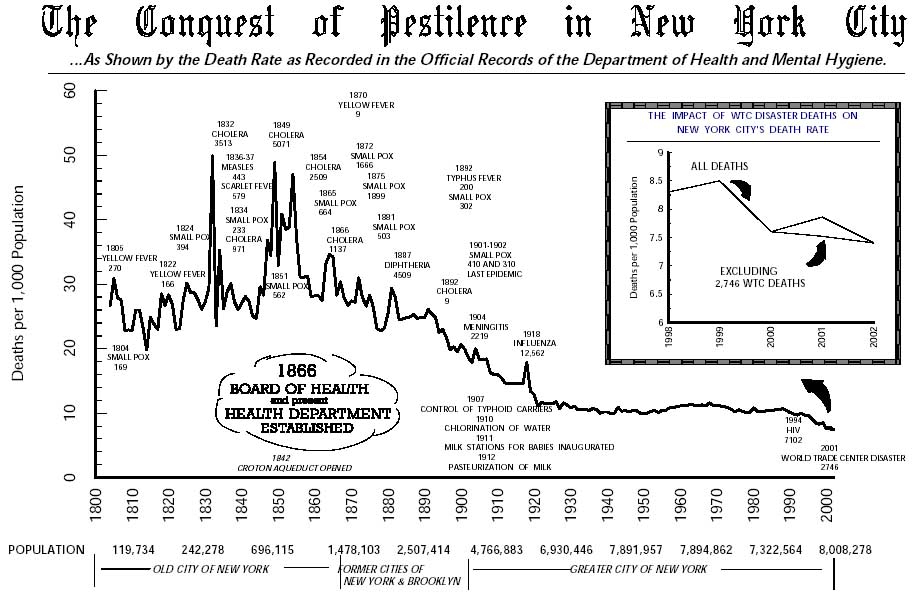
More recently (e.g. the last 150 or so years) social changes and technologies have allowed cities to move from places of pestilence to locations where you are more likely to be healthier, happier and live longer than your rural cousins.  These technologies are of course the lowly toilet, sewer system, asphalt (to reduce dust), internal combustion engine (to reduce things like horse dung) and clean water.  Parallel political structures needed to be created to provide these externalities* such as effective police forces, water works, street maintenance and an (ideally) non-corrupt overall administration to manage these services.

The Conquest of Pestilence in New York City; Stirling Behavioural Science Blog

The Conquest of Pestilence in New York City; Stirling Behavioural Science Blog

Slums as a Success Story

At this point, many people would point to the slums of Mumbai or Rio and suggest that the conditions there make cities a failure.  While Glaeser does not minimize the human suffering that does occur in quasi-legal no man’s land of slums, he also suggests that those living there are (on average) better off than their rural kin who they left behind.  Cities encourage innovation, reward hard work and there is a better chance to have access to medical care, clean water and schools for your children in a slum than in a rural province.

Once again, it is important to differentiate anecdotal, statistical and absolutes at this point.  For the young man who left a rural village in Brazil and died the next day in gang warfare in a Rio slum – cities would seem to be a bad deal.  But his tragedy has to be matched against the many others who became middle class through hard work, innovation or access to education.

Political Impact on Cities

Cities and political processes go hand in hand.  For example, the more democratic a country is, the more distributed its cities are likely to be; conversely, the more autocratic, the more likely that a single city will lord over other cities (the largest cities in dictatorships, … contain, on average 35 percent of the countries’ urban population versus 23 percent in stable democracies, p. 235).  Over the past 100+ years perhaps the greatest political influence on a city was the favouring of the automobile through the creation of highways and mortgage deductions for private ownership.

In the United States, the creation of the inter-state highway system (which was partially completed to support improved military transportation) has allowed for the creation of suburbs compounded by three other factors: road economics, tax policy and school funding.  The fundamental law of road congestion states that as roads are built, they are filled at nearly the same rate as their construction.  Thus more roads mean more traffic with only congestion pricing (a political hot potato if there ever was one) mitigating this effect.  Returning to the United States, a generous mortgage interest deduction further encouraged the purchase of the best available home a family could afford.  The localization of school boards and their funding meant that parents would also select a home where the good schools were.  The impact since the end of the WWII was the creation of a suburban sprawl and the gutting of inner-city communities.

The urban riots the United States has experienced can be partially traced to the flight of educated and leadership enabled citizens (white and black) away from the urban centers.  This was more than a lack of policing or social policy, this was as much the destruction of the social fabrics of the communities.  Akin this effect in the United States, Glaeser comments on how much safer the Mumbai slums are than the Rio equivalents despite the former being poorer.  Mumbai slums are better functioning social spaces and thus they provide their own safety nets and controls that are less likely to be found in the more transient Rio slums.

Creating Great Cities

Glaeser offers some direction on how to keep cities healthy, happy, lower environmental footprint and safe.  Firstly, allow cities to grow up.  This increases the density per square metre meaning that the same public-service is being optimized.  Green spaces are important to allow parents to raise their families and community safety must occur concurrently.  Community-based and adequate policing is part of the safety equation in addition to creating functioning social-spaces and communities.  Further to this, a community needs to have a say in the make-up of its local environment (bars, night clubs, daycares, etc.) but must not have a complete veto otherwise cities become balkanized into enclaves of Not in My BackYard.

Glaeser also strongly supports the consumption pricing of public goods.  Thus those driving in from the suburbs should be paying for this right or the developer constructing a high-rise tower should pay a sufficiently high enough fee to compensate the local community for this vertical-intrusion.  These are excellent economic principles that often falter in harsh light of political reality.  Nevertheless, at least they should be part of the discourse on what type of city we want to live in and have available to us.

Triumph of the City is a good read for anyone interested in the practical application economics and civil engineering to the messy realities of human communities.  The book is strongly skewed toward the United States context but Glaeser should be commended in bringing in numerous global examples to balance this bias out.  There are lots of juicy footnotes for those who want a deeper dive into the details.  Triumph of the City is a good book for any History/Economics/Civil Engineering-wonks out there.

(*) In economics, an externality is the cost or benefit that affects a party who did not choose to incur that cost or benefit [WIKIPEDIA].

Ribbon Cutting and Fire Rescues

Elected officials face the dual challenge of delivering good government while engaging in ribbon-cutting and crisis rescues. As public expectations rise, the complexities of governance increase, often leading to instability. Balancing immediate public appeasement with long-term effective management is crucial for maintaining a functioning civil service and a successful democracy.

Continue reading