ITM Triangular Conceptual Model

The following graphic has been kicking around in my head, in various incarnations for a few years. It considers the inter-relationship between Information, Technology and their Management or Governance.
ITM Triangle

ITM Triangle

Definitions: Information, Technology and Management (ITM)

Before looking at the whole model, what are its components?  How do you separate information from technology or from management?  One the one hand you do not; there is a continuum in which very few things are strictly one thing or another and lots of bulging between the triangle points where the business of an IT Department happens.  Nevertheless, there is nothing like a good definition and these are from COBIT.

Triangle Points

  • Information: An asset that, like other important business assets, is essential to an enterprise’s business. It can exist in many forms. It can be printed or written on paper, stored electronically, transmitted by post or by using electronic means, shown on films, or spoken in conversation.
  • (Information) Technology: The hardware, software, communication and other facilities used to input, store, process, transmit and output data in whatever form
  • Management:  Plans, builds, runs and monitors activities in alignment with the direction set by the governance body to achieve the enterprise objectives. and/or
  • Governance: Ensures that stakeholder needs, conditions and options are evaluated to determine balanced, agreed‐on enterprise objectives to be achieved; setting direction through prioritization and decision making; making; and monitoring performance and compliance against agreed‐on direction direction and objectives.

Central Core

There are a lot of things going on inside an IT department but generally they rely on people and the application of knowledge.

  • IT People: individuals either employed by, contracted to or otherwise contribute to the objectives of the organization and its IT goals (note, this is not a COBIT definition).  A central leadership roles found in IT departments is the CIO:
    • Chief Information Officer: The most senior official of the enterprise who is accountable for IT advocacy, aligning IT and business strategies, and planning, resourcing and managing the delivery of IT services, information and the deployment of associated human resources.  For brevity this also includes the potential differentiated functions of a Chief Technology Officer or a Chief Knowledge Officer.
  • Knowledge: The intangible awareness of how to do something (e.g. through user manuals, guides, etc.) or the application of ability and other intangible properties to a problem.  Knowledge is brought to an organization by the people who join it but there is also often a localized set of abilities unique or particular to a well run organization as well. According to Merriam Webster (no COBIT definition), knowledge includes:
    • a (1) : the fact or condition of knowing something with familiarity gained through experience or association (2) : acquaintance with or understanding of a science, art, or technique
    • b (1) : the fact or condition of being aware of something (2) : the range of one’s information or understanding <answered to the best of my knowledge>
    • c : the circumstance or condition of apprehending truth or fact through reasoning : cognition
    • d : the fact or condition of having information or of being learned <a person of unusual knowledge>

Client/Environment Results

Outside of the triangle are the clients and consumers of service who tend to think about ITM in silos.  For example, my computer is not booting (technology), I need a report that will tell me… (information), why is IT so “@Q#!$%*” expensive (management/ governance).  The reality is more subtle and holistic and increasingly all three need to work together to provide quality service to the organization. To this end, how the client interacts with IT can be broken into one of the following four means:

  • Application: what most users think of when they think about IT.  COBIT defines these as: A computer program or set of programs that performs the processing of records for a specific function
  • Information System: what most users manipulate when they are using an application.  COBIT definition: The combination of strategic, managerial and operational activities involved in gathering, processing, storing, distributing and using information and its related technologies.
  • Governance/Management:  How you know how to allocate scarce resources to prioritize business problems.  The actual individuals and committees that perform the management/governance functions described in the above definitions.  For example a corporate IT steering, project or program steering or working committee.
  • Utilities: generally invisible to users, until something goes wrong.  Collectively, the software, hardware and other technologies that perform particular computerized functions and routines that are frequently required during normal processing (adapted from COBIT).

Triangle and Real Life

The benefit of using a triangular model is that each point interacts with the other two.  That is there are gradients rather than a set of discrete locations. Thus an application is an example of technology but generally it consumes, transforms or outputs information. Information in isolation is generally not usable without technology or governance (e.g. It needs a report to deliver it and standards to understand it).
The model can also help IT folks view their craft holistically. ‎ Working in one area or another may create blind spots for the other two. Thus someone working in the app development space may forget the information imperatives or lose sight of the business needs for the application. A business user may over-simplify the role of information management or the challenges of building technology to deliver quality and timely information. Finally, while things such as data science are gaining traction the need a suitable container to produce it and the oversight to apply or use it is not diminished.

The So-What Factor?

Nice triangle, but will it get me funding for a data center upgrade, a new ERP system or better business intelligence (BI) tools?  Yes, in a way.  The Triangle can be used to demystify why expenditures and efforts in all areas are necessary.  As well, the triangle may be used as the basis for things like a heat map of where to invest the next dollar. If past years have seen good efforts in BI tools, have the transactional systems kept pace in feeding these systems?  Is there good oversight on master data records or big data to know who owns what and what do you do with the data when you find it?
What are your thoughts on the ITM Triangle?  Does it cover sufficiently what your IT area does, are their gaps or is too high level?

A Roach Gut

In my ongoing effort to remember what I have read, an excellent read from one of my favorite authors, Mary Roach.  She has previously graced the pages of my blog with two books: Stiff and Packing for Mars.

Roach and the Perfected Non-Fiction Format

Roach has perfected the non-fiction story format.  She tackles a subject familiar to all of us and answers the questions we either are too timid to ask or would never have thought of.  Like most good non-fiction writers she provides additional details on the subject and is not afraid to take us down an interesting rabbit hole.  In this book, she does not disappoint as she explores the digestive system from top to bottom.

Meals start with sight, taste and smell. They end up with something you don't want to see, taste nor smell.

Meals start with sight, taste and smell. They end up with something you don’t want to see, taste nor smell.

Gulp: Adventures On The Alimentary Canal.

The book is the historical, pathological and physical aspects of the human gut from the mouth through to the other end.  Along the way, Roach pokes at and identifies taboos about the digestive system.  For example why I used the euphemism ‘other end’ rather than ‘anus’ – an enduring human taboo against feces and the need to defecate.

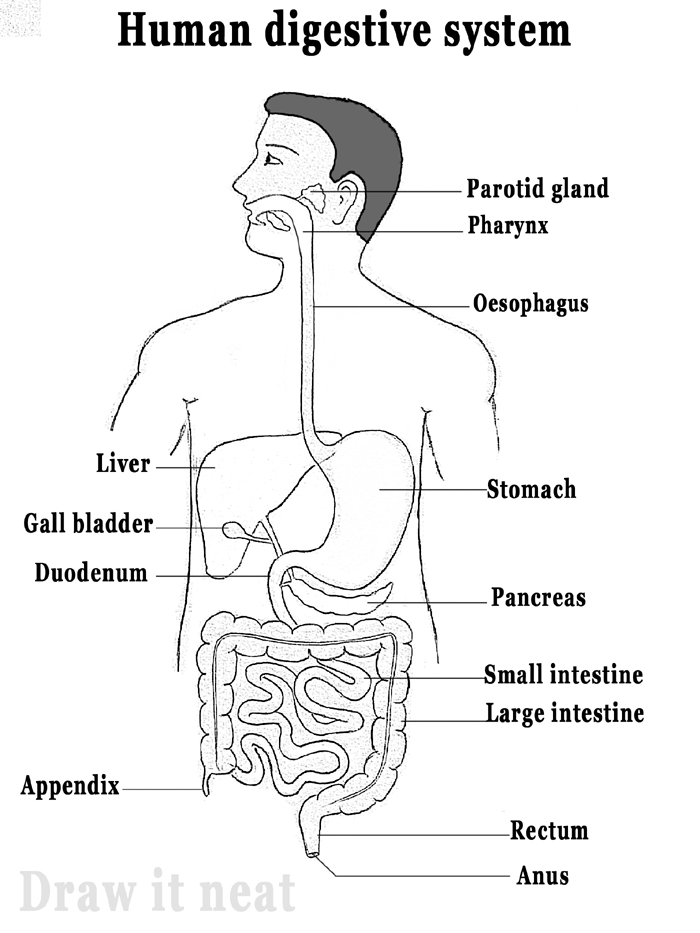
And that is the book in a nutshell, a tour from when food starts (primarily the nose), through where the bolus is prepared and the nutrition is extracted (stomach and intestines) and finally where the finished product is produced (colon, rectum, anus, plop!).  This structure is easily our oldest.  One could argue that the digestive system is the center of the body with other organs and functions there to serve it (brains to find the food, arms to reach it, legs to carry it, etc. with lots of intestinal bugs along for the ride and helping in the process) [p. 321]].

Human Digestive System

Human Digestive System: Courtesy of http://www.drawitneat.blogspot.com

The Far North: the Nose and Mouth

Roach starts the journey along the alimentary canal at the nose, the most important sensing device for taste.  She proceeds to the mouth where taste continues and the receptors can be fooled.  For example, experiments suggest that cheap wine can be as good as expensive wine  – unless you know which one is which will then bias this opinion p.30.  Or that palatants are used to coat food (human, pet and otherwise) to make otherwise bland or non-tasting food – well taste like something p.42.

A side trip into the eating preferences of our pets is made where we learned that cats are monguesic, meaning they like to stick to one food p. 43.  In contrast dogs will eat almost anything that smells good, wolfing it down in great gulps.  The wolfing part leads to the highest compliment a dog can pay for your cooking, to vomit it up after gulping excessively p.50.

Taste is the doorman to the digestive tract allowing our ancestors to evaluate and eat more of desirable foods or spit out those not meeting muster (and sometimes tasting like mustard)  p.46.  In turn, culture influences to a large extent what we eat and what we accept as substitutions.  Once a child is ten years old, they are relatively fixed in what they eat and it is difficult to change the preferences p.67.  Nevertheless there seems to be a global disinclination to consume organs of the reproductive tract (ovaries, penis, testicles, etc.) no matter the animal p. 72.

As for the claim that the human mouth is a cesspool of bugs, well that is true but the comparison may be off.  Saliva is also good for wound care as it contains various factors which encourage healing  p. 121.  It also contains enzymes which start the digestive process.  For example, the main digestive enzyme in stimulated saliva is amylase.  This enzyme breaks starches down into simple sugars prior to the food heading to the stomach p.110.

Stomach, Intestines and a Mint Wafer

The stomach has two functions, disinfection and storage.  The hydrochloric acid in the stomach kills most bacteria that we would pick up while scavenging on the savanna.  Because food was uncertain there, the stomach was also a handy storage device holding a meal for a few hours.

Don’t eat too much of a meal though as the typical human stomach will rupture with the addition of 3-7 litres of fill (water and otherwise).  Most of the time our stomachs do not rupture due to protective feed back mechanisms including up-chucking that last mint wafer.  For those with failed mechanisms the usual cause for a rupture is the ingestion of sodium bicarbonate after a large meal which can cause the stomach to swell and compress the diaphragm.  As a result, the ‘ruputurees’ were unable to burp or vomit away the building pressure p. 186-188.

Almost there, the Colon and Points South

A bi-product of digestion are the flammable gases such as methane or hydrogen. The gases produced are the result of anaerobic metabolism but they are particularly generated through the digestion of meat, lactose intolerance, legumes or simply the fact that as we get older, we get flabbier inside and out including the colon p. 235.  The existence of gas can lead to dutch ovening your bed partner or to lethal results.

When conducting a colonoscopy usually the gases are removed by protracted bowel-cleansing and the application of carbon dioxide.  Despite these precautions, one sixty-nine year old French man was killed by an exploding pocket of gas (the result of a laxative) while undergoing a colonoscopy.  The spark from the cauterizing loop in the scope ignited a pocket and killed not only the man but also expelled the scope out per Newton’s laws of momentum  p. 225.

In the early 1900’s autointoxication, self-poisoning from your own feces, was considered to be a health risk and lead to a surge in enemas and other methods to clean the bottom pipes.  The younger sister was the 1970’s focus on high fiber diet.  Now science is leaning toward the importance of a bit of transit time (normal duration through the digestive tract is about 30 hours. p.87).  For example, hydrogen sulfide in the bowel may actually thwart some forms of cancers and act as an antiinflammatory p. 262.

The colon primarily focuses on absorbing moisture from the food in transit.  Nevertheless, it is also the place where a number of vitamins and nutrients are created such as B and K.  Because of the poor absorption abilities in the colon, sometimes a return-trip is necessary.  This is the reason that dogs, rabbits and rodents eat their own feces, they are running a meal through the small intestine twice and absorb the nutrients they missed the first time p. 273.

Elvis and Close Encounters of a Fecal Kind

A diseased colon may lack the ability to move material through itself and will begin to swell and stretch.  One such example, a mega-colon of J.W. was 28 inches in diameter at its widest girth p. 289.  Without surgery, the colon that keeps on growing may either push into the other organs or potentially kill its owner through ‘defecation associated sudden death’.  This latter condition, may have killed Elvis.  He suffered from chronic constipation and died pushing in the act of defecation which potentially caused his heart attack.

For some surgery is not needed but a small donation is appreciated.  Fecal transplants moves the flora from a healthy gut to one in need.  Some individuals on potent antibiotics may lose their flora and as a result are at the mercy of whatever bugs happen to come along.  Through a donation and a retrofitted colonscope, a high percentage of patients find relief for a variety of digestive maladies p. ~320.

The People and Things You Will Meet in the Alimentary Canal!

The canal is full of interesting people (err, speaking metaphorically about the book).  A Harley driving sniffer who is effectively a human forensic gas chromatograph.  She can tell you why your wine/beer/olive oil is skunky [p. 24]

Horace Fletcher who promoted thorough chewing of food – to an excess, up to 700 times for a single bite p. ~70.

A convicted murder who ‘hoops’ in contra-band through a stretch rectum.  With practice, good hoopers can smuggle in smart phones, tobacco and even four metal blades, twelve inches long and two inches in diameter p. 203.

Alex St. Martin was a Canadian trapper who was accidentally shot in the side with the wound healing as an open fistulated passage.  Thus it was possible to examine the workings of his stomach in action.  The original surgeon who treated St. Martin and who (un)intentionally created the fistula was William Beaumont. p.89.  The two had a long-standing professional relationship of both master/servant (St. Martin working for Beaumont) and doctor/patient.  Roach discusses in details the suspected intimacy of these two individuals separated by culture and class but joined by a common fistula.  After all, how much better can you know a person after they have stuck their tongue in your fistula?  p. 96

Finally human hair can be found in the digestive tract either inadvertently, through eating or via your steamed rice at the local take out place.  Because hair is 14-percent L-cystein, an amino acid commonly used in meat flavorings, a Chinese food operation was caught using it instead of soy to make cheap soy sauce p. 73.

The After Taste

Although I enjoy Roach’s writing I was left feeling a bit peckish after this read.  I think that she could have explored the physiology in a bit more detail (e.g. some more details how the organs work and interact) and she could have done a deeper dive into common diseases.  For example, I was hoping to read more on irritable bowel syndrome, gluten intolerance, burst appendices or diverticulosis.  Nevertheless, I left the book satisfied, not stomach bursting but satisfied