In a previous blog, Factoid Bingo was introduced. Think of this blog as sort of an annex. It records details that bog the main blog down. Poke around and use the details noting that it is written primarily as a memory jog for myself.
What is this Factoid You Speak Of?
If you have not read the previous blog, Factoid Bingo helps a large(ish) group of people introduce themselves to each other. Best played in person, the game shares an interesting fact about a person via a randomized list of Factoids. In the game, each player tries fill the card by finding the owner of the respective facts. Prizes are given for blackouts, lines and to the introverts in the group.
Phrank’s Detailed Memory Jog
The Play
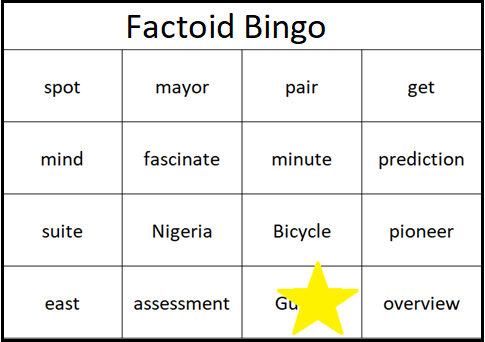
- Upon arriving, each person gets a unique and randomized card with 16 different ‘factoids’ about their co-workers (see above graphic) as well as a strip of stickers.
- The factoids were collected prior to the event and are composed of a word (or two) as well as a sentence explaining why this person selected this factoid, for example:
- Nigeria: Where my parents are from. (Bob)
- Bicycle: I love to cycle and bike tour. (Raj)
- Guitar: I play bass in a jazz band on the weekends. (Sabrina)
- If a person has not provided a Factoid, they are assigned a random word. Alternatively, all players may receive a random word without pre-submission to simplify the game or if there is not time to collect this information.
- People talk to each other and see if their factoid is on the other person’s card.
- For example, Bob asks if Sabrina’s Factoid appears on his card (see below).
- She says yes (‘Guitar’) and they talk about her being in a band.
- Sabina gives Bob one of her stickers (e.g. a gold star) which he puts on ‘Guitar’.
- If Bob’s card does not have any of Sabina’s interests, she still gives him a sticker, he puts it on the back of the card.
- The two move on to talk to other people.
- The alternative to stickers is that they sign each other cards. Stickers may also be reserved for those who previously submitted a factoid versus those assigned a factoid.
The End Game
- After a time-limit, the cards are ‘judged’. Prizes are awarded for things such as:
- First completed card
- Most stickers on the front (with a count of the back to break a tie)
- Most stickers on the back
- Introvert’s award, for no or fewest stickers
- The largest sticker received
- The most unique sticker
- A list of the factoids, the meaning and the person are provided afterwards at the venue and electronically.
- An alternative to a time based end of play, is a Bingo format. Interim prizes for the first line, first diagonal and first black out are given.
- If the group is more introverted or unfamiliar with each other, a time based end of play is recommended.
Preparation & Logistics
The game has simple logistics and material with most items already in a supply cabinet. Don’t let the length of the description below scare you off, it is for my own memory-jog.
Pre-Game Activities
Collection of Factoids
A week or so before the event, each attendee is asked to provide their Factoid composed of three parts:
- Their Name
- 1-2 Word Factoid
- A sentence or two explaining the Factoid
Notes and cautions on the Factoids.
- Nothing personal nor controversial. A Factoid is a fact a person is willing to share with a wider audience. Profane or inappropriate Factoids must be changed.
- Good Examples:
- Nigeria: Where my parents are from. (Bob)
- Bicycle: I love to cycle and bike tour. (Raj)
- Guitar: I play bass in a jazz band on the weekends. (Sabrina)
- Not So Great Examples:
- ??: Umm, I don’t know what to write.
- Sally: ’cause that is my name.
- The quick brown fox jumped over the lazy dog: This is my factoid and it is way too long…
- (*#+)##: [Really, what would your mother say!!]
- Uniqueness: statistically, the more people playing the game, the greater the chance of duplicates, as a result, each Factoid should be unique likely on a ‘First Enter, First Gets’ basis; for example:
- The first person to enter Bicycles, gets this Factoid.
- The next person to enter “bicycles” will be asked to change it to something else.
- Bicycle, bike, cycling, road-bikes, mountain-biking – are all unique and accepted (unless of course someone has previously entered it).
Printing and Preparing the Cards
Participants must enter their Factoids at least a few hours before the event. I have developed a ‘bingo-card’ spreadsheet that prints randomized Factoid Cards. You can build your own spreadsheet (see a previous blog Who Wants to be a Fraudster?) or put a comment below and I will send you mine for the price of a story of how you plan to use it.
Hole-punch the card and run some strings through them to hang around the participant’s neck.
Marking the Card
As the game is played, the question will be, ‘Excuse Me, Do I have your Factoid?‘. If yes, then it is marked off. A signature or initial will do the trick but stickers are more fun. The sillier the stickers the better as they become a point of conversation (‘Can I have the unicorn?’). Remember, to apply the stickers to both the back and front of the card based on whether or not a person has the Factoid on the card or not.
Prizes and the Winners
As the intention of the game is to encourage interaction between participants, the prizes are of less importance. They could include a sticker announcing things like: ‘Most Sociable’, Factoid-Finder’, or Best Introvert. alternatively, trinkets can also be given out.
Encourage the participants to keep the card as a souvenir of the event. This is an aide de memoire of the people. Alternatively, temporarily collect them and make a montage of interactions.
Material & Tools
For each of the components, I have provided a material ‘on a scale’ meaning from the most readily available to something that may need to be purchased or arranged for.
- Factoid Cards
- Ideal: A large index card
- Unlined (blank) index card.
- European size A6 (105 x 148mm) or 4 x 6 inches.
- Most printers can adjust to the relevant size but test print a few in advance.
- Good Enough: Print on a normal page and cut it in half.
- Super Fancy: Custom printed with logos, etc. as a souvenir of the event.
- Ideal: A large index card
- Factoid Collection
- Ideal: SharePoint list in which the uniqueness of the Factoid is enforced.
- Good Enough: Scraps of paper hand entered or a Google sheet one a web page.
- Super Fancy: Develop an application, consider playing the entire game on smart phones.
- Factoid Randomizer & Printing
- Ideal: The above-mentioned spreadsheet that allows randomized cards to be printed.
- Good Enough: A document in which the words are pasted and randomized manually.
- Super Fancy: Generate the cards excluding the person’s own ‘Factoid’. If the group previously knows each other, generate the cards in which the people they would normally interact with are excluded from each others card.
- Stickers
- Ideal: Ask people with older children to ‘donate’ unused stickers’; alternatively purchase them at a stationary store.
- Good Enough: Bingo markers or a pen.
- Super Fancy: Specially printed stickers for the event or give out pens which the participants can take home (then they have a pen for the duration of the program!).
- Prizes
- Ideal: Raid a local thrift shop and supply cabinet with a particular eye out for the meaningless and useless.
- Good Enough: Printed certificates.
- Super Fancy: Prizes of higher value, for example, most sociable and introverts, get lunch with a senior person.
- Factoid Master sheet
- Ideal: Extract from the SharePoint list, emailed out as a PDF to all participants.
- Good Enough: Not required and can be skipped, or a single master file posted in a central location.
- Super Fancy: Business cards with the Factoid are printed and given out.
Planning and Organization Needed
This final section walks through the general steps to conduct the game. These are based on the above ‘ideal’ entries and can be scaled up, down or eliminated as required.
- Approval: goes without saying, get the organizer to approve the concept, assign any budget and support the recruitment of the volunteers.
- Infrastructure: Setup a SharePoint List, spreadsheet, etc. to collect the Factoids
- Communications and Promotion: There will be strong resistance to entering the Factoids, pre-event encouragement and communications is critical.
- Volunteers: Relatively few but include:
- Preparation and Infrastructure: creating SharePoint site, encouraging participation, printing and preparing the cards.
- Prizes and Other Logistics: Finding prizes, stickers, other material.
- Event Management: helping to explain the cards and the activity at the event. Answer questions during the activity. Assist with prize announcements. Organize post event activities.
- Give/Explain the Cards and Stickers: The following provides some sample written communications, but invariably, people will not read the instructions and prefer to have it explained. A short script is useful.
- Master of Ceremonies and Prizes: Ensuring the game does not drag on too long and that it supports rather than detracts from the main program is paramount. The game will need to be adjusted depending upon whether the audience will arrive nearly all at the same time or in a staggered fashion:
- Same Time: Explain the game and provide a narrow time box for activity, say 15-minutes of the program.
- Staggered Arrival: Explain the game at a more personal level and elongate the play time, ideally making it secondary to other activities but completed before the first group of people start to leave.
- Close and Debrief: The objective of the game is to encourage human interactions in a fun manner. Debrief whether this accomplished the goal and modify the game as required for future interactions.
Sample Communications
- Collection: Welcome to the Financial Literacy program. We are excited to have you and we are planning a quick game to help us get to know each other. Go here [LINK] and enter three pieces of information:
- a) Factoid: 1-2 words that you associate with yourself. As the factoids will be public, nothing too personal and keep it clean folks. Factoids are unique across the group. If you enter ‘bicycle’ and someone has already picked ‘Bicycle’, select a different word. Bike, cycle, or mountain biking all will work (if not taken by someone else).
- b) Description: A sentence or explaining the Factoid. This is the answer to the question: ‘Why did you pick the Factoid ‘bicycle’? Because I love cycle in the summer.’
- c) Name: Select your name from the drop down of attendees.
- Change: You can change your Factoid up until a few hours before the event starts.
- Entry Reminder: The Financial Literacy event happens in xx days and we noticed you have not entered your Factoid. Please do so to win great prizes! (Okay, the prizes are not so great, but we still need your Factoid).
- Card Give Out: This is your Factoid Bingo Card and xx stickers.
- Over the next xx hour, ask people “do you have my Factoid?”.
- If they have it on their card, put a sticker on the FRONT of the card on the space.
- If not, put a sticker on the back of the card, a ‘good to meet you’ acknowledgement.
- When time is up, we will provide prizes for things a blacked-out card, lines, most stickers, etc.
- Keep the card as a reminder of the people you met today.
 Organizational Biology