
The IPOOG model attempts to organize the disparate activities of a nonprofit (or any small organization) into five core activities. A ‘citizen-science’ test-drive of the time tracking element of the IPOOG leads to three conclusions. The tool can work but it relies on underlying project literacy, and it could benefit from a better user interface.
I have used project management and strategic planning to pay the bills and they have been a longstanding professional interest of mine.
- A Bottom-Up Philosophy for Teaching Project Management
- IPOOG v2024 – the Story So Far
- Five Part IPOOG – A Refresher
- Beyond the Birkie
- The Impetus for the Citizen-Science Project
- Three Citizen-Science Questions to be Answered
- Thank You for IPOOGing – Overall Conclusions
- Thank You for IPOOGing – Answering the Questions
- Next Stop – Frank’s 2024 IPOOG’ing and IPOOG v2025
- Notes
A Bottom-Up Philosophy for Teaching Project Management
Since using early incarnations of Microsoft Project, I have had a problem with the starting premise of the project management ethos, ‘that complex project management methods can be scaled down to simpler projects‘.
I have never seen this worked properly and things like project management training tries to teach the student how to build the most complex things and then teaches them how to run garden variety projects by trying to eliminate extraneous complexity.
I prefer a bottom-up approach to project-literacy, ‘first, teach basic tenants and then incrementally add complexity on a need-to-learn basis‘. This learning model is also the underlying basis for Agile Project Management [1].
Additionally, through my career and volunteer work, I have noticed a general lack of knowledge of project management methodologies. You don’t need the advanced tools and knowledge taught in the scaled down model noted above, but you do need those basic tenants. For example, being able to answer the Four Project Management Questions.
IPOOG v2024 – the Story So Far
In 2023 and 2024 I pulled together some disparate planning tools into a new one called the IPOOG. The 2024 Birkie Business Model was the result which provided an overview graphic of this nonprofit and the event it ran (see gallery below for the Birkie Business Model image).
As noted in the above post, the IPOOG is a variation of a Six Sigma construct – the SIPOC (Suppliers, Inputs, Process, Output, and Customers). IPOOG is used instead because not every nonprofit has a customer, but everyone has an outcome.
Five Part IPOOG – A Refresher
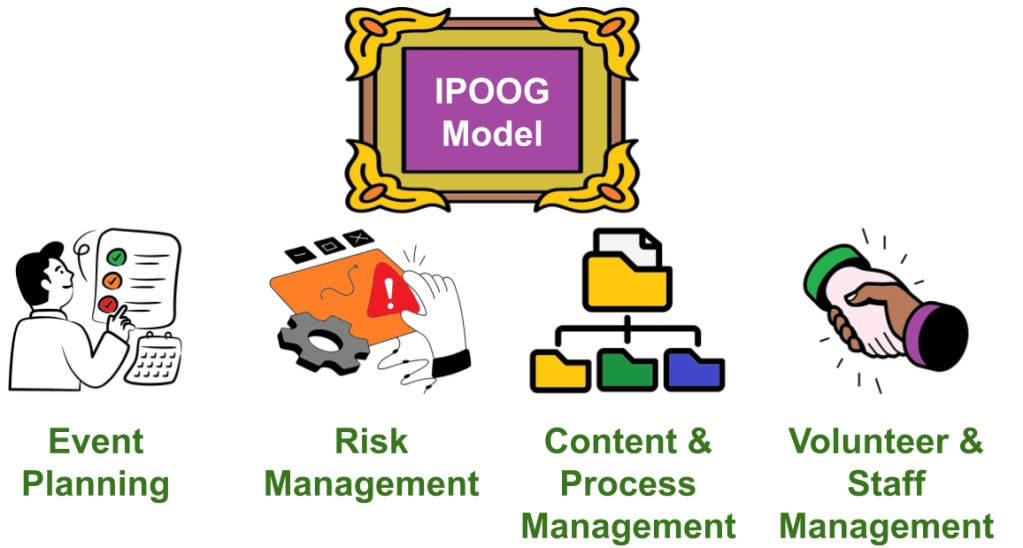
The IPOOG Model is broken into five parts. At the top level is the aforementioned graphic. It provides an overview of the organization. In a single snapshot, the organization’s Input, Process, Output, Outcome, and Governance functions.
Below the graphic, and integrated into it, are four core activities. To a greater or lesser extent, these are fleshed out in other blogs:
- Planning: How an organization prioritizes what is important and organizes its Time, Talent, and Treasure to achieve these priorities.
- Risk Management: The people, processes, and technologies to enable opportunities and mitigate risk. See the further reading section below on this topic.
- Content and Process Management: Organizations in general and nonprofits in particular are constantly challenged in documenting their business processes. See the further reading section below for some thoughts on why Documentation is a Waste of Time and how to make it value add.
- Volunteer & Staff Management: How to attract, retain, and manage the human resources needed by a nonprofit.
- This Core activity is also where staff and volunteer time Tracking Comes in, the subject of ‘citizen-science’ project discussed below.
Organizations are welcome to tweak these five parts – but I cannot think of a nonprofit whose service delivery would not fit into the above. Still, the tool must resonate with the organization’s leadership, volunteers, and funders – so change away!
Beyond the Birkie
The Birkie was a good initial use-case for the IPOOG tool. The question is whether it is unique to this organization or could other nonprofits and organizations use the methodology. To this end, a ‘citizen-science’ activity was run in late 2024.
The Impetus for the Citizen-Science Project
Organizations run on ‘Time, Talent, and Treasure’. Volunteers contribute the first two. A volunteer hour is a highly perishable gift that must be managed properly. To keep the hours flowing the nonprofit must constantly reduce the ‘The Burden of Volunteering‘.
Unfortunately, at the same time, the organization needs to know how much time it took to do an activity and what type of skills are needed. Beyond internal planning reasons, grant reporting often demands this information.
Finally, the stalwart volunteer will eventually need to be replaced. Like staff members, volunteers are only passing through [2]. One of the first questions the new volunteer will ask is ‘what is the time commitment’. Not knowing is bad, under-estimating is worse.
Knowing what your volunteers worked on and for how long is good information – but how to best collect it?
Three Citizen-Science Questions to be Answered
How to collect volunteer hours is being examined through two means. Firstly, I committed to track my volunteer efforts for at least five months of 2024 (see Tracking IPOOG Time and Three Months of IPOOG’ing as well as a future blog). A more formal citizen-science project involved three volunteers and three research questions:
- Can organizations and individuals benefit from systematically tracking time?
- How can the process of time tracking be automated to be as non-intrusive as possible?
- What are the benefits/concerns of tracking time in such a manner?
The intention was to have three individuals use the tool for very different volunteer activities. One individual bowed out early, another did not use the tool but did participate, and a third is using IPOOG to plan for an international cycling trip.
Thank You for IPOOGing – Overall Conclusions
A hearty thank you to these three volunteers given that the process occurred at a very busy, pre-Christmas, time of year. Before trying to answer the above questions, I arrived at 3 conclusions:
- Project Management Knowledge. Understanding how to conceive, design, run, and close a project is not widespread in our society.
- Basic Project-Literacy is a precursor to introducing any tools to an organization.
- Project literacy is an important skill to have to run any type of organization.
- The Tool Makes the Experience. The original IPOOG tools were developed in Microsoft Excel and converted to Google Sheets.
- For the most part the transition went well with some ‘GSheet idiosyncrasies’.
- The larger problem is basic spreadsheet knowledge given that the IPOOG tool was a ‘kludge’.
- Tools such as Monday.com may mitigate the poor user experience.
- For now, the roll out is restricted to a few ‘spreadsheet-gurus’.
- Content is King. A clunky tool notwithstanding, two of the participants found having to use project methodology and a tool improved their understanding of their respective volunteer-activities.
- The resulting IPOOG they created can become a template to make future activities easier and faster to organize.
Thank You for IPOOGing – Answering the Questions
- Can organizations and individuals benefit from systematically tracking time?
- Although only one individual was able to track her time, the general answer is yes.
- As noted above in the conclusions, having the time records was secondary to creating the project-structure to record the time.
- A future research project may consider how the individual and/organization can use the time results.
- How can the process of time tracking be automated to be as non-intrusive as possible?
- For this activity, the answer is inconclusive.
- A great deal of time and energy was spent explaining the Google Sheet.
- As a result, this question will need to be considered in a future session.
- What are the benefits/concerns of tracking time in such a manner?
- Indirectly, the largest concern is ‘getting started’ on tracking time.
- Although all three individuals acknowledge the benefits of having their time track, two of the individuals found it difficult to start tracking time as it was a net new activity.
- It was hoped that this experiment would deal with the challenges of two or more individuals entering their time (and any resulting record degradation, sorting, etc.); unfortunately, because of only one individual entering their time, this did not occur.
- This challenge is part of the need for good user interface design and project literacy.
Next Stop – Frank’s 2024 IPOOG’ing and IPOOG v2025
I have two additional blogs planned. The first is a summary of using the tool for five months in 2024 to record my volunteer activities. The second are enhancements to the 2024 ‘kludge’. Still a kludge in 2025 but now with more kludgy-features!
Once again, thank you to those who volunteered and contributed to the above citizen-science effort. Stay tuned for updates and let me know your thoughts below!
Notes
- Project Management is generally divided into two methods, the traditional Waterfall and Agile.
- There are lots of variations and gray zones between them but, this dichotomy is good enough mental model.
- The fundamental difference is the degree of analysis and end-state planning that goes into the method.
- Waterfall is great if you know you need to build a hospital and you pretty much know the end state.
- Agile is great if you know you need a computer system but are not quite sure of the details or what the final system will look like.
- Google these for further understanding or comment if below if you have a different take.
- The managing the volunteer life cycle is discussed in Lucky 7’s in LAST VeGA.
 Organizational Biology