
The nonprofit sector is faced with stagnant resources and increasing demands. The CPA Community Ambassadors assist nonprofits by providing valuable expertise. A series of ‘Event-Ideas’ are presented which may address the demands on the nonprofit sector.
For the next few months, as ideas appear, this post will be updated.

- Pity the Volunteer-Board
- An Embarrassment of (Information) Riches
- A Litany of Challenges
- CPAs (and Others) to the Rescue
- Generating a List of (Not So) Great Ideas
- Conference and Connection Ideas – Administration
- (De)Constructing a Nonprofit
- What Information Is Out There and How to Use It?
- How Government Works, a Ground Up Review – Part 1/3
- Policies, Procedures, Legislation, Regulations and Directives – part 2/3
- Policies, Procedures, Legislation, Regulations and Directives – part 3/
- Innovation in the NonProfit
- Citizen Science and the Nonprofit
- Accounting and Finance Related Ideas
- Further Reading
- Annex: Resources Available
Nonprofits are part of civil society. They provide critical services which governments or businesses can’t or won’t. Sheltering the homeless, protecting animals, or offering sports are just a few examples
Pity the Volunteer-Board
While the demand for nonprofit services has gone up, resources, support, and volunteers have remained stagnant or declined. Concurrently, the cost or burden to volunteer and run organizations have increased, e.g. higher risks, insurance costs, and legislation.
The senior leadership of a volunteer board must steer the organization through these challenges; assuming they have the understanding, resources, and skills to do so.
An Embarrassment of (Information) Riches
Many resources and organizations exist to help nonprofits and their boards. For example, the Alberta Government provides an extensive library of resources and online courses (see the Annex below). At the Federal level, a Charitable tax status is a significant form of indirect public support. Additionally, an internet search yields hundreds of Canadian and thousands of international resources to help a nonprofit. So….
Given the extensive body of knowledge available, why are nonprofit boards struggling?
A Litany of Challenges
There are multiple challenges, including the following:
- One Directional Resources. Often the resources are excellent but also one directional. How does an attendee watching a video ask questions?
- Contextualization. A continuation of the One Direction problem, what is the problem that needs to be solved and what happens if there are multiple problems? How does a nonprofit analyze and disentangle its challenges so it knows what resources should be accessed?
- Organizational Variation. Although we speak of nonprofits as a homogeneous population, they are highly variable. Their purpose, inter-personal dynamics of the board, operating environment, or available resources make them unique.
- Personal Capacity. An individual serving on a nonprofit board is gifting their time. Taking more time and capacity to attend courses, read, or research is daunting.
- Personal and Organizational Change Readiness. It is not unusual for a nonprofit to be personality driven. One or a few individuals are passionate about an issue and invest consider time, talent, and perhaps treasure in its realization. Fast forward a few years or decades and the people, process, and technology that made it successful is now an impediment. New volunteers either conform or are leave. (See also the The Healthcare Ethos – A Definition for a variation of this challenge).
This is where CPA Community Ambassadors and other organizations can help.
CPAs (and Others) to the Rescue
Accountants are uniquely qualified to help organizations. They speak ‘accounting’ which is the language of business. They are at least familiar with organizational issues through their training. Finally, they know how to research a problem. If one one accountant is invaluable, image a whole gaggle of them (what is the collective noun for a multiple accountants)?
The CPA Community Ambassadors (CPA Ambassadors) of Alberta was founded in 2011. It goal is to help CPAs find meaningful and productive volunteer opportunities and provide information to help both nonprofits and CPAs. The CPA Ambassadors help non-profit organizations, ranging from small to large and complex, that serve a wide variety of sectors.
Generating a List of (Not So) Great Ideas
I have worked with the group on a number of projects with CPA Ambassadors (see the further reading section). The group is welcoming for an interloper like me. Recently, I attended a planning meeting to generate conference ideas. This post list my suggestions. The ideas start from the most conceptual and then down into the weeds of some specific ideas. Not all are worthy of further consideration but then the silliest idea may lead to a better one later on!
For consistency, it is assumed that each session is offered virtually. They can be transitioned to in-person as well. The beauty of virtual sessions are that the logistics are simpler, a YouTube video can be produced, and geography is irrelevant. The downside of virtual are ‘Zoom-fatigue’ and a tuned out audience.
Conference and Connection Ideas – Administration
These ideas are at the organizational level. They are broad and perhaps the least practical – in the short run.
(De)Constructing a Nonprofit
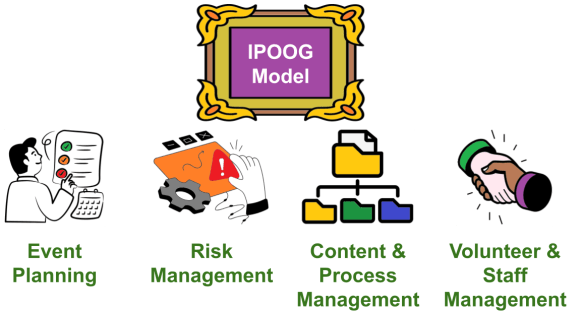
While every nonprofit is unique in its own right, conceptual models can help boards understand their organizations. The business literature has many such models, few which are directly applicable to an entity whose purpose is to NOT make a profit. Enter IPOOG or the Input, Process, Output, Outcome, and Governance framework. It allows nonprofits to understand the flow of resources (financial and other) through their organization with a focus on WHY the organization exists (Outcome) and HOW it should be managed (Governance).
IPOOG can then be tailored to what is important for an organization. For example, an event focused organization may be primarily concerned with Event Planning, Risk, Processes that are reproducible year over year, and finding/retaining volunteers. A humanitarian organization will not focus on Events but instead on sustained operations and paid staff. IPOOG is the starting point to help an organization what it does well (its Strengths), where it has room to improve (Weakness), availability of resources (Opportunity), and the risk of excess demand or changing environmental conditions (Threats).
What Information Is Out There and How to Use It?
The Annex below lists multiple resources available to a nonprofit covering the full IPOOG gamut. This Information Treasure trove has a problem, where does a poor beleaguered nonprofit board member start? This session will provide a survey of information from Alberta, neighbouring provinces, the Federal Government, agencies, the UN, and other sources. Think of this conference as the meta-conference – information about information.
Organizational notes: Speakers may include senior officials from the Alberta Government, peers in other provinces, and interested Agencies. This could be structured as a ‘speed-dating’ forum to quick orientate nonprofits (and CPAs) of where to find what.
How Government Works, a Ground Up Review – Part 1/3
Canada has three-levels of government, federal, provincial/territorial and municipal/aboriginal. How do these government-levels work, what are the similarities, differences and nuances for each? How do these levels of government support or impinge upon nonprofits.
Organizational notes: Consider collaborating for this event, include presentations from past and present sitting politicians and a tour of a political building such as the legislature or parliament buildings.
Policies, Procedures, Legislation, Regulations and Directives – part 2/3
Accountability and oversight has many forms starting with a legal framework. What provincial and federal legislation impact nonprofits. What about case law that affects nonprofits?
Organizational notes: Speakers from Service Alberta to addres the Societies, Freedom to Care, and other Acts. Representatives from the Law Society of non-profits in the courts.
Policies, Procedures, Legislation, Regulations and Directives – part 3/
Building on the theoretical framework introduced in the second session, this one will showcase organizations who have mastered the subtle art of policies and procedures. Thematically, this session will look who has mastered the art of ‘just enough policy’.
Organizational notes: Surveys in advance, use of technologies like wikis for procedures, an overview of best practices of documentation from Six Sigma and Quality Management realms.
Innovation in the NonProfit
Almost all nonprofits start out being innovative but work in a risk averse environment. This inherent conundrum is compounded during times of fiscal restraint when ideas are solicited but resources are few. What is innovation, how do you get it, how do you keep it and when should you avoid it? How to propose, implement and sustain an innovative idea or culture in an environment that is less than ideal. (2016-09-21 – An Innovative Conference).
Organizational notes: What nonprofits are considered innovative, speakers from Alberta Innovates, what are the challenges to innovation, how can AI help/hinder innovation?
Citizen Science and the Nonprofit
Although Citizen Science is most closely associated with social and environmental sciences, there is really no reason it cannot be more broadly applied. The Citizen Science hub provides the following definition (from Citizen [BLANK]):
- Citizen Science is based on natural and social science methodologies.
- It involves members of the public in monitoring and scientific research.
- These projects can range from local to regional, and global scales, and participation can vary from data collection to other aspects of the scientific process, like the creation of research questions, data analysis, project evaluation, and reporting.
Environmental organizations likely are already involved in such a program through things like iNaturalist.ca or eBird.org. However, all nonprofits could potentially deal with such a partnership. A recreational cyclist club partnering with the Faculty of Recreation; a hot rod club partnering with the Faculties of Engineering or History.
Organizational Notes: Invite the Citizen Science Alberta Community of Practice (CitSci Alberta) to discuss the conceptual framework. Invite different organizations to discuss the benefits and challenges of such projects.
Accounting and Finance Related Ideas
VAT A Board Needs to Know About GST
When does a nonprofit need to worry about the Canadian Goods and Service Tax (GST)? Should a nonprofit proactively get a GST number and how much bother/risk is there to doing the reporting?
Organizational notes: This is a topic in which CPAs can shine. With a zillion tax experts, this can present a simplified topic. Consider making this a CPA Canada event.
Part III – Is It Really So Different?
Part III – Accounting Standards for Not-for-Profit Organizations is the accounting standard such organizations will use to prepare their financial statements. How does it differ and how is it the same as compared to For Profit or Public Sector standards? What does a Small to Medium sized nonprofit need to know about the standards?
This session will be broken into three parts. The first involves basic financial literacy for the volunteer or staff member who is doing the book keeping. The second is for the volunteer treasurer (or Controller/CFO) who is preparing the financial statements. The last part is for the nonprofit board.
Organizational notes: A representative from CPA Canada and perhaps a CPA who specializes in nonprofits. This can tie into content and sessions available elsewhere.
Further Reading
The following are some of the projects I have undertaken with CPA Ambassadors.
- VMS, CPAs, and Volunteers – May 28, 2024, and
- Safety and the Volunteer: How to Comply With/Excel at AB’s OHS Requirements).
- 2020-11-18 – CPA Ambassador – Budgeting for Non Profits,
Annex: Resources Available
Alberta Government Resources
- Community Development Unit services.
- Non-profit learning centre
- Grants, funding and supports for non-profits
- Alberta Non-profit Listing Dashboard
 Organizational Biology
Pingback: Thank You for the FCPA | Organizational Biology