People are central to Organizational Biology (orgbio) and orgbio is composed of two fundamental elements: Mass (machinery, intangibles such as patents and policies and procedures) and the ephemeral quality of Adeptness which is the human application of mass toward an organizational objective.
I just finished the first part of the CPA’s public sector certificate program. This blog is to put down some notes and thoughts on the course and also a suggestion for CPA Alberta/Canada about what next to do with this program.
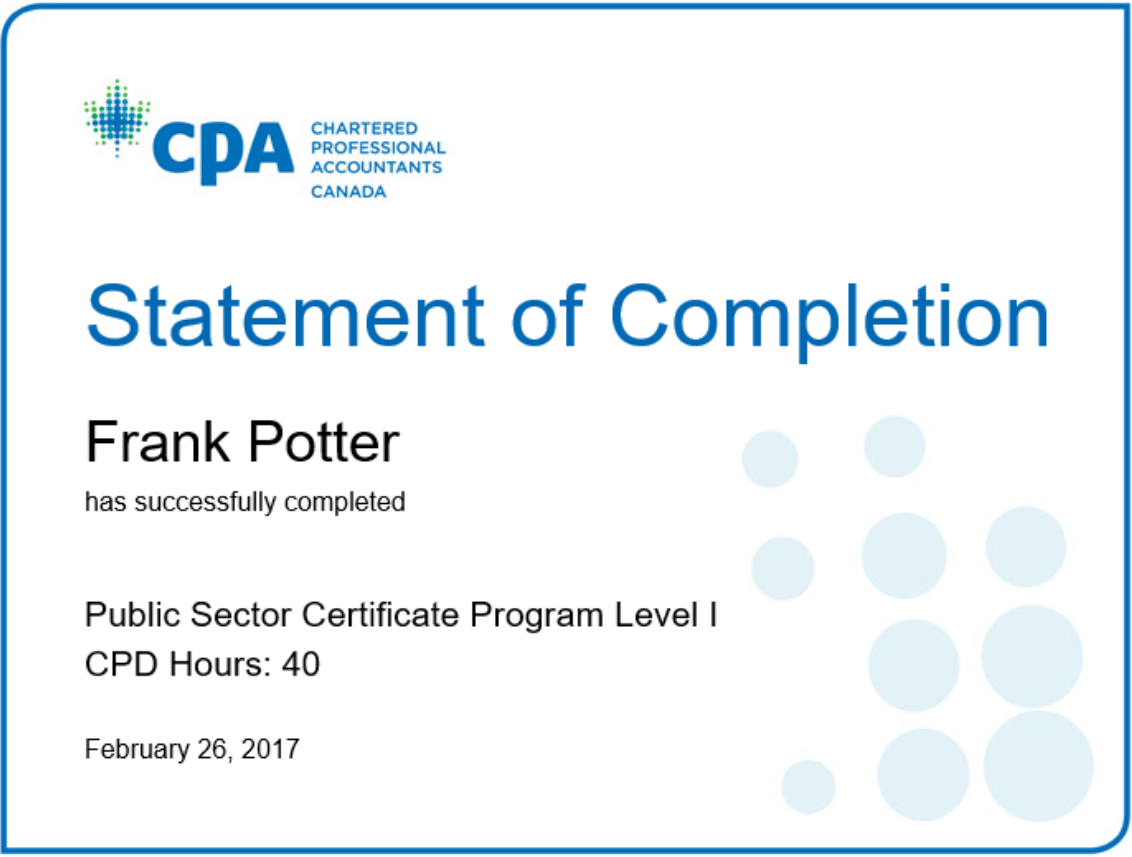
Certificate of Completion
Kudos to FMI and CPA for a Focus on the Public Sector
Thank you to CPA Canada and their partner, the Financial Management Institute (FMI) for developing this program. I can’t say that I have done an exhaustive search but I am pretty sure that this course is unique in Canada for discussing how the public sector differs from our private sector peers. As well, a good portion of the course focuses on Canadian Public Sector Accounting Standards (PSAB – the B standards for Board).
To be honest, I have kind of missed out studying PSAB. The standards were not part of my training twenty years ago (and they have come a long way during this time anyway). Being a ‘budget-guy’ I had a transient need to know the standards. Thanks to this course, I have a better understanding of what they are and that they are actually pretty good. By way of overall content, the course offered the following topics:
Module 1: Governance and decision-making processes (budgets, legislature, etc.)
Module 2: The public sector planning and budgeting process.
Module 3: Government operating and capital budgets.
Module 4: public sector accounting standards including dives into:
Concepts & Principles (1000 —1300)
Financial Reporting (2100 —2700)
Financial statement items (3030 —3510)
Not-For-Profit Organization Accounting (PS 42**)
PSAB Statement of Recommend Practice.
Module 5: Decision Support
Module 6: Auditing.
Modules 1-4 were pretty good, Module 5 very weak and Module 6 was a bit of strange. It seemed to be cobbled together or directly lifted from another program. To support the above modules, the course referenced a number of real life examples and some pretty good reference material. Unfortunately the material was a bit stale (generally 2+ years old or older) and as such could use a refresh.
A final kudo is the software that CPA Canada used for this course. Called Brightspace, it is a learning management system from Desire to Learn (D2L) a Canadian company out of Kitchener Ontario. Brightspace was clean, intuitive and easy to navigate. I did my MBA online (through Athabasca) using the then state of the art Lotus Notes, D2L is definitely a step in the right direction.
Needs Work Though
Although I thought the course was a good use of my time, I personally think that it needs work. The following are some suggestions for CPA for its next course re-write:
What Learning Gap is Being Addressed: This is a post-designation course and as such I was expecting material aimed at someone working in the public sector. Instead, the course went down a few rabbit holes such as calculating current ratio. As a result, I think CPA needs to better analyze and think about the target audience and their educational needs of those taking this course.
Hire an Editor. I suspect that portions of this course were mashed together from a variety of sources. In fact the last module (#6) did not even bother to change the original audience in the content. This course is important enough to have hired an editor and is pricey enough ($1K CAD) to have expected one.
Refresh the Content. For a new course, it references a good number of circa 2012 era materials. As well, the Value for Money section of Module 6 uses a now withdrawn document but does not even mention PS 5400 and 6410 assurance standards on Value for Money audits. For a new program I would have expected at least circa 2015 material.
Have some Interaction. One of the reasons I signed up for this program was because it had some high-flying contributors. I saw neither hide nor hair of them. I did notice later on (after I had abandoned the discussion board) that the a newly hired moderator was making an valiant effort to encourage group discussions.
More than Traditional Accounting. The course covered a variety of topics at a cursory level such as budgeting, costing and the audit function. The course could easily expand into other common facets of the public sector experience. For example, how to brief and interact with the political level; the challenges of systems in the public sector and how about a bit on the weird world of public sector procurement.
Worthy of a Core Module?
Notwithstanding some of the above tweaks and enhancements, I believe this course (or its improved successor) should be at least an elective if not potentially a core module in the PEP program. For those unfamiliar with the training to become a CPA, individuals must complete electives and core modules in such traditional areas as financial reporting, tax, audit or management accounting as part of CPA’s Professional Education Program or PEP.
CPA Alberta Professional Education Program (PEP)
I would not recommend that the existing course be either as it really needs some work and lots more relevant content while jettisoning the audit and financial performance elements which are covered in other PEP modules. In addition, I would expand the dive into PSAB and likely include something like a mentorship program with seasoned accountants who live and breath PSAB.
To this last point, the course could be delivered using interaction with local governments. I know here in Edmonton, students taking this module could also meet with the provincial controller, municipal CFOs or senior financial managers from the federal level.
Next Steps
I plan to reach out to CPA Alberta to see if they would be interested in running a pilot elective with this course as the basis. I have some thoughts on additional content I would add but there is definitely a good starting point. Once again, kudos to CPA Canada for taking some initial steps in helping accountants who have chosen the public sector path.
At the end of the day, 40 good hours of professional development and I now have information and resources I did not have before starting this course… the sign of a worthwhile use of ones time!
This may end up being a wrong turn at Albuquerque but I see that Mississauga-Erin Mills Liberal MP Iqra Khalid is proposing a private members bill M-103 to address ‘Islamophobia’. I thought I would contribute to the democratic process by providing some definitions and examples of what Islamophobia should mean.
(b) freedom of thought, belief, opinion and expression, including freedom of the press and other media of communication;
(c) freedom of peaceful assembly; and
(d) freedom of association.
As a result, under the constitution, the following statements are equally protected:
The Pope is God’s Vicar here on earth.
Mohamed is God (Allah’s) last prophet.
Joseph Smith received golden plates from God.
Ones actions should be mindful of Karma.
All the above is superstitious nonsense not worthy of a rational person.
Superstitious Nonsense & the Belief instinct
To number five above, the likes of Richard Dawkins would take this as their belief protected by the constitution. Where atheists can fall down is not recognizing the enormous evolutionary advantage religion has given humanity in being a successful species, the importance of the ‘Belief Instinct‘.
Religion has allowed us to create larger organizational units by applying the mortar of group cohesion across individuals. This has not been without its costs. The Crusades, the oppression of women under Sharia Law or polygamy under early Mormonism are all examples where religion has gone wrong. While it is easy to spin and wish to re-write the past, it is more important to recognize the following:
Religion is a fundamental instinct of humanity and will manifest itself with or without a formal outlet.
Religion, like other primal urges, needs to be directed to the betterment of society.
Religion must evolve as societies do so, while there are some universal truths, such as though shall not kill, there is no universal or ‘right’ religion.
Without religious evolution, humanity risks reaping the worst from the belief instinct while losing the benefits it can provide.
Canada can be a guiding light of helping individuals, communities and religion evolve to accommodate new social and cultural norms.
A Suggested Addendum to the Private Member’s Bill
To help Ms. Khalid to navigate the tricky waters of religion, I would suggest the following revision to private member’s bill M-103 (written in non-legal speak):
Whereas the people of Canada:
hold core values, such as the freedom of religion, above all others,
recognize the role of faith and the belief instinct in personal matters and social cohesion,
recognize the value religion has conveyed and inflicted on humanity,
recognize the values of equality of all people and equality of all before a common law.
Whereas the people of Canada acknowledge the Arabic word Islam to mean ‘acceptance’ and therefore Islamophobia means an irrational fear of acceptance. We the people thus condemn Islamophobia which is defined as any religion or systematic or personal belief system that:
Seeks to enrich individuals who hold position of religious-authority through corruption, personal gain of power or actions contrary to the law or Canadian norms;
Has tenants and implicit/explicit actions that are contrary to the law and fabric of historical Canadian values including those of justice, freedom of religion, equality, personal responsibility and reasonable inclusion of people of all faiths and perspectives;
Seeks to do harm to Canadian society through either direct or indirect action including encouraging actions contrary to the laws of good government;
Seeks to forcibly convert or impose its views on individuals who chosen to have alternative views including a non (atheist) view of religion; and
Fails to evolve with the changing nature of society, for example the changing role of personal beliefs in contrast with the original tenants of the religion.
To reduce Islamophobia, we ask all Canadians to not only look into their respective minds and souls but to also reach out to others who do not share their beliefs and state:
‘I don’t believe in your God or religious view-point, but first and foremost I will do everything in my power here on earth to protect your right to hold your beliefs as a Canadian‘.
Acceptance-philia
In a small way hopefully the above can lead to Islamophilia or a love of acceptance. Acceptance that religion is a human instinct to be managed, that religion must evolve to meet cultural changes. Ultimately our time here on earth is short – let’s all make the best of it before we meet our respective maker.
Have you ever had the unenviable task of creating a procedure for something? Maybe a high level set of policies or a hands on ‘How-To’ guide. Great – now picture the end result in your mind. Got it pictured? Okay, where is it now?
Thank you (AGAIN in some cases) for the Use of Your Brain
Of course no good deed ever goes unpunished and to that end, the following are the folks who have helped me with the friendly-peer-review. Hopefully I can return the favor in the future. Also, if you are on the list and are logging this as professional development, feel free to refer to this post and notice below.
To whom it may concern, the above individuals were asked to perform a friendly-peer review of an article (2017 – Life Beyond the “Big Honkin’ Binder” ) published in the Financial Management Institute of Canada January, 2017, FMI*IGF eJournal. The estimated time to perform this review was between 2 to 3 hours completed in early September, 2016. All of the above individuals demonstrated a firm grasp of the subject matter and helped to create-net-new original thought and critique through this peer-review which will be reflected in the final article.
Don’t you hate it, you think you have a brilliant original thought and that darn Google shows you that numerous people have thought it before you! Such is the case of one of my Phrankisms, ‘Managed Serendipity‘. In this case, it is okay because through fortunate happenstance I can potentially work on a better definition.
Off the snow track
Definition of Managed Serendipity
The ability to respond to and take advantage of an opportunity in the future. The catch is that you don’t know what attributes will be called on by that opportunity or even if such a chance will occur in the future.
As the name implies, there are two parts to the concept. Managed is what you can actively do to either generate opportunities or capitalize on them as they appear. Serendipity is entirely beyond your control, it is fate, fortune, chance or God’s will. You can only react to serendipity not control it. This is not a new concept by any stretch. Here are three examples:
In the fields of observation chance favors the prepared mind. (translated from Louis Pasteur from: Dans les champs de l’observation le hasard ne favorise que les esprits préparés); source: Wikiquote.
Optionality is the ability to switch from one course of action to another thus taking advantage of uncertainty and changing circumstances (adapted from ‘Antifragile Things That Gain From Disorder’, Nicholas Taleb).
Life is what happens to you while you’re busy making other plans. Attributed to John Lennon but based on a Readers Digest quote from 1957 (courtesy Quote Investigator).
Examples of Managed Serendipity
The best way to foster Managed Serendipity is education. Graduating from High School, College or an apprenticeship gives you more options then dropping out in Grade 10. Beyond formal education, life choices and personal investments are part of Managed Serendipity. This includes having at your disposal a wide variety of skills and experiences that initially seem only relevant in one narrow circumstance.
By way of an example, I did the lay up and editing for the 7th edition of the Waskahegan Trail Guide. That experience gave me a much better appreciation for desktop publishing, layout and production of complex documents – skills that have tipped job interviews in my favour or allowed me to do more complex volunteer activities – such as blogging on Managed Serendipity (yeah)!
Limitations to Managed Serendipity
To start, one’s own health. Being free of self-inflicted health limitations (e.g. excessive weight, poor physical conditioning, mental well-being, etc.) better positions you to seize an opportunity. Certainly family circumstances can impact Managed Serendipity. For example, caring for your young children limits your work opportunities – but also provides you with infinite joy and a core reason for your existence, a very fair trade off. At the same time, being the primary care giver for an aged parent or spouse, shrinks your world (but such are the burdens borne with love).
Notwithstanding family restrictions, people fail to recognize an opportunity when it presents itself. To this, I have four maxims I use in my life so as to recognize Managed Serendipity:
Always answer the door when opportunity knocks.
Remember opportunity typically knocks when you are in the bathtub.
Never negotiate on the other party’s behalf.
Manage to the downside.
Pay yourself now for the future maybes.
Answer When Opportunity knocks
Opportunity is constantly knocking. It may be something as obvious as a head hunter or less straightforward as your daughter’s soccer coach asking if you can edit a newsletter – and therefore learn new software. At least hear what opportunity has to sell before closing the door and …
Opportunity Knocks When You are in the Bath
Opportunity seldom knocks when it is convenient for you. Sometimes Managed Serendipity means leaving a good paying government job on Friday and boarding a plan on Sunday to fly to and work in Munich German for 18 months (hey it happens, trust me). After hearing opportunity out, remember that timing is never convenient or circumstances are easy. Of course you need to balance this against other personal circumstances (young children, aged parents, etc.).
Never negotiate on the other party’s behalf.
It is amazing how often there are circumstances in which a person will not propose an option in negotiations because they think the other party will reject it. For example, you approach your employer and say, ‘hey, can I take a leave of absence and go work in Vienna for year?‘ Your problem ends in asking the question and starts upon hearing the response. Their problem starts on hearing the question and ends formulating the response. Don’t confuse your problems (asking) with their problems (responding).
You may have young children and a chance to work abroad appears. DON’T forego this opportunity because traveling with a six year old is hard. DO eliminate the opportunity if travelling with your precious child is unduly dangerous.
Life, Gravy Lumps and All
When presented with a situation, can you accept the worst case scenario? Finding a new job, accepting rejection or perhaps receiving a ‘no’ answer? If the answer is yes then you have managed to the downside. If you can live with worst case scenario then everything else is gravy. Sometimes the gravy is lumpy, perhaps separating … but heck, it is still GRAVY!
Pay Yourself Now for Future Maybes
Set yourself up for future possibilities by learning, learning and experiencing. Take the opportunity to edit the kids soccer newsletter because in the future you may be building websites with that experience. Learn that new language because you may visit or work there – or for someone you might meet in the classroom. In other words, increase the chances the opportunity will come and knock at your door… but pay yourself while you are doing it.
A new thing learned may lead to something in the future – but probably it will not. Therefore, enjoy what you are doing for its own merits in the here in now. This is paying yourself first. You can’t force the serendipity part – you can only manage it.
Ying, Yang and the Border
Managed Serendipity is like the Asian concept of Ying and Yang. They are complementary, distinct and inter-related. To me the most interesting thing about Ying and Yang is not the two tadpole’esque features – it is border or interface between them. As in any border, there is danger between safety/adventure or risk/opportunity.
I wish I could say that seizing an opportunity is without risk but that is not the case. An aging parent’s health may deteriorate with out your care, your young child may feel displaced between cultures and you may not have a job waiting for you upon your return – risks. Of course you may also feel refreshed and a better care giver upon your return, your child is stronger working through cultural displacement and you landed an even better job – opportunities.
Ying-Yang courtesy of Wikipedia (used via creative commons).
As Stephen Covey talks about in ‘The 7 Habits of Highly Effective People; Powerful Lessons in Personal Change’: Nobody ever laid on their death-bed and wished they had spent more time at the office. In parallel, no one ever laid peacefully in the death-bed content they stayed in the bath tub despite incessant knocking.
On November 7, I attended a session put on by the Canadian Institute called “Government Connects“. All levels of government spoke about digital transformation of their services. One of the speakers was the boss of all Alberta Public Servants, Marcia Nelson. Marcia did a great job discussing what the Government of Alberta is doing in moving its services online. Certainly Digital Government is the nirvana for most governments as they see cyberspace as being a cheaper, faster and more effective way to deliver more services to citizens.
The User as the Product
Marcia, and many of the speakers, talked about the expectations of citizens relative to their other digital experiences. For example the ease to create a Facebook account, the functionality available via a GMail account or how a LinkedIn profile is now almost as important as a resume or a business card. The question from Marcia, and others was ‘how can governments compete with these products?‘.
The other side of these services is a profit motive. Facebook makes it easy to set up a profile so it can target you with advertisements. Gmail wants you as an email client so it can scan your email and target its advertisement. LinkedIn wants you to buy a premium membership or at least get your eyeballs on its advertisements. All of the above are examples of monetizing you as a user into becoming their product. Assuming informed consent, there is nothing wrong with monetization. It is an economic transaction in which a slice of your privacy is exchanged for some really good services (like watching cat videos on Facebook just saying).
The Digital Government Disadvantage
So where does government fit into this? Firstly there is the challenge of resources. A quick scan of the September 2016 quarterly results of Facebook shows they have about $10.6USD Billion in physical and intangible assets*. Included in this number is $5.1USD Billion of network and computer software assets (physical) in addition to $1.7USD Billion in technologies and patents (intangible). In other words, Facebook has excellent technical infrastructure to offer a premium product for free to users. And if they don’t have a good product now, their $30.3USD Billion in current assets (e.g. cash, securities, etc.) can be used to buy that good product.
* Note, for those accounting weenies out there, an interesting item they have on their balance sheet is ‘Acquired users’. I could not readily find a definition for this term but it appears that the users are really the Product!
Pity someone like the Government of Alberta (GoA). A $50 billion a year organization in which an estimated 2.5%, over $1 billion, is spent annually on Information Management and Technology (IMT) (adapted from: GoA IMT Plan, 2016 – 2021, p. 4). From the GoA’s most recent financial statements, they have $4.4CAD Billion (about $3USD Billion) of computer assets – hey not bad – of which 78% of is fully depreciated (e.g. over 5 years old) – YIKES! (adapted from GoA 2015-16 Financial Statements, p. 63).
Beyond relying on old technology, the GoA has to do a lot more than Facebook. While Facebook can focus on social media, the GoA needs to run registry systems (e.g. vital statistics, land titles or drivers licenses), health systems (e.g. immunization, medical records), education (K-12, student finance, apprenticeship certificates), business (collect taxes/royalties/fines) and human social functions (tracking children in foster care, seniors or homelessness).
The above is not a new story but it is worth repeating every now and then that governments do things that no one else wants to with a tiny fraction of the resources of private industry. Governments must also build and run systems that have almost no tolerance for failure.
Risk and Skin in the Game
To the last point, risk, this is where government is at a further disadvantage. The original investors in FaceBook backed a winner. Those who put money in to Myspace, Friendster or DIGG did not fare so well (huh, never heard of some of these, check out the grave yard of failed social media infographic from the Search Engine Journal January 25, 2013). Nicholas Taleb calls investors (win or lose) people with ‘Skin in the Game‘ from his book Anti-Fragile. In contrast, public servants never have skin in the game. We are always spending other people’s money and our fantastically worst case for abject failure is forced retirement or perhaps being fired – maybe.
In other words, governments have both an advantage and disadvantage around risk. The individuals involved do not have personal risk (advantage) but the organizations also lack the mind focusing benefit of the ‘terror of failure’ (disadvantage).
The Monetization Continuum and How Can Governments ‘Compete’
The reality is that Governments can’t and shouldn’t compete with the Facebook’s of the world. Creating a bleeding edge user experience would be an inexcusable use of public funds and without the terror of failure would not likely be successful anyway.
But because thought exercises can lead to innovation, I am proposing the ‘Monetization Continuum‘ for governments; a government simply needs to pick a point on a line. At one end (generally status quo) is ‘Mind and Accept the Gap‘ at the other is ‘Full Monetization‘ with other options falling between these two. Definitions are provided below as well as way points but generally if you are Singapore you may be more comfortable having McDonald’s ads on your obesity website. If you are at the other extreme – well this is where Minding the Gap comes in.
Monetization Continuum
End Points
Definition
Examples
Mind and Accept the Gap
Governments acknowledge that they will lag and explain why to their citizens. Periodically, governments leap-frog into a stronger position.
Status Quo
Monetize
Fund digital government through ad, premium memberships or sponsorship revenue.
The reality is that governments will and should never monetize their services. There is a slippery slope of what is reasonable and in good taste. Governments have something that Facebook or Google does not have – the coercive powers of taxation and legislation. Perhaps governments does not need to build systems when they can force organizations operating in its jurisdictions to offer the services. There is a long tradition of this in the telecommunications world, for example. This would not be monetizing users as products, this would monetizing providers as servants for the public good. Just a thought.
The author reflects on receiving the Edmonton Bicycle and Touring Club’s Volunteer of the Year award for 2016, appreciating the club’s low-drama environment and effective volunteer engagement through purpose, affiliation, and experience. They emphasize the importance of hope in cycling, while suggesting potential improvements to attract diverse community members.
On November 17, 2016, FMI Edmonton hosted: CPAs and the Public Service. Now that CPA Alberta is almost a toddler (16+ months old at time of writing), it is time to ask the question: How Can CPA Alberta help the members who work in the public service?
Nicolas Taleb would have us believe that strategic planning is ‘superstitious babble’ (see Anti-fragile strategic planning). In contrast, Kaplan and Norton make strategic planning a cornerstone of the Balanced Scorecard. The reality is probably in the middle.
This blog however considers the question, how much time should an organization spend on planning? Successful or not, when do you cut your losses for a year or when do you think that you are not doing enough?
How Much Is Enough?
On the one hand, strategic planning can become its own self-sustaining cottage industry. Endless meetings are held and navels are closely examined with little to show for it. On the other hand, the organization is so tied up in operations and ‘crisis du jour‘ that they wake up and discover the world (and even their organization) has completely changed around them.
What rule of thumb or heuristic can be used to know that you are doing enough Strategic Planning without decorating cottages? My proposed answer is somewhere between the 1.0% and 0.1%. Although a full order of magnitude separates these values, a range is important due to the volatility of an environment an organization finds itself in. Governments are likely on the low-end (closer to 0.1%) and tech start-ups on the higher end (1.0%).
For more on the basis for these heuristics, take a read of ‘A Ruling on 80, 90 and 99‘ for my thoughts and a review of such things as Vilfredo Pareto’s legacy and internet lurkers. A recap from this blog is as follows:
Pareto: 20% of an organization’s actions account for 80% of its results.
90 Rule: 1% of the operational decisions are enacted by 9% of the organization affecting the remaining 90%.
99 Rule: 0.1% of the strategic decisions are enacted by 0.9% of the organization which impacts the remaining 99%.
Thus the 99 Rule provides a minimum amount of time for an organization to consider strategic questions while the 90 rule provides a maximum amount of time.
Who Does What and What to Do with Your Time?
Consider a fictional organization of 1,000 people. This is a medium sized business, typical government Ministry or employees of a large town or a small city. Assuming there is about 1,700 productive hours on average per year per employee (e.g. after vacation, training, sick time, etc. see below for my guesstimation on this) this means the organization in total has 1,700,000 hours to allocate. How much of this precious resource should be spent doing strategic planning?
I am recommending no less than 1,700 hours and no more than 17,000 hours in total. In total means involving all people in all aspects of the process. Thus if there is a one hour planning meeting with 20 people in the room, that is 20 hours. To prepare for this meeting, 3 people may have spent 2 full days each – another 3 x 2 x 8-hours or another 48 hours against the above budget.
Measuring what Matters
The point of completing these measurements is to answer four fundamental questions:
Is the organization doing enough strategic planning relative to the environment?
Is the organization doing too much planning?
Are we getting value for the investment of resources?
How do we get better at the activities to reduce this total?
Is the organization doing enough strategic planning relative to the environment?
What happens if you discover you are not doing enough? For example your 1,000 person organization is only spending 100 hours per year doing planning. You may be very good and efficient and if so bravo to you and your planning folks! On the other hand, you may be missing opportunities, blind sided by challenges and mired in the current day’s crisis – in which case maybe a bit more effort is needed.
Is the organization doing too much planning?
The 1,000 person organization may also be in a Ground Hog Day’esque hell of constantly planning with not much to show for it. Perhaps you have a full time planning unit of five people who host dozens of senior management sessions and the best they can is produce an anemic planning document that is quickly forgotten. In this case, measuring the effort of consuming 10 to 20 thousand hours of efforts for nought can lead to better approaches to the effort.
Are we getting value for the investment of resources?
The above two examples demonstrate how a bit of measurement may help you decide that 100 hours is more than sufficient or 20,000 hours was money well spent. The output of the planning process is… well a plan. More importantly it is a culture of monitoring, planning and adapting to changing organizational and environmental circumstances. Thus setting an input target of planning to measure the quality of the output and the impact of the outcomes can answer the question if the planning effort were resources well spent.
How do we get better at the activities to reduce this total?
The advantage of measuring, evaluating and reflecting on the planning efforts is to get better at. Setting a target (be 1.0% or 0.1%) is the first step of this activity and measuring against this target is the next.
Good luck with your planning efforts and let me know how much time your organization spends on its planning initiatives.
* How much Time Do You Have?
How much time does an organization have per annum to do things? The answer is … it depends. Here are two typical organizations. The first is a medium size enterprise that works an 8-hour day, offers 3-weeks vacation per year, in addition to sick days and training (e.g. for safety, regulatory compliance, etc.). On the other hand is a Ministry that offers a 7.25-hour day, 5-weeks of vacation plus sick and training days.
Organization
Medium Size Company
Government Ministry
Hours/day (1)
8 hours
7.25 hours
Work days per year (2)
254
250
Work Hours per year
2,032
1,812.5
Avg Vacation days x work hours (3)
120
(3 weeks)
181.25
(5 weeks)
Avg Sick Days/year x work hours (4)
60
(7.5 days)
54
(7.5 days)
Avg Hours of Learning/year (5)
42
29
Total productive hours/employee
1,810
1,548.25
Few professionals work an 8-hour day let alone a 7.25-hour one. Nevertheless, everyone has non-productive time such as bathroom breaks, filling up on coffee, walking between buildings. So I am leaving the actual average productive hours at 8 and 7.25 respectively.
For a cool site in adding this calculation, see: www.workingdays.ca. Note this includes 3 days of Christmas Closure.
10 days is the minimum number of vacation days required to be given to an employee. The average is a surprisingly difficult number to find (at least to a casual searcher). 15 days is based on an Expedia 2015 survey.
Sources vary. I have chosen the high value for the for-profit organization as they often have stringent regulatory requirements for health and safety training. For government I have chosen a medium value. Sources:





 Organizational Biology