Unknown's avatar

About Frank SAPAA

Webmaster and Board Member of SAPAA and born and raised Albertan. Love exploring Alberta particularly in the winter on snow shoes.

A Ruling on 80, 90 and 99

Heuristics or rules of thumb are of great benefit in formulating approximations and quick decisions.  They can just as easily lead one astray through over simplification.  In thinking about heuristics as they apply to organizations, I have been pondering three: the 80/20 Rule, the 90 Rule, and the 99 Rule.

The 80/20 Rule or Pareto Principle

The Pareto Principle is a heuristic that estimates cause and effect, it is defined as:

Also known as the 80/20 rule, the law of the vital few, or the principle of factor sparsity; states that, for many events, roughly 80% of the effects come from 20% of the causes.  Named after Italian economist Vilfredo Pareto (adapted from wikipedia).

While the Pareto Principle has reasonably good statistic evidence of its validity in estimating cause and effect, it does not do so well in predicting effort.  In other words, 20% of your future actions will yield 80% of the future value.  Which of the four out of five things will you do that will have no or limited impact on the 80%?

The 90 Rule

This rule is based on the observation of contributions to social media sites.

In Internet culture, the 1% rule is a rule of thumb pertaining to participation in an internet community, stating that only 1% of the users of a website actively create new content, while the other 99% of the participants only lurk (adapted from Wikipedia). 

It may seem strange to invoke an internet rule but compare this to an organizational structure. What is the relative proportion of shop floor workers to middle to senior managers?  Typically there is about a 1:10 ratio of doers versus managers.

Consider an organization of 1,000 people; a reasonable sized government ministry or medium-sized enterprise.  Within such an organization, there would be about 10 senior leaders (Assistant/Deputy Ministers, CEOs, Vice Presidents), 90 middle level managers (Directors, Managers, Assistant Managers) and 900 shop floor staff and immediate supervisors (clerks, sales people, workers, supervisors, etc.).

In other words the 90 rule is a reasonable heuristic to predict the allocation of resources and effort.  1% or the allocated resources will have a disproportionate effect on the next 9% which in turns controls or influences the final 90% of an organization.

The 99/0.9/0.1 Rule

A more lean view of the 90 rule is that 99 rule.  The 90 rule is accurate in the allocation of operational resources but I believe underestimates the effect of more strategic or exceptional events.  The CEO’s decision to close an unprofitable factory is not made by 10 people in the above fictional organization, but instead by 1 person.  Certainly the other 9 people support and (hopefully) validate the decision but the impact is then disproportionate to the remaining 990 individuals in an organization.

The 99 rule is a better tool to estimate strategic decisions within an organization.

Recap of the Rules

  • Pareto: 20% of an organization’s actions account for 80% of its results.
  • 90 Rule: 1% of the operational decisions are enacted by 9% of the organization affecting the remaining 90%.
  • 99 Rule: 0.1% of the strategic decisions are enacted by 0.9% of the organization which impacts the remaining 99%.

What are your thoughts?  Are the above heuristics reasonable and  valuable tool when allocating organizational resources?  Is there too much variability and the rules are a meaningless average?  Do you have any anecdotal experience with any of the above rules in either their cause or effect?

Monetizing Being a Public Servant

Early season snow storms are dangerous things.  Not only for driving but also when you take a long walk and your brain slips into thought experiments.  For example, when you are walking along and your brain says – hey you could potentially retire in a few years and do something outside the public service where you currently work.

In other words the snow and my brain conspired to ponder the question, ‘How do you monetize your career as a public servant?’.

Monetizing the Problem

First a definition, what is monetization? There are a swack of definitions but they all generally boil down to trying to convert something to ready cash. The following extract from Wikipedia’s definition provides a good example:

… attempting to make money on goods or services that were previously unprofitable or had been considered to have the potential to earn profits.

So, what exactly are we monetizing in this context? How to have a career post public service that commands a similar level of pay, respect and respect. Not to put too fine of a point on it, but public servants have a (not)/justifiable reputation of being unemployable post government.

The Obvious Methods

So, after a career of say 25, 30 or more years, how do you convert that experience into a second career or even part-time income?  The obvious answers that came to me include:

  1. Maximize a Public Sector Pension and/or Semi-Retirement
  2. Gain Unique Experience of Value to Someone
  3. Retire from a Senior Position that has Cache and Contacts
  4. Keep Your Toe in the Real World

Maximize a Public Sector Pension and/or Semi-Retirement

This is the most obvious method is that you enjoy the government backed annuity otherwise known as a public sector pension.  Sure, maybe you will do some greeting at Wal-Mart or try to convert a hobby into a paying proposition – but generally you don’t monetize the experience.

There is of course a cliché here that public servants have gold-plated pensions and to certain extent it is true (to learn more about this subject, see the post-conference notes on public sector retirement by the FMI).  The other side of this cliché of course is the lack of stock options, bonus and other non-monetary factors related to be a public servant.  Nevertheless, a thirty-five year pension is a pretty sweet bit of monetization!

Gain Unique Experience of Value to Someone

The fellow who spent his career as a spot-mountain-frog-lip-taster-technician may discover that he has a very unique skill set.  Governments do things that business and organizations don’t so this is definitely a consideration for monetization – assuming there is a market for the specialization – and there is the rub.  No other organization may want to pay for (thus monetize) frog-lip-tasting.  However there are some less obvious examples of converting experience into post-retirement careers.

If you work in an administrative function, likely the experience can be monetized – to a point.  A human resource consultant, accounting clerk or procurement specialist can find (if they want) post-retirement employment.  Unfortunately, the more senior the public sector experience the less likely of making a lateral leap.  As an accountant, I have managed to avoid dealing with taxes, shareholder accounting and the like because I have focused on budgets, systems and governance.  As a result, most controller roles are closed to me because I lack this basic for-profit experience.  The same examples can be made for other administrative functions in human resources, procurement, etc.

Retire from a Senior Position that has Cache

Retiring as a Deputy Minister or City Manager may open up future opportunities.  Think of the senior politicians, for example, who have gone back into law firms or think tanks.  Alas often the value you can bring to an organization are the contacts and systems knowledge of the recently departed government.  This knowledge is perishable in the extreme, particularly if there is a subsequent change in government or significant re-organization.

Mandatory cooling off periods may further diminish the relative value of recent experience if one needs to wait six to twenty-four months before cashing in.  Nevertheless, if you got to be a senior civil servant, you probably have skills of value beyond a government context.

Keep Your Toe in the Real World

One method of ensuring the ability to work in the real world post public service is to not really ever leave it.  A toe in may range from owning real estate property, working part-time (e.g. doing taxes if you are an accountant) or teaching courses.  In this way you have non-government experience to point to.  A further upside is having additional income of doing some or all of these things.  A downside is working more than one job during your career.

Monetization May Mean More than Money

If you are willing to stretch the definition of monetization, there is more to life than a second (third, fourth or fifth) career.  You can also use your experience in a volunteer capacity helping our or other societies.  For example Canadian Executive Services Overseas takes retired executives and places them globally and here at home (e.g helping first nation communities).  Churches, non-profit boards and community leagues are other potential beneficiaries of a life time in the service of the public.

Not all of these will pay the bills if one’s pension is not fully maximized.  However if money is not a primary driver (hey, you did take a government job after all), then you may be paid in post-retirement experiences!

Thank you snow storm for helping me clear my thoughts whilst walking… now back to work because I am not quite at the point of being able to start monetizing….

Guts, Gory and the Organization

Giulia Enders has written a delightful book on our Guts.  If the title was not sufficient the sub-title describes it all: Gut: The Inside Story of Our Bodys Most Underrated Organ.

Gut is a good read for anyone who digests food (which pretty much covers everyone living) and is a potential lesson for organizations that there is more complexity in a system then we can ever imagine.

Have Some Guts, Read Gut

Gut is a pretty easy read.  Enders presents the physiology of the Gut in a very accessible manner and explains the key functions of the major organs (e.g. stomach, small/large intestines, liver, etc.).  Originally published in German, the English translation has great cheek and humour.  In fact, Gut would make an excellent text-book for junior or senior high school biology given its easy accessibility.

As a microbiologist, Enders delves into the other organ of our body, the microbiota of the gut.  Based on current research, Enders makes the case that the dividing line between where our cells start and bacteria and other germs end is not as clear cut as we may think. For example:

  • Children born via Caesarean section are not endowed with the bugs found within their mothers’ birth canal.  As a result they must source their bugs from the environment and these may not be the most beneficial.  These children take months or years to develop a healthy gut microbiota.  They are also at a risk of developing asthma or allergies.
  • Breast feeding has a similar impact on allergies and the like.  Mothers milk not only feeds the baby but also contains nutrients galacto-oligosaccharides (GOS) to feed the child’s gut.
  • The gut’s bacteria helps to train our immune system to not only recognize threats but to also not over-react to them.  As a result, this reduces allergies, asthma and potentially juvenile diabetes.
  • We periodically wipe out all or portions of our microbiota through the use of antibiotics, poor diet and stress.  When the good bugs depart their spots can be replaced by the less than desirable who then can be difficult to displace.
  • The appendix is not a slacker who does not realize its time has passed.  Current research indicates that the appendix is a store house of good bacteria that can repopulate the gut if the intestines have been flushed due to diarrhea.

Organization’s Need Guts

Ender has not only written a very accessible book that discusses such delicate matters as what our poop should look like, she has reminded us that perceptions of systems are based on best available information at a point in time.  For the gut, bacteria are necessary to not only break down food but to also stress the immune system so it does not over or under react.  Structures such as appendices may appear useless but turn out to be vital to our long term health.

The gut can be used as an analog for organizations.  Poop jokes aside, a healthy organization is more complex and mysterious then it first appears.  While we may be inclined to oversimplify them, organizations have interactions and systems that may not be immediately apparent.

Elevators are Like Guts – They Mix and Separate

Here is one small example: riding elevators.  In my building a new system has replaced the traditional ‘up’ button with destination buttons.  Rather then jumping on the first elevator going up, you select your floor and proceed to that lift going exactly to that floor plus perhaps a few floors above and below yours.

This system has dramatically improved the speed by which people are carried to their floors – and it has cut the accidental and random interactions of people.  Previously who you got on with was chance.  As a result, there was an opportunity to interact with a variety of people who you may only see intermittently.  Now the elevator ride is much more homogenous – you ride with people from one floor above or below.

More efficient, yes – beneficial to the organization – not necessarily.  In as much as good bacteria trains our immune system and a diverse flora is better for us, random interactions and non-sterile organizational mixing is also of value.  Good organizations need slight agitation, a diverse culture and some randomness to be effective and healthy – just like a good gut.  In addition, organizations should recognize that individuals who may not seem to be part of a main structures may in fact have a disproportionate impact on the health of the culture.  Introducing the occasional disruptive employees/contractors, the mail room clerk who is a clearing house of information across many floors or a cafeteria that promotes chance encounters vertically and horizontally across the organization.

Embrace your Internal and Organizational Micro-biota

The gut is more complex than we ever imagined and has a stronger influence well beyond converting food to energy and nutrition.  In the same way, organizations are more complex then we can imagine and elements we may think of being without use can turn out to be instrumental to its health.  Enjoy Enders’ gut and good luck with your biotas – both the micro and organizational varieties.

Innovation Bingo

On September 21, 2016, the Edmonton FMI Chapter hosted the following session (detailed description found below in the ‘blog-annex’: Fostering Innovation in the Public Service When Money is Tight.  Part of the conference was a game entitled ‘Innovation Bingo’.  The objectives of the game were as follows:

  1. Help participants assimilate knowledge about innovation.
  2. Assist in networking with other participants, particularly those outside of ones normal circle of associates.
  3. Win some prizes.

How the Game was Played

  • As part of the pre-conference notes and as a physical hand out, each participant was given a bingo card (see the last two pages of the pre-conference notes: FMI-2016-09-21-Innovation-PreNotes or download Innovation Bingo.
  • Instructions were provided on the card, informally at each table by event leader and then en masse at the start of the session.
  • The card was alluded to a few times by the moderator and during the conference.
  • The card had two sides:
    • Personal Information: name, birth month, interests, and needs.
    • Bingo card proper.
  • At the end, prizes were distributed but only if the individual was willing to share the results of their card.

Assessment of the Game

The following conclusions were drawn from the results of the game:

  1. The game itself provided a reasonable ice breaker at table.
  2. Individuals did not actively use the card outside of their table and there was limited interaction or discussion with the card.
  3. The room itself however appeared to be well engaged and networked suggesting that the card and game provide some social license that eased initial conversations.

Conclusions and Future Use of Innovation Bingo

  • An en masse ice breaker game can work at the table level.
  • Room level coordination requires greater coordination which would detract from the program.
  • Conclusion: ‘Bingo’ games of varying forms can be used in other FMI events but should be downplayed and use for fun things such as prize distribution.

Blog Annex – FMI Event Description:

Fostering Innovation in the Public Service When Money is Tight. 

Public servants are expected to be innovative while working in a risk averse environment. This inherent conundrum is compounded during times of fiscal restraint when ideas are solicited but resources to execute few. This session will investigate innovation in the public services from a number of facets.

What is innovation, how do you get it, how do you keep it and when should you ignore it? Next, how to propose, implement and sustain an innovative idea or culture in an environment that is less than ideal. Finally, thoughts and strategies of making the case for innovation during times of fiscal restraint; after all, never let a good crisis go to waste. 

Six PoC Questions for Success

Proofs of Concept (PoC) are great.  They allow one to test a small component and then apply success (or failure) to future endeavours.  Certainly the all time champion of the PoC are the Myth busters.  Adam and Jamie would start each myth with a small-scale test before going big (and with the obligatory BIG explosion).

To Hack or to Formalize a PoC

PoCs come in many sizes.  At one end is the developer who experiments and comes up with a workaround or a more elegant way to achieve a result (aka a good ‘hack’).  On the other end is an organization that incrementally works toward a final objective.  For example sending a series of Apollo missions into space with each one adding on to the knowledge and experience of its successor.  This blog considers more than a midnight pizza fueled hack-a-thon but much less than sending humans into the unknown.

Buzz Aldrin Apollo 11 - the beneficiary of a series of Proof of Concepts.

Buzz Aldrin Apollo 11 – the beneficiary of a series of Proof of Concepts.

The Scientific Process (sort of) to the Rescue

One of human’s greatest achievements was the development of the Scientific Method which involves (courtesy of dictionary.com):

noun; 1. a method of research in which a problem is identified, relevant data are gathered, a hypothesis is formulated from these data, and the hypothesis is empirically tested.

The following Six PoC Questions for Success is loosely based on the above method.  The intent is to help an organization understand why a PoC is a good idea and the result.  At the same time, this is ‘just-enough’ formalization.  After all, it is important to let the brilliant folks develop ‘elegant-hacks‘ without too much paper work.

1. What was the Business problem being addressed?

Why was a PoC identified?  Generally this is to address a specific business problem.  Pure research is okay as an objective for a PoC.  That is developing technologies or techniques with no immediate application but future potential value for an organization.

2. How is the problem currently being solved?

The answer to this question is that it is often not solved, done through intuition or completed via a manual/semi-automated process. This question helps the organization understand what to do the with the results of a PoC.  If the manual process is only slightly more costly then a fully automated variety, why bother with the complexities of automation?

3. The Question

In effect this is the hypothesis portion of the scientific method.  Ideally this question should be a simple Yes/No.  If the nature of the question changes through the PoC process, that is okay – but the evolution of the question should be included as part of the final report.  Thus we may have started asking question X but we ended up answering question Y.  The reason is that X was too big/small/wrong and Y was answerable.

Defining the question is important so your PoC team does lose its way and they have a touchstone to come back to. A bit of formalization around how they can change, extend, shrink or otherwise amend the question is important.

4. What were the results at the end of the project?

This question should have two parts, a) and b).  Part a) is the predicted result.  By including a prediction, the PoC can stay focused on the intended result.  This is not to discount secondary benefits or chance discoveries but it does help to ensure that a PoC does not become its own self-sustaining cottage industry. Consider keeping part a) secret from the PoC team if you want the benefits of the double blind effect.

Part b) is what happened, what were the results?  This should support the response to the question answered above.  Ideally the result is Yes or No but it might be Maybe.  Of course everyone wants a momentous discovery every time.  However failure should be seen as a positive result – such a result may have saved an organizations considerable time, talent and treasure.

5. What are the next steps?

This should be a very practical listing of how to use these results.  Examples of next steps may include refining a subsequent PoC, engaging in a larger scale test or moving the resulting solution to production.

6. What is the Future Vision, What is Possible?

Question five focuses on the practical and immediate application of the PoC results.  Question six let’s the team blue sky a bit and extrapolate findings to larger contexts.  This is part of the fun and value of the PoC – the larger application of something new.

No Explosion – Using the Six Questions

Sorry, unlike the Mythbusters, there is no end of blog explosion.  Instead, these questions are a handy reminder of the things to consider when a PoC is being suggested.   Let me know your thoughts on the six questions.  Would you add a question or take away one or more of them?

Cash is King but Flow is the Empress

David Trahair writes on financial matters and provides a very welcome Canadian point of view on retirement and investment considerations.  In his 2012 book: Cash Cows, Pigs and Jackpots; The Simplest Personal Finance Strategy Ever he provides both financial advice and some self-help to boot!

Pig Tied to a Stake; Frederick George Richard Roth; Metropolitan Museum of Art: #06.404
Keep your Cash Pigs under control. Pig Tied to a Stake; Frederick George Richard Roth; Metropolitan Museum of Art: #06.404
Continue reading

Audit Question Log

An idea that I have been kicking around for a few years is why organizations don’t maintain a list of audit questions they have been asked in an Auditor Question Log?  Such a log contains the questions, responses and the organization’s supporting policies or documentation.

Continue reading

Cycling on a Grade – Part I of II

Describing cycling ride difficulty poses challenges due to the need to assess individual abilities and bike conditions. Current grading rubrics cater primarily to experienced cyclists. To address this, a Cycling Grading chart inspired by skiing is proposed, categorizing rides by distance, speed, duration, and elevation, enhancing clarity for new cyclists.

Continue reading

We Don’t Need No Stinkin’ Gears

This week I ran a cycling program for my bike club called: “We Don’t Need No Stinkin’ Gears“.  I have talked about gears and cycling for a number of years but this is the first time I pulled together a program that dealt with the topic en masse.

Audience and Do we Need Another Post?

A quick Google search indicates more than 500,000 hits on this topic – so why another post?  Firstly as a reminder for me when I do this instruction in person.  Secondly because the audience for this post is the person who is keen to learn but is trailing behind in a 20KM ride and the thought of riding 50KM seems absolutely daunting.

As always, if you have improvements (e.g. Phrank has no idea what he is talking about, don’t listen to him), comment away!  As well, take a read of the 500,000 or so other resources on the internet; including some of the better ones I stumbled across, see the conclusion section below.

The Big Gear is Connected to the Little Gear

Bikes typically have two sets of gears: front and back.  The front one is called the crank or the chain rings and the rear one is the cassette.  The numbers of gears vary: 2-3 front rings 5-9 cassette rings are common.  Looked at on angle, both sets of gears look like a cone with the top loped off.  The front one has more lopping and a wider base and the rear one less so on both accounts.

The little gear on the crank is the first gear or number 1 with the reverse for the cassette.  From there the numbers ascend until you run out of gears to count (e.g. 3 on the crank and 9 on the cassette).  The chain connects the front and the back and transmits the power.

You Can Count on Your Gears

If you look at a bike, the first gear in the front, the small one, is closer to the bike.  From there the second and third are further away from the bike.  Just like in a car, a first gear is good for climbing hills.  Similarly, the first gear on the rear is also number 1 and it is also good for climbing hills.

Here is the tricky bit, watch carefully….

If you look at the rear cassette the cone is reversed or inverted from the front.  That is the big gear is close to the rim and the small (first) gear is furthest away from the bike.  This gives the bike its mechanical advantage.  For example, if you divide the number of teeth of the front gear by the number in the back you get a ratio of roughly how many fully pedal strokes it takes to turn the rear cassette once.  The following graphic does a better job of showing this ratio.  Assuming this configuration exists, for every turn of the front crank, the rear hub would turn somewhere between 0.8 and 4.0 times.

Mecahnical Advantage of a 3 ring crank X a 9 ring cassette.

mechanical Advantage of a 3 ring crank X a 9 ring cassette.  This gear configuration is for illustrative purposes only, your gear ratios will likely vary from the above.

The Missing Gears

The good news is that you paid extra for that 27 speed bike… the bad news, using all 27 is inadvisable.  Chains like to run in rings that are mostly parallel to each other.  They can handle a bit of an angle but not too much.  A cross geared bike will not only wear faster but is more susceptible for the chain jumping from one ring to another.  This is why it is important to get used to shifting through both the front and rear gears – so you can maximize the 27 gear POTENTIAL of your bike.
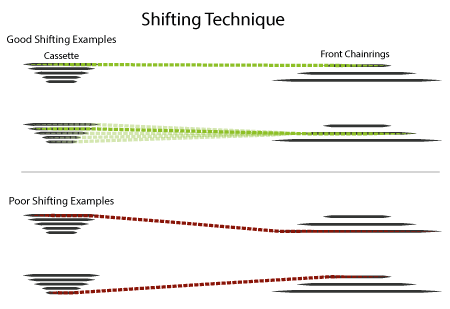
Proper and Cross Chain gearing. Image courtesy of REI.com.

Proper and Cross Chain gearing. Image courtesy of REI.com.

Cadence, Torque and a Little Downstroke will Do Ya

In an early blog, The Art of Riding Bikes, there is a discussion of the importance of cadence over torque.  Torque is the big strong guy grinding up the hill.  Cadence is the 90lbs lady passing him on the hill pedalling in a seemingly effortless manner.

You do need to apply torque to the pedal, some force is needed.  The analogy I use is: ‘apply as much force to the pedal as you would to a soccer ball being kicked to a two-year-old’.  Now, unless you like kicking balls hard at small children, this means a relatively light amount of effort.

Because the effort is less, something needs to compensate to provide power to the bike – this is where cadence and gears come in.  Try to keep your cycle strokes the same with a consistent force allowing the gears to compensate for the terrain or wind.  How many strokes?  Aim for anything between about 70-120 per minute with an ideal of about 90.  Your legs will tell you if you have too many revolutions per minute or if you can add a few more to the mix.

Put the Peddle to the … Little Metal Thing on your Cycling Shoe

The peddles are how we convert the up and down motion of your legs to the circular motion of the gears.  What is the best pedal to use, the answer is one you are comfortable with.  Before you stick to the tried and true flat pedal (available on kids bikes everywhere), to think about and consider adding toe clips, baskets or cycling cleats to your pedal ensemble.  They will help you transmit more energy with very little or no additional effort on your part.

At this point in the discussion I usually get dubious looks about attaching a bike to the bottom of one’s shoe.  To start, you will probably fall over due to unclipping at least once (ish) and it will take practice.  Some very good riders I know have forsaken the clip and they do fine.  A basket or cleat will take you further but you have to comfortable and trusting in the relationship.

A Shift in Cycling Style

Putting all of the above together takes practice.  Shifting needs to become simple muscle memory that you no longer think about.  To do this you need to get on the bike and start riding and shifting through the gears – both the front and the rear.  On a flat stretch, consciously practice working from the first gear front/back to the highest gears (e.g. 3/9) in the rear.

By becoming comfortable with shifting you can then better anticipate and be shifting up or down an instant or two before you need to.  By doing so, you can maintain that constant cadence and torque discussed above which in turns allows you to cycle for longer time periods and thus distances.

Alas you will run out of gears on some future hill that is a bit too steep.  At this point you have one of three choices.  Firstly get off and walk.  Due to a missed gear, a steep hill or other reasons (my dog ate my homework and so I had to walk my bike); sometimes the walk is the best answer.

Your second option is to traverse the hill.  Assuming the path way is wide enough, cut an angle back and forth across the hill rather than straight up it.  This will add some distance but cut down the angle of attack.

Send Your Nether-regions a Post

The final hill climbing technique is the post.  This is where you stand in the pedals and lift your tender bits off of the seat.  As an added bonus, the method also allows for blood to return to the pelvic floor thus reducing the discomfort of a allow a saddle to come in contact with your No-Sunshine Zones.  Posting is a short-term solution as you are switching from low-torque-high-cadence model to a high-torque-low-torque model.

Conclusion, Further Reading and Good Links

Once again, this post is meant to be used as a memory jog for me and a learning aid for the people I am standing in front of.  If you want to learn more, the internet has a plethora of material including posts that are a lot more technically accurate than the above (including strange algebraic symbols).

See you on the road!

REI

I ripped off their graphic so the least I can do is point out an excellent article on their website: https://www.rei.com/learn/expert-advice/bike-gears-and-shifting.html

Coach Levi

Very good article cover many of the same topics as in the blog:
http://coachlevi.com/cycling/complete-beginner-guide-to-bicycle-gears-shifting/

Wikipedia

When in doubt, what have the wiki’ites to say about the topic:
https://en.wikipedia.org/wiki/Bicycle_gearing

Still More Links!

Bike Gears: How Do They Work?

http://www.cyclingweekly.co.uk/news/product-news/using-bikes-gears-efficiently-148101

Gearing 101 Tutorial: A bit technical and much more detail then the above.  http://www.cyclingsite.com/lists_articles/gearing_101.htm