Unknown's avatar

About Frank SAPAA

Webmaster and Board Member of SAPAA and born and raised Albertan. Love exploring Alberta particularly in the winter on snow shoes.

A (Step-By-)Step Father How To Guide

Now that another Fathers’ Day has come and gone, I got a nudge from myself to blog about being a step parent.  I have been a step father to two great sons for almost 30 years.  This blog is not to say being a step parent was easy or to provide a twelve-step program to success (pun sort of intended).  Instead, this is a father’s day pause to reflect on the challenges and joys of step-parenthood.  Also, in case I fall into a time vortex, what I would do the same or differently.

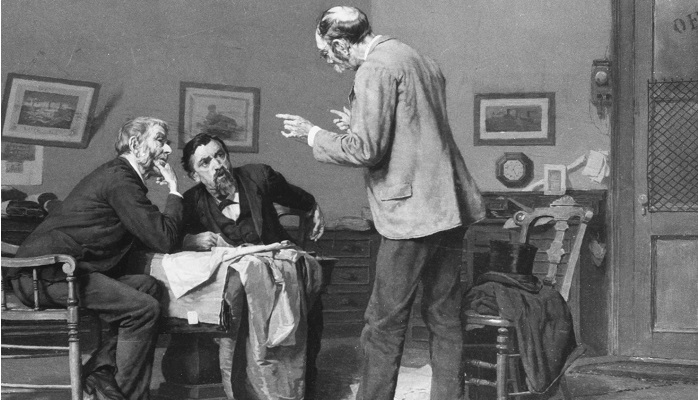
Great-Grand-Father's Tale of the Revolution—A Portrait of Reverend Zachariah Greene.  Metropolitant Museum of Art (detail), Accession Number: 1984.192

Great-Grand-Father’s Tale of the Revolution—A Portrait of Reverend Zachariah Greene. Metropolitant Museum of Art (detail), Accession Number: 1984.192

On that note, yup, I would do it all over again.  The things that I would change are all about me being a better role model and parent to the boys and not about them. They are/were good kids and they did not choose to go from having a just a single mom to having a step dad.  This point leads me to my first lesson as a step father, you married the kids mom – you did not marry the kids; they were just part of the package.

However, they are still children.  When in doubt about your responsibility as a parent, remember this simple rule: adults are responsible for giving children the right sort of memories.  Some of those memories will involve having enough food to eat and a warm bed to sleep in.  It goes without saying that those memories do not include abuse or neglect (the likes of Hansel and Gretel notwithstanding).  As for the operative word, the ‘right’ memories; they don’t all have to be happy memories.  Some of the most important memories will involve a ‘bad choice well explained’ after the fact.  Ideally though, your step children’s good memories will outweigh the bad from the moment you enter their lives.

In this case the operative word is ‘enter’.  Your spouse and their children had a life before you came along.  It may have been brief or you may find yourself with grown step children.  No matter the point of entry, remember this: “you will never be part of that portion of their life”.  Don’t begrudge, belittle or betray it.  Instead, listen, smile and honour it.  One of my reflections is that in my desire to establish my own family I had forgotten that these people had one before I showed up.  Until you establish your own traditions and stories, for a long time you may be seen as an interloper to their family.  Guess what, you are an interloper; get over it and start to build those good memories.

Despite years of effort, credit for your contributions to the newly formed family may not be forthcoming.  Your response should be, ‘so what’.  Biological parenthood can take as little as a brief moment of passion.  Step parenthood, like good parenthood,  takes a life time of ongoing choice and commitment.  Stick with it, you may be surprised with a thank you that seemingly comes out of the blue (even if it was itself years in the making).  Beside, even if you don’t get a thank you, eventually the kids will graduate school and move out… and then life starts to get really weird!

Hypothetically speaking, someday you may find your self at a step-grandchild’s birthday party with your wife, stepson and step-daughter-in-law.  Also at the party is your wife’s ex-husband and perhaps maybe a few other subsequent-ex-wives.  Throw in a mixed family on your side and you may need to graph some of the relationships of child having the birthday.  As for the kids themselves, they are cool with it.  More presents and people to love them is what a mixed on mixed on mixed world means.  And that means you need to be cool with it because it is not about you, it is about modeling the behaviour of an adult who loves and supports unconditionally.  These will be memories that you can give your step-grand children (and to your own children, and their half brothers and your step daughter-in-law and…. etc.).

FMI – 2015-16 Program Thoughts

As the Director of Programming for the Edmonton chapter of the Financial Management Institute, I get the chance to bring great topics to our members.  Our Chapter’s focus is on programming of interest for our members who are public servants in the greater metro-Edmonton area.  On March 12, the board is conducting its planning session for the 2015-16 program year.  This is your chance to contribute to the planning process without having to attend a board meeting (although if you want to volunteer…).

Leave a comment on this page with your idea.  A title is welcome but if you have a paragraph or two to add even better.  The items below list the potential topics of interest.  The sequence of events will be as follows:

  1. Identify great programming ideas.  An idea is composed of a title, a short description (e.g. a paragraph) and any other details such as potential partners.
  2. Identify programming venues.  Currently we focus on breakfast meetings but that is practice rather than the rule.
  3. Hold the March 12 meeting planning meeting.
  4. Update the future events page on the fmi.ca website.
  5. Execute!  This includes identifying an event project manager and start the planning process.

Our current ideas are as follows and are listed in no particular order, tentative sessions are just that, tentative.

Fraud awareness in the Public Sector (September 23, 2015), Scheduled

Internal controls are central to the fiduciary responsibilities of financial professionals and financial managers in the public service.  How good are your controls, is passing an audit enough and can you have too much control?  These are the questions that a panel of experts will discuss including examples from the real world of auditing.

Status of Capital Projects in Alberta and in Particular the metro-Edmonton Area, Votes: 16 – Scheduled for November 2015.

(Suggested by George W) What are the major capital projects being built in Alberta and what is the role of either by either public or private interests in their development?  This session will look at a state of the projects and how public servants can assist and support capita project based economic growth.  Also discussed will be the challenges of maintenance after completion, what are the options for keeping the lights on after the ribbon has been cut.

The Art of Influencing Others, Votes 16 – Schedule for January 2016

(Suggested by Neil P) In 1936, Dale Carnegie wrote ‘How to Win Friends and Influence People’.  80 years later, the nature of business may have changed dramatically, and continues to change… yet the basic principles of human interaction and workplace communication have, in essence, remained the same. Given the changes in today’s world and business environment, the humanity of his teachings are more crucial now than ever before, and the ability to win friends and influence people in business is an increasingly important skill.  This seminar will teach you how to manage people and give you the crucial foundational skills to shift from being an individual contributor to a well-respected manager who can achieve team success.

Foster Innovation in the Public Service When Money is Tight, Votes: 15  – Scheduled for May 2016

(Suggested by Sue K) Public servants are expected to be innovative while working in a risk averse environment.  This inherent conundrum is compounded during times of fiscal restraint when ideas are solicited but resources to execute few.  This session will investigate innovation in the public services from a number of facets.  Firstly, what is innovation, how do you get it, how do you keep it and when should you ignore it?  Next, how to propose, implement and sustain an innovative idea or culture in an environment that is less than ideal.  Finally, thoughts and strategies of making the case during times of fiscal restraint, after all, never let a good crisis go to waste!

How to Run Effective Meeting, Votes:13

(Suggested by Neil P) Public servants and financial managers spend a good portion of their working day in meetings.  But what is the result from this time spent?  This session will help you be more effective through both other standing the psychology and practical skills.  Including in this section is how ‘Roberts Rules of Order’ can help you be more productive in a meeting without sacrificing innovation or open communication.

Public Service and Its Unions, Votes 10

One pervasive constant in the public service is the existence of unions across all levels of government.  This session will consider the benefits to the members, citizens and taxpayers unions play and what are the corresponding costs or inefficiencies they introduce.

Surviving the Dreaded Re-Organization, Votes:10

(Suggested and contributed by Rene M and Darci S) Ministry re-organizations and municipal re-engineering have been with public servants since the initial governments.  Why do re-organizations occur in the first place from the political level, who has mastered the art of surviving and what can a public servant take away from or contribute to the re-organization?  Beyond the structural changes, what are the specific challenges in changes in leadership and the loss of corporate knowledge at the executive level.  What are the impacts to managers, non-managers with a specific focus on the role of the finance person in the reorganization.

Healthcare, Finance and Your Tax Dollars, Votes: 9

An exploration of the healthcare expenditures made within the province and nationally.  How can this expenditure can be maintained, what is the impact on government revenues (at all levels) and how will it be affected by the aging of the Baby-Boomers.  A panel discussion will occur.

How Government Works, a Ground Up Review, Votes: 7

Canada has 3 levels of government, federal, provincial/territorial and municipal/aboriginal.  How do these government levels work, what are the similarities, differences and nuances for each?  What should a financial manager or public servant know about these similarities or differences?  This event will include presentations from past and present sitting politicians and a tour of the Alberta Legislature.

Public Sector Budget, Part II: Do Results/Performance Based Budgets really perform (or deliver results), Votes: 6

(Contributed to by Nobey) Known by many names and methodologies (Results Based, Zero Based, etc.), a performance based budget strives to link inputs (financial and other resources) with the outputs and intended outcomes.

In theory, a perfect model for allocating the scarce resources available to a public service.  In practice though, what have been their successes and challenges?

These are the perspectives and challenges FMI will explore in this engaging panel discussion and presentation formatted conference.  Of interest to all who hold, manage or rely on public-budgets.

Governments, Disaster Response and the 2013 Floods – Two Years Later, Votes:6

In June 2013, the first ever province wide state of emergency was declared.  One of the most destructive natural disasters occurred in which large portions of Southern Alberta was under water.  Looking back two years, what are the lessons learned for all levels of government in emergency response.  How can the Public Service be both agile and maintain the fiduciary responsibilities expected of it.  In addition to the 2013 Southern Alberta Floods, lessons from the SARS epidemic, Slave Lake Fire and Forest Fires will be considered.  This session will be of interest to any public servant interested in planning for the unexpected.

Procurement, Who Is Doing Better?, Votes: 5

(Suggested and contributed to by BTH and Bageshri V) In February 2015 the FMI asked the question, Procurement who does it well?  At this session we will return to procurement but with a larger supply chain focus and ask who is doing procurement even better?  Included in this session will be a return to the Government of Alberta’s Contract Review Committees – xx years after their inception.

SharePoint More Than File Storage, Votes: 3

(Suggested by Dianne L) The Microsoft collaboration tool SharePoint has become the new standard in offices.  Unfortunately for many organizations, it quickly becomes simply another network drive – and not a particularly good one at that.  In this session you will learn 5 things that you may not have known SharePoint could do: 1. Be your go-to Desk Reference/Procedure resource; 2. De-clutter the infamous network drive; 3) Become a budget system – without (almost) using Excel; 4) Store emails and declutter your inbox; 5) Used as a ministry/department priority tracking system.

Time Management, Votes: 3

Time and attention has become the new precious commodity for busy professionals. Email, smart phones and pervasive technologies nibble away at the twenty-four hours allocated each day to deal with business, family and personal priorities.   What are the philosophies, techniques and methods to make the best use of those twenty-four hours?

Public Sector Budget, Part I: Who Loves their Budget System, Votes: 3

Budgets are central to a public service organization.  In many ways they are as important or perhaps more important than even the financial statements.  This is particularly so in organizations using the Westminster model of budget approval (e.g. the provincial or federal governments).

Given their importance, who does budgeting well?  Who has clients that love the system and who can produce reliable and forecasts quickly?  This session will explore these questions and opportunities from four lens, the system, municipal, provincial and federal perspectives.

Operational, Strategic, Business, Risk and Other Planning, Votes: 3

(Suggested by John K) Public servants and in particular financial managers are asked to lead, contribute to, evaluate and then manage to a variety of plans.  But what exactly does the organization when they want a strategic/operational/business or risk plan?  What are the common elements in these documents?  More importantly, how can public servants prepare credible, useful and enduring plans from that ever so-edge of the side of their desk?  This session will provide definitions, tips, tricks, guidance and most important, clues how to plans that spend as little time on the shelf as possible.

Who Loves their ERP and ERM?, Votes: 3

(Suggested and contributed to: Chris M and Darwin B) It is a truism that systems are the new bricks and mortars for organizations.  Unfortunately with this importance comes the risk when they are not well designed, implemented, run, managed or governed.  This session will look at the last two challenges in the context of two systems – how best to manage and govern an organization’s Enterprise Resource/Risk Management systems?  This will include topics such as – what should be the vision for these systems, who should be the governors, the managers, the users with the voice and to integrated the disenfranchised users?  As well, best practices/examples will be discussed from both local metro-Edmonton and from further afield.

Have Designation – Will Travel, Vote: 2

PSAB, IFRS and IPSAS means that accountants are increasingly less tied to specific industry, employer or even country.  What are the risks, rewards and opportunities for a professional accountant to take a secondment or leave to parts unknown?  What is the value proposition to the home and receiving organization?  How should family, career and community factor into this decision?  

Public Service Renewal – Three Years Later, Votes: 2

On November 1, 2012, IPAC-Edmonton and FMI held a joint conference to hear about initiatives to renew the public sector from its senior leaders. The panelists included Simon Farbrother (City Manager, City of Edmonton), Peter Watson (Deputy Minister of Executive Council, Government of Alberta), and Jim Saunderson (Chief Financial Officer – Western Economic Diversification, Government of Canada).

Three years on, what has changed and is renewal still a priority for governments?  What are the specific risks for the provision of financial, accounting or economic services?  This conference will revisit 2012 and look forward another three years in the context of public sector renewal.

Standards, Standards and More Standards, Votes: 0

(Suggest by John K) for accountants working in non-traditional finance areas, it is easy to get rusty on the standards that underpin our work. This refresher will provide a whirlwind tour for the financial manager on the accounting standards in force and that influence the public service.  This will include the legacy Canadian CICA, International Accounting Standards (IAS), International Financial Reporting Standards (IFRS), Canadian Public Sector Accounting Board (PSAB), International Public Sector Accounting Standards (IPSAS).

The 360 Review and Benefits of Self-Knowledge, Votes: 0

(Suggested by John K) Many organizations employ 360 reviews to help employees better understand themselves through how others perceive them.  During this session, the 360 review will be explained (including its strengths, shortcomings, costs, etc.) and how you can collect feedback informally about yourself through less formal means.

Policies, Procedures, Legislation, Regulations and Directives, Votes: 0

(Suggested by Carey M) Accountability and oversight comes in many forms.  What organizations have mastered the subtle art of enough control that does not destroy innovation in its ranks.  This session will look at that delicate balance including special focuses on the federal and provincial treasury boards and municipal equivalents.

One Town – Many Governments, Votes: 0

(Suggested by Ron M) Edmonton is a government town. What may surprise you though is exactly how much government is going on in our area code.  Within a hundred kilometres of the legislature dome there are xx independent government levels and organizations.  This includes the federal, provincial, municipal, first nations, crown organizations (agencies, boards and commissions) – and don’t forget the universities, schools, Alberta Health Services and other full and partially arms length entities.  How well does these entities cooperate with each other at a political, executive, financial management (yeah FMI!) and professional level.  What can be done to improve this cooperation and is there a dark side to knowing your neighbours a bit too well?

Critical Thinking and the Financial Professional, Votes: 0

(Suggested by Lucia S) How well do you perform when it comes to critical thinking and analysis and how well do you communicate the results?  This session will explore the dark arts of critical thinking and combine it with how to present and communicate such analysis in a simple and effective manner to executives and to the political level.

Mission Possible: Building Better Teams?, Votes: 0

(Suggested by Sandra V) Teams or at least work units are the basis for most organizational structures.  How can financial managers build better teams and how can financial professionals and public servants be better followers and contributors to a team?  More importantly, how to balance the success of the team with individual performance management and promotion.  This session will explore these issues and concepts.

Accounting for and Managing Assets in Government, Votes: 0

How well does your organization manage the asset life cycle?  How is that asset verification thing working out for you?  Are your organization policies, procedures and technology current or are they getting a bit stale?  Finally, do you understand the accounting standards relative to tangible, intangible, component-ization or work in progress accounting?  This session will examine the asset life cycle, who is doing it well, the standards and what could be done better.

Building Teams When Times are Tough, Votes: 0

(Suggested by Xin N) Individuals are appraised by teams produced!  However, how do you build effective teams, resolve conflict and create a healthy work place when the demands on the individual public servant have become greater than ever?  This session will provided you with practical skills in team building and work relationships so as to keep your individual sanity and your team effectiveness.

The Art of Performance Measurement, Management and Avoiding Unintended Consequences, Votes: 0

An old saw goes, ‘What gets measured gets done’.  However in dueling quotes, Albert Einstein said: “Everything that can be counted does not necessarily count; everything that counts cannot necessarily be counted’.  Thus the challenge of performance measurement in the public service.  What are the acknowledged performance measurements for government organizations, how can the costs to collect these measures be reduced while improving their accuracy, finally, what is the role of the financial professional to managing measurements (both financial and non-financials).

Transfer Pricing and Internal Costing of Goods and Services, Votes: 0

Full costing of government is a challenge.  Central services (finance, human resources, IT, etc.) are often seen as a ‘free-good’.  Nevertheless, stakeholders (taxpayers, citizens, politicians) want to know the cost of delivering a project, program or service.  Twenty years ago, activity based costing, budgeting and management was one method to accomplish transfer pricing – since then the accounting world has become largely silent for these techniques.  This session will discuss the value and purpose transfer pricing, the existing accounting standards and success (and not so success) stories.

Information Management and Government Decision Making, Votes: 0

A central role of financial managers and public servants is to ‘speak truth to power’; however truth needs to be based on good information and evidence.  What are the sources of information that can be used to make good decisions?  How do public servants manage information that is growing faster than the ability to assimilate let alone understand it.  This session will allow the public servants to understand what is information, how can it be managed, how it can be used for decision-making and how is this a good career tool.

Cost Accounting in the Public Service, Votes: 0

Activity Based Costing (ABC) and Budgeting (ABB) have seen their fortunes rise and fall over the past few decades.  The Alberta Government has passed the Results Based Budgeting (RBB) Act which seeks to systematically review all government programs and services from an output and outcome perspective.  This session will discuss the role cost accounting/budgeting plays in this new world at all levels of government.  What are the human, system and cultural changes needed to make RBB, ABC, ABB or any other similar resource allocation process successful?

SharePoint Wikis as a Desk Reference Tool – How-To Pages

This is the second in a good intentioned series of blogs detailing my experiences and uses of the tool.  The first blog, SharePoint 101, provided some context and a ‘fictional use-case’ which the following blog is based on.

Continue reading

SharePoint – 101

I like SharePoint, it is not a love-level relationship but it has matured definitely to the like stage.  Through this and future good-intention blogs, I want to put down what I think are some pretty cool ways to use SharePoint and just as important, some good ways to use the tool.

SharePoint, huh?

If you are reading this and have never used or heard of SharePoint, go onto some of my other postings on this website.  Unfortunately SharePoint is kinda hard to explain and so therefore I will assume that you know about the following things:

  • Its general architecture (e.g. there are farms, sites, sub-sites, lists and items)
  • Its typical structures (lists, libraries, workflows, webparts, pages, search, etc.)
  • Who uses and how access is managed (e.g. super-administrators; site-administrators; users with contributor, read and other access)

If any of the above is makes you go huh?, sorry I can’t help you but I can point you in the right direction:

  1. Wikipedia has a good over-view description.
  2. Read the Microsoft Sales Stuff.
  3. Take a course, there are lots out there including those from Microsoft.
  4. By a book, Chapters or Amazon sells lots, and
  5. Most importantly – start using it!

How Not to Use SharePoint

… but before you start using SharePoint, here is something to recognize about how not to use SharePoint.  Don’t use SharePoint as a glorified Network File System.  It can do so much more, so why do so many people do so little with it?  Hopefully the next few blogs will give you just some examples.

How to Use SharePoint

In my ongoing effort to remember what the heck I have done, I have the good intention of writing a series of blogs about some cool uses of SharePoint (and associated technologies).  Check back to read about cool stuff or to see a post of shame of good intentions gone bad.

  • SharePoint Wikis as a Desk Reference Tool
  • Data Dictionary (of SharePoint and other stuff)
  • Looking up a Look Up of a Look Up
  • Managing Sites, Structures and People (a poor man’s content management strategy)
  • Using SharePoint as a Budgeting Tool

Business Case Example

I have used SharePoint for a variety of uses including:

  • An internal facing team-site with a handful of users having access
  • A highly restricted decision making site with very sensitive information
  • A status reporting system for dozens of project teams who in turn need to consolidate their work into a few sentences for an executive office
  • A ministry briefing binder in which hundreds of documents were managed that had varying degrees of sensitivity and right of access
  • Widely available budget site in which budget clients uploaded their working papers for consolidation
  • A project site composed of numerous teams working on a complex system transition

For the purposes of this and other blogs, I will use a fictional example of a budget site in which internal clients need to submit content and documents.  This example will centre around a government organization and specifically one that primarily manages projects but also manages contractors, contracts and staff.

Procurement Questions

On February 26, 2015, the FMI-Edmonton Chapter is hosting a professional development session, ‘Procurement-Who Does it Well?’.  The pre-event program notes are available (including speaker biographies) for those wanting a bit more detail or context.

Louis Moeller,

Louis Moeller,

The purpose of this session is to explore:

Canadian governments (federal, provincial, municipal and agencies) collectively procure  billions of dollars each year. Efficient and effective procurement is critical to the proper functioning of government operations and central to a modern economy.  This professional training session will consider the public sector procurement challenges from many perspectives including procurement professionals, public servants who need to purchase goods/services, the financial manager, system providers and of course the taxpayer who ultimately pays for the purchase.  This is a joint presentation by FMI and PwC Canada – a global leader in supply chain and procurement.

 With any good session, a set of questions helps to explore the issues.  Available to speak to (if not answer the questions) are experts from PriceWaterhouseCoopers (PwC) as well as Federal/Provincial/Municipal government finance and procurement professionals.  In addition, we will also use the ‘wisdom of crowds’ for this session in which individuals attending can text/email in responses to questions which they think better answer or contribute to the question.

Questions fall into one of the following themes:

1. The Future of Procurement

(Questions relating to changes in People, Process and the Products of the procurement process?  This includes the use of technologies, legislation, training, etc.).

  • Alberta has recently introduced legislative and Treasury Board directive changes increasing the difficulty of conducting sole-source contracts, the use of contract review committees, changes to conflict of interest and other amendments.  Where do these changes place Alberta relative to the rest of Canada for transparency and over-sight of the procurement process?  Should any of the changes be adopted by other levels of government, if not already; in particular, by municipalities?
  • How well do government organizations in Alberta coordinate their procurement activities? Do other jurisdictions to a better job and if so, what will Alberta need to do to match this performance?
  • How procurement-literate is the average public servant?  What is the minimum they should know and where is the best place to learn this?

2. The Current Practicalities of Procurement

(Questions relating to how to ensure compliance with existing organizational and legislative rules and procedures.  This includes reducing the burden compliance while selecting the best vendor during a procurement event).

  • How much is public-sector procurement a technology problem, a political problem, a people problem, a process problem – or is there a problem?
  • How do private sector vendors perceive the government procurement processes in Alberta?  How and how much should their perceptions, needs and circumstances be taken into consideration when designing a procurement process or running a procurement activity?
  • Are inefficiencies in the public-sector procurement process used to discourage expenditures and thus they are a form of cost avoidance or containment on the part of a government?

3. From the Procurement Professional’s Perspective

(Questions related to how a procurement professional can support public servants in selecting vendors of goods and services).

  • How does an organization know that it has a good procurement process?  What metrics should an organization track against to make this assessment and are benchmarks available in general or in particular to public-sector procurement?
  • Who is the ‘pin-up organization’ that every procurement manager wishes their organization could emulate?  Who is the best of the best when it comes to public-sector procurement?
  • A common compliant amongst public servants are the Byzantine procurement rules, seemingly arbitrary changes to the procurement process and endless legal reviews.  How much is this perception real and how can procurement professionals streamline and the process without losing accountability for a fair, open and transparent bidding process?
  • When should a procurement professional be the person to negotiate price with a vendor?  What other procurement attributes (e.g. delivery, quality, terms, conditions, etc.) should be the responsibility of the public servant making the purchase versus the procurement professional?

4. From the Financial Manager’s Perspective

(Questions related to what a financial manager must consider when supporting public servants or procurement professionals).

  • Canadians were perhaps shocked with the revelations of corruption in Quebec.  Over all, how does Canada or Alberta fair on its public-sector procurement being free of corruption?  What are the pro-active and retro-active activities to maintain a corruption free status (or to de-corrupt it, as applicable).
  • What is the one way a financial professional can assist a public servant or a procurement professional in the context of procurement?

5. Alberta’s Contract Review Committees

(Questions specific to operating a contract review committee within a public sector organization with a specific focus on the province of Alberta’s implementation of a review committee).

Alberta Context: A Government of Alberta Treasury Board directive requires that all departments have in place a contract review committee ‘to support the procurement accountability framework’. This framework in turn will: ‘support consistent goods and services procurement practices, including those in respect of Construction, across all departments, that reflect best practices and foster accountability, fairness, effectiveness, and efficiency ‘.

  • Some Alberta Ministries already have contract review committees, how much is this experience being considered when setting up new contract review committees?
  • Are the experiences of other governments also being considered, for example ad hoc committees used in selection of federal or municipal committees.
  • Should the vendor experience or perspective be considered as part of the deliberations of a contract review committee?
  • Some ministries had review committees while others have yet to establish a committee before the April 1, 2015 deadline.  How much should and will the committees differ across the ministries?  What are the FOIPP and public disclosure consideration for these committees?

Dead Men Make Good Reads

Dr. William Maples passed away nearly 30 years ago (February 1997) at the young age of 59.  Never heard of him you say?  How about these names: Quincy, CSI (Vegas, New York, Portage la Prairie) or Bones – have you heard of them?

Maples was the inspiration or at least haunts these popular television shows.  In his book, Dead Men Do Tell Tales, he provides a glimpse into the life of what was then a unique animal – a forensic anthropologist.

Working in Florida, he pioneered or studied under the first scientist who combined these disciplines.  I recall seeing this book when it first came out in the early 1990’s and wanted to read it – now 30 years later I can check it off the list.  Its age is both a detraction and an appeal for reading the book now.  On the detraction side, Maples is describing state of the art that has long since been made obsolete.  On the appeal side, he shines a light into his science just before it went mainstream with television shows such as CSI or Bones.

This book is more than a historical curiosity though, it is also a good read.  Maples had the opportunity to examine some world-famous bones include the elephant man, Spanish conquistadors, US president Taylor and the remains of the family of the last Russian Czar.  He tells of these exploits in a direct and slightly casual way, sort of how you would imagine him delivering a lecture on the subject to interested laymen.

The book includes photos and some descriptions that I passed over in places.  Nevertheless, if you like CSI, science or history – keep a look out for Dead Men Who Still Tell Good Tales.

Leo Tolstoy Grave - 1910.  Scherzo di Follia; Accession Number: 2010.423.5 (detail) metmuseum.org

Leo Tolstoy Grave – 1910. Scherzo di Follia; Accession Number: 2010.423.5 (detail) metmuseum.org


The Secret to a Secret Life

Pssst, wanna hear a secret?  Dr. Gail Saltz writes about people who have kept secrets from spouses, family members, friends and themselves.  That is not all though, she is an okay writer and the book was a solid read but it left me ever so wanting for a few more secrets.  Pass it on!

Scherzo di Follia; Accession Number: 2005.100.198 (detail) metmuseum.org

Scherzo di Follia; Accession Number: 2005.100.198 (detail) metmuseum.org

By way of a full disclosure, I have written about secret lives before in my blog: How to Disappear – When you Really Need to Go!  That read was more of a how to book to disappear when you don’t want others to find you (e.g. after winning the lottery and avoiding your dead-beat relatives).  Saltz’s book provides an alternative perspective of living a secret life, the psychological impact.  Her biography lists her accomplishments as “Psychiatrist, psychoanalyst, columnist, bestselling author“.  This book is based on her experiences with the first two: Dr. Saltz, psychiatrist and psychoanalyst.

From these experiences she provides a series of pseudo-case histories from her own practice including a matronly shop lifter, a happy married sex-addict and an upper-middle class tax cheat.  She also introduces some of the famous people who have lived secret lives such as:

  • T.E. Lawrence or Lawrence of Arabia; military hero and sexual pervert.
  • Charles Lindbergh: american hero and polygamist.
  • An assortment of rogues-galley such as Ted Bundy.

Not every secret of course is as pathological, immoral or criminal.  In fact secrets are part of childhood.  According to Saltz, keeping secrets establishes an identity outside that of your parent’s.  The secrets start with playing peek-a-boo, evolves to secrets about possessions (including secret friends) in mid-childhood and then secrets of shame in adolescents.  Secrets are part of an adult world ranging from passwords, PIN numbers, sexual tastes of your spouse, non-disclosure agreements or even your own self-talk about whether or not to kill your SOB-boss.

These secrets, through our life-journey, are necessary or largely harmless.  There is a tipping point when a secret goes from a protected password to gnawing at one’s psychological health.  Saltz lists the cost of keeping these types of secrets both in the book and in two appendices (there are two Cosmopolitan Magazine like check lists for determining if someone you know has a secret or whether you have one); symptoms include:

  • Moody, nervous, temper, beleaguered, preoccupied
  • Acts suspicious such as unaccounted for time away from friends, family or work
  • Missing money or unexplained bills
  • Depression, physical ailments or exhaustion

In other words, it may be the flu, a bad weekend in Las Vegas, over spending for a surprise birthday party or there may be a dark secret.  This is hardly a convincing list and this is where I find Saltz’s book a bit disappointing.  Saltz’s remedy for most secrets in the book is to go and see a shrink for absolution.  As well, although she introduces some historical secret keepers, she missed some real whoppers.  Folks like high-ranking Nazi officials living in Argentina, Alan Turing living with both a war and a homosexual secret life or even ex-CIA or secret agents living with the actions demanded of them by their country.

In other words, Saltz’s book is good, but not great.  The psychology she introduces seems a bit to pop-psychology like and a little too good to be true.  I would have liked a bit more meat to go with the secret-sauce Saltz was serving up in the book, ‘Anatomy of a Secret Life’.


Proofiness

Mathematics can be used and presented in a manner that distorts the underlying truth or at least the underlying likelihood of a truth.

A mathematician seated at a table, working on mathematical equations

A mathematician seated at a table, working on mathematical equations

YAWWWNNNNN, who cares – Charles Seife does and tells us why you should care too in this book, “Proofiness: How You’re Being Fooled By The Numbers“.

Seife’s position is that bad math is more than being hoodwinked into buying oatmeal (see Quaker Oatmeal cholesterol numbers); bad numbers disenfranchise voters and erodes the democratic rights of Americans.

A Bad Math Field Guide

Be warned, this is a heavily American-focused book in which about half is dedicated to the challenges of the US voting systems.  If you can get past this bias, some interesting terminology and underhanded methods are exposed.  Here are a few:

  • Truthful numbers: come from good measurement that is reproducible and objective
  • Potemkin* numbers: derived from nonsensical or a non-genuine measurement
  • Disestimation: taking a number too literally without considering the uncertainties in its measurement
  • Fruit packing: Presentation of accurate numbers in a manner that deceives through the wrong context.  Techniques include cherry-picking, apples to oranges and apple polishing.
  • Cherry picking: Selection of data that supports an argument while underplaying or ignoring data that does not.
  • Comparing apples to oranges: ensuring the underlying unit of measurement is consistent when comparing two or more populations.
  • Apple-polishing: data is touched up so they appear more favourable (this was the Quaker Oatmeal trick).
  • Randumbness: because humans are exceptional at discerning patterns we also suffer from randumbness, insisting there is order where there is only chaos.
  • Prosecutors Fallacy**: Presenting a probability incompletely and leading to a false data assumption.

* Named for Prince Potemkin who convinced the empress of Russia that the Crimea was populated by constructing villages that were only convincing when viewed from a distance – such as a passing royal carriage.  An example of a Potemkin number was Joe McCarthy’s famous claim of 205 communists in the State Department.

** This one is worth a blog on its own so for more, read: http://en.wikipedia.org/wiki/Prosecutor’s_fallacy.

Take Your Field Guide With You to Work

These are important concepts for not only a citizen to consider when looking at dubious polling information but in the business or public policy world as well.  If there is a shortcoming in Seife’s book, this is it.  In my opinion he over focuses on the bad use of numbers in the public arena without touching on how CEO’s, CFOs, Boards and government-Ministers may also be hoodwinked.

Individuals being asked to make decisions based on numbers need to be able to cut through the packaging techniques discussed above.  This is becoming more important as our society moves to a 144 character Twitter attention span and public policy needs to be distilled down to a simple infographic.  As well, while developing a dashboard for a business is valuable, be sure that it is not filled with polished, cherry picked, Potemkin numbers based on a disestimation

Disenfranchising a few Million

Returning to the book, Seife has some advise for the US when it comes to the United States census.  Written into the constitution, once-every-decade process of counting all American citizens costs about $6.5 Billion dollars.  For this expenditure, it is estimate that the census misses about 2% of the United States population and double counts about 1%.  While these numbers would in theory cancel each other out (more or less), the impact is that there about 10 million US voters not accounted for in the census.

This error rate can be mitigated through techniques known as statistical sampling which will smooth out the distortions.  The result would be generally more people counted in poorer, racial minority areas who don’t like to fill in census forms or talk to government officials.  The ‘result of the result’ would be these people would then have more politicians to vote for (larger representation) and to send to Washington.

So far sounds good except that poor, non-white folks tend to vote for the Democrats which is why there is another perspective: only a count – counts. This being America, the counting challenge has generated a lot of legal attention and two population numbers.  One used by everyone who needs precise data to estimate everyday population trends and another used to reapportion the House of Representative seats.  After numerous legal battles, millions of Americans are disenfranchised because only a more error prone enumeration technique is permitted (see pages 185-198 for a more thorough explanation and also some very impressive legal gymnastics by the Supreme Court).

A Math Journey with a Curmudgeon

Seife sees himself as unbiased journalist although his leftiness tends to negate this somewhat.  He distrusts political polls, NASA, fluffy articles in scientific journals and the social sciences.  In other words, reading Proofiness is like visiting with a self-indulgent, opinionated curmudgeon – who is also brilliant and often right.  If you use numbers to make decisions in your day to day life, I would encourage you to take your ‘Proofiness-Field Guide’ with you.

Triumph of the City

How can you not love a book that combines economics, civil engineering and history!  Edward Glaeser combines these elements into a generally good read that traces the impact of the city from its earliest times to its modern incarnations.  His thesis is that building-up is good and environmentally responsible; sprawl is understandable but not sustainable.

Origin of a City

Cities started and thrive on technology.  The invention of agriculture and the domestication of beasts of burdens was the genesis for our urban journey.  As a result, cities became gateways along trade routes for the spread of culture, innovation and disease.  Since these earliest times, ongoing technological changes have allowed cities to flourish.  The creation of a better transportation (the wheel, canals, steam, street car, automobile, etc.) have allowed for cities to take advantage of the exchange of goods and services.

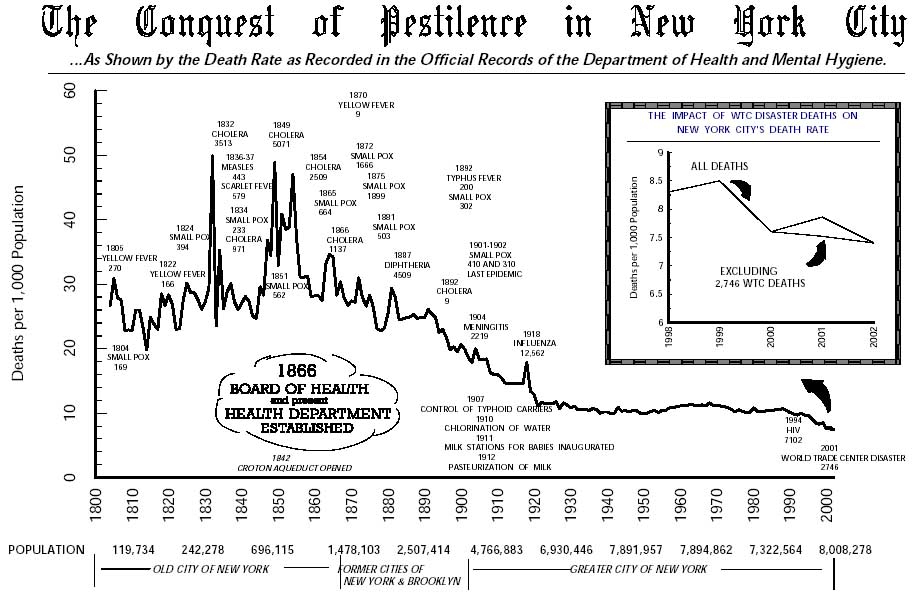
More recently (e.g. the last 150 or so years) social changes and technologies have allowed cities to move from places of pestilence to locations where you are more likely to be healthier, happier and live longer than your rural cousins.  These technologies are of course the lowly toilet, sewer system, asphalt (to reduce dust), internal combustion engine (to reduce things like horse dung) and clean water.  Parallel political structures needed to be created to provide these externalities* such as effective police forces, water works, street maintenance and an (ideally) non-corrupt overall administration to manage these services.

The Conquest of Pestilence in New York City; Stirling Behavioural Science Blog

The Conquest of Pestilence in New York City; Stirling Behavioural Science Blog

Slums as a Success Story

At this point, many people would point to the slums of Mumbai or Rio and suggest that the conditions there make cities a failure.  While Glaeser does not minimize the human suffering that does occur in quasi-legal no man’s land of slums, he also suggests that those living there are (on average) better off than their rural kin who they left behind.  Cities encourage innovation, reward hard work and there is a better chance to have access to medical care, clean water and schools for your children in a slum than in a rural province.

Once again, it is important to differentiate anecdotal, statistical and absolutes at this point.  For the young man who left a rural village in Brazil and died the next day in gang warfare in a Rio slum – cities would seem to be a bad deal.  But his tragedy has to be matched against the many others who became middle class through hard work, innovation or access to education.

Political Impact on Cities

Cities and political processes go hand in hand.  For example, the more democratic a country is, the more distributed its cities are likely to be; conversely, the more autocratic, the more likely that a single city will lord over other cities (the largest cities in dictatorships, … contain, on average 35 percent of the countries’ urban population versus 23 percent in stable democracies, p. 235).  Over the past 100+ years perhaps the greatest political influence on a city was the favouring of the automobile through the creation of highways and mortgage deductions for private ownership.

In the United States, the creation of the inter-state highway system (which was partially completed to support improved military transportation) has allowed for the creation of suburbs compounded by three other factors: road economics, tax policy and school funding.  The fundamental law of road congestion states that as roads are built, they are filled at nearly the same rate as their construction.  Thus more roads mean more traffic with only congestion pricing (a political hot potato if there ever was one) mitigating this effect.  Returning to the United States, a generous mortgage interest deduction further encouraged the purchase of the best available home a family could afford.  The localization of school boards and their funding meant that parents would also select a home where the good schools were.  The impact since the end of the WWII was the creation of a suburban sprawl and the gutting of inner-city communities.

The urban riots the United States has experienced can be partially traced to the flight of educated and leadership enabled citizens (white and black) away from the urban centers.  This was more than a lack of policing or social policy, this was as much the destruction of the social fabrics of the communities.  Akin this effect in the United States, Glaeser comments on how much safer the Mumbai slums are than the Rio equivalents despite the former being poorer.  Mumbai slums are better functioning social spaces and thus they provide their own safety nets and controls that are less likely to be found in the more transient Rio slums.

Creating Great Cities

Glaeser offers some direction on how to keep cities healthy, happy, lower environmental footprint and safe.  Firstly, allow cities to grow up.  This increases the density per square metre meaning that the same public-service is being optimized.  Green spaces are important to allow parents to raise their families and community safety must occur concurrently.  Community-based and adequate policing is part of the safety equation in addition to creating functioning social-spaces and communities.  Further to this, a community needs to have a say in the make-up of its local environment (bars, night clubs, daycares, etc.) but must not have a complete veto otherwise cities become balkanized into enclaves of Not in My BackYard.

Glaeser also strongly supports the consumption pricing of public goods.  Thus those driving in from the suburbs should be paying for this right or the developer constructing a high-rise tower should pay a sufficiently high enough fee to compensate the local community for this vertical-intrusion.  These are excellent economic principles that often falter in harsh light of political reality.  Nevertheless, at least they should be part of the discourse on what type of city we want to live in and have available to us.

Triumph of the City is a good read for anyone interested in the practical application economics and civil engineering to the messy realities of human communities.  The book is strongly skewed toward the United States context but Glaeser should be commended in bringing in numerous global examples to balance this bias out.  There are lots of juicy footnotes for those who want a deeper dive into the details.  Triumph of the City is a good book for any History/Economics/Civil Engineering-wonks out there.

(*) In economics, an externality is the cost or benefit that affects a party who did not choose to incur that cost or benefit [WIKIPEDIA].