Unknown's avatar

About Frank SAPAA

Webmaster and Board Member of SAPAA and born and raised Albertan. Love exploring Alberta particularly in the winter on snow shoes.

Who Wants to be a Fraudster?

Central to most financial literacy programs is fraud awareness. How to keep the bad guys from getting your money, possessions or good name. Who Wants to be a Fraudster? is a variation of the classic bingo game in which participants match a term or concept to a fraud related question.
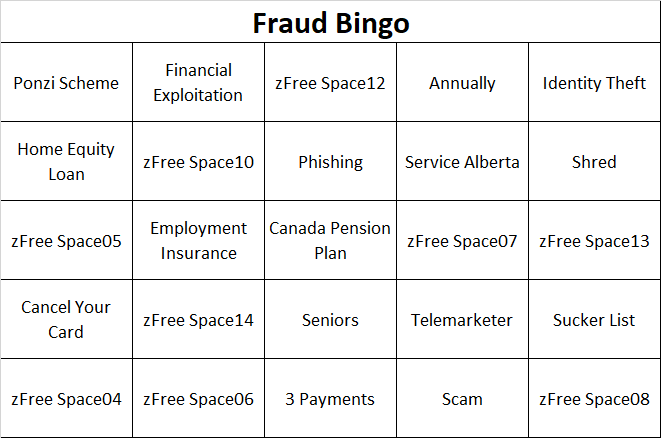
Sample bingo card for the game, Who Wants to be a Fraudster?
Fraud Bingo Card
Continue reading

I Want to Learn

A core premise of adult learning is that the individual must have influence over the content of the instruction. In a workshop setting, this can be done by asking participants to rate both their knowledge of a topic and the relative importance a topic is to them relative to the time and attention available in the session.

Continue reading

Here, There and Points in Between

Have you ever heard of the ‘Peter Principle‘? It was a satirical management theory developed by Laurence Peters in the late 1960’s. At the center was the maxim that everyone rises to their level of incompetence. You get promoted based on past good work until you are in a position in which your skills, experience and aptitude are no longer aligned with the job functions. Meant to be tongue in cheek, what happens if we don’t have to stay incompetent – what happens if we can become a different person?

An image of a chimney sweeper with his ladder and brush walking across the scene with a blue background.
Chimney Sweeper sign in Vienna Austria, taken August, 2018 by author.

This is the basis of the book, ‘What Got You Here Won’t Get You There‘ by Marshall Goldsmith and Mark Reiter.

Continue reading

Don’t Confuse the Container with Its Contents

You would never confuse ketchup with the ketchup bottle.  Ketchup is that blood substitute on your new white shirt while the bottle is the thing that slipped resulting in the white-shirt-blotch. If we can keep ketchup straight, why is it so hard with information?

Continue reading

Thinking Positive About a Negative Score

Organizations need to pick winners and losers.  For example, a government must decide to whether to fund project X, Y or Z; a corporation only has the capital to build asset A, B or C. 

Most organizations have developed a portfolio selection and management methodology.  There are typically 2 parts to such a process: a set of criterion and a scoring scheme to rank the criteria.  In this blog, I want to focus on the second challenge, the scoring. 

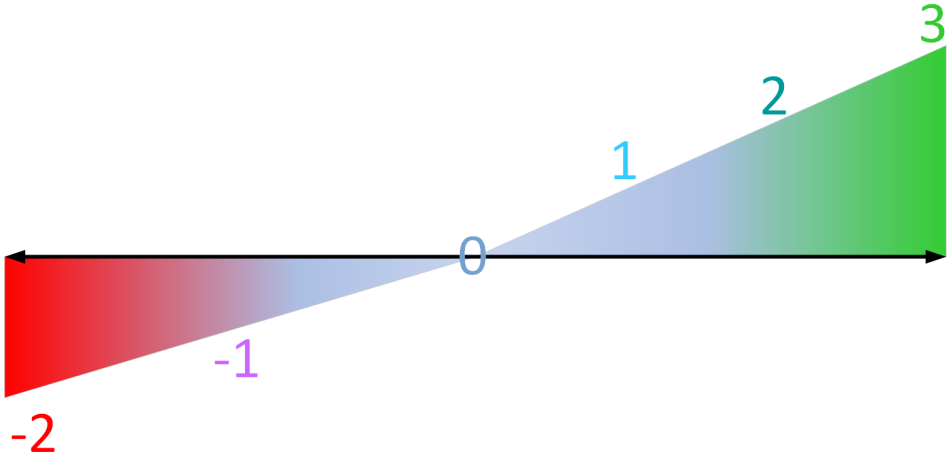
Balancing scoring Model is composed of two right-angled triangles sloping a center vanishing point which represents the value of zero.  At the left, the triangle dips below a black line 2 units into the negative.  At the right the triangle rises out of the line 3 units.  -1, 0, 1 and 2 value points are between these two extremes.
The +/- Scoring Metric
Continue reading