SAMI Financial Literacy Goals

Most people have heard of the marshmallow test. Ask a young child if they want one marshmallow now or two in a short while. The test was designed and originally delivered in the late 1960’s and early 1970’s, it showed a correlation between a young child’s ability to delay gratification and their future success [1].
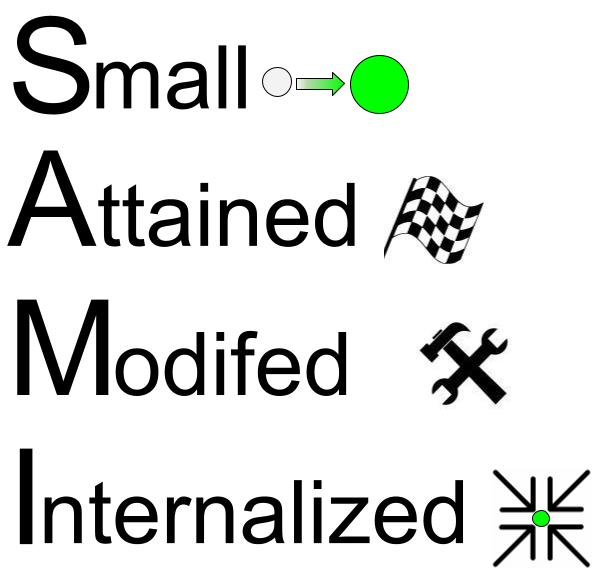
Graphic representation of the SAMI Goals.
SAMI Goals (Small, Attained, Modified and Internalized)
Continue reading

Lagom & Literacy

Lagom is a Swedish that roughly translates to ‘Just Right’. It does not mean average, sufficient, moderate or adequate – it means the right amount for the circumstances. It is an expression of comfort and has elements of the concept of “Gemütlichkeit” or coziness.

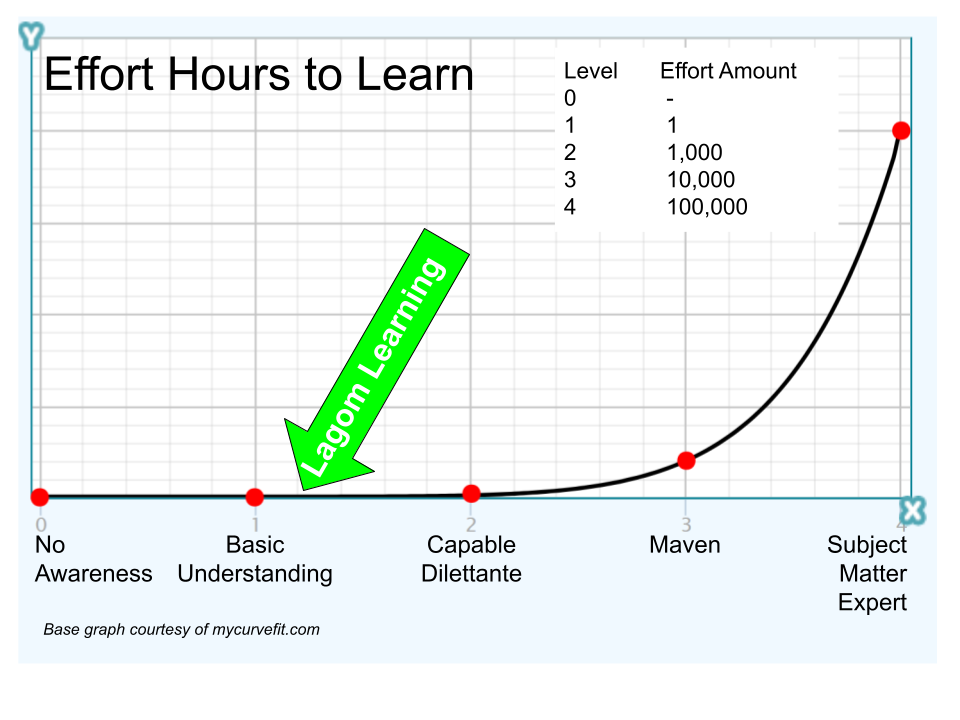
A scale with five horizontal points. The vertical axis increases on a logarithmic scale starting at one (Level 1) and ending at 10,000 (Level 4).
Lagom – learning – Levels. A logarithmic scale of the level of effort to learn a subject.
Continue reading

Go Forth and Budget

Having been a ‘budget-guy’ my entire professional life, I have promoted the concept of ‘Just-Enough Budgeting‘. Use only enough planning to achieve the maximum value from the planning [1]. Developing financial plans are expensive, challenging to maintain and may run counter to the well-being of an organization [2].

Vienna Sculpture of the family.
Continue reading

Where’$ My Money

A dark ‘game’ used in select Financial Literacy circumstances to teach how compounding interest works as well as the value of paying down debt.

Example of a Loan and the Interest and payments made. Note that even after the hard work of this family, they had barely paid off $58 of the original $5,000 loan made to them as a result of a high rate and compounding interest.
Continue reading

Financial Literacy – Self Assessment

One of the challenges of teaching financial literacy is developing an assessment of where individual students and the entire class is at in regards to their knowledge and habits. The following self-assessment tool is a non-scientific method to perform this evaluation.

Financial Literacy Self Assessment Tool
Continue reading

Human Resource Budgeting – A Range of Options

Human resource costs can represent a large portion of an organization’s budget. They also come in a variety of shapes and sizes: hourly, salary, permanent, temporary, contracted, etc. This blog provides a range of methods to estimate these costs. A key feature is that there is not a one-size fits all solution.

16. The Big Drawer, 2010 Pechet & Robb   Located: 8 Lonsdale Avenue Description: This outdoor monument to shipyard workers marks the original entrance to the Burrard Drydock Shipyards and the location where workers punched their time cards. Specifications: steel, photo collage About the Artists: Bill Pechet and Stephanie Robb have worked as a design studio team for architecture and art in Vancouver since 1991. Their work maintains a focus on building bridges with art, imagination and everyday life.
The Big Drawer, North Vancouver
Continue reading

What is This Budget-Thing You Speak Of?

I recall sitting in a board meeting for a non-profit I was involved with years ago and the budget process came up. Specifically the word ‘budget’ meant to different things to different board members.

A 2x2 matrix using the axes of Openness and Authority/Standards
Openness X Authority Matrix
Continue reading