Most people never have to consider the challenges (and enormous benefits) of choosing to be an international public servant. That is an employee of an international organization.
For the duration of your employment you don’t typically pay taxes, nor do you pay into a national social security network such as the Canada Pension Plan or a health insurance program. When you are younger this seems like a great deal but what happens when you leave the service or when you retire? Do you have a pension, health insurance or other social benefits when you are no longer an international public servant?
The answer is… it depends and this is a look into the most well-known of the international organizations, the United Nations, and their post-employment employer benefits programs.
Pension Plan or Provident Fund
The United Nations offers a pension plan but some organizations (and nations) have taken a different direction, Provident Funds. Effectively a provident fund is a savings account
When I was contracting for NATO, for example, I recall staff being able to withdrawal from their provident fund to buy homes or pay for the children’s education. Obviously the details of each fund is very different but that is a potential advantage to an employee of a provident fund is the ability to make use of the resources earlier rather than waiting for retirement.
Unfortunately provident funds are seldom portable between organizations. Another challenge is that risk is not distributed. Thus for a person and family who remain healthy, they may retire and leave a nice inheritance to their children. Conversely if you/family become ill earlier in your life your provident fund may be quickly depleted.
A benefit to the employer is controlling the liability associated with the provident fund. They truly are a define contribution scheme meaning that the long-term liability ends after each monthly fund payment. On the other hand, a friend of mine moved to Malaysia and knows stories of older people having to go back to work after gambling away their lump sum provident fund payment. But back to the United Nations!
After Service Health Insurance (ASHI)
The United Nations offers two types of after-service benefits to its employees, a pension and health insurance. As a career organization, this makes sense and the portability of both of these programs is excellent. The pension fund is a defined benefit plan with a five year vesting periods. With ~$54B USD fund, the pension is generally considered to be fully funded although has been under criticism for its investments, governance and performance (e.g. see: The UN General Assembly Urges The 54 billion pension fund to shape up).
ASHI is another matter and represents a significant cost and liability to the United Nations. The following graphic provides a visual image of why this is a critical issue given that this one benefit represents nearly 90% of the total employee benefit liabilities. ASHI and the other long-service employee benefits have grown to the largest liability for the UN primarily because of ‘pay-as-you-go’ philosophy. All sources from the 2016 UN Financial Statements.
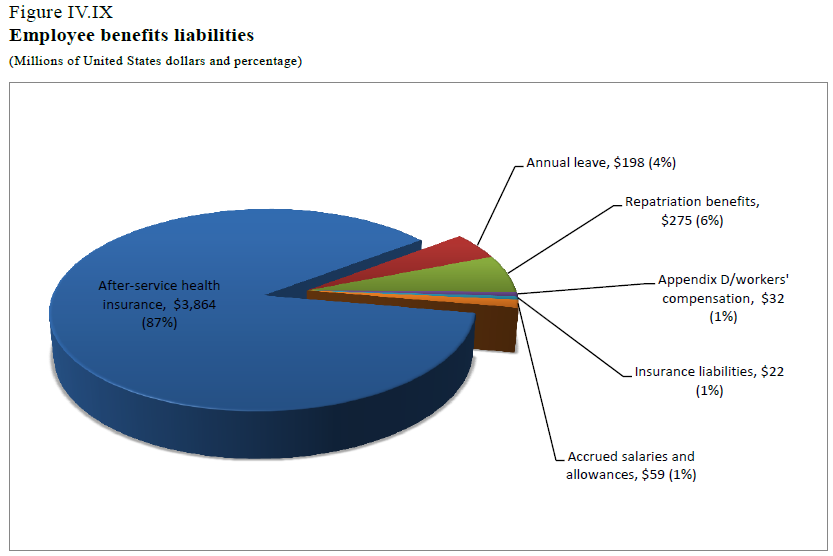
Analysis of UN long service employee benefits (2016 financial statements)
What can the Alberta Government learn?
The UN’s ASHI’s deliberation has a direct parallel to the current challenges of an aging population and funding medical needs. One of the primary challenges is moving from a pay-as-you-go to a fund-as-you-go model. Given the accumulation of public debt and the inclination in the western democratic tradition to focus on shorter time horizons, this solution may be a challenge. Nevertheless, the UN experience can be an excellent analog to inform public policy in Alberta (and Canada and elsewhere) on managing citizen (and public servant) costs.

 Organizational Biology