As an accountant, I am both proud and obligated to report my Continuous Professional Learning and Development (PD). The following are my calendar year 2017 activities which total more than 300 hours (which does not included are some of my social activities such as cycling and snowshoeing). I have no problem making these as a public declaration given that accountants serve the public. Within the comments field I will include the learnings, whether it is verifiable or not (e.g. I have a bit of paper to prove that I was there).
Date
Event
Time (Hours)
Comments
2017
Awards and Nominations
20
Member of CPA Alberta awards and nominations committee. This included attending meetings (~10 hours), reviewing and managing submissions (~20 hours) and developing future plans to improve public sector participation (see the blog series of the same topic).
2017
FMI – Disruptive Writers
100
Although I am only claiming 100 hours, this was actually about 200 hours of effort. Nevertheless, some great learnings from this event including:
Attended and supported its promotion and planning.
July/ Aug
Attended and participated in the GoA ERP planning sessions
5+ days for ~10 hours
– Learned best practices of supply chain management.
– Participated in planning sessions for the GoA.
improved facilitation methods.
Jun 22
Forrester Briefing – Digital Transformation: Charting a Digital Strategy in the Age of the Citizen
2
Breakfast meeting with the topic of:Technology has mobilized citizens with information and access power they’ve never had before. That changing expectation compels government agencies and organizations to transform to meet their needs. Attendees will: – Master digital’s new rules. – Learn how to differentiation through digital innovation. – Identify the technologies to transform your digital experiences and operations.
Jun 6
FMI Planning Session
2
Facilitated a planning session to establish the next year’s programming for the Edmonton Chapter.
May 17
GoA: Management Engagement Sessions
2
Facilitated session on employee engagement, management’s role and the GoA employee engagement program.
Public Institution Cyber Security Protocols Working Group Session
6
Facilitated and attended this work session between the Ministry of Advanced Education and Alberta’s post secondary institutions. Focus was on how to harden cyber security.
Mar 30
CPA Alberta – Get Connected 2017
2
Attendance at the CPA Mixer between employers and new and existing CPAs.
Feb 26
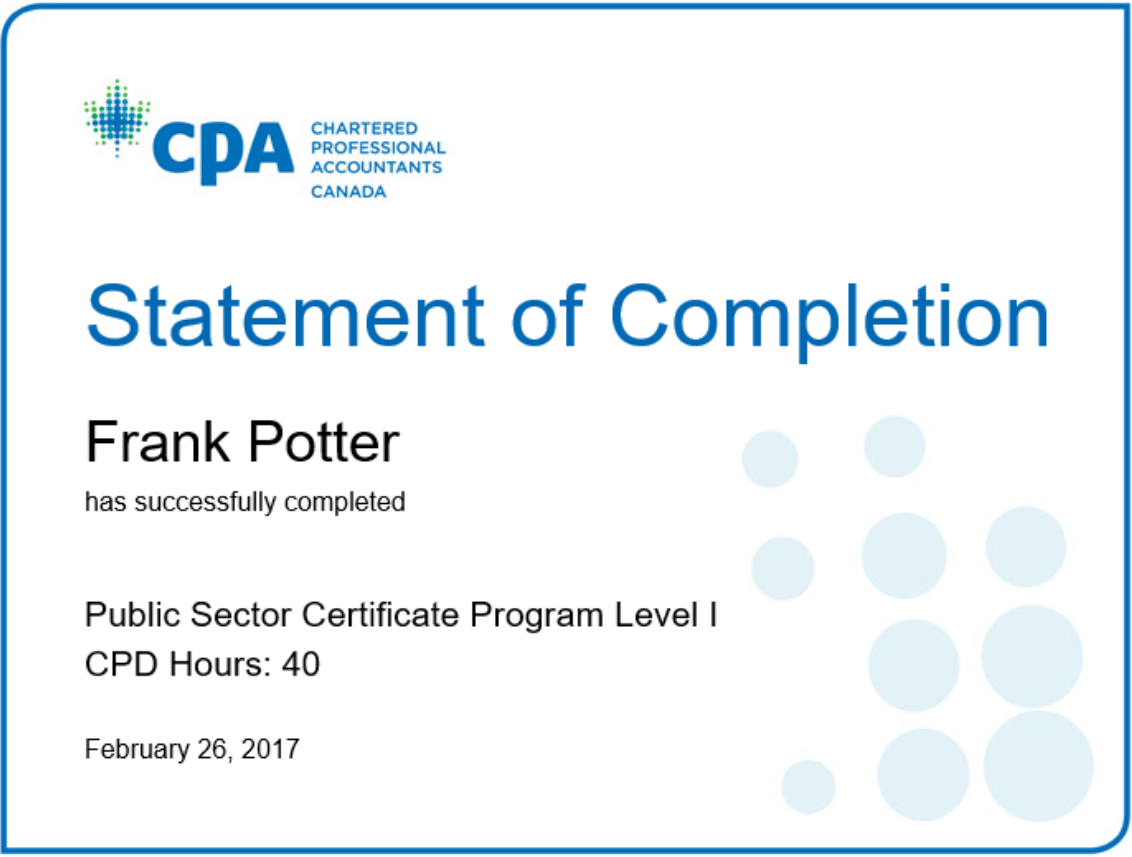
Public Sector Certificate Level 1
40
For my thoughts on this program see my blog of the same name.
Feb 14
First Look at Microsoft Dynamics 365
2
Presentation by Sierra Systems providing an overview of Dynamics 365 technology. Held at the Glenora Club.
Feb 9
The Alberta Economy – Between a Budget and a Hard Place
10
Attendance (3 hours).
Support the development of the pre-conference notes via my interns (Cox and Kaur).
Jan 31
People Leader Community Network – Info Session
1
Internal Advanced Education training session on leadership and sharing common methods among management.
Jan 24
Field trip to Treasury Board and Finance
2
What is the role of TBF-Finance relative to the GoA finance function (e.g. inter-units, leadership, etc.)
What are some of the issues TBF has in consolidations, preparation of statements, etc.
What would a career look like in a corporate agency such as TBF for a new CPA
A demonstration of IBRS and how it helps to keep the TBF GL clean particularly through the RIA Module.
What is the role of the TBF budget team relative the ministry.
What challenges and advantages does your team have in preparing the Ministry budget relative to AE.
Discussion on your career trajectory and how a CPA helps you in your budget role.
Demonstration of your coolest Budget thing you are currently using
What role does a controller play in the GoA
As an overview, how are the GoA Financial statement consolidated and what are the issues and challenges of doing so
What projects does the controller office have underway that may affect AE finance/itm
What would a career look like in a corporate agency such as the controller’s office for a new CPA
Jan 18
Blockchain Innovation Session #2
2
The role of block chain currently and in the future within the public service. Presentations by PwC and current users.
This is the second list of potential disruptive factors that could influence the Canadian Public Service over the next decade or so. See the previous blog for the first set of three and Seven Days of Disruption blog for the entire set. These are in support of November 22, 2017 FMI Conference – Disruptive Writers.
Changing Nature of Power (2015)
Cyber Insecurity (2015)
Dawning of a new urban transportation age and the Canadian City (2017 and editor)
Changing Nature of Power (2015)
Adapted from A.T. Kearney 2015: In today’s world, power is increasingly fleeting and diffuse. It is disseminated across individuals empowered by new technologies such as search engines and social media; to lower levels of government, including cities; and to start-ups and user-driven networked organizations. The rise of the global middle class is leading to greater individualism and expectations for service from their governments and from businesses, with consumers having never had a broader freedom of choice. Global trust in most institutions reached an all-time low in 2015, with governments continuing to be the least-trusted institution.
Editor note: So What? The answer is that trust is foundation of a society and an economy. It profoundly reduces the transaction cost in both. Public institutions support this trust by enforcing social norms. In a strange twist, public institutions are sometimes powerless at the hands of a small but vocal group of individuals.
For example, an August 2017 discussion on free speech at Ryerson University was cancelled because the University was concerned about safety and security. Described as domestic terrorism by one of the panelists, this is an example of public institution (Ryerson) self-censuring thought and discussion with a resulting degradation of its own power and trust. While the individuals involved may congratulate themselves on forcing their view points onto an entire institution, they should also recognize that they are sharing a common heritage with the black, brown or red shirts who dominated politics a century ago.
Cyber Insecurity (2015)
Adapted from A.T. Kearney 2015:While the upside of the Internet is enormous, cyber threats continue to multiply. Estimates put global cyber crime losses at somewhere between $375 billion and $575 billion annually. All connected devices and systems are vulnerable to attack. Computer systems, for example, are vulnerable to ransomware. The growing IoT also lacks strong security systems and is highly vulnerable to data theft. To make matters more complex, the cyber arena is a growing domain of warfare between countries, in which businesses can be caught in the crossfire. The “Darknet”—parts of the “Deep Web” that are not discoverable by traditional search engines—remains a serious criminal threat, especially with the rise of crypto-currencies. It is cloaked with encryption software that provides anonymity to users. The Darknet is used as a source of cyber attacks, as well as a place to buy and sell ransomware and other cyber weapons. Another business risk of the Darknet is that it provides a marketplace for stolen data collected through cyber attacks, augmenting hackers’ motivation to continue conducting such attacks.
Editor note: Governments see online services as a way to provide better government for fewer resources. The Singapore, Scandinavia and the United Kingdom are acknowledged leaders in this effort although the Canada Revenue Agency has also made great strides in allowing for a digital experience. Nevertheless, governments have a number of challenges including the Facebook-effect, the Shiny-bauble problem and resource asymmetry.
Facebook Effect – You are the Product
The Facebook-effect is the problem of comparing government services to a for profit service such as Facebook. If Facebook can provide service xyz or make its offerings free, why can’t a government? There are of course a number of answers to this. Firstly Facebook is not constrained by the same legal, moral and democratic frameworks. Facebook has an entirely different revenue model. For social media, the user is the product. Thus your likes, shares and contributions builds up a profile of you as a person which can then be monetized. For governments such monetization of a citizen would be outrageous. Finally, Facebook can fail while governments are expected to be enduring. If Facebook ceased to exist tomorrow it would be inconvenient but a new social media product would take its place (anyone still using MySpace?).
The Shiny-Bauble Problem
Governments like to implement new things. Ribbon cutting and shovel turning is good press and leads to the primary objective of any government – staying in power. As a result, governments get distracted by the Shiny-Bauble which have a short-term effect or solution that has little enduring value and may cause long-term harm to a society. The worst thing about Shiny-Baubles is that they may become entrenched in a society by a small group who benefit from the government largess. In other words, the only thing worst than a Shiny-Bauble is trying to turn one-off.
Resource Asymmetry
Governments often have fewer and less enabled resources to delivery digital services or fight cyber-threats than the legitimate and illegitimate competitors. The above Facebook discussion is one aspect of this resource asymmetry and consuming valuable government resources pursuing a Shiny-Bauble is another. A darker example of asymmetry is that the bad guys only need to look for and exploit a single weakness in a government’s cyber environment. At the same time, a government must fight all threats while trying to provide services.
Dawning of a new urban transportation age and age of renewables (2017 and editor)
Adapted from A.T. Kearney 2015: The global urban population has risen steadily over the past two decades. According to the United Nations (UN), there were about 2.9 billion urbanites in 2000, but that number has increased to 4.1 billion and will hit 4.5 billion in 2022. The number of megacities, defined as cities with 10 million or more inhabitants, rose from just 17 in 2000 to 29 in 2015, and the total is projected to rise to 36 by 2025. Hyper-urbanization is heightening congestion levels in cities around the world. The age of the automobile may be ending as cities adopt innovative new technologies and use more traditional mass and individual transit methods to enable smarter and more sustainable urban transportation and growth.
(Editor) Public transit and electric vehicles are two ways that urbanization will change the face of a city but tele-commuting and promoting walk/bike-able cities are another. This raises a challenge for Canadians as much of our housing stock has been built since the mid-20th century and the economics and logistics for all of these mitigating solutions will require significant government investment and coordination. It will also require a change in cultural norms and expectations as owing a home has become central to financial and personal-security well-being.
I find myself on the Chartered Professional Accountants Awards Nomination committee. We are responsible for identifying individuals who are eligible to receive one of the following awards:
This is part two of my thoughts on Risk Management. Part I, “Guns, Telephone Books and Risk” focused on the problem of creating long lists of things that will (may) never happen.
I just finished the first part of the CPA’s public sector certificate program. This blog is to put down some notes and thoughts on the course and also a suggestion for CPA Alberta/Canada about what next to do with this program.
Certificate of Completion
Kudos to FMI and CPA for a Focus on the Public Sector
Thank you to CPA Canada and their partner, the Financial Management Institute (FMI) for developing this program. I can’t say that I have done an exhaustive search but I am pretty sure that this course is unique in Canada for discussing how the public sector differs from our private sector peers. As well, a good portion of the course focuses on Canadian Public Sector Accounting Standards (PSAB – the B standards for Board).
To be honest, I have kind of missed out studying PSAB. The standards were not part of my training twenty years ago (and they have come a long way during this time anyway). Being a ‘budget-guy’ I had a transient need to know the standards. Thanks to this course, I have a better understanding of what they are and that they are actually pretty good. By way of overall content, the course offered the following topics:
Module 1: Governance and decision-making processes (budgets, legislature, etc.)
Module 2: The public sector planning and budgeting process.
Module 3: Government operating and capital budgets.
Module 4: public sector accounting standards including dives into:
Concepts & Principles (1000 —1300)
Financial Reporting (2100 —2700)
Financial statement items (3030 —3510)
Not-For-Profit Organization Accounting (PS 42**)
PSAB Statement of Recommend Practice.
Module 5: Decision Support
Module 6: Auditing.
Modules 1-4 were pretty good, Module 5 very weak and Module 6 was a bit of strange. It seemed to be cobbled together or directly lifted from another program. To support the above modules, the course referenced a number of real life examples and some pretty good reference material. Unfortunately the material was a bit stale (generally 2+ years old or older) and as such could use a refresh.
A final kudo is the software that CPA Canada used for this course. Called Brightspace, it is a learning management system from Desire to Learn (D2L) a Canadian company out of Kitchener Ontario. Brightspace was clean, intuitive and easy to navigate. I did my MBA online (through Athabasca) using the then state of the art Lotus Notes, D2L is definitely a step in the right direction.
Needs Work Though
Although I thought the course was a good use of my time, I personally think that it needs work. The following are some suggestions for CPA for its next course re-write:
What Learning Gap is Being Addressed: This is a post-designation course and as such I was expecting material aimed at someone working in the public sector. Instead, the course went down a few rabbit holes such as calculating current ratio. As a result, I think CPA needs to better analyze and think about the target audience and their educational needs of those taking this course.
Hire an Editor. I suspect that portions of this course were mashed together from a variety of sources. In fact the last module (#6) did not even bother to change the original audience in the content. This course is important enough to have hired an editor and is pricey enough ($1K CAD) to have expected one.
Refresh the Content. For a new course, it references a good number of circa 2012 era materials. As well, the Value for Money section of Module 6 uses a now withdrawn document but does not even mention PS 5400 and 6410 assurance standards on Value for Money audits. For a new program I would have expected at least circa 2015 material.
Have some Interaction. One of the reasons I signed up for this program was because it had some high-flying contributors. I saw neither hide nor hair of them. I did notice later on (after I had abandoned the discussion board) that the a newly hired moderator was making an valiant effort to encourage group discussions.
More than Traditional Accounting. The course covered a variety of topics at a cursory level such as budgeting, costing and the audit function. The course could easily expand into other common facets of the public sector experience. For example, how to brief and interact with the political level; the challenges of systems in the public sector and how about a bit on the weird world of public sector procurement.
Worthy of a Core Module?
Notwithstanding some of the above tweaks and enhancements, I believe this course (or its improved successor) should be at least an elective if not potentially a core module in the PEP program. For those unfamiliar with the training to become a CPA, individuals must complete electives and core modules in such traditional areas as financial reporting, tax, audit or management accounting as part of CPA’s Professional Education Program or PEP.
CPA Alberta Professional Education Program (PEP)
I would not recommend that the existing course be either as it really needs some work and lots more relevant content while jettisoning the audit and financial performance elements which are covered in other PEP modules. In addition, I would expand the dive into PSAB and likely include something like a mentorship program with seasoned accountants who live and breath PSAB.
To this last point, the course could be delivered using interaction with local governments. I know here in Edmonton, students taking this module could also meet with the provincial controller, municipal CFOs or senior financial managers from the federal level.
Next Steps
I plan to reach out to CPA Alberta to see if they would be interested in running a pilot elective with this course as the basis. I have some thoughts on additional content I would add but there is definitely a good starting point. Once again, kudos to CPA Canada for taking some initial steps in helping accountants who have chosen the public sector path.
At the end of the day, 40 good hours of professional development and I now have information and resources I did not have before starting this course… the sign of a worthwhile use of ones time!
Thank you (AGAIN in some cases) for the Use of Your Brain
Of course no good deed ever goes unpunished and to that end, the following are the folks who have helped me with the friendly-peer-review. Hopefully I can return the favor in the future. Also, if you are on the list and are logging this as professional development, feel free to refer to this post and notice below.
To whom it may concern, the above individuals were asked to perform a friendly-peer review of an article (2017 – Life Beyond the “Big Honkin’ Binder” ) published in the Financial Management Institute of Canada January, 2017, FMI*IGF eJournal. The estimated time to perform this review was between 2 to 3 hours completed in early September, 2016. All of the above individuals demonstrated a firm grasp of the subject matter and helped to create-net-new original thought and critique through this peer-review which will be reflected in the final article.
On November 7, I attended a session put on by the Canadian Institute called “Government Connects“. All levels of government spoke about digital transformation of their services. One of the speakers was the boss of all Alberta Public Servants, Marcia Nelson. Marcia did a great job discussing what the Government of Alberta is doing in moving its services online. Certainly Digital Government is the nirvana for most governments as they see cyberspace as being a cheaper, faster and more effective way to deliver more services to citizens.
The User as the Product
Marcia, and many of the speakers, talked about the expectations of citizens relative to their other digital experiences. For example the ease to create a Facebook account, the functionality available via a GMail account or how a LinkedIn profile is now almost as important as a resume or a business card. The question from Marcia, and others was ‘how can governments compete with these products?‘.
The other side of these services is a profit motive. Facebook makes it easy to set up a profile so it can target you with advertisements. Gmail wants you as an email client so it can scan your email and target its advertisement. LinkedIn wants you to buy a premium membership or at least get your eyeballs on its advertisements. All of the above are examples of monetizing you as a user into becoming their product. Assuming informed consent, there is nothing wrong with monetization. It is an economic transaction in which a slice of your privacy is exchanged for some really good services (like watching cat videos on Facebook just saying).
The Digital Government Disadvantage
So where does government fit into this? Firstly there is the challenge of resources. A quick scan of the September 2016 quarterly results of Facebook shows they have about $10.6USD Billion in physical and intangible assets*. Included in this number is $5.1USD Billion of network and computer software assets (physical) in addition to $1.7USD Billion in technologies and patents (intangible). In other words, Facebook has excellent technical infrastructure to offer a premium product for free to users. And if they don’t have a good product now, their $30.3USD Billion in current assets (e.g. cash, securities, etc.) can be used to buy that good product.
* Note, for those accounting weenies out there, an interesting item they have on their balance sheet is ‘Acquired users’. I could not readily find a definition for this term but it appears that the users are really the Product!
Pity someone like the Government of Alberta (GoA). A $50 billion a year organization in which an estimated 2.5%, over $1 billion, is spent annually on Information Management and Technology (IMT) (adapted from: GoA IMT Plan, 2016 – 2021, p. 4). From the GoA’s most recent financial statements, they have $4.4CAD Billion (about $3USD Billion) of computer assets – hey not bad – of which 78% of is fully depreciated (e.g. over 5 years old) – YIKES! (adapted from GoA 2015-16 Financial Statements, p. 63).
Beyond relying on old technology, the GoA has to do a lot more than Facebook. While Facebook can focus on social media, the GoA needs to run registry systems (e.g. vital statistics, land titles or drivers licenses), health systems (e.g. immunization, medical records), education (K-12, student finance, apprenticeship certificates), business (collect taxes/royalties/fines) and human social functions (tracking children in foster care, seniors or homelessness).
The above is not a new story but it is worth repeating every now and then that governments do things that no one else wants to with a tiny fraction of the resources of private industry. Governments must also build and run systems that have almost no tolerance for failure.
Risk and Skin in the Game
To the last point, risk, this is where government is at a further disadvantage. The original investors in FaceBook backed a winner. Those who put money in to Myspace, Friendster or DIGG did not fare so well (huh, never heard of some of these, check out the grave yard of failed social media infographic from the Search Engine Journal January 25, 2013). Nicholas Taleb calls investors (win or lose) people with ‘Skin in the Game‘ from his book Anti-Fragile. In contrast, public servants never have skin in the game. We are always spending other people’s money and our fantastically worst case for abject failure is forced retirement or perhaps being fired – maybe.
In other words, governments have both an advantage and disadvantage around risk. The individuals involved do not have personal risk (advantage) but the organizations also lack the mind focusing benefit of the ‘terror of failure’ (disadvantage).
The Monetization Continuum and How Can Governments ‘Compete’
The reality is that Governments can’t and shouldn’t compete with the Facebook’s of the world. Creating a bleeding edge user experience would be an inexcusable use of public funds and without the terror of failure would not likely be successful anyway.
But because thought exercises can lead to innovation, I am proposing the ‘Monetization Continuum‘ for governments; a government simply needs to pick a point on a line. At one end (generally status quo) is ‘Mind and Accept the Gap‘ at the other is ‘Full Monetization‘ with other options falling between these two. Definitions are provided below as well as way points but generally if you are Singapore you may be more comfortable having McDonald’s ads on your obesity website. If you are at the other extreme – well this is where Minding the Gap comes in.
Monetization Continuum
End Points
Definition
Examples
Mind and Accept the Gap
Governments acknowledge that they will lag and explain why to their citizens. Periodically, governments leap-frog into a stronger position.
Status Quo
Monetize
Fund digital government through ad, premium memberships or sponsorship revenue.
The reality is that governments will and should never monetize their services. There is a slippery slope of what is reasonable and in good taste. Governments have something that Facebook or Google does not have – the coercive powers of taxation and legislation. Perhaps governments does not need to build systems when they can force organizations operating in its jurisdictions to offer the services. There is a long tradition of this in the telecommunications world, for example. This would not be monetizing users as products, this would monetizing providers as servants for the public good. Just a thought.


 Organizational Biology