The Book of Trust

In my ongoing effort to remember what I have read, some notes on Stephen M.R. Covey’s book ‘The SPEED of Trust: The One Thing that Changes Everything‘.

Not THAT Stephen Covey but the son who is continuing the family tradition of writing. To be honest, this Covey is a better writer than his dad and the Speed of Trust is a good read. The examples are relevant and his personal experiences applying the concepts makes the book very genuine.

There is a lot to the trust model: Trust Taxes and Dividends, Five Waves (starting with the self), 4 Cores of Credibility and 13 Behaviors, whew!

Image courtesy of: http://www.safetymattersblog.com;
MONDAY, APRIL 1, 2019 Culture Insights from The Speed of Trust by Stephen M.R. Covey

The good news is that the book can be distilled down to a few key messages:

The Critical Bits

  1. Trust is Relevant, Tangible and Measurable; it saves money and reduces transaction time (Speed and Cost)
  2. Trust is about Character and Competence, you need both to be trusted.
  3. 4 Cores of Credibility are the foundation factors of Character (1. Integrity, 2. Intent) and Competence (3. Capabilities, 4. Results).
  4. TASKS is a mnemonic to define individual capabilities: Talent, Attitude, Skills, Knowledge & Style).
  5. Trust is found in five waves, your: self (the basis for the 4 Cores noted above), relationships, organization, market & society.
  6. There are 13 behaviors which can be summarized into Character (be a stand up guy – honest, respectful, loyal, etc.), Competence (deliver results, lead and follow well) and a combination of the two (listen, keep commitments and generate trust).
  7. Low-trust organization pay trust taxes in the form of: 1. Redundancy, 2. Bureaucracy, 3. Politics, 4. Disengagement, 5. Turnover, 6. Churn (employee, sales), 7. Fraud.
  8. High-trust organizations receive dividends: 1. Value, 2. Growth, 3. Innovation & Collaboration, 4. Execution, 5. Loyalty.

A Little More Summary

If you don’t want to read the book but want more details, the following document courtesy of Soundview Executive Book Summaries provides the highlights of the book. A Google search will lead to results and other summaries.

A Trusty Model

Although I think there are too many moving parts in the model for it to be practical the underlying principles are sound. Trust saves money, generates income, supports efficient and effective people/family/organizations/ societies and quite frankly is always preferable to a non-trusting environment.

The 1 sentence summary: trust greases the wheels of organizations, families and societies; it is a function of Character and Competence ; trust is built up over a lifetime and can be lost in an instant.

Smallwood – Big Read

Most Canadians know who Joey Smallwood is, the first premier of Newfoundland and Labrador. Richard Gwyn, one of Canada’s pre-eminent popular historians, book on Smallwood lists his triumphs and his failures.  Gwyn’ makes you wish you had known Smallwood and realize that characters such that can no longer exist in your hyper-connected world.

SMALLWOOD: THE UNLIKELY REVOLUTIONARY by Richard Gwyn, February 17, 2015

A Practical Socialist and Politician

Smallwood called himself a socialist and spent much of his early years on one failed social project or another in Newfoundland and a brief stint in New York city.  By his middle age, and after the Second World War, he seemed to have missed his chance to make his mark in the world despite having hosted a widely popular Newfoundland based radio program.

However, timing is everything, and just after the war Newfoundland was given an opportunity to regain its ability to self-govern or join Canada (joining the United States was another possibility  but lacked a champion).  In this campaign, Joseph Smallwood became Joey a likable buffoon with cat-like political instincts.

Needless to say Joey won the referendum (the second one actually) and Newfoundland joined Canada.  He then went onto to become one of Canada’s longest-serving premiers until his election loss in 1972 (23 years in office).  More than just a provincial politician, Joey played key roles in the Canadian Federal Liberal scene and was an intimate of St. Laurent, Pearson and Trudeau.

Impractical Schemes, Graft and Churchill Falls

Smallwood was a man of his times and Gwyn paints a sympathetic albeit tragic portrait of the man.  Newfoundland had a small war chest on joining Canada and Joey proceeded to use the money in (mostly) misguided attempts to industrialize the province.  While there were some successes in iron ore mining and paper mills, most would now be considered busts including his crown jewel – the Churchill Falls Hydroelectric station.

In addition, some of the associates and government ministers re-directed government resources for their own benefit.  Despite this temptation and Joey looking the other way, Smallwood did not enrich himself during his time in office – but others did.  These others are part of a cast of characters that Smallwood associated with in order to achieve his objective of industrialization.

A Book 3-Decades in the Writing

This book was initially published in 1968 just as Smallwood had announced his (first) retirement and then was updated 1972 after he retired for a second (and last) time after his election loss.  Gwyn re-issued it twice in 1999 (8 years after Smallwood’s death) and most recently in 2015.  In many ways reading a book written and revised over 3-Decades is almost as interesting as the core subject matter.  Gwyn does not fully update the text but does tease out some individuals for special mention who went on to greater things such as John Crosbie or Rex Murphy.

In the end, a good read about an interesting character, a period in Canada of significant change and our newest and most easterly province – Newfoundland.

Management versus Employees

In my ongoing effort to remember what I have read, some notes on Hayes Drumwright’s book: Management vs. Employees: How Leaders Can Bridge the Power Gaps That Hurt Corporate Performance.  Nothing much new in this book that has not already been said by numerous authors, nevertheless, still a good read at an inspirational level and a reminder of some enduring truths about leadership.

Who is Drumwright

Drumwright is one of the lesser-nobles of the US entrepreneurial set.  According to Entrepreneur.com

Hayes Drumwright is the founder of POPin … (and) is also the founder of Trace3, a business transformation solutions company … In 2010, Hayes was named the Ernst & Young Entrepreneur of the Year in Orange County and the Desert Regions, California.

Prior to these two success, Drumwright also started, grew a company called “Techfuel” which then crashed and failed during the dot.com bubble burst at the beginning of the century.  He later started Trace3 and was eventually ousted from his own company and later began a series of successful businesses including the winery Memento Mori.

Why Listen to Him

Yawn, another ‘got lucky’ success story, what could Hayes possibly have to tell me that I haven’t read elsewhere.  The answer: earnestness and learning the value of being humble.  

He comes across as a geniually nice guy.  He is a family man (3 boys and girl) who speaks lovingly of his wife, mother and his siblings.  In other words, he is the kind of guy you would want to live next door to, have your daughter marry or even work for.  Because he is a nice guy who is willing to learn from his mistake, he does have something to say.  They may not be new but that does not make them any less valuable in hearing again.

Servant Leadership

Ultimately, Drumwright’s messages can be summed up in the concept of servant leadership: 

… A leadership philosophy in which the main goal of the leader is to serve. … A Servant Leader shares power, puts the needs of the employees first and helps people develop and perform as highly as possible. Servant leadership inverts the norm, which puts the customer service associates as a main priority. Instead of the people working to serve the leader, the leader exists to serve the people (Courtesy of Wikipedia).

Key Messages

  • Us versus Them: ‘Them’ varies by context but includes an organization’s employees, customers, families and community.  By putting ‘Them’ first there is more to go around, what he calls ‘delayed selfishness’.  
  • Leaders and Complacency: Leaders help people to achieve their current ‘home-run’ and then immediately establish their next ‘home-run’; by doing so the leader prevent people from becoming complacent. 
  • Being versus Becoming: Further to the discussion on Complacency is the importance to strive to be constantly ‘becoming’ rather than ‘being’.  The latter is static and means that progress is no longer being made while the former is dynamic and involves constant challenges, failures and trust in one’s self, organization, family, etc.
  • Trust: In order to help ‘Them’, a leader needs to build trust.  Very little can be accomplished without it and much can be done with it.  
  • Tenure and Seniority: Tenure or seniority in an organization is not a right to disconnect, it is an obligation to perform at a higher level.  
  • Tension and Respectful-Conflict:  Conflict is healthy; too many like-minded people avoid challenging and thus improving each other. 
  • Attribution Error: we attribute negative behaviour of others to their individual characters while attributing our negative behaviours to our environment – we give ourselves the benefit of the doubt (originally from Patrick Lencioni).
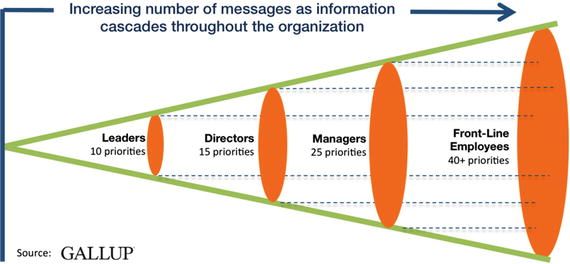
  • Barfing Downhill: Top leaders think they are being clear by identifying top 3 goals.  The problem is that by the time those top 3 make it to the bottom of the organization, they have expanded many-fold meaning that the line-employee is faced with numerous messages that have lost their meaning.  As well, barf only rolls downhill with little communication going back up again.  
  • Separate the Truth from Goodwill:  People don’t like to hurt another’s feelings and this is even more so when they are loved one or a leader.  While goodwill is comforting it can also be disastrous if it leads to a wrong decision.  Conversely it is important to separate pride from your ideas so that it does not equally cloud the truth. 
  • Failure needs to be Enjoyed:  It teaches individuals and organizations fundamental truths and provides for corrections. 
  • Talk to your Children About the Importance of Failure: This is an excellent section in the book in which Drumwright talks about the prospect of failure in a business venture with his children.  This was not to scare them but to include them in the realities of the world.  In the day of age of helicopter parents, excellent stuff. As a leader, it is important to discuss your failures, your likely continued future failures and the importance of learning from these failures. 
  • Minimum Viable Stuff: Coined by Eric Reis in the Lean Startup, this is the basis to invest the minimum so as to achieve the maximum success/failure in the shortest period of time.  
  • Institutionalize Anonymity: The truth is that organizations generally are becoming less and less tolerant of diversity of opinions – particularly as organizations strive to embrace mantras of diversity and inclusion.  While this may seem paradoxical it also means that organizations need to increasingly protect opinions that don’t fall into the narrow parameters of politically correctness.  Drumwright’s POPin application does this through an application but a good old fashion suggestion box works to.  

Good Reminders and An Enjoyable Read

While Hayes is only on the bubble of a rags to riches story, he has learned a few important lessons and such his book is a good reminder of truths presented elsewhere.  It will be interesting to watch this individual as he gains more experience and continues to internalize it for our benefit. 

Neuroplasticity and the manager

The more we understand about how the brain works the more almost magical it appears.  At one time we had a very mechanical view of the brain in that section A controlled sight and section B over there managed the left thumb. Norman Doidge is a doctor and an author who has helped us realize that the brain and our very understanding of our mind is much more nuanced, complex and wonderful.  In his late (ish) book, The Brain’s Way of Healing [1] he takes us through a series of case studies and current understanding of the brain.

Read My Crib Notes

I thought the subject matter of the book interesting enough to jot down some crib notes which are available in a previous blog, Book: The Brain’s Way of Healing.  If you are not up to reading the whole book, feel free to peak over my shoulder at my crib notes.

How Is a Brain Like Your Organization

In many ways our understanding of organizations and the brain have taken parallel tracks.  Historically we knew that they both accomplished things but their exact roles and processes were complete mysteries.  As science, engineering and society has evolved we have gone through periods of understanding in the context of the time.

In the earliest times it was an absolute mystery.  As western medicine evolved, the brain was seen as a mechanical organ with specializations.  In parallel, organizations were being understood from a mechanical model through the work of such titans as Frederick Taylor (Scientific Management).  During the 1950’s to 1990’s the workings of the brain went from a mechanical view to one of a highly integrated system with the ability of one part taking over the function of a defunct section of the brain – the basis for the science of neuroplasticity.  At the same time organizations evolved from a hierarchical function based structure to adopting a more agile team based one.

Today we have a profound understanding of the workings of the brain.  Among those understandings is the realization that skills, thoughts and memories are not fixed in anyone spot or location but are held collectively within a larger neural system.  Ultimately this distributed model is much more robust and resilient than the strictly mechanical model – although infinitely more complex as well.

A Good Read and Final Lessons for Organizations

So if you enjoy the bio sciences (or even want a better understanding of how your noggin’ works) then take a read of Doidge’s book.  If you want to be a better manager then recognize that how the organization works is likely invisible to you – just like that memory or skill in your own brain.  While you may not have direct control you can also nurture and support this reality be establishing effective structures, resources and then stand back to be amazed what good people can do.

[1] The Brain’s Way of Healing: Remarkable Discoveries and Recoveries from the Frontiers of Neuroplasticity. Norman Doidge (Author)

Against the Gods

Peter L. Bernstein wrote “Against the Gods: The Remarkable Story of Risk” in the late 1990s, well before the financial meltdown of 2008 or the dot come bubble burst a few years later. The book itself is a good refresher of the history of mathematics and provides a reasonably entertaining and well written history of risk.  Before getting to the book though, a quick detour about Bernstein himself.

A Life Well Lived

Bernstein died in 2009 at the age of 90.  Over those nine decades he was born into relative wealth, served as an officer in World War II, worked for the US federal government, taught university, took over his father’s investment business, sold the business for a tidy sum, wrote ten books – 3 in his late 80’s and became a respected academic.  WHEW

For anyone of us, a few of the above accomplishments in our lifetime would be gratifying (including making it to 90) let alone the number he accomplished.  In other words, Bernstein can be said to have had a life well lived.

The Good News from the Gods

Some of the reviews on http://www.goodreads.com have critiqued Bernstein’s writing style.  It is not the most elegant I have ever read but it was reasonably engaging and not too technical.  He takes a chronological approach to risk but this is really on the mathematics of risk.

He notes the restrictions early western mathematicians had including the Roman numeric system, the enlightenment and renaissance (to get beyond the notion that all things are pre-ordained by God), bookkeeping, forecasting, algebra and an unfinished game of chance.

To this last point, the question was how best to divide up the winnings of a game with a fixed number of iterations of the game that was partially played.  This question spurred the mathematics to ask the question about probabilities and the future.  Risk management was born.

From the renaissance, Bernstein takes us through the development of more advanced mathematics, game theory and then finally the rise of the Quants in computerized trading.

In other words, the book is a good and reasonably accessible refresher on the history of mathematics and specifically the development of statistics and financial mathematics.  Bernstein does explore some of the human side of risk.  For example he discusses those old favorites of behavioral economics: loss aversion, regression to the mean / Prospect Theory, ambiguity aversion, etc. In other words, a good historical romp that ties in some familiar and some unfamiliar details into a reasonably good overview of the mathematics of risk…

The Bad News about the Gods

… and therein lies the biggest problem with the book, big on math short on the story of risk.  There is so much more that Bernstein could have incorporated into the book.  For example

  • How is risk perceived and managed in different cultures.
  • How have the Christian and Muslim beliefs about risk and interest rates changed their respective trajectories.
  • What has been the impact over the past 50 years on risk management given that risk has now being overtly managed.
  • How have institutions such as the military, healthcare or pharmaceuticals changed in how they managed risks.
  • What was the impact of large-scale events on the acceptance and management of risk, for example did the Black Death make people more or less risk averse and how did this affect risk management.

In a way it is too bad that Bernstein wrote the book when he did or that he did not write it say 10-12 years later.  I would have been interested in his views on the 2008 financial crisis and the work of Nicholas Taleb, etc. who also discussed risk, statistics and randomness.

In the End

So, a good read if you enjoy history, mathematics and what a fuller understanding of the concepts of risks.  A revised edition would be great, or even better, a second volume with more depth and breadth.  Never the less a read that rounds out anyone interested in Risk Management.

A few Quotes and Thoughts

Publisher’s Description: With the stock market breaking records almost daily, leaving longtime market analysts shaking their heads and revising their forecasts, a study of the concept of risk seems quite timely. Peter Bernstein has written a comprehensive history of man’s efforts to understand risk and probability, beginning with early gamblers in ancient Greece, continuing through the 17th-century French mathematicians Pascal and Fermat and up to modern chaos theory. Along the way he demonstrates that understanding risk underlies everything from game theory to bridge-building to winemaking.

p. 15: Time is the dominant factor in gambling.  Risk and time are opposite sides of the same coin, for if there were no tomorrow there would be no risk.  Time transforms risk, and the nature of risk is shaped by the time horizon: the future is the playing field.  Time matters most when the decisions are irreversible.

p. 197: The essence of risk management lies in maximizing the areas where we have some control over the outcome while minimizing the areas where we have absolutely no control over the outcome and the linkage between effect and cause is hidden from us.

p. 228: Keynes argued that interest is a reward for parting with liquidity, not for refraining from consumption.

p. 232: Game theory says that the true source of uncertainty is in the intentions of others.


Enterprise Risk Management – And a bit of Sales

In my ongoing effort to remember what I read, a few notes about a book on Enterprise Risk Management: Mastering 21st Century Enterprise Risk Management: Firing Dated Practices | The Best Practice of ERM | Implementation Secrets; by Gregory M. Carroll. 

Full Disclosure: Fast Track Founder

Before going any further, the book is written by the founder of an Australian company, Fast Track, which sells ERM and compliance software.  On the one hand there is a bias in the book toward the software.  On the other hand, EXCELLENT!, the company has been thinking about ERM for more than 30 years, who better to comment.

The ERM I Was Expecting

I have been on the periphery of the Risk Management Biz for most of my career and it never impressed me very much.  It seemed like a bolt on activity to compile a ‘telephone book‘ of risks that would never happen.  Worse, risk management takes precious management and organizational time away from operations which ironically increases risks.  This is not to discount the value of risk management though and having mitigation plans for many of the likely scenarios (hacks, robberies, natural disasters, etc.).  Starting with mitigation is why I wrote the blog series on ‘Anitfragile Risk Management (ARM)‘.

This book is short (about 80 pages) and has some good practical advice on ERM.  I would not buy the full version but definitely take a good skim/read via your public libraries online services.  The following 5 items are my key takeaways from the book; there are more but these are ones that I will likely return to a few times.

  1. Risk Management in 30 Seconds.
  2. Acknowledgement that Risk Management is a Dark Art
  3. The Nature of Risks
  4. Risk Management is Really Opportunity Optimization
  5. Ten Rules for a Successful IT Project

Carroll presents a vision or ERM that is much closer to my view of ARM… to a point.  So notes on the great points he makes in his book and the limitations of thinking about risk management when you are in the business of selling ERM systems (these editorial comments are in italics).

Risk Management in 30 Seconds

In ten paragraphs, Carroll runs through what is Risk Management, the summary of the summary is as follows (pp 4-5):

  1. 00:00 Definition: The level of uncertainty in any situation. Risk management is a system that identifies, quantifies and attempts to reduce or eliminate uncertainty.
  2. 00:25 Identification: ERM starts with a set of corporate objectives covering all aspects of the enterprise’s intents. Understand organizational risk appetite: the level of risk that can be tolerated on an on‐going basis.
  3. 01:00 Assessment: A subjective and preventive evaluation of each uncertainty in a specific area of operation by internal subject matter experts. A risk matrix grades the impact of a risk based on likelihood of it happening and the effect (consequences) if it does.
  4. 01:40 Control: A control is an action or measure that can alter an uncertainty.
  5. 02:00 Mitigation: Mitigation is a fancy word for an action that reduces or eliminates a risk.
  6. 02:45 Review: Review is value add and facilitates continual improvement.

This is a good overview and is entirely consistent with ISO 31000.  Carroll’s point in this section is that risk management is not especially difficult and that a simple framework can help you.  The ARM methodology turns the above 3 minute overview on its head however and places review and mitigation first and the other activities subordinate to these value add functions. 

Acknowledgement that Risk Management is a Dark Art

Carroll describes risk management as being 80% Art and 20% science (p. 12).  This is part of his view that organizational change and people management are central to an effective ERM systems.

Carroll is on the right track here but I would change his allocations slightly.  I would put the Art part as being 90%, the Process Changes as being 9% and the ERM system itself as being 1%.  Risk/Opportunity management is primarily a state of mind that is dependent upon trust, adeptness, competence of people.  An ERM without this is doomed to failure, an organization with these attributes already has an ERM system.

The Nature of Risks

Carroll differentiates between the ‘Nature of Risk’ and the ‘Types of Risk’.  Nature is a higher level classification that groups risks conceptually; how the risk presents itself and how it is subsequently managed (p. 13); they are as follows:

  1. Technical Risks are the broad group of risks whose state can be measured discretely and against which quantitative limits can be set and monitored. They are caused by variations that affect the system and are managed through use of mathematical models.
  2. Operational Risks are around the internal operations of a business, predominantly dealing with people, processes and systems and what most people think of in enterprise risk management.  Qualitative by nature, they tend to be caused by changes to organisation or behaviour, and are managed though process management.
  3. Security risks are aggressive actions. They are intentional in nature, as opposed to other categories which are consequential in nature. They are premeditated attacks which are managed proactively through surveillance and defensively though multi‐layered safeguards commonly refer to as “defence‐in‐depth”.
  4. Black Swan events are events in human history that were unprecedented and
    unexpected at the time they occurred. These once‐in‐a‐lifetime events are
    unpredictable, occur abruptly and catastrophic in nature.  Being unpredictable and occurring abruptly, the risk itself cannot be managed in a traditional sense, so we have to manage its effects using such methods as disaster planning and relief strategies.

Carroll acknowledges that the four presented are not meant to be exhaustive.  Nevertheless, this is a much better starting point than an exhaustive ‘type of risk’ listing.  The challenge I have seen with such lists is that very quickly organizations get bogged down into definitional quagmires.  The above list can be thought of as having multiple dimensions, for example internal or external to the organization.  

Risk Management is Really Opportunity Optimization

ISO 31000 focuses not on risks but on uncertainty which may be positive or negative to an organization.  Carroll’s book is generally upbeat about both although most of his examples end up being of negative variety versus positive.

This upbeat note extends into systems implementations.  Obviously his frame of references is for implementing an ERM system but his words of wisdom could be as easily applied to an ERP or other corporate system.  Nothing new here but still a good refresher:

  • People: The employees, managers, customers and other stakeholders.  In particular, what motivates your employees and how can you align a project to these motivations to be most successful.
  • Change Management: A project is not about the technology it is about how people will work once the project team has long gone.
  • The System and the Project: Lastly, how the project and system will be implemented and then used to support the above.

Ten Rules for a Successful IT Project

  1. Don’t outsource requirement planning.
  2. With software vendors, big is not necessarily best (Note, I think there is some bias here on the part of Carroll toward his software and away from the larger systems; this bias may be entirely justified but full disclosure nevertheless).
  3. Choose a ‘people’ project manager.
  4. Have a living risk management protocol.
  5. Ensure all stakeholders have “skin” in the game.
  6. Use an agile implementation technique.
  7. A quick game is a good game.
  8. Plan your testing.
  9. Training – Sell the benefits.
  10. Treat as a change-management issue not an IT project.

https://www.linkedin.com/in/gregorymcarroll

Principles of Legitimacy

In Malcom Gladwell’s book, ‘David and Goliath’, he refers to the ‘principle of legitimacy’.  These principles are the basis (or lack thereof) for why one group will allow themselves to be subject to another.

The principles stress that it is the behaviour of the leaders that determines whether or not the followers will follow.  At least, the principles indicate whether the followers see the leaders as being legitimate [1].

Walter Gadsden, 17, was attacked by police dogs on May 3, 1963, during civil rights demonstrations in Birmingham, Ala. (Bill Hudson/Associated Press) , courtesy of www.boston.com

Walter Gadsden, 17, was attacked by police dogs on May 3, 1963, during civil rights demonstrations in Birmingham, Ala. (Bill Hudson/Associated Press) , courtesy of http://www.boston.com [3]

The three principles of legitimacy

  1. those being ruled need to feel that they have a voice in the arrangement (e.g. no taxation without representation)
  2. the rules must be predictable and consistent (e.g. rule of law and due process)
  3. the rules must be consistently applied and appear to be fair to all being asked to follow the rules (e.g. equality before the law)

Kindergartens, Northern Ireland and the Jim Crow Laws

The writing brilliance of Gladwell is that he introduces this concept first in a kindergarten and then applies it to broader contexts such as Northern Ireland or the segregation laws of American South pre-1960.  In these examples, Gladwell extends the theme of his book in which an advantage may in fact be a disadvantage.

For example, the British Army in Northern Ireland had the men and material to temporarily impose control over the local population but not to sustain it because they failed to establish legitimacy amongst both the protestant and catholic populations.

Strong armed tactics doomed the British Army to decades of occupation and directly or indirectly resulted in the death of hundreds if not thousands of combatants and civilians.  The principles of legitimacy are not without their consequences.

Too much or too little legitimacy?

Gladwell does not have the space in his book to discuss is how much or how little of each are needed based on varying circumstances. There are circumstances where one of the three is reduced to nearly zero (try asking for a voice in the arrangement during the first week of army boot camp).

Alternatively, is there such a thing as too much of these principles?  Do they break down when taken to the extreme?  Have you ever been ‘surveyed’ to death by an employer asking about your degree of motivation or engagement with the company?

How about rules being applied too consistently such that the application actually erodes the legitimacy.  A ten-year old child who is expelled from school because they made an imaginary gun out of their fingers is an example of a zero tolerance policy gone horribly wrong [2].

Leadership (and Life) is Hard

The take away from Gladwell’s book is that these three principles of legitimacy are just that – principles.  They are not hard and fast rules and leadership is in their application rather than their memorization.

Here are some of my thoughts on considerations before over-applying one of the three principles of legitimacy:

  1. A voice in the arrangement:
    1. Ultimate accountability cannot be delegated away however.
      • For trekkies, Captain Picard solicited his crew’s opinion but he still made the decision.
      • Alternatively, calling for a vote and a study group when the captain orders everyone into life rafts is ill-advised.
    2. Coercion can compensate for a voice in the arrangement, but only within short time periods or overwhelming force.
      • The soldier in the boot camp knows that his time is short and the ultimate value of the camp’s training outweighs the immediate discomfort.
      • Conversely, segregation worked not only because of the power of the whites in the South but also a lack of an united front amongst the blacks (see [2] for the back story behind a famous civil rights photo).
    3. A voice does not equal gaming the system.
      1. The squeaky wheel gets the grease but it also violates the other two rules of fairness and consistency.
  2. Predictable and consistent and 3. Consistently applied and appear to be fair to all being asked to follow the rules
    1. To be predictable and consistent, a system needs to quickly and fairly establish two things: 1) how to change the rules and 2) how to allow for exceptions while disallowing unfair advantage.
    2. Having a voice in the exceptions is critical.
      • Think about a handicap parking spot.
      • We allow society (the leaders) to dictate that we give up the best parking spot because as a society we have had a voice (directly or indirectly) that this is a legitimate use of power.
      • At the same time though if choice spots were given out based on political affiliation or personal relations, the majority of the voices would be against the privilege.
    3. The sense of fairness is culturally biased.
      1. In traditional Islamic families, the opinion of the father or grandfather is nearly law.
      2. It may seen fair to deny a girl a right to an education or marry a non-Muslim in this context.  In the secular West, these would seem patently unfair and sexist.

Lessons for the business reader

For business leaders, is there anything new here?  Yes and No.  Societies with the greatest longevity have adhered to these principles.  These principles are also the hallmark of good leadership and good governance.

If you want to build an enduring organization that will outlast you remember that those being led:

  1. Seek both a voice in the decision but also expect leadership when leadership is needed.
  2. Expect rules to be fair, predictable and consistent but not at the expense of common sense.
  3. Know that part of leadership is in recognizing and explaining the exceptions without the system falling victim to being gamed or exploited.

Leadership is still hard but authors such as Malcom Gladwell can help us to challenge our assumptions and become better, more legitimate, leaders.

Notes, Comments & Further Reading

  1. p. 207: “When people in authority want the rest of us to behave, it matters – first and foremost – how they behave.
  2. Milford 5th-grader suspended for pointing imaginary gun, as reported Nov 19, 2014,
  3. Gladwell devotes nearly a full chapter to the back story behind this  picture which was a turning point for the American Civil Rights movement in 1963.
    • However, there more in the photo than meets the eye: p. 192: “The boy in Bill Hudson’s famous photograph is Walter Gadsden.  He was a sophomore at Parker High in Birmingham, six foot tall and fifteen years old.  He wasn’t a marcher.  He was a spectator.  He came from a conservative black family that owned tow newspapers in Birmingham and Atlanta that had been sharply critical of (Martin Luther) King.”
  4. Implicit in the above discussion is the role of trust as a human bond within organizations.  The following are some other thoughts on this and related matters: