In a previous blog, Co-Opetition at 20-Something, I gave myself a memory jog for the book of the same name. One of the reasons I was re-reading this book was to know what the concept has to say about Co-Opetition and Non-Profits [1].
Continue readingCategory Archives: Collaboration
Driving MS Daisy 2018
A Little Context Please
Canada has the highest rate of multiple sclerosis (MS) in the world, with an estimated 1 in 340 Canadians living with the disease. While it is most often diagnosed in young adults aged 15 to 40, younger children and older adults are also diagnosed with the disease (source, MS Society). Each June the MS Society of Alberta and the NWT runs the Leduc to Camrose ride over two days and about 150km.

Teaching Gears to Be a Better Manager
In the Spring I run a weekly program called ‘Wheeleasy Wriders‘ which teaches newbie cyclists how to go from a painful 20KM ride to thinking that a 60KM ride is a breeze. Although this is a hobby, the techniques that I use are directly translatable into a work environment and the reverse as well – Wheeleasy Wriders makes me a better manager – last week is a good example.
How To Explain The Round Gizmos On a Bike
Many new riders are scared of their gears. Although a marvel of engineering, they do require a small investment of time to learn how to use them properly. But using gears effectively is not what this blog is about (however the blogs listed below DO talk about such things). Last week I took a page out of my work environment and did the following:
- I broke the riders into groups of three composed of 2-newbies and 1-experienced rider.
- I separated married couples into different groups (more on this later).
- My request was that each newbie explain to the other newbie how their gears worked on their bike (as if the other explainee-newbie was going borrow the explainer’s bike).
- After a couple of minutes they switched roles and the explainer became the explainee.
- The experienced rider was there to listen and provide additional information, corrections and encouragement.
Teaching Focuses the Mind
The result was that most of the newbies self-assessed their gear knowledge higher after the explanation than before. Why, for the following reasons:
- They had to actively recall past explanations and externalize the content and concepts.
- Based on the recall, they had to match the explanations to what they were seeing.
- There was a small amount of anxiety to get the explanation right. This anxiety actually helps to better form memories.
- Anxiety notwithstanding, the experienced rider represented a safety net.
- The experience rider had to compare their own mental-model of how gears work into two different newbie explanations. This conversion strengthen their own understanding of the gears.
- I separated the couples because people who know each other very well can have a harder time communicating. They use codes, shortened forms of speech, etc. that takes away from the effort to externalize and codify a complex topic (such as how bike gears work).
Giving Training the Gears
I use similar teaching methods at work when I need to train people. Rather than standing around in a parking lot explaining bike gears, at work this is done through webinars and conference calls. One of my ‘rules’ is that I actively encourage cheating on my exams. Thus, other audience members are encouraged to help the ‘trainer’ out. Because the audience knows they be asked next to provide an explanation, there is better attention and retention for the content. I have learned a few cautions/guidelines though:
- Always Build Up: This is not about ridiculing or embarrassing the person. Before asking the question, be reasonably assured the person can answer the question or be guided to the answer. Only use this technique (or select the person) if the person can feel more positive about themselves after they have done the activity.
- Be Ready to Move On … QUICKLY: You may discover that you asked a person who simply does not know or is getting flustered by the attention. If so, quickly move on so that person is not social embarrassed. Moving on could include: providing lots of clues, going to someone else or changing the subject.
- Gentle Humour Lubricates: use gentle and positive humour to help the situation. Be careful that the humour is not caustic or ridicules the person. A bit of self-depreciation works for me.
- Mix Up the Couples: mix and match people who don’t know each other well. This forces different levels of communication effort.
- Bit Size the Learning: if possible, focus on only one to two key concepts in each session. More than this will overload the person and create too much anxiety.
- Summarize, Crystallize and Repeat the Learning: be sure to repeat the 2-5 key messages from the learning so that the memories can quickly form around these kernels. Memory and learning works best when there are mnemonic devices or conceptual construct to hang the details on.
Good luck with your efforts to train and explain in your organization. Also, if you want to learn more about riding or how to use your gears, be sure to read:
String Theory on a Bus
People are central to Organizational Biology (orgbio) and orgbio is composed of two fundamental elements: Mass (machinery, intangibles such as patents and policies and procedures) and the ephemeral quality of Adeptness which is the human application of mass toward an organizational objective.
Continue readingWriting as a Team Sport – Wikies and Helpers
I have been able to call upon friends and colleagues to help me craft articles:
In all of these cases, the contributors provided me with excellent advice and the resulting articles were much better as a result. This article is no exception: SharePoint as a Documentation Tool; Life Beyond the “Big Honkin’ Binder”.
Thank you (AGAIN in some cases) for the Use of Your Brain
Of course no good deed ever goes unpunished and to that end, the following are the folks who have helped me with the friendly-peer-review. Hopefully I can return the favor in the future. Also, if you are on the list and are logging this as professional development, feel free to refer to this post and notice below.
|
Person |
Organization |
| Chad B. | Government of Alberta |
| Eric S. | Government of Alberta |
| Howard T. | Government of Alberta |
| Mavin K. | Government of Alberta |
| Mona E. | Self Employed |
| Paul B. | Government of Alberta |
| Terry E. | Retired |
| Uday D. | United Nations |
To whom it may concern, the above individuals were asked to perform a friendly-peer review of an article (2017 – Life Beyond the “Big Honkin’ Binder” ) published in the Financial Management Institute of Canada January, 2017, FMI*IGF eJournal. The estimated time to perform this review was between 2 to 3 hours completed in early September, 2016. All of the above individuals demonstrated a firm grasp of the subject matter and helped to create-net-new original thought and critique through this peer-review which will be reflected in the final article.
Accounting for Questions
On November 17, 2016, FMI Edmonton hosted: CPAs and the Public Service. Now that CPA Alberta is almost a toddler (16+ months old at time of writing), it is time to ask the question: How Can CPA Alberta help the members who work in the public service?
Continue readingInnovation Bingo
On September 21, 2016, the Edmonton FMI Chapter hosted the following session (detailed description found below in the ‘blog-annex’: Fostering Innovation in the Public Service When Money is Tight. Part of the conference was a game entitled ‘Innovation Bingo’. The objectives of the game were as follows:
- Help participants assimilate knowledge about innovation.
- Assist in networking with other participants, particularly those outside of ones normal circle of associates.
- Win some prizes.
How the Game was Played
- As part of the pre-conference notes and as a physical hand out, each participant was given a bingo card (see the last two pages of the pre-conference notes: FMI-2016-09-21-Innovation-PreNotes or download Innovation Bingo.
- Instructions were provided on the card, informally at each table by event leader and then en masse at the start of the session.
- The card was alluded to a few times by the moderator and during the conference.
- The card had two sides:
- Personal Information: name, birth month, interests, and needs.
- Bingo card proper.
- At the end, prizes were distributed but only if the individual was willing to share the results of their card.
Assessment of the Game
The following conclusions were drawn from the results of the game:
- The game itself provided a reasonable ice breaker at table.
- Individuals did not actively use the card outside of their table and there was limited interaction or discussion with the card.
- The room itself however appeared to be well engaged and networked suggesting that the card and game provide some social license that eased initial conversations.
Conclusions and Future Use of Innovation Bingo
- An en masse ice breaker game can work at the table level.
- Room level coordination requires greater coordination which would detract from the program.
- Conclusion: ‘Bingo’ games of varying forms can be used in other FMI events but should be downplayed and use for fun things such as prize distribution.
Blog Annex – FMI Event Description:
Fostering Innovation in the Public Service When Money is Tight.
Public servants are expected to be innovative while working in a risk averse environment. This inherent conundrum is compounded during times of fiscal restraint when ideas are solicited but resources to execute few. This session will investigate innovation in the public services from a number of facets.
What is innovation, how do you get it, how do you keep it and when should you ignore it? Next, how to propose, implement and sustain an innovative idea or culture in an environment that is less than ideal. Finally, thoughts and strategies of making the case for innovation during times of fiscal restraint; after all, never let a good crisis go to waste.
Six PoC Questions for Success
Proofs of Concept (PoC) are great. They allow one to test a small component and then apply success (or failure) to future endeavours. Certainly the all time champion of the PoC are the Myth busters. Adam and Jamie would start each myth with a small-scale test before going big (and with the obligatory BIG explosion).
To Hack or to Formalize a PoC
PoCs come in many sizes. At one end is the developer who experiments and comes up with a workaround or a more elegant way to achieve a result (aka a good ‘hack’). On the other end is an organization that incrementally works toward a final objective. For example sending a series of Apollo missions into space with each one adding on to the knowledge and experience of its successor. This blog considers more than a midnight pizza fueled hack-a-thon but much less than sending humans into the unknown.

The Scientific Process (sort of) to the Rescue
One of human’s greatest achievements was the development of the Scientific Method which involves (courtesy of dictionary.com):
noun; 1. a method of research in which a problem is identified, relevant data are gathered, a hypothesis is formulated from these data, and the hypothesis is empirically tested.
The following Six PoC Questions for Success is loosely based on the above method. The intent is to help an organization understand why a PoC is a good idea and the result. At the same time, this is ‘just-enough’ formalization. After all, it is important to let the brilliant folks develop ‘elegant-hacks‘ without too much paper work.
1. What was the Business problem being addressed?
Why was a PoC identified? Generally this is to address a specific business problem. Pure research is okay as an objective for a PoC. That is developing technologies or techniques with no immediate application but future potential value for an organization.
2. How is the problem currently being solved?
The answer to this question is that it is often not solved, done through intuition or completed via a manual/semi-automated process. This question helps the organization understand what to do the with the results of a PoC. If the manual process is only slightly more costly then a fully automated variety, why bother with the complexities of automation?
3. The Question
In effect this is the hypothesis portion of the scientific method. Ideally this question should be a simple Yes/No. If the nature of the question changes through the PoC process, that is okay – but the evolution of the question should be included as part of the final report. Thus we may have started asking question X but we ended up answering question Y. The reason is that X was too big/small/wrong and Y was answerable.
Defining the question is important so your PoC team does lose its way and they have a touchstone to come back to. A bit of formalization around how they can change, extend, shrink or otherwise amend the question is important.
4. What were the results at the end of the project?
This question should have two parts, a) and b). Part a) is the predicted result. By including a prediction, the PoC can stay focused on the intended result. This is not to discount secondary benefits or chance discoveries but it does help to ensure that a PoC does not become its own self-sustaining cottage industry. Consider keeping part a) secret from the PoC team if you want the benefits of the double blind effect.
Part b) is what happened, what were the results? This should support the response to the question answered above. Ideally the result is Yes or No but it might be Maybe. Of course everyone wants a momentous discovery every time. However failure should be seen as a positive result – such a result may have saved an organizations considerable time, talent and treasure.
5. What are the next steps?
This should be a very practical listing of how to use these results. Examples of next steps may include refining a subsequent PoC, engaging in a larger scale test or moving the resulting solution to production.
6. What is the Future Vision, What is Possible?
Question five focuses on the practical and immediate application of the PoC results. Question six let’s the team blue sky a bit and extrapolate findings to larger contexts. This is part of the fun and value of the PoC – the larger application of something new.
No Explosion – Using the Six Questions
Sorry, unlike the Mythbusters, there is no end of blog explosion. Instead, these questions are a handy reminder of the things to consider when a PoC is being suggested. Let me know your thoughts on the six questions. Would you add a question or take away one or more of them?
Can We Stop and Define Stop?
This week I will be going into an operational planning meeting. Like most of the operational planning meetings I have attended, three questions are being asked:
- What do we want/need to start doing
- What do we need to continue to do or finish and
- What should we STOP doing?
The first two questions are relatively easy to answer and there is a plethora of information on How, Why, When, Where and What to plan. In this blog, I want to focus on the Stop question, specifically:
What does “Stop” Mean in the Context of Operational Planning?
How Many Stops have been Really Stopped?
In my career, I have been in dozens of planning meetings and I cannot really recall something identified as ‘should be Stopped’ that was actually stopped. At the same time, over my career, I have stopped doing many things that I used to do with out the ‘thing’ being part of a planning meeting. Why is it so hard to identify a process to stop and then actually stop it?
Stopping to Define A Process
A quick stop for a definition and in this case the word ‘Process’ which is one of these wonderfully loaded terms. Fortunately the good folks at the International Standards Organization can help: (source: http://www.iso.org, ISO 9000:2015; Terms and Definitions, 3.4.1, accessed 2016-04-02):
3.4.1 process: set of interrelated or interacting activities that use inputs to deliver an intended result (Note 1 to entry: Whether the “intended result” of a process is called output (3.7.5), product (3.7.6) or service (3.7.7) depends on the context of the reference.).
Assuming that an organization wants to stop a process, the challenge of doing so is built into the definition – when you stop something, you must deal with the inputs, the outputs and the impact on the inter-relation between potentially numerous activities.
Starting to Use a Process Focused Way of Stopping
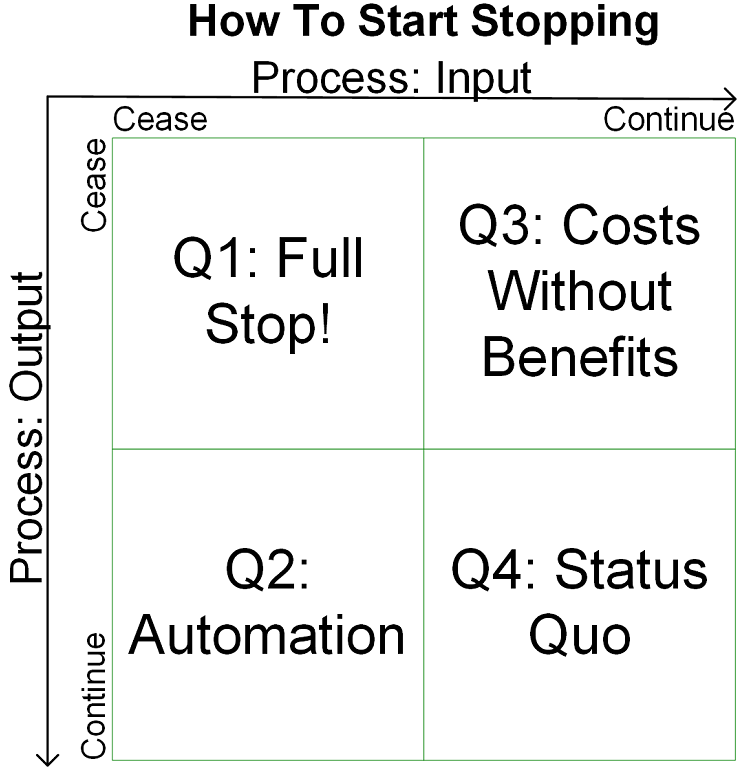
Fortunately the above definition also gives us a methodology to evaluate what processes we can stop, change or that we are stuck with. The Process Focused Way of Stopping uses a 2 x 2 matrix which asks two simple questions: will Inputs or Outputs Cease or Continue? Inside the resulting matrix is a gradient between the extremes of fully stopping or continuing to deploy inputs and outputs. The four themed quadrants can help an organization understand the challenges and execution of stopping a process and interrelated impacts on the organization of doing so.

The Four Quadrants of Stopping
Or how to manage the “Law of Unintended Consequences“.
- Full Stop!:
- Inputs Stop, Outputs Stop
- Business Example: Nokia, formerly a pulp and paper company that evolved into an electronics/cell phone company.
- Organizational thoughts: abandoning or decamping from a process.
- Risks/challenges: if a downstream process requires the output, a new and not necessarily better process may spring up to fill the void
- Automation:
- Inputs Stop, Outputs Continue
- Business Example: Automation of airline ticketing and reservation systems over the past 40 years.
- Organizational thoughts: automation is central to productivity enhancements and cost savings.
- Risks/challenges: over automation can backfire, for example, being able to talk to a human is now seen as premium support for a product instead of simply directing customers to a website or a phone response system.
- Costs Without Benefits (Yikes!):
- Inputs Continue, Outputs Stop
- Business Example: A mining company paying for site remediation long after the mine has been closed.
- Organizational thoughts: Generally this is the quadrant to avoid unless there is a plan to manage the risks and downside costs (e.g. a sinking fund).
- Risks/challenges: Organizations may land here as a result of the Law of Unintended Consequences..
- Status Quo:
- Inputs Continue, Outputs Continue
- Business Example: any company that stays the course in their product line; this includes companies that should have changed such as Kodak.
- Organizational Thoughts: this is a typical reaction when asked to changed processes. Lack of organizational capacity and willingness to change supports general inertia.
- Risks/challenges: As Kodak discovered, a lack of willingness to internally cannibalize and prune an organization may lead to external forces doing it for you.
How to Start Using a Process Focused Way of Stopping?
‘So What?’, how can this model be used? At a minimum I plan to bring it with me to the next planning session and when someone identifies an activity to ‘STOP’ I will point to the quadrant the thing falls into. This is not to prevent good organizational design, new ideas or planning; but it is to focus on the practicalities of planning and execution.
Limits of the Model
The model has its limits. The first is that is micro-biased. It assumes the organization, processes, outputs, and the like remain relatively constant. If your company is bought and the division shut down, the model is mute. The other limitation is technology. AI is seen as an automation tool but what happens when it becomes a game change at the macro level.
Nevertheless, hopefully you can start using this Stopping Model the next time you begin a planning meeting!
Write as a Team Sport: Antifragile Strategic Planning
I have been able to call upon friends and colleagues twice to help me craft articles. In both cases IAEA Property, Plant and Equipment Framework and LATE the group provided me with excellent advice.
A huge note of thanks (and a libation or coffee on me next time I see you) to the following individuals who provided ‘friendly-peer-review’. As in the last go round, the result was a much better article. The article itself can be accessed through my “Antifragile Strategic Planning: director’s cut” or directly from the FMI website: January 2016.
Thank you for the Use of Your Brain
Of course no good deed ever goes unpunished and to that end, the following are the folks who have helped me with the friendly-peer-review. Hopefully I can return the favor in the future. Also, if you are on the list and are logging this as professional development, feel free to refer to this post and notice below.
|
Person |
Organization |
| Anne-Marie A. | Alberta Bone and Joint Health Institute |
| Pam Q. | Athabasca University |
| Stacey D. | Government of Alberta |
| Shakeeb S. | Government of Alberta |
| Peter N. | Retired |
To whom it may concern, the above individuals were asked to perform a friendly-peer review of an article intended to be published in the Financial Management Institute of Canada journal, FMI*IGF Journal. The estimated time to perform this review was between 2 to 3 hours completed in early December, 2015. All of the above individuals demonstrated a firm grasp of the subject matter and helped to create-net-new original thought and critique through this peer-review which will be reflected in the final article.
The above activity meets the definition of Charter Professional Accountant – Alberta’s verifiable continuous professional development. Evidence for this include this web page attesting to the involvement as well as the emails and responses provided to myself. I welcome contact if further confirmation is required.