A SMART Thirty-Something

Most people have heard of the mnemonic SMART.  What you may not know is that this heuristic will turn 40 next year.  Written by George T. Doran, it was first published in 1981 [1].

A woman sporting a large back pack, gazes down a valley in the Albertan Eastern slopes, summer 1985.
Not everything that can be counted counts.
Not everything that counts can be counted. (Attributed to Albert Einstein but likely coined by William Bruce Cameron, American professor of Sociology, circa 1957).
Continue reading

4C’ing Trust in Your Organization

In a previous blog I introduced the concept of the 4 Cs: Communication, Coordination, Control & Command. These are management and organizational tools to achieve short- and long-term objectives. They also have their own individual costs, benefits and effectiveness. In this thought exercise I want to focus on the impact the above have on organizational trust.

Continue reading

Business Process Documentation or Borrowing from Sheffield

What is the role of business process mapping to internal controls? The Sheffield model outlines various purposes for mapping, including clarity, compliance, process improvement, and training. The Sheffield University guidance provides a structured approach to process mapping, with different levels and options for each purpose, emphasizing the importance of accurate documentation.

Continue reading

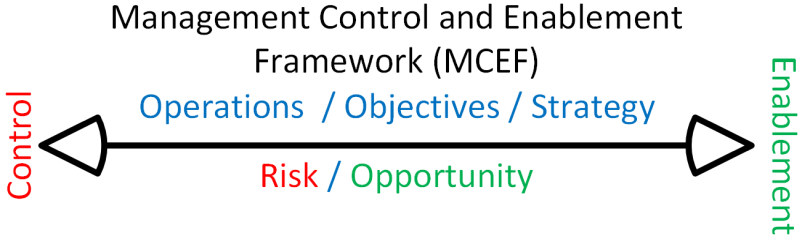
MCEFing the Gap – Introduction

Organizations are created to achieve objectives of a board of directors or the equivalent.  The challenge has been how to enable an organization but also protect the resources entrusted to it by its owners.  That is, how do you both Control and Enable an organization? The COSO Framework frames the question of Control but does not address the other side of the coin, things like employee-motivation, capitalizing on opportunities, customer service or the outcomes of public policy.  These are examples of what I call ‘Enablement’.

Continue reading

COSO – Mind the Gap

The author completed a COSO certification course, appreciating its quality despite previous frustrations with online learning. However, the course fell short in addressing the practical deployment of COSO, leaving gaps in internal-control specifics. Nonetheless, COSO promotes adaptability for organizations, suggesting they can customize the framework to better suit their needs.

Continue reading

Measuring Control – Challenges

The article discusses the challenge of measuring internal control effectiveness within organizations, specifically within the COSO framework. It emphasizes the need for reasonable assurance rather than absolute control, encouraging periodic checks on high-risk processes. It suggests organizations regularly review and update controls for relevance and effectiveness to ensure organizational objectives are met.

Continue reading