Day 1: Climate, Biotech and Canadian Competitiveness

What are some of the larger potential disruptive factors that could influence the Canadian Public Service over the next decade or less.  The following three are the first in a list that will be used at the November 22, 2017 FMI Conference – Disruptive Writers.

  • Seven Days of Disruption (Initial Blog).
  • Accelerating Global Climate Change and the cost to mitigate (2015 and editor)
  • Biotechnology: Frankenstein, Super-bugs and Super-cures (adapted from 2016 and editor)
  • Canadian Competitiveness and Productivity (editor)

Accelerating Global Climate Change and the Cost to Mitigate

Adapted from A.T. Kearney 2015: Food production, rising sea levels, increased range of tropical diseases and impacts to fragile environments such as the arctic and northern forests are some of the negative impacts identified.  At the same time, Canada could be a net beneficiary as more of its land mass becomes suitable for agriculture and lower cost for exploration of mineral wealth in the arctic.  These are tenuous gains as compared to social and mass population upheavals however.

Editor note: in many ways the past 200+ years of using fossil fuels can be compared to a young person inheriting a vast fortune from an unknown dead relative.  The changes have been both negative and positive.

On the positive side, there are billions of people alive today or who have lived in the past two centuries that would not have lived without the exploitation of fossil fuels.  Fossil fuels have given us a standard of living in which even the poorest Canadian is living better than many past kings or queens.  Hydrocarbons deliver clean water, warm homes, take away sewage, pave our streets, move food to our stores, fix nitrogen out of the air to grow the food and give us miracle materials such as plastics.

However, like a young adult waking up from a massive party we are also noticing that the trust fund is running low.  As well, 200+ years of living with fossil fuels has directly or indirectly killed many of our fellow species, polluted our homes.  The hunt for the fuels have led to corruption and creating vast fortunes in societies that have exported extremism and intolerance of things like women’s rights.

The cost to leave the fossil fuel era is considerable and may not occur in our lifetime.  The reality is that the engineering and technologies to replace an energy dense and convenient storage medium such as gasoline is considerable.  Canada has committed to shutter its coal power plants.  In 2014 this represented approximately 10% of the nation’s total generation nearly all in Western Canada [1].  Assuming these plants are closed by the target date of 2030, 63.6 terrawatt hours of capacity will need to be replaced [2].  Globally, Canada’s coal generation represents 0.67% of the total world generation capacity [3].  Thus the cost of leaving fossil fuels in the ground are not only direct but indirect as we place ourselves at a competitive disadvantage despite being a global powerhouse in energy reserves.

Biotechnology

Adapted from A.T. Kearney 2016: Just four years after its invention, “copy-and-paste” biotechnology is bending the cost and timeline curves for major scientific breakthroughs. CRISPR-Cas9—which stands for “clustered, regularly interspaced short palindromic repeats” and “CRISPR-associated protein number nine”—was discovered in 2012. This biotechnology has the ability to delete, repair, or replace genes, making it a function for genetic manipulation that will allow researchers to do three things more cheaply and effectively than ever before: alter human genetic code, cure diseases, and even create new lifeforms.   Its applications will have far-reaching impacts on a multitude of industries, altering business models, regulatory environments, and consumer demands and preferences worldwide.

Editor’s Note: Bio-technology is one of the things that makes us human even if the technology part has advanced considerably.  10,000 years ago the methods would have included burning forests to plant crops or encourage grazing animals; selecting grains such as wheat, rye or rice; or domesticating the dog, horse or cow.

More recently state sponsored food research was central to of the green revolution of the late 20th century.  Genetically modified food has continued this revolution although with a sense of unease.  Bio-technology promises designer cures for diseases and an improved standard of living for humanity.  The shadow includes Frankenfoods, designer babies and other nightmares from science fiction.  Regulation and a stable civil society is one way to control this.  Another method is to ensure that the work is done in a culture of openness and transparency – something perhaps more difficult if the research leaves Western countries and is taken up in repressive regimes or nations lacking a history of civil discussion.

Canadian Competitiveness

Adapted from the Conference Board of Canada: Canada’s standing on the 2017 Global Competitive Index as issued by World Economic Forum improved one place to 14th.  Switzerland ranks first, followed by the United States, Singapore, the Netherlands, and Germany.  Taxation and government regulation impeded competitiveness while a good K-12 and post-secondary education systems provided an offset.  Canada benefits from efficient labour markets and a sound financial and securities systems.  Canada lacks consistent investment in research and development, has degrading public infrastructure, poor coordination between universities and business and an over-reliance on natural resources.

Editors Note: This subject was discussed at the September 21, 2016 FMI Edmonton Chapter event Fostering Innovation in the Public Service When Money is Tight.

[1] Adapted from Canada Coal Profile, Figure 6 and Table 1, accessed 2017-11-13; https://www.iea.org/ciab/papers/Canada.pdf.
[2] ibid Power generation (gross) in TWh in 2014.
[3] Key World Energy Statistics, Electricity Generation by source, accessed 2017-11-13;  http://www.iea.org/publications/freepublications/publication/KeyWorld2017.pdf

Seven Days of Disruption

On November 22, 2017, the Edmonton Chapter of the Financial Management Institute is running an event entitled ‘Disruptive Writers‘.  In addition to hearing 3 great speakers discuss their books on either future disruptions or managing change, we will be playing a game called ‘Pin the Tale on the Disruption‘.  Sort of a mini-Delphi of what participants at the conference think will be the biggest challenge to the Canadian Public Service between now and …. ohhhh, say…. 2025 (e.g. about 7 years hence).

The Source of Disruption

There is a variety of sources for the disruptions but they are primarily based on the excellent work of the A.T. Kearney who have produced 3 Global Trend documents (available as follows):

It’s tough to make predictions, especially about the future (Yogi Berra)

A word of caution about the difficulty of making predictions.  Inevitably something better or worse will have muscled all of the excellent possible futures out of the picture.  In addition, Black Swans and the unpredictable are a near certainty.  So, to my future self, I profusely apologize/acknowledge for being so absolutely wrong/right in naming the following future disruptions.

A Laundry List of Disruption (in alphabetical order)

  1. Accelerating Global Climate Change and the cost to mitigate (2015 and editor)
  2. Biotechnology: Frankenstein, Super-bugs and Super-cures (adapted from 2016 and editor)
  3. Canadian Competitiveness and Productivity (editor)
  4. Changing Nature of Power (2015)
  5. Cyber Insecurity (2015)
  6. Dawning of a new urban transportation age and the Canadian City (2017 and editor)
  7. Depopulation Waves (2015)
  8. Evolving Artificial Intelligence (2015)
  9. Geopolitical Realignment and Continued Global Violent Extremism (2015)
  10. Growing debt overhang (2017)
  11. Immigration and Changes to the Canadian Values and Characters (editor)
  12. Indigenous Power (editor)
  13. Islandization” of the global economy (2017), NAFTA Negotiations and the rise of protectionism (editor)
  14. IT Revolution 2.0 and the Rise of the Machines (adapted from 2015)
  15. Post Consumerism (adapted from 2016)
  16. Quebec and Regional Tensions (editor)
  17. Resource and Commodity Supply, Demand and Price (adapted from 2015)
  18. Rising storm of populism; Canada and Cultural War in the Age of Trump and the Progressives (adapted from 2016 and editor)

Can We Monetizing Government Services?

On November 7, I attended a session put on by the Canadian Institute called “Government Connects“. All levels of government spoke about digital transformation of their services.  One of the speakers was the boss of all Alberta Public Servants, Marcia Nelson.  Marcia did a great job discussing what the Government of Alberta is doing in moving its services online.  Certainly Digital Government is the nirvana for most governments as they see cyberspace as being a cheaper, faster and more effective way to deliver more services to citizens.

The User as the Product

Marcia, and many of the speakers, talked about the expectations of citizens relative to their other digital experiences.  For example the ease to create a Facebook account, the functionality available via a GMail account or how a LinkedIn profile is now almost as important as a resume or a business card.  The question from Marcia, and others was ‘how can governments compete with these products?‘.

The other side of these services is a profit motive.  Facebook makes it easy to set up a profile so it can target you with advertisements. Gmail wants you as an email client so it can scan your email and target its advertisement.  LinkedIn wants you to buy a premium membership or at least get your eyeballs on its advertisements.  All of the above are examples of monetizing you as a user into becoming their product.  Assuming informed consent, there is nothing wrong with monetization.  It is an economic transaction in which a slice of your privacy is exchanged for some really good services (like watching cat videos on Facebook just saying).

The Digital Government Disadvantage

So where does government fit into this?  Firstly there is the challenge of resources.  A quick scan of the September 2016 quarterly results of Facebook shows they have about $10.6USD Billion in physical and intangible assets*.  Included in this number is $5.1USD Billion of network and computer software assets (physical) in addition to $1.7USD Billion in technologies and patents (intangible).  In other words, Facebook has excellent technical infrastructure to offer a premium product for free to users.  And if they don’t have a good product now, their $30.3USD Billion in current assets (e.g. cash, securities, etc.) can be used to buy that good product.

* Note, for those accounting weenies out there, an interesting item they have on their balance sheet is ‘Acquired users’.  I could not readily find a definition for this term but it appears that the users are really the Product!

Pity someone like the Government of Alberta (GoA).  A $50 billion a year organization in which an estimated 2.5%, over $1 billion, is spent annually on Information Management and Technology (IMT) (adapted from: GoA IMT Plan, 2016 – 2021, p. 4). From the GoA’s most recent financial statements, they have $4.4CAD Billion (about $3USD Billion) of computer assets – hey not bad – of which 78% of is fully depreciated (e.g. over 5 years old) – YIKES! (adapted from GoA 2015-16 Financial Statements, p. 63).

Beyond relying on old technology, the GoA has to do a lot more than Facebook.  While Facebook can focus on social media, the GoA needs to run registry systems (e.g. vital statistics, land titles or drivers licenses), health systems (e.g. immunization, medical records), education (K-12, student finance, apprenticeship certificates), business (collect taxes/royalties/fines) and human social functions (tracking children in foster care, seniors or homelessness).

The above is not a new story but it is worth repeating every now and then that governments do things that no one else wants to with a tiny fraction of the resources of private industry.  Governments must also build and run systems that have almost no tolerance for failure.

Risk and Skin in the Game

To the last point, risk, this is where government is at a further disadvantage.  The original investors in FaceBook backed a winner.  Those who put money in to Myspace, Friendster or DIGG did not fare so well (huh, never heard of some of these, check out the grave yard of failed social media infographic from the Search Engine Journal January 25, 2013).  Nicholas Taleb calls investors (win or lose) people with ‘Skin in the Game‘ from his book Anti-Fragile.  In contrast, public servants never have skin in the game.  We are always spending other people’s money and our fantastically worst case for abject failure is forced retirement or perhaps being fired – maybe.

In other words, governments have both an advantage and disadvantage around risk. The individuals involved do not have personal risk (advantage) but the organizations also lack the mind focusing benefit of the ‘terror of failure’ (disadvantage).

The Monetization Continuum and How Can Governments ‘Compete’

The reality is that Governments can’t and shouldn’t compete with the Facebook’s of the world.  Creating a bleeding edge user experience would be an inexcusable use of public funds and without the terror of failure would not likely be successful anyway.

But because thought exercises can lead to innovation, I am proposing the ‘Monetization Continuum‘ for governments; a government simply needs to pick a point on a line.  At one end (generally status quo) is ‘Mind and Accept the Gap‘ at the other is ‘Full Monetization‘ with other options falling between these two.  Definitions are provided below as well as way points but generally if you are Singapore you may be more comfortable having McDonald’s ads on your obesity website.  If you are at the other extreme – well this is where Minding the Gap comes in.

Monetization Continuum

End PointsDefinitionExamples
Mind and Accept the GapGovernments acknowledge that they will lag and explain why to their citizens. Periodically, governments leap-frog into a stronger position.Status Quo
MonetizeFund digital government through ad, premium memberships or sponsorship revenue.


Premium services could even be tax-deductible!

Faster border crossing via Nexus.

On the Subject of Not Likely

The reality is that governments will and should never monetize their services.  There is a slippery slope of what is reasonable and in good taste.  Governments have something that Facebook or Google does not have – the coercive powers of taxation and legislation. Perhaps governments does not need to build systems when they can force organizations operating in its jurisdictions to offer the services.  There is a long tradition of this in the telecommunications world, for example.  This would not be monetizing users as products, this would monetizing providers as servants for the public good.  Just a thought.

Monetizing Being a Public Servant

Early season snow storms are dangerous things.  Not only for driving but also when you take a long walk and your brain slips into thought experiments.  For example, when you are walking along and your brain says – hey you could potentially retire in a few years and do something outside the public service where you currently work.

In other words the snow and my brain conspired to ponder the question, ‘How do you monetize your career as a public servant?’.

Monetizing the Problem

First a definition, what is monetization? There are a swack of definitions but they all generally boil down to trying to convert something to ready cash. The following extract from Wikipedia’s definition provides a good example:

… attempting to make money on goods or services that were previously unprofitable or had been considered to have the potential to earn profits.

So, what exactly are we monetizing in this context? How to have a career post public service that commands a similar level of pay, respect and respect. Not to put too fine of a point on it, but public servants have a (not)/justifiable reputation of being unemployable post government.

The Obvious Methods

So, after a career of say 25, 30 or more years, how do you convert that experience into a second career or even part-time income?  The obvious answers that came to me include:

  1. Maximize a Public Sector Pension and/or Semi-Retirement
  2. Gain Unique Experience of Value to Someone
  3. Retire from a Senior Position that has Cache and Contacts
  4. Keep Your Toe in the Real World

Maximize a Public Sector Pension and/or Semi-Retirement

This is the most obvious method is that you enjoy the government backed annuity otherwise known as a public sector pension.  Sure, maybe you will do some greeting at Wal-Mart or try to convert a hobby into a paying proposition – but generally you don’t monetize the experience.

There is of course a cliché here that public servants have gold-plated pensions and to certain extent it is true (to learn more about this subject, see the post-conference notes on public sector retirement by the FMI).  The other side of this cliché of course is the lack of stock options, bonus and other non-monetary factors related to be a public servant.  Nevertheless, a thirty-five year pension is a pretty sweet bit of monetization!

Gain Unique Experience of Value to Someone

The fellow who spent his career as a spot-mountain-frog-lip-taster-technician may discover that he has a very unique skill set.  Governments do things that business and organizations don’t so this is definitely a consideration for monetization – assuming there is a market for the specialization – and there is the rub.  No other organization may want to pay for (thus monetize) frog-lip-tasting.  However there are some less obvious examples of converting experience into post-retirement careers.

If you work in an administrative function, likely the experience can be monetized – to a point.  A human resource consultant, accounting clerk or procurement specialist can find (if they want) post-retirement employment.  Unfortunately, the more senior the public sector experience the less likely of making a lateral leap.  As an accountant, I have managed to avoid dealing with taxes, shareholder accounting and the like because I have focused on budgets, systems and governance.  As a result, most controller roles are closed to me because I lack this basic for-profit experience.  The same examples can be made for other administrative functions in human resources, procurement, etc.

Retire from a Senior Position that has Cache

Retiring as a Deputy Minister or City Manager may open up future opportunities.  Think of the senior politicians, for example, who have gone back into law firms or think tanks.  Alas often the value you can bring to an organization are the contacts and systems knowledge of the recently departed government.  This knowledge is perishable in the extreme, particularly if there is a subsequent change in government or significant re-organization.

Mandatory cooling off periods may further diminish the relative value of recent experience if one needs to wait six to twenty-four months before cashing in.  Nevertheless, if you got to be a senior civil servant, you probably have skills of value beyond a government context.

Keep Your Toe in the Real World

One method of ensuring the ability to work in the real world post public service is to not really ever leave it.  A toe in may range from owning real estate property, working part-time (e.g. doing taxes if you are an accountant) or teaching courses.  In this way you have non-government experience to point to.  A further upside is having additional income of doing some or all of these things.  A downside is working more than one job during your career.

Monetization May Mean More than Money

If you are willing to stretch the definition of monetization, there is more to life than a second (third, fourth or fifth) career.  You can also use your experience in a volunteer capacity helping our or other societies.  For example Canadian Executive Services Overseas takes retired executives and places them globally and here at home (e.g helping first nation communities).  Churches, non-profit boards and community leagues are other potential beneficiaries of a life time in the service of the public.

Not all of these will pay the bills if one’s pension is not fully maximized.  However if money is not a primary driver (hey, you did take a government job after all), then you may be paid in post-retirement experiences!

Thank you snow storm for helping me clear my thoughts whilst walking… now back to work because I am not quite at the point of being able to start monetizing….

Cash is King but Flow is the Empress

David Trahair writes on financial matters and provides a very welcome Canadian point of view on retirement and investment considerations.  In his 2012 book: Cash Cows, Pigs and Jackpots; The Simplest Personal Finance Strategy Ever he provides both financial advice and some self-help to boot!

Pig Tied to a Stake; Frederick George Richard Roth; Metropolitan Museum of Art: #06.404
Keep your Cash Pigs under control. Pig Tied to a Stake; Frederick George Richard Roth; Metropolitan Museum of Art: #06.404
Continue reading

Procurement Questions

On February 26, 2015, the FMI-Edmonton Chapter is hosting a professional development session, ‘Procurement-Who Does it Well?’.  The pre-event program notes are available (including speaker biographies) for those wanting a bit more detail or context.

Louis Moeller,

Louis Moeller,

The purpose of this session is to explore:

Canadian governments (federal, provincial, municipal and agencies) collectively procure  billions of dollars each year. Efficient and effective procurement is critical to the proper functioning of government operations and central to a modern economy.  This professional training session will consider the public sector procurement challenges from many perspectives including procurement professionals, public servants who need to purchase goods/services, the financial manager, system providers and of course the taxpayer who ultimately pays for the purchase.  This is a joint presentation by FMI and PwC Canada – a global leader in supply chain and procurement.

 With any good session, a set of questions helps to explore the issues.  Available to speak to (if not answer the questions) are experts from PriceWaterhouseCoopers (PwC) as well as Federal/Provincial/Municipal government finance and procurement professionals.  In addition, we will also use the ‘wisdom of crowds’ for this session in which individuals attending can text/email in responses to questions which they think better answer or contribute to the question.

Questions fall into one of the following themes:

1. The Future of Procurement

(Questions relating to changes in People, Process and the Products of the procurement process?  This includes the use of technologies, legislation, training, etc.).

  • Alberta has recently introduced legislative and Treasury Board directive changes increasing the difficulty of conducting sole-source contracts, the use of contract review committees, changes to conflict of interest and other amendments.  Where do these changes place Alberta relative to the rest of Canada for transparency and over-sight of the procurement process?  Should any of the changes be adopted by other levels of government, if not already; in particular, by municipalities?
  • How well do government organizations in Alberta coordinate their procurement activities? Do other jurisdictions to a better job and if so, what will Alberta need to do to match this performance?
  • How procurement-literate is the average public servant?  What is the minimum they should know and where is the best place to learn this?

2. The Current Practicalities of Procurement

(Questions relating to how to ensure compliance with existing organizational and legislative rules and procedures.  This includes reducing the burden compliance while selecting the best vendor during a procurement event).

  • How much is public-sector procurement a technology problem, a political problem, a people problem, a process problem – or is there a problem?
  • How do private sector vendors perceive the government procurement processes in Alberta?  How and how much should their perceptions, needs and circumstances be taken into consideration when designing a procurement process or running a procurement activity?
  • Are inefficiencies in the public-sector procurement process used to discourage expenditures and thus they are a form of cost avoidance or containment on the part of a government?

3. From the Procurement Professional’s Perspective

(Questions related to how a procurement professional can support public servants in selecting vendors of goods and services).

  • How does an organization know that it has a good procurement process?  What metrics should an organization track against to make this assessment and are benchmarks available in general or in particular to public-sector procurement?
  • Who is the ‘pin-up organization’ that every procurement manager wishes their organization could emulate?  Who is the best of the best when it comes to public-sector procurement?
  • A common compliant amongst public servants are the Byzantine procurement rules, seemingly arbitrary changes to the procurement process and endless legal reviews.  How much is this perception real and how can procurement professionals streamline and the process without losing accountability for a fair, open and transparent bidding process?
  • When should a procurement professional be the person to negotiate price with a vendor?  What other procurement attributes (e.g. delivery, quality, terms, conditions, etc.) should be the responsibility of the public servant making the purchase versus the procurement professional?

4. From the Financial Manager’s Perspective

(Questions related to what a financial manager must consider when supporting public servants or procurement professionals).

  • Canadians were perhaps shocked with the revelations of corruption in Quebec.  Over all, how does Canada or Alberta fair on its public-sector procurement being free of corruption?  What are the pro-active and retro-active activities to maintain a corruption free status (or to de-corrupt it, as applicable).
  • What is the one way a financial professional can assist a public servant or a procurement professional in the context of procurement?

5. Alberta’s Contract Review Committees

(Questions specific to operating a contract review committee within a public sector organization with a specific focus on the province of Alberta’s implementation of a review committee).

Alberta Context: A Government of Alberta Treasury Board directive requires that all departments have in place a contract review committee ‘to support the procurement accountability framework’. This framework in turn will: ‘support consistent goods and services procurement practices, including those in respect of Construction, across all departments, that reflect best practices and foster accountability, fairness, effectiveness, and efficiency ‘.

  • Some Alberta Ministries already have contract review committees, how much is this experience being considered when setting up new contract review committees?
  • Are the experiences of other governments also being considered, for example ad hoc committees used in selection of federal or municipal committees.
  • Should the vendor experience or perspective be considered as part of the deliberations of a contract review committee?
  • Some ministries had review committees while others have yet to establish a committee before the April 1, 2015 deadline.  How much should and will the committees differ across the ministries?  What are the FOIPP and public disclosure consideration for these committees?

Proofiness

Mathematics can be used and presented in a manner that distorts the underlying truth or at least the underlying likelihood of a truth.

A mathematician seated at a table, working on mathematical equations

A mathematician seated at a table, working on mathematical equations

YAWWWNNNNN, who cares – Charles Seife does and tells us why you should care too in this book, “Proofiness: How You’re Being Fooled By The Numbers“.

Seife’s position is that bad math is more than being hoodwinked into buying oatmeal (see Quaker Oatmeal cholesterol numbers); bad numbers disenfranchise voters and erodes the democratic rights of Americans.

A Bad Math Field Guide

Be warned, this is a heavily American-focused book in which about half is dedicated to the challenges of the US voting systems.  If you can get past this bias, some interesting terminology and underhanded methods are exposed.  Here are a few:

  • Truthful numbers: come from good measurement that is reproducible and objective
  • Potemkin* numbers: derived from nonsensical or a non-genuine measurement
  • Disestimation: taking a number too literally without considering the uncertainties in its measurement
  • Fruit packing: Presentation of accurate numbers in a manner that deceives through the wrong context.  Techniques include cherry-picking, apples to oranges and apple polishing.
  • Cherry picking: Selection of data that supports an argument while underplaying or ignoring data that does not.
  • Comparing apples to oranges: ensuring the underlying unit of measurement is consistent when comparing two or more populations.
  • Apple-polishing: data is touched up so they appear more favourable (this was the Quaker Oatmeal trick).
  • Randumbness: because humans are exceptional at discerning patterns we also suffer from randumbness, insisting there is order where there is only chaos.
  • Prosecutors Fallacy**: Presenting a probability incompletely and leading to a false data assumption.

* Named for Prince Potemkin who convinced the empress of Russia that the Crimea was populated by constructing villages that were only convincing when viewed from a distance – such as a passing royal carriage.  An example of a Potemkin number was Joe McCarthy’s famous claim of 205 communists in the State Department.

** This one is worth a blog on its own so for more, read: http://en.wikipedia.org/wiki/Prosecutor’s_fallacy.

Take Your Field Guide With You to Work

These are important concepts for not only a citizen to consider when looking at dubious polling information but in the business or public policy world as well.  If there is a shortcoming in Seife’s book, this is it.  In my opinion he over focuses on the bad use of numbers in the public arena without touching on how CEO’s, CFOs, Boards and government-Ministers may also be hoodwinked.

Individuals being asked to make decisions based on numbers need to be able to cut through the packaging techniques discussed above.  This is becoming more important as our society moves to a 144 character Twitter attention span and public policy needs to be distilled down to a simple infographic.  As well, while developing a dashboard for a business is valuable, be sure that it is not filled with polished, cherry picked, Potemkin numbers based on a disestimation

Disenfranchising a few Million

Returning to the book, Seife has some advise for the US when it comes to the United States census.  Written into the constitution, once-every-decade process of counting all American citizens costs about $6.5 Billion dollars.  For this expenditure, it is estimate that the census misses about 2% of the United States population and double counts about 1%.  While these numbers would in theory cancel each other out (more or less), the impact is that there about 10 million US voters not accounted for in the census.

This error rate can be mitigated through techniques known as statistical sampling which will smooth out the distortions.  The result would be generally more people counted in poorer, racial minority areas who don’t like to fill in census forms or talk to government officials.  The ‘result of the result’ would be these people would then have more politicians to vote for (larger representation) and to send to Washington.

So far sounds good except that poor, non-white folks tend to vote for the Democrats which is why there is another perspective: only a count – counts. This being America, the counting challenge has generated a lot of legal attention and two population numbers.  One used by everyone who needs precise data to estimate everyday population trends and another used to reapportion the House of Representative seats.  After numerous legal battles, millions of Americans are disenfranchised because only a more error prone enumeration technique is permitted (see pages 185-198 for a more thorough explanation and also some very impressive legal gymnastics by the Supreme Court).

A Math Journey with a Curmudgeon

Seife sees himself as unbiased journalist although his leftiness tends to negate this somewhat.  He distrusts political polls, NASA, fluffy articles in scientific journals and the social sciences.  In other words, reading Proofiness is like visiting with a self-indulgent, opinionated curmudgeon – who is also brilliant and often right.  If you use numbers to make decisions in your day to day life, I would encourage you to take your ‘Proofiness-Field Guide’ with you.

Triumph of the City

How can you not love a book that combines economics, civil engineering and history!  Edward Glaeser combines these elements into a generally good read that traces the impact of the city from its earliest times to its modern incarnations.  His thesis is that building-up is good and environmentally responsible; sprawl is understandable but not sustainable.

Origin of a City

Cities started and thrive on technology.  The invention of agriculture and the domestication of beasts of burdens was the genesis for our urban journey.  As a result, cities became gateways along trade routes for the spread of culture, innovation and disease.  Since these earliest times, ongoing technological changes have allowed cities to flourish.  The creation of a better transportation (the wheel, canals, steam, street car, automobile, etc.) have allowed for cities to take advantage of the exchange of goods and services.

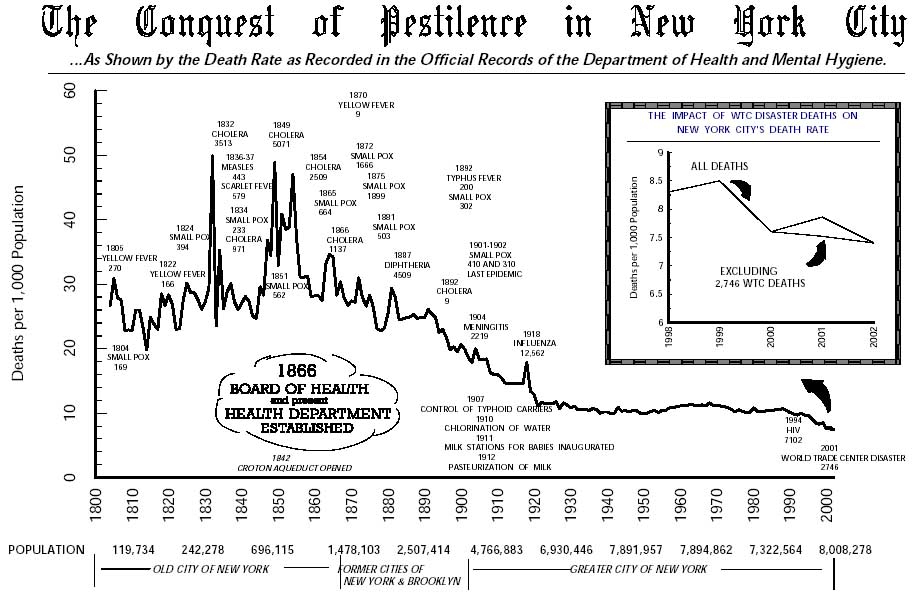
More recently (e.g. the last 150 or so years) social changes and technologies have allowed cities to move from places of pestilence to locations where you are more likely to be healthier, happier and live longer than your rural cousins.  These technologies are of course the lowly toilet, sewer system, asphalt (to reduce dust), internal combustion engine (to reduce things like horse dung) and clean water.  Parallel political structures needed to be created to provide these externalities* such as effective police forces, water works, street maintenance and an (ideally) non-corrupt overall administration to manage these services.

The Conquest of Pestilence in New York City; Stirling Behavioural Science Blog

The Conquest of Pestilence in New York City; Stirling Behavioural Science Blog

Slums as a Success Story

At this point, many people would point to the slums of Mumbai or Rio and suggest that the conditions there make cities a failure.  While Glaeser does not minimize the human suffering that does occur in quasi-legal no man’s land of slums, he also suggests that those living there are (on average) better off than their rural kin who they left behind.  Cities encourage innovation, reward hard work and there is a better chance to have access to medical care, clean water and schools for your children in a slum than in a rural province.

Once again, it is important to differentiate anecdotal, statistical and absolutes at this point.  For the young man who left a rural village in Brazil and died the next day in gang warfare in a Rio slum – cities would seem to be a bad deal.  But his tragedy has to be matched against the many others who became middle class through hard work, innovation or access to education.

Political Impact on Cities

Cities and political processes go hand in hand.  For example, the more democratic a country is, the more distributed its cities are likely to be; conversely, the more autocratic, the more likely that a single city will lord over other cities (the largest cities in dictatorships, … contain, on average 35 percent of the countries’ urban population versus 23 percent in stable democracies, p. 235).  Over the past 100+ years perhaps the greatest political influence on a city was the favouring of the automobile through the creation of highways and mortgage deductions for private ownership.

In the United States, the creation of the inter-state highway system (which was partially completed to support improved military transportation) has allowed for the creation of suburbs compounded by three other factors: road economics, tax policy and school funding.  The fundamental law of road congestion states that as roads are built, they are filled at nearly the same rate as their construction.  Thus more roads mean more traffic with only congestion pricing (a political hot potato if there ever was one) mitigating this effect.  Returning to the United States, a generous mortgage interest deduction further encouraged the purchase of the best available home a family could afford.  The localization of school boards and their funding meant that parents would also select a home where the good schools were.  The impact since the end of the WWII was the creation of a suburban sprawl and the gutting of inner-city communities.

The urban riots the United States has experienced can be partially traced to the flight of educated and leadership enabled citizens (white and black) away from the urban centers.  This was more than a lack of policing or social policy, this was as much the destruction of the social fabrics of the communities.  Akin this effect in the United States, Glaeser comments on how much safer the Mumbai slums are than the Rio equivalents despite the former being poorer.  Mumbai slums are better functioning social spaces and thus they provide their own safety nets and controls that are less likely to be found in the more transient Rio slums.

Creating Great Cities

Glaeser offers some direction on how to keep cities healthy, happy, lower environmental footprint and safe.  Firstly, allow cities to grow up.  This increases the density per square metre meaning that the same public-service is being optimized.  Green spaces are important to allow parents to raise their families and community safety must occur concurrently.  Community-based and adequate policing is part of the safety equation in addition to creating functioning social-spaces and communities.  Further to this, a community needs to have a say in the make-up of its local environment (bars, night clubs, daycares, etc.) but must not have a complete veto otherwise cities become balkanized into enclaves of Not in My BackYard.

Glaeser also strongly supports the consumption pricing of public goods.  Thus those driving in from the suburbs should be paying for this right or the developer constructing a high-rise tower should pay a sufficiently high enough fee to compensate the local community for this vertical-intrusion.  These are excellent economic principles that often falter in harsh light of political reality.  Nevertheless, at least they should be part of the discourse on what type of city we want to live in and have available to us.

Triumph of the City is a good read for anyone interested in the practical application economics and civil engineering to the messy realities of human communities.  The book is strongly skewed toward the United States context but Glaeser should be commended in bringing in numerous global examples to balance this bias out.  There are lots of juicy footnotes for those who want a deeper dive into the details.  Triumph of the City is a good book for any History/Economics/Civil Engineering-wonks out there.

(*) In economics, an externality is the cost or benefit that affects a party who did not choose to incur that cost or benefit [WIKIPEDIA].

Lapdances, Polygamy and Religion – The Price of Everything

My oldest brother runs an excavation company and I remember riding with him once.  He had dug up some dirt and was looking for a potential buyer.  Someone had paid him to do the digging (actually it was me) and now he was looking for someone to pay for the dirt I paid him to get rid of.  My brother had discovered what most individuals with a truck and an excavator do not know: the money is not in the work it is in the deal.   I readily paid a price to get rid of dirt and someone else was keen to pay for the same dirt – and my brother happily knew the value of both sides of the equation.

Kreuzenstein Castle north of Vienna
Continue reading