A University of Alberta (U of A) student project team will be going head-to-head with community leaders to explain and pitch the Volunteer Steward smartphone Application.
Continue readingDragons and Protected Areas – April 4, 12-13h
2

A University of Alberta (U of A) student project team will be going head-to-head with community leaders to explain and pitch the Volunteer Steward smartphone Application.
Continue readingI find myself running three student projects; I am treating each one as if the students were small consulting companies on contract. ‘Consultant’ is a term I am also hoping to de-mystify through a virtual session on February 29 between the three projects and individuals who (have) called themselves ‘consultant’.
Continue readingIn a previous blog, Factoid Bingo was introduced. Think of this blog as sort of an annex. It records details that bog the main blog down. Poke around and use the details noting that it is written primarily as a memory jog for myself.
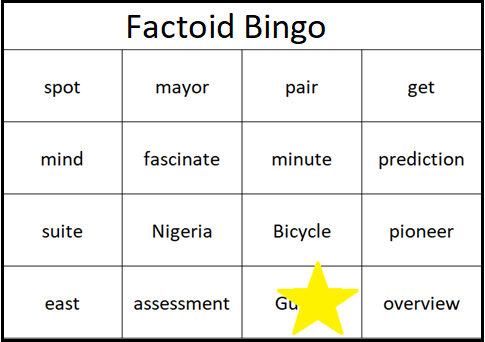
Factoid Bingo helps a large(ish) group of people introduce themselves to each other. Best played in person, the game shares an interesting fact about a person via a randomized list of Factoids. In the game, each player tries fill the card by finding the owner of the respective facts. Prizes are given for blackouts, lines and to the introverts in the group.
Continue readingA dark ‘game’ used in select Financial Literacy circumstances to teach how compounding interest works as well as the value of paying down debt.

One of the challenges of teaching financial literacy is developing an assessment of where individual students and the entire class is at in regards to their knowledge and habits. The following self-assessment tool is a non-scientific method to perform this evaluation.

For most people, we accumulate (or not) wealth slowly, year over year. We work, save, spend, borrow and then go back to work. For the (un)lucky few, wealth comes suddenly which can give rise to Sudden Wealth Syndrome (SWS).

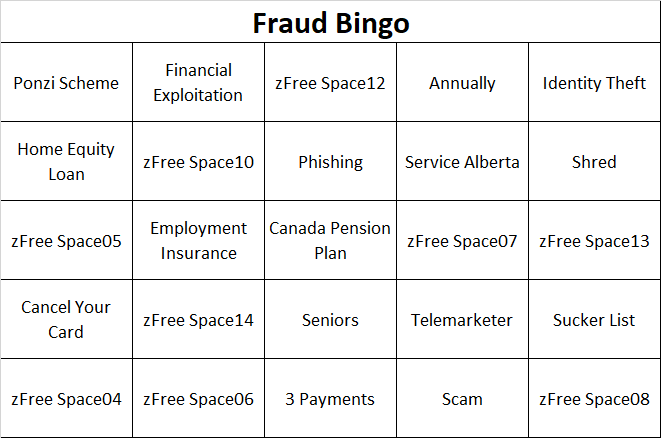
Central to most financial literacy programs is fraud awareness. How to keep the bad guys from getting your money, possessions or good name. Who Wants to be a Fraudster? is a variation of the classic bingo game in which participants match a term or concept to a fraud related question.
A core premise of adult learning is that the individual must have influence over the content of the instruction. In a workshop setting, this can be done by asking participants to rate both their knowledge of a topic and the relative importance a topic is to them relative to the time and attention available in the session.
Continue readingIt is sometimes necessary to divide a group up randomly. While the good ole’ fashion count-down-the-line works, it fails to give the resulting groups a starting point of their own identity.
Continue reading Organizational Biology