Thinking Positive About a Negative Score

Organizations need to pick winners and losers.  For example, a government must decide to whether to fund project X, Y or Z; a corporation only has the capital to build asset A, B or C. 

Most organizations have developed a portfolio selection and management methodology.  There are typically 2 parts to such a process: a set of criterion and a scoring scheme to rank the criteria.  In this blog, I want to focus on the second challenge, the scoring. 

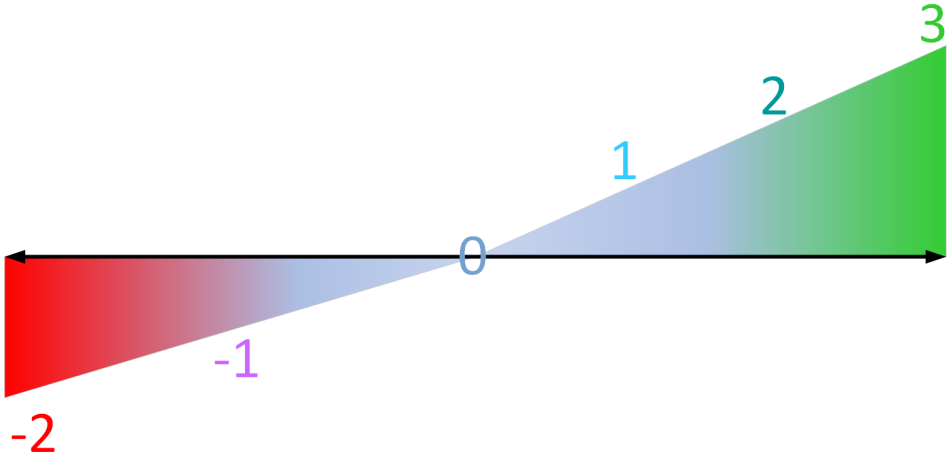
Balancing scoring Model is composed of two right-angled triangles sloping a center vanishing point which represents the value of zero.  At the left, the triangle dips below a black line 2 units into the negative.  At the right the triangle rises out of the line 3 units.  -1, 0, 1 and 2 value points are between these two extremes.
The +/- Scoring Metric
Continue reading

A Valid Validation Map

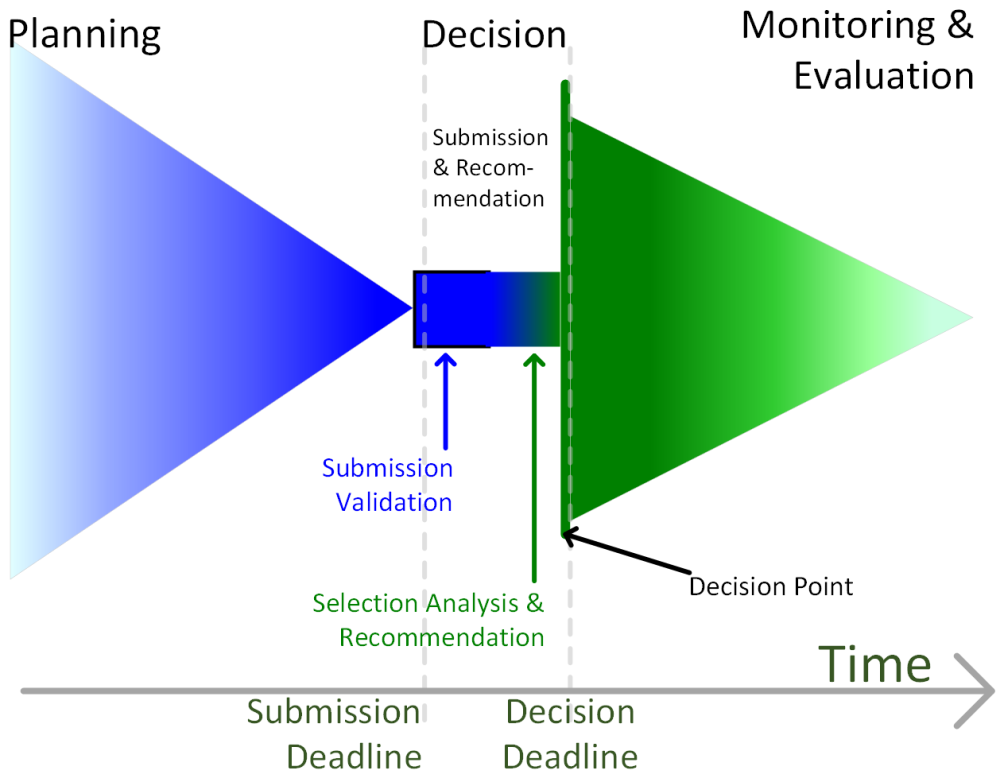
How does a ‘requester’ know that a ‘submitter’ has provide a correct, complete, accurate and relevant ‘submission’? A framework to evaluate the planning, receipt, and evaluation of submissions.

A blue triangle, with its apex on
Submission Validation/Decision model of the NOW-Event.
Continue reading

A SMART Thirty-Something

Most people have heard of the mnemonic SMART.  What you may not know is that this heuristic will turn 40 next year.  Written by George T. Doran, it was first published in 1981 [1].

A woman sporting a large back pack, gazes down a valley in the Albertan Eastern slopes, summer 1985.
Not everything that can be counted counts.
Not everything that counts can be counted. (Attributed to Albert Einstein but likely coined by William Bruce Cameron, American professor of Sociology, circa 1957).
Continue reading

A Brief History of RBM

The blog introduces Results-Based Management (RBM), emphasizing its significance in public sector reform as outlined in “Reinventing Government”. It discusses the historical context of RBM, its endorsement by key organizations, and the challenges of implementing standardized practices. The focus is on ensuring effectiveness and accountability in public expenditures for optimal results.

Continue reading

The RBM Plan!

Results Based Management (RBM) is a fixture in international organizations and used to varying degrees by governments world wide.  For Canadian business professionals or accountants, RBM is an unfamiliar term although they may be better acquainted with RBM’esque concepts such as portfolio investment management or continuous improvement.  

Continue reading

Using the Now-Event Map

In my last blog, I introduced the ‘NOW-Event-Map‘.  This model combines both a forward looking strategic planning model with a retrospective performance reporting model.  At the center of the map is the enduring concept of ‘NOW’.  At the end of the prior blog I promised some thoughts on how the map might be used – besides as an academic thought exercise. 

Three arrows are over-layed on the NOW-Event Map.  The inner most arrow is clockwise and links real time events to operational plans.  The second area is also clockwise and links monthly or quarterly information to tactical planning.  The final arrow is counter-clockwise and links all results to the strategic and visioning planning activities.
The interaction between results and planning.
Continue reading

Now-Event Map

The ‘Cone of (Un) Certainty’ has been a fixture in strategic planning for a few decades [1].  In reviewing these models I was struck by the assumption that planning ends…. and well that is it. To correct this, I would like to propose a planning model entitled: ‘The NOW-Event Map’. which considers both planning and delivery.  

Graphic showing the differences between planning, execution and results. Left, blue cone of opportunity. Centre, a white circle with a black dot in the middle indicating the concept of 'now'. Right, successively smaller stakes of triangles indicating the reduced relevance of results over time.
The NOW-Event Map
Continue reading

A Logical Framework

I am brushing up on a few concepts and processes that I have used in the past and may very well need to use in the future.  One concept concerned a business philosophy of Results Based Management (RBM) and a tool RBM uses for project design, the Logical Framework (LogFrame).

Matrices of the Logical Framework.  Rows are in ascending order: Goals, Purpose, Output and Activities.  Columns, left to right, are: Summary, Indicators, Verification and Assumptions.
Logical Framework Matrix – Overview of Columns and Rows
Continue reading

Government and Education

What exactly does government do?  No, this is not the start of a Libertarian rant, this is a question of what are some of the big building blocks of a modern government as it pertains to education.  My first pass suggests that there are eight, as listed below.  It will be interesting to do some research on each of the blocks in sequence and see if I missed any or included too much in my first pass.

Functions that Are Good for Your Constitution

By way of clarity, this is not a discussion about the philosophy of government, the degree the state should interfere in the economy or the affairs of its citizens or the programs it should (not) provide.  Also, this focuses exclusively on education although I consider education starting at birth and ending with working.  In addition, there is a continuous exit and entry process.  A high school student gets their first job or a middle-age person is laid off and returns to school for re-training.  To this end, I am proposing that there are 8 core functions or enablers of education:

  1. Curriculum: what gets taught.
  2. Delivery & Institutions: who delivers the curriculum.
  3. Registration: who are students being taught.
  4. Results & Performance Management: how was school and is the process of teaching getting better, worse and changing fast enough for the environment.
  5. Certification: how do we know the student passed and how do we assess the veracity of the claim.
  6. Compliance: are the parties involved in the above doing what they are supposed to?
  7. Funding: who pays for all of the above and according to what formulas.
  8. Governance: where does the buck stop.

Limits of Education

Each of the above functions transcend the Education government-function and are found more or less through out the rest of government.  Conversely, there are functions that are absent or implied in the above list that are more prominent in other areas of government.  For example, taxation exists in the Education function, at least in Canada, through property assessments.  However, I will de-emphasize this function mostly because other areas of government perform these tasks on behalf of education (e.g. a ministry of finance). 

As a straw dog and 50,000-foot view, what do you think?  Have I missed a function noting the focus on education or would you remove an element?  Next stop on the school bus, curriculum.