Six PoC Questions for Success

Proofs of Concept (PoC) are great.  They allow one to test a small component and then apply success (or failure) to future endeavours.  Certainly the all time champion of the PoC are the Myth busters.  Adam and Jamie would start each myth with a small-scale test before going big (and with the obligatory BIG explosion).

To Hack or to Formalize a PoC

PoCs come in many sizes.  At one end is the developer who experiments and comes up with a workaround or a more elegant way to achieve a result (aka a good ‘hack’).  On the other end is an organization that incrementally works toward a final objective.  For example sending a series of Apollo missions into space with each one adding on to the knowledge and experience of its successor.  This blog considers more than a midnight pizza fueled hack-a-thon but much less than sending humans into the unknown.

Buzz Aldrin Apollo 11 - the beneficiary of a series of Proof of Concepts.

Buzz Aldrin Apollo 11 – the beneficiary of a series of Proof of Concepts.

The Scientific Process (sort of) to the Rescue

One of human’s greatest achievements was the development of the Scientific Method which involves (courtesy of dictionary.com):

noun; 1. a method of research in which a problem is identified, relevant data are gathered, a hypothesis is formulated from these data, and the hypothesis is empirically tested.

The following Six PoC Questions for Success is loosely based on the above method.  The intent is to help an organization understand why a PoC is a good idea and the result.  At the same time, this is ‘just-enough’ formalization.  After all, it is important to let the brilliant folks develop ‘elegant-hacks‘ without too much paper work.

1. What was the Business problem being addressed?

Why was a PoC identified?  Generally this is to address a specific business problem.  Pure research is okay as an objective for a PoC.  That is developing technologies or techniques with no immediate application but future potential value for an organization.

2. How is the problem currently being solved?

The answer to this question is that it is often not solved, done through intuition or completed via a manual/semi-automated process. This question helps the organization understand what to do the with the results of a PoC.  If the manual process is only slightly more costly then a fully automated variety, why bother with the complexities of automation?

3. The Question

In effect this is the hypothesis portion of the scientific method.  Ideally this question should be a simple Yes/No.  If the nature of the question changes through the PoC process, that is okay – but the evolution of the question should be included as part of the final report.  Thus we may have started asking question X but we ended up answering question Y.  The reason is that X was too big/small/wrong and Y was answerable.

Defining the question is important so your PoC team does lose its way and they have a touchstone to come back to. A bit of formalization around how they can change, extend, shrink or otherwise amend the question is important.

4. What were the results at the end of the project?

This question should have two parts, a) and b).  Part a) is the predicted result.  By including a prediction, the PoC can stay focused on the intended result.  This is not to discount secondary benefits or chance discoveries but it does help to ensure that a PoC does not become its own self-sustaining cottage industry. Consider keeping part a) secret from the PoC team if you want the benefits of the double blind effect.

Part b) is what happened, what were the results?  This should support the response to the question answered above.  Ideally the result is Yes or No but it might be Maybe.  Of course everyone wants a momentous discovery every time.  However failure should be seen as a positive result – such a result may have saved an organizations considerable time, talent and treasure.

5. What are the next steps?

This should be a very practical listing of how to use these results.  Examples of next steps may include refining a subsequent PoC, engaging in a larger scale test or moving the resulting solution to production.

6. What is the Future Vision, What is Possible?

Question five focuses on the practical and immediate application of the PoC results.  Question six let’s the team blue sky a bit and extrapolate findings to larger contexts.  This is part of the fun and value of the PoC – the larger application of something new.

No Explosion – Using the Six Questions

Sorry, unlike the Mythbusters, there is no end of blog explosion.  Instead, these questions are a handy reminder of the things to consider when a PoC is being suggested.   Let me know your thoughts on the six questions.  Would you add a question or take away one or more of them?
Can We Stop and Define Stop?

This week I will be going into an operational planning meeting.  Like most of the operational planning meetings I have attended, three questions are being asked:

  1. What do we want/need to start doing
  2. What do we need to continue to do or finish and
  3. What should we STOP doing?

The first two questions are relatively easy to answer and there is a plethora of information on How, Why, When, Where and What to plan.  In this blog, I want to focus on the Stop question, specifically:

What does “Stop” Mean in the Context of Operational Planning?

How Many Stops have been Really Stopped?

In my career, I have been in dozens of planning meetings and I cannot really recall something identified as ‘should be Stopped’ that was actually stopped.  At the same time, over my career, I have stopped doing many things that I used to do with out the ‘thing’ being part of a planning meeting.  Why is it so hard to identify a process to stop and then actually stop it?

Stopping to Define A Process

A quick stop for a definition and in this case the word ‘Process’ which is one of these wonderfully loaded terms.  Fortunately the good folks at the International Standards Organization can help: (source: http://www.iso.org, ISO 9000:2015; Terms and Definitions, 3.4.1, accessed 2016-04-02):

3.4.1 process: set of interrelated or interacting activities that use inputs to deliver an intended result (Note 1 to entry: Whether the “intended result” of a process is called output (3.7.5), product (3.7.6) or service (3.7.7) depends on the context of the reference.).

Assuming that an organization wants to stop a process, the challenge of doing so is built into the definition – when you stop something, you must deal with the inputs, the outputs and the impact on the inter-relation between potentially numerous activities.

Starting to Use a Process Focused Way of Stopping

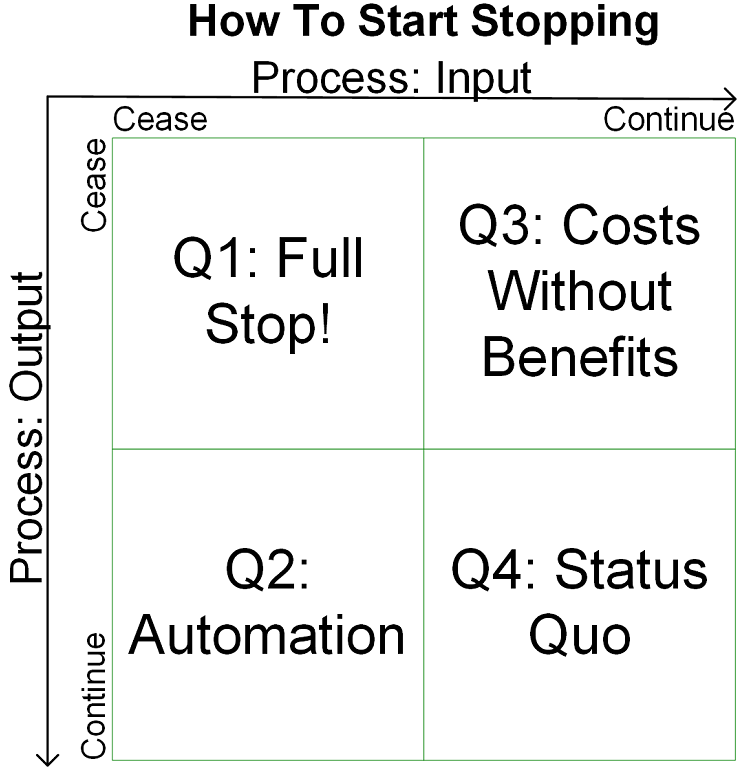
Fortunately the above definition also gives us a methodology to evaluate what processes we can stop, change or that we are stuck with.  The Process Focused Way of Stopping uses a 2 x 2 matrix which asks two simple questions: will Inputs or Outputs Cease or Continue?  Inside the resulting matrix is a gradient between the extremes of fully stopping or continuing to deploy inputs and outputs. The four themed quadrants can help an organization understand the challenges and execution of stopping a process and interrelated impacts on the organization of doing so.

Process View Model

The Four Quadrants of Stopping

Or how to manage the “Law of Unintended Consequences“.

  • Full Stop!:
    • Inputs Stop, Outputs Stop
    • Business Example: Nokia, formerly a pulp and paper company that evolved into an electronics/cell phone company.
    • Organizational thoughts: abandoning or decamping from a process.
    • Risks/challenges: if a downstream process requires the output, a new and not necessarily better process may spring up to fill the void
  • Automation:
    • Inputs Stop, Outputs Continue
    • Business Example: Automation of airline ticketing and reservation systems over the past 40 years.
    • Organizational thoughts: automation is central to productivity enhancements and cost savings.
    • Risks/challenges: over automation can backfire, for example, being able to talk to a human is now seen as premium support for a product instead of simply directing customers to a website or a phone response system.
  • Costs Without Benefits (Yikes!):
    • Inputs Continue, Outputs Stop
    • Business Example: A mining company paying for site remediation long after the mine has been closed.
    • Organizational thoughts: Generally this is the quadrant to avoid unless there is a plan to manage the risks and downside costs (e.g. a sinking fund).
    • Risks/challenges: Organizations may land here as a result of the Law of Unintended Consequences..
  • Status Quo:
    • Inputs Continue, Outputs Continue
    • Business Example: any company that stays the course in their product line; this includes companies that should have changed such as Kodak.
    • Organizational Thoughts: this is a typical reaction when asked to changed processes.  Lack of organizational capacity and willingness to change supports general inertia.
    • Risks/challenges: As Kodak discovered, a lack of willingness to internally cannibalize and prune an organization may lead to external forces doing it for you.

How to Start Using a Process Focused Way of Stopping?

‘So What?’, how can this model be used?  At a minimum I plan to bring it with me to the next planning session and when someone identifies an activity to ‘STOP’ I will point to the quadrant the thing falls into.  This is not to prevent good organizational design, new ideas or planning; but it is to focus on the practicalities of planning and execution.

Limits of the Model

The model has its limits. The first is that is micro-biased. It assumes the organization, processes, outputs, and the like remain relatively constant. If your company is bought and the division shut down, the model is mute. The other limitation is technology. AI is seen as an automation tool but what happens when it becomes a game change at the macro level.

Nevertheless, hopefully you can start using this Stopping Model the next time you begin a planning meeting!

ITM Triangular Conceptual Model

The following graphic has been kicking around in my head, in various incarnations for a few years. It considers the inter-relationship between Information, Technology and their Management or Governance.

ITM Triangle

ITM Triangle

Definitions: Information, Technology and Management (ITM)

Before looking at the whole model, what are its components?  How do you separate information from technology or from management?  One the one hand you do not; there is a continuum in which very few things are strictly one thing or another and lots of bulging between the triangle points where the business of an IT Department happens.  Nevertheless, there is nothing like a good definition and these are from COBIT.

Triangle Points

  • Information: An asset that, like other important business assets, is essential to an enterprise’s business. It can exist in many forms. It can be printed or written on paper, stored electronically, transmitted by post or by using electronic means, shown on films, or spoken in conversation.
  • (Information) Technology: The hardware, software, communication and other facilities used to input, store, process, transmit and output data in whatever form
  • Management:  Plans, builds, runs and monitors activities in alignment with the direction set by the governance body to achieve the enterprise objectives. and/or
  • Governance: Ensures that stakeholder needs, conditions and options are evaluated to determine balanced, agreed‐on enterprise objectives to be achieved; setting direction through prioritization and decision making; making; and monitoring performance and compliance against agreed‐on direction direction and objectives.

Central Core

There are a lot of things going on inside an IT department but generally they rely on people and the application of knowledge.

  • IT People: individuals either employed by, contracted to or otherwise contribute to the objectives of the organization and its IT goals (note, this is not a COBIT definition).  A central leadership roles found in IT departments is the CIO:
    • Chief Information Officer: The most senior official of the enterprise who is accountable for IT advocacy, aligning IT and business strategies, and planning, resourcing and managing the delivery of IT services, information and the deployment of associated human resources.  For brevity this also includes the potential differentiated functions of a Chief Technology Officer or a Chief Knowledge Officer.
  • Knowledge: The intangible awareness of how to do something (e.g. through user manuals, guides, etc.) or the application of ability and other intangible properties to a problem.  Knowledge is brought to an organization by the people who join it but there is also often a localized set of abilities unique or particular to a well run organization as well. According to Merriam Webster (no COBIT definition), knowledge includes:
    • a (1) : the fact or condition of knowing something with familiarity gained through experience or association (2) : acquaintance with or understanding of a science, art, or technique
    • b (1) : the fact or condition of being aware of something (2) : the range of one’s information or understanding <answered to the best of my knowledge>
    • c : the circumstance or condition of apprehending truth or fact through reasoning : cognition
    • d : the fact or condition of having information or of being learned <a person of unusual knowledge>

Client/Environment Results

Outside of the triangle are the clients and consumers of service who tend to think about ITM in silos.  For example, my computer is not booting (technology), I need a report that will tell me… (information), why is IT so “@Q#!$%*” expensive (management/ governance).  The reality is more subtle and holistic and increasingly all three need to work together to provide quality service to the organization. To this end, how the client interacts with IT can be broken into one of the following four means:

  • Application: what most users think of when they think about IT.  COBIT defines these as: A computer program or set of programs that performs the processing of records for a specific function
  • Information System: what most users manipulate when they are using an application.  COBIT definition: The combination of strategic, managerial and operational activities involved in gathering, processing, storing, distributing and using information and its related technologies.
  • Governance/Management:  How you know how to allocate scarce resources to prioritize business problems.  The actual individuals and committees that perform the management/governance functions described in the above definitions.  For example a corporate IT steering, project or program steering or working committee.
  • Utilities: generally invisible to users, until something goes wrong.  Collectively, the software, hardware and other technologies that perform particular computerized functions and routines that are frequently required during normal processing (adapted from COBIT).

Triangle and Real Life

The benefit of using a triangular model is that each point interacts with the other two.  That is there are gradients rather than a set of discrete locations. Thus an application is an example of technology but generally it consumes, transforms or outputs information. Information in isolation is generally not usable without technology or governance (e.g. It needs a report to deliver it and standards to understand it).
The model can also help IT folks view their craft holistically. ‎ Working in one area or another may create blind spots for the other two. Thus someone working in the app development space may forget the information imperatives or lose sight of the business needs for the application. A business user may over-simplify the role of information management or the challenges of building technology to deliver quality and timely information. Finally, while things such as data science are gaining traction the need a suitable container to produce it and the oversight to apply or use it is not diminished.

The So-What Factor?

Nice triangle, but will it get me funding for a data center upgrade, a new ERP system or better business intelligence (BI) tools?  Yes, in a way.  The Triangle can be used to demystify why expenditures and efforts in all areas are necessary.  As well, the triangle may be used as the basis for things like a heat map of where to invest the next dollar. If past years have seen good efforts in BI tools, have the transactional systems kept pace in feeding these systems?  Is there good oversight on master data records or big data to know who owns what and what do you do with the data when you find it?
What are your thoughts on the ITM Triangle?  Does it cover sufficiently what your IT area does, are their gaps or is too high level?

Write as a Team Sport: Antifragile Strategic Planning

I have been able to call upon friends and colleagues twice to help me craft articles.  In both cases IAEA Property, Plant and Equipment Framework and LATE the group provided me with excellent advice.

A huge note of thanks (and a libation or coffee on me next time I see you) to the following individuals who provided ‘friendly-peer-review’.  As in the last go round, the result was a much better article.  The article itself can be accessed through my “Antifragile Strategic Planning: director’s cut” or directly from the FMI website: January 2016.

Thank you for the Use of Your Brain

Of course no good deed ever goes unpunished and to that end, the following are the folks who have helped me with the friendly-peer-review.  Hopefully I can return the favor in the future.  Also, if you are on the list and are logging this as professional development, feel free to refer to this post and notice below.

Person

Organization

Anne-Marie A.Alberta Bone and Joint Health Institute 
Pam Q.Athabasca University
Stacey D.Government of Alberta
Shakeeb S.Government of Alberta
Peter N.Retired

To whom it may concern, the above individuals were asked to perform a friendly-peer review of an article intended to be published in the Financial Management Institute of Canada journal, FMI*IGF Journal. The estimated time to perform this review was between 2 to 3 hours completed in early December, 2015. All of the above individuals demonstrated a firm grasp of the subject matter and helped to create-net-new original thought and critique through this peer-review which will be reflected in the final article. 

The above activity meets the definition of Charter Professional Accountant – Alberta’s verifiable continuous professional development.  Evidence for this include this web page attesting to the involvement as well as the emails and responses provided to myself.  I welcome contact if further confirmation is required.

The CIA and You!

The CIA heuristic stands for Control, Influence, and Affect, guiding individuals to assess what they can manage in their lives. It emphasizes maximizing direct control, wisely influencing situations, and accepting external factors. Applied to child rearing, it highlights shifting dynamics of control and influence. This strategy encourages thoughtful actions for optimal outcomes.

Continue reading

Strategic Planning: How Not to Waste Your Time 

Strategic planning can be more effective by focusing on three principles: first, prioritize the planning process over the final document; second, timely execution is crucial, as plans quickly become outdated; third, concise plans of four pages promote clarity and strategic thinking. These methods aim to enhance organizational responsiveness and focus.

Continue reading

SharePoint Wikis as a Desk Reference Tool – How-To Pages

This is the second in a good intentioned series of blogs detailing my experiences and uses of the tool.  The first blog, SharePoint 101, provided some context and a ‘fictional use-case’ which the following blog is based on.

Continue reading

Proofiness

Mathematics can be used and presented in a manner that distorts the underlying truth or at least the underlying likelihood of a truth.

A mathematician seated at a table, working on mathematical equations

A mathematician seated at a table, working on mathematical equations

YAWWWNNNNN, who cares – Charles Seife does and tells us why you should care too in this book, “Proofiness: How You’re Being Fooled By The Numbers“.

Seife’s position is that bad math is more than being hoodwinked into buying oatmeal (see Quaker Oatmeal cholesterol numbers); bad numbers disenfranchise voters and erodes the democratic rights of Americans.

A Bad Math Field Guide

Be warned, this is a heavily American-focused book in which about half is dedicated to the challenges of the US voting systems.  If you can get past this bias, some interesting terminology and underhanded methods are exposed.  Here are a few:

  • Truthful numbers: come from good measurement that is reproducible and objective
  • Potemkin* numbers: derived from nonsensical or a non-genuine measurement
  • Disestimation: taking a number too literally without considering the uncertainties in its measurement
  • Fruit packing: Presentation of accurate numbers in a manner that deceives through the wrong context.  Techniques include cherry-picking, apples to oranges and apple polishing.
  • Cherry picking: Selection of data that supports an argument while underplaying or ignoring data that does not.
  • Comparing apples to oranges: ensuring the underlying unit of measurement is consistent when comparing two or more populations.
  • Apple-polishing: data is touched up so they appear more favourable (this was the Quaker Oatmeal trick).
  • Randumbness: because humans are exceptional at discerning patterns we also suffer from randumbness, insisting there is order where there is only chaos.
  • Prosecutors Fallacy**: Presenting a probability incompletely and leading to a false data assumption.

* Named for Prince Potemkin who convinced the empress of Russia that the Crimea was populated by constructing villages that were only convincing when viewed from a distance – such as a passing royal carriage.  An example of a Potemkin number was Joe McCarthy’s famous claim of 205 communists in the State Department.

** This one is worth a blog on its own so for more, read: http://en.wikipedia.org/wiki/Prosecutor’s_fallacy.

Take Your Field Guide With You to Work

These are important concepts for not only a citizen to consider when looking at dubious polling information but in the business or public policy world as well.  If there is a shortcoming in Seife’s book, this is it.  In my opinion he over focuses on the bad use of numbers in the public arena without touching on how CEO’s, CFOs, Boards and government-Ministers may also be hoodwinked.

Individuals being asked to make decisions based on numbers need to be able to cut through the packaging techniques discussed above.  This is becoming more important as our society moves to a 144 character Twitter attention span and public policy needs to be distilled down to a simple infographic.  As well, while developing a dashboard for a business is valuable, be sure that it is not filled with polished, cherry picked, Potemkin numbers based on a disestimation

Disenfranchising a few Million

Returning to the book, Seife has some advise for the US when it comes to the United States census.  Written into the constitution, once-every-decade process of counting all American citizens costs about $6.5 Billion dollars.  For this expenditure, it is estimate that the census misses about 2% of the United States population and double counts about 1%.  While these numbers would in theory cancel each other out (more or less), the impact is that there about 10 million US voters not accounted for in the census.

This error rate can be mitigated through techniques known as statistical sampling which will smooth out the distortions.  The result would be generally more people counted in poorer, racial minority areas who don’t like to fill in census forms or talk to government officials.  The ‘result of the result’ would be these people would then have more politicians to vote for (larger representation) and to send to Washington.

So far sounds good except that poor, non-white folks tend to vote for the Democrats which is why there is another perspective: only a count – counts. This being America, the counting challenge has generated a lot of legal attention and two population numbers.  One used by everyone who needs precise data to estimate everyday population trends and another used to reapportion the House of Representative seats.  After numerous legal battles, millions of Americans are disenfranchised because only a more error prone enumeration technique is permitted (see pages 185-198 for a more thorough explanation and also some very impressive legal gymnastics by the Supreme Court).

A Math Journey with a Curmudgeon

Seife sees himself as unbiased journalist although his leftiness tends to negate this somewhat.  He distrusts political polls, NASA, fluffy articles in scientific journals and the social sciences.  In other words, reading Proofiness is like visiting with a self-indulgent, opinionated curmudgeon – who is also brilliant and often right.  If you use numbers to make decisions in your day to day life, I would encourage you to take your ‘Proofiness-Field Guide’ with you.