In my ongoing effort to remember what I have read, some notes on Atul Gawande’s book, “The Checklist Manifesto: How to Get Things Right” [1].
Continue readingChecklist Manifesto
1

In my ongoing effort to remember what I have read, some notes on Atul Gawande’s book, “The Checklist Manifesto: How to Get Things Right” [1].
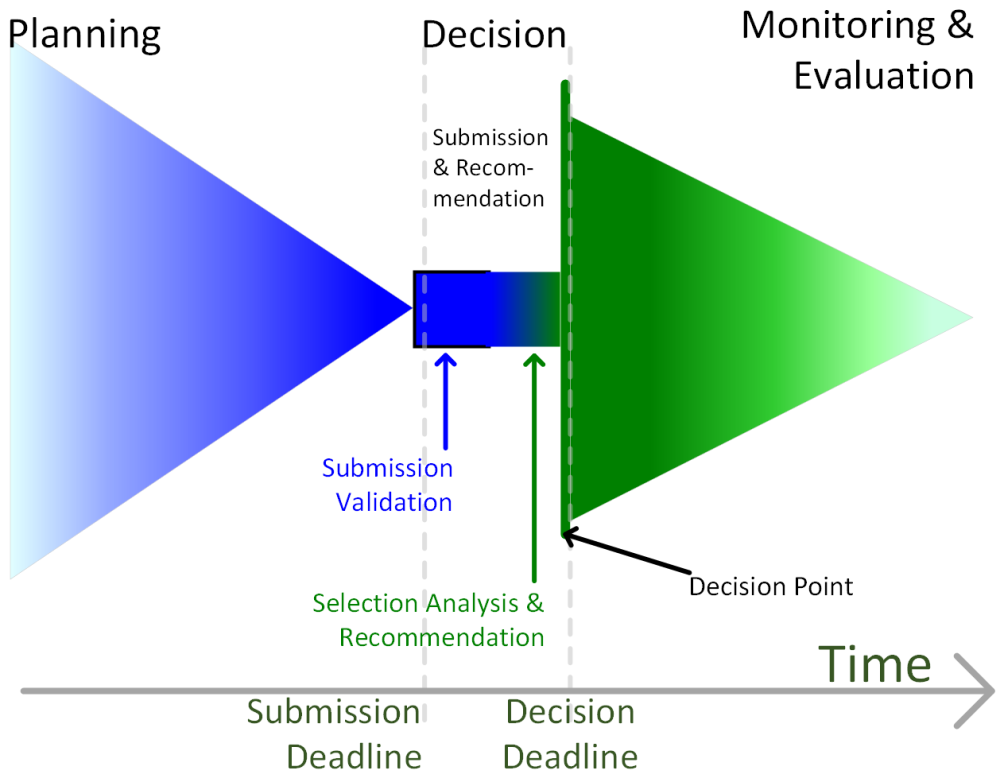
Continue readingHow does a ‘requester’ know that a ‘submitter’ has provide a correct, complete, accurate and relevant ‘submission’? A framework to evaluate the planning, receipt, and evaluation of submissions.
Results Based Management (RBM) is a fixture in international organizations and used to varying degrees by governments world wide. For Canadian business professionals or accountants, RBM is an unfamiliar term although they may be better acquainted with RBM’esque concepts such as portfolio investment management or continuous improvement.
(Author’s note: this post was the start of an ambitious writing plan that has not yet come to fruition.)
Continue readingSome notes on a course I recently took as a volunteer with the Canadian Executive Services Overseas or CESO. Overall, a good course that was not too preachy and had useful information when working in different cultures. Highlights are as follows.

The following are my notes so I can use the technique again (in about a decade or so) or for your benefit. As an aside, I have used this technique 3-4 times with success. The first time was in 1995 when I bought a Geo Metro via fax (times change!). See the further reading section for other methods and techniques.

I have a very vague recollection that the 4C’s concept was taught to me in my very brief stint in the Canadian Navy by a Chief Warrant Office. Unfortunately, I cannot find anything to collaborate this so I guess I may not owe a debt to that old sea-dog.
Continue readingIn my ongoing effort to remember stuff, the rules our house used to play the game ’31’. There are lots of variations of this game including versions in which you have to go home and tell your wife you lost the house in a card game. As this game was typically played with the family (or things like Scout camp) the gambling aspect was downplayed… but not entirely.
Objective: To be the last person with one or more of their three chips plus one ‘donkey’.
Cards: a single deck played with cards 7 (lowest card) to Ace (high); 2 to 6 are not used in the game.
Chips: three counters (we have traditionally used M and M’s or chocolates); one each to each player.
The one aspect of the game of Thirty-One that I never liked was that eventually players were ‘out’. This meant they had to wait around until eventually two players were left and all of the counters have been won or loss.
The Thirty-One Zombie variation allows the players to stay in the game although they are then ineligible of ‘winning’ the game.
What do you think those who have played thirty-one at my house, an improvement or changes you would make?
New Year’s resolutions are dangerous affairs, so dangerous that most people quickly abandon them for the familiar arms of bad habits. It is with this in mind that I am sharing my resolution: I no longer plan to drive to work. Dear boss, don’t worry, I am planning on coming to work just that I don’t plan to drive there.
There are of course a number of reasons to not drive:
I am comfortable enough with my parsimonious-ality to let you know my motivation is a combination of numbers #4 and #5. As for the other reasons (#1), I doubt my little Ford Ranger will make that much of a difference to climate change as compared to the 259 NEW GW of coal-fired generation plants China is bring online. Fortunately I am both capable and legally allowed to drive (#2 and #3). Besides, like the vast majority of people, I am an above average driver!
Having just come back from Vienna with a world class transit system, I will be using a system that is definitely middle of the road. Not chickens in cages seated next to me but definitely not at the Western European standard either. My son swore off the bus when going to University with horror stories of them blowing past waiting passengers at bus stops, arriving late, excessively early and surly drivers. Hopefully my adventures are more pleasant.

U2 U-Bahn (metro) crossing the Danube heading into Vienna City Center
But back to my motivations and the first is economics and while the cash flow is positive it is not great, here is how driving versus the bus stacks up:
| Factor | Driving | Bus |
| Bus Pass per Month | – | 116.00 |
| Gas Costs*/Month | 130.00 | – |
| Parking Pass**/Month | 126.15 | – |
| Insurance/Maintenance | $$$ | – |
| Total Cost | 246.15 | 116.00 |
| Cost per Work Day$$ | 12.30 | 5.80 |
| Driving time # | 30-45 minutes/day | 60-90 minutes/day |
Assuming 20 work days per month ($$), the difference in cost is about $6.50/day or about $130.00 per month or perhaps a grand a year. Mehhh, not really big enough money to be spending 100% more time in my commute, so why would anyone want to give up a comfy(ish) Ford Ranger for a bus?
My motivation is the 3.2km walk from my house to the bus depot. 3,200 metres in the morning is about 3,000 steps (of a suggested 10,000 per day total) and 40 minutes in walking meditation. Once on the bus , I plan to read. While I can listen to books in my vehicle, taking notes while driving is not recommended. There is also something peaceful about letting someone else worry about the stop and go of traffic while you either read or stare into middle space. Finally, the most important reason involves a bike.
I hope to bike commute more this year. Not having a parking pass is like burning my boats; there is no going back! Okay, I can pay for expensive day parking but that metaphor is not nearly as good as smoldering boats.
So that is my new year’s resolution and given that I just dropped $116 on a pass to get started. If I can get through January, then February should be easier, etc.. Wish me luck and if not, see you on the road in February.
Document for use during the 2018-12-05 Vienna Based International Organization Presentation:
It presents concepts found in posts relating to COSO and internal control, in particular:
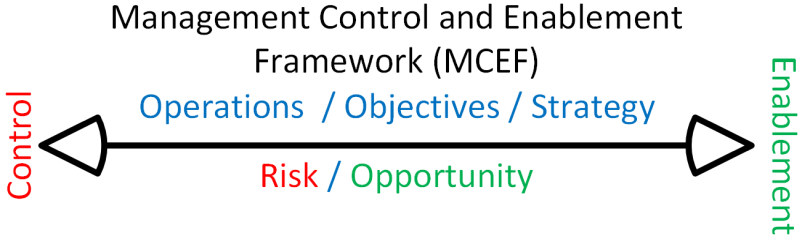
I introduced the ‘Management Control and Enablement Framework’ (MCEF) in a previous blog, MCEFing the Gap – Introduction. In this blog I hope to address one possible reaction, “Great, Another Friggin’ Framework”.
Continue reading Organizational Biology